
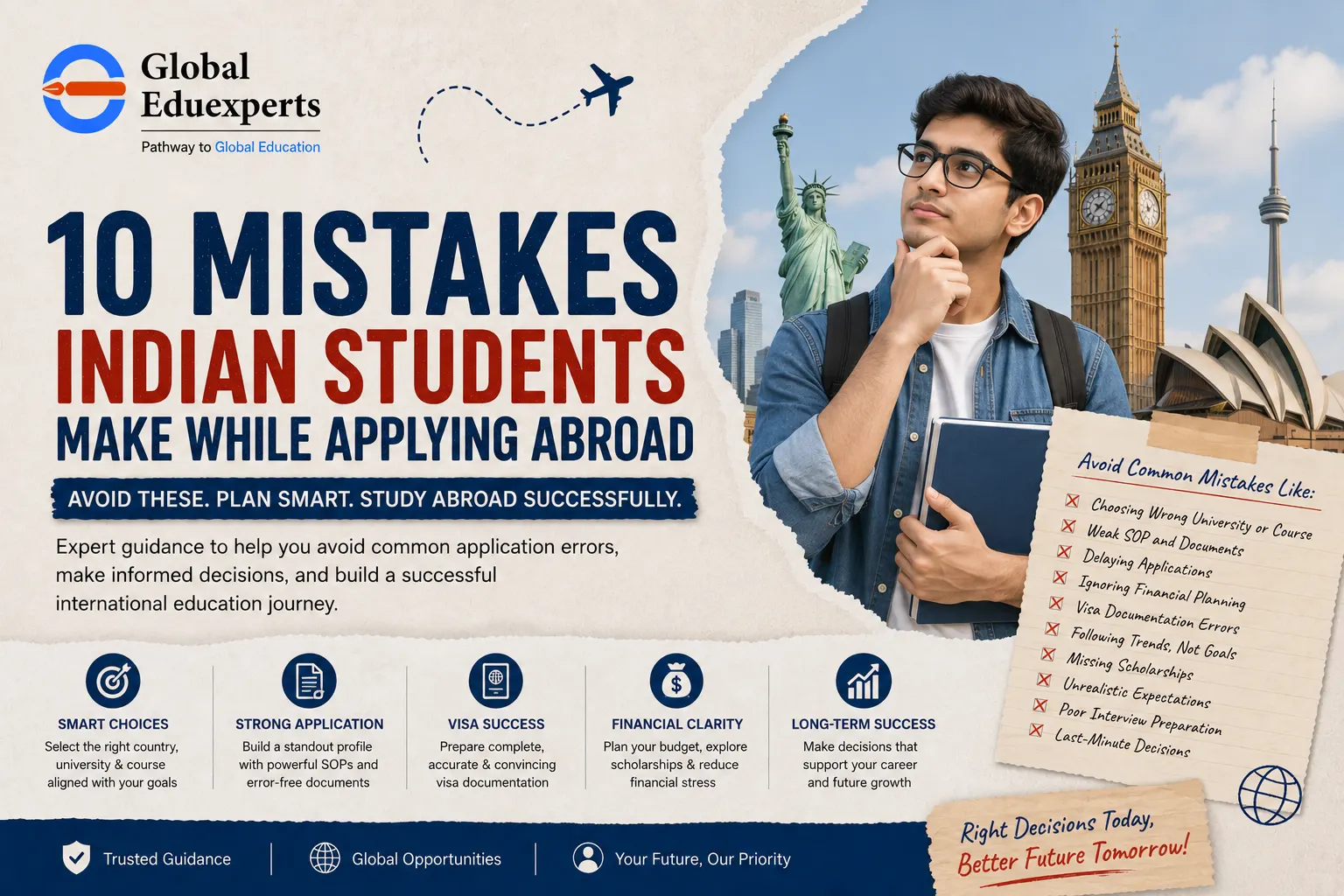
Understanding the common mistakes Indian students make while applying abroad helps students avoid problems related to university selection, SOP writing, visa preparation, scholarships, financial planning, and unrealistic expectations. The guidance supports students who want to study in countries like USA, UK, Canada, Australia, Ireland, and Europe by helping them make more informed, career-focused, and financially practical study abroad decisions with fewer application and visa-related mistakes.
This is probably one of the most common mistakes Indian students make while applying abroad.
And honestly, it happens very easily now.
Because students are constantly exposed to:
So naturally, many students start believing:
But the reality is much more complicated.
A university that works perfectly for one student may be completely wrong for another.
That’s why many mistakes Indian students make while applying abroad begin at the university shortlisting stage itself.
This happens all the time.
Students search:
Without checking:
A university may have:
But still may not be the best option for:
This is one of the biggest mistakes in university applications abroad students continue making.
This has become much more noticeable recently.
Students now make decisions based on:
And sometimes forget to compare:
A destination may look exciting online…
But may not be financially or professionally suitable for every student.
This is something students often realize too late.
A famous university does not automatically guarantee:
Students should compare:
Instead of depending only on brand names.
Because sometimes:
This creates serious pressure later.
Students sometimes apply to expensive universities without properly calculating:
And after admission:
Many study abroad application errors happen because students focus heavily on:
Without planning:
This part is rarely discussed openly.
But university selection can sometimes influence:
Students who apply randomly without:
May create unnecessary visa complications later.
That’s why students should think beyond:
Many students ask:
But fewer ask:
This is where long-term thinking becomes important.
Students should compare:
Because some universities may offer:
This still happens constantly.
Students choose universities because:
Without checking:
And later:
The issue is not only rejection.
Sometimes students actually get admission…
But later realize:
And correcting those decisions later becomes difficult and expensive.
If you want to avoid common study abroad application mistakes, the better question is not:
Which university is most famous online?
It should be:
Which university realistically supports my career goals, financial capacity, academic profile, and future opportunities?
Because successful study abroad planning is not about chasing popularity.
It’s about choosing institutions that genuinely align with your future.
Explore STUDY IN USA opportunities to compare universities, course quality, career outcomes, and practical study abroad options based on your future goals.
This is another major reason many students face:
And honestly, it usually doesn’t happen because students are not capable.
It happens because students often apply emotionally instead of realistically.
They see:
And assume:
Without properly checking whether their profile actually matches the university’s admission requirements.
This has become one of the most common mistakes Indian students make while applying abroad today.
This happens very frequently.
Students sometimes apply without carefully checking:
And later realize:
Every university has:
Some students believe:
But language scores influence:
A student may have:
But weak IELTS/PTE scores can still:
This becomes one of the most overlooked common study abroad application mistakes.
This is especially important for Indian students.
Different countries and universities have:
Some institutions may:
Others may:
Students sometimes apply widely without checking:
And later face:
This is very common.
Students create shortlists with only:
Without balancing applications with:
And when all applications become overly ambitious:
A realistic application strategy should include:
Not only:
This has become a serious issue now.
Students see:
But rarely see:
As a result:
And students begin applying without:
This is another hidden issue.
Some programs may require:
But students apply anyway assuming:
Which creates unnecessary study abroad application errors later.
This part is rarely discussed.
When students apply unrealistically:
And students suddenly realize:
This is important to understand.
Being realistic does not mean:
It means:
Because even:
Students often ask:
But fail to ask:
That one difference changes the entire application strategy.
If you want to avoid mistakes students make while applying to foreign universities, the better question is not:
Which universities are most famous?
It should be:
Which universities realistically align with my academic profile, test scores, career goals, and future opportunities?
Because successful study abroad planning is not about applying everywhere.
It’s about applying strategically to places where your profile genuinely fits.
Check UK Eligibility requirements to understand academic criteria, IELTS/PTE expectations, and realistic admission possibilities before applying abroad.
This is probably one of the most avoidable mistakes students make during the study abroad process.
But it still happens constantly.
Students often think:
And suddenly:
That’s when panic starts.
And honestly, many mistakes Indian students make while applying abroad happen not because the process is impossible…
but because students delay important decisions for too long.
This is very common.
The study abroad journey includes:
Each step takes:
A process students imagine will take:
Often realistically needs:
This is one of the biggest problems caused by delays.
Many universities follow:
Which means:
Students who apply late may face:
This becomes one of the most frustrating study abroad application errors because it is usually preventable.
Students frequently focus only on:
But scholarship deadlines may:
Some funding opportunities are available only during:
So delayed planning can directly affect:
Later, students realize:
This is where delayed applications create the biggest pressure.
Once admission arrives late:
Students suddenly need to manage:
Within very limited timelines.
And even small delays during visa stages can:
This becomes one of the major study abroad visa rejection reasons for Indian students in some situations because rushed applications often contain:
Students often postpone:
But if scores are delayed:
And one postponed task starts affecting the entire process.
This part is understandable.
Many students delay applications because:
So instead of:
They postpone:
Until pressure becomes unavoidable.
This is where most problems begin.
When timelines become tight:
And overall decision quality drops significantly.
Students sometimes don’t realize this early enough.
If:
Students may need to:
Which can delay plans by:
That becomes emotionally and financially exhausting for many students.
Students often believe:
But the reality is:
Starting early creates:
If you want to avoid mistakes to avoid when applying for study abroad, the better question is not:
How late can I apply?
It should be:
How early can I start planning properly to reduce stress, improve opportunities, and make stronger long-term decisions?
Because good study abroad planning is not about rushing before deadlines.
It’s about giving yourself enough time to make smarter decisions calmly and strategically.
Explore USA Scholarships opportunities early to improve funding chances and avoid missing important application and scholarship deadlines.
Many students focus heavily on:
But underestimate something extremely important:
Their documentation.
And honestly, this is where many applications become weak without students even realizing it.
Because universities are not evaluating only:
They are also trying to understand:
That’s why weak SOPs, copied content, and poor supporting documents have become one of the most common mistakes Indian students make while applying abroad.
This happens constantly.
Many students think an SOP only needs:
So they write:
Without clearly explaining:
And the SOP starts sounding:
This is probably one of the biggest common SOP mistakes for study abroad applications.
Students often:
Thinking:
But universities review thousands of applications every year.
They can usually identify:
Very quickly.
And copied SOPs often weaken:
This is another major issue.
Some SOPs mention:
For example:
Universities want to understand:
Not perfect certainty…
But at least:
Many SOPs could fit:
That’s the problem.
Students sometimes fail to explain:
And the application starts feeling:
Students usually focus more on SOPs…
but recommendation letters matter too.
Poor LORs often:
Some students even:
And universities can often identify:
Good LORs should explain:
In a believable and realistic way.
Universities evaluate applications holistically.
Weak documentation can create doubts about:
Even students with:
Can face weaker admission outcomes because their documentation fails to present them properly.
This connects closely with delayed applications.
When students start late:
And the final application feels:
This becomes one of the major study abroad application errors students regret later.
Students sometimes believe:
So they use:
And the content loses:
Simple, honest, and structured writing usually works much better than trying to sound “impressive.”
Students often ask:
Instead of asking:
That difference matters much more.
If you want to avoid mistakes students make while applying to foreign universities, the better question is not:
How do I make my SOP sound impressive?
It should be:
How do I make my application realistic, clear, personalized, and aligned with my actual academic and career goals?
Because strong documentation is not about dramatic storytelling.
It’s about helping universities understand the student behind the application clearly and honestly.
Explore Uk Courses to better align your SOP, academic goals, and career plans with the right international programs and industry opportunities.
This is one of the biggest mistakes students realize only after getting admission.
At the beginning, most students focus heavily on:
But many don’t fully calculate:
And honestly, this creates serious pressure later.
Because international education is not only about:
It’s about:
That’s why poor budgeting has become one of the most common mistakes Indian students make while applying abroad.
This happens constantly.
Students compare:
And ignore:
But in many countries:
And students suddenly realize:
This part surprises many families.
Before even reaching the university, students may already need to pay for:
These costs may individually seem manageable…
But together:
And many students simply don’t plan for them early enough.
This is another reality students underestimate.
Exchange rates change constantly.
Even small currency shifts can increase:
Students often calculate budgets using:
Without considering:
A large number of Indian students now depend partly or fully on:
But many students apply abroad first…
and think about loan planning later.
That creates problems because:
Students sometimes select:
Without realistically evaluating:
This has become a very common misconception.
Students often hear:
But reality is more complicated.
Part-time opportunities vary depending on:
And part-time income may help with:
But usually should not be treated as:
This part is rarely discussed openly.
When finances become unstable abroad:
And the overall study experience becomes:
Many study abroad mistakes Indian students should avoid are actually connected to:
This is extremely important.
A very expensive university does not automatically guarantee:
Students should compare:
Together.
Because financial planning should connect with:
Students often watch:
Without seeing:
This creates unrealistic assumptions about:
And later:
Students often ask:
Instead of asking:
That difference matters a lot.
If you want to avoid mistakes to avoid when applying for study abroad, the better question is not:
Which country looks cheapest initially?
It should be:
Which option realistically balances education quality, career opportunities, affordability, and long-term financial sustainability?
Because successful study abroad planning is not only about getting admission abroad.
It’s about ensuring the entire journey remains manageable academically, emotionally, and financially.
Understand Australia Cost planning including tuition fees, accommodation expenses, and budgeting strategies before selecting your study abroad destination.
For many students, the visa stage feels like the final hurdle in the study abroad process.
By this point:
And students feel:
But honestly, this is also the stage where small mistakes can create major problems.
Because student visa applications are not evaluated only on:
Visa authorities also review:
That’s why visa-related issues remain one of the biggest mistakes Indian students make while applying abroad.
This is probably the most common issue.
Students often submit:
Without realizing how carefully visa authorities review:
In many countries, students must clearly demonstrate:
And even small inconsistencies can:
This happens more often than students expect.
Sometimes students:
Even accidental errors can create:
And once inconsistencies appear:
This becomes one of the most damaging study abroad application errors because it affects:
Certain countries may require:
But many students assume:
And attend interviews without:
As a result:
Visa officers usually evaluate:
Not whether they memorize perfect answers.
This is another major problem.
Every country has:
Students sometimes assume:
Which leads to:
One of the biggest common visa mistakes for study abroad is treating every country’s process the same way.
Students who delay applications often:
That creates:
And rushed visa files are much more likely to contain:
This is something students rarely think about.
Visa officers often assess whether:
For example:
Students should be able to explain:
Clearly and realistically.
Students frequently:
Without verifying:
But visa systems change regularly.
And outdated or incorrect advice can:
In many cases:
Instead:
And the overall application appears:
Students often think:
But universities and visa authorities evaluate:
That misunderstanding creates:
If you want to avoid study abroad visa rejection reasons for Indian students, the better question is not:
How fast can I file my visa?
It should be:
How can I prepare a clear, accurate, financially strong, and realistic visa application with proper planning?
Because successful visa approval is not about shortcuts.
It’s about presenting a well-prepared and credible student profile consistently across the entire application.
Learn about the complete USA Visa process including financial documentation, interview preparation, and common mistakes students should avoid during visa applications.
This has become one of the most common study abroad patterns in recent years.
Students often choose:
Not because they genuinely match their goals…
But because:
And honestly, this creates long-term problems more often than students expect.
Because what works well for one student may be completely wrong for another.
That’s why blindly following trends has become one of the major mistakes Indian students make while applying abroad.
This happens very frequently.
A group of friends decides:
And suddenly students begin:
Without properly asking:
Peer influence feels comfortable because:
But study abroad planning should never become:
This is much more visible now than before.
Students constantly watch:
And certain destinations suddenly start appearing:
Than they actually are.
But social media rarely shows:
So students begin making decisions based on:
This is another serious issue.
Some students pick courses because:
Without checking:
And later:
This becomes one of the most damaging study abroad mistakes Indian students should avoid because course selection directly affects:
Students sometimes assume:
But industries evolve quickly.
A course that feels highly popular today may become:
If students choose it without:
That’s why career-focused decision-making matters much more than:
This is something students often ignore.
Every country has:
For example:
But students often choose destinations simply because:
Without comparing:
This is becoming very common now.
Students ask:
Before asking:
Long-term settlement opportunities matter…
but career sustainability matters more.
Choosing a country only because:
Without career planning can create:
This is rarely discussed openly.
Many students apply abroad because:
And they fear:
So instead of:
They rush toward:
The issue is not only:
Sometimes students successfully move abroad…
But later realize:
And changing direction later becomes:
Students often ask:
Instead of asking:
That difference changes everything.
If you want to avoid mistakes to avoid when applying for study abroad, the better question is not:
Where is everyone else going?
It should be:
Which country, university, and course realistically align with my skills, interests, financial situation, and long-term career plans?
Because successful study abroad planning is not about following trends.
It’s about building a future that actually fits you personally and professionally.
Explore STUDY IN EUROPE opportunities to compare emerging career-focused destinations, affordable education systems, and long-term global opportunities.
Many students assume studying abroad is possible only if:
And because of that belief, they sometimes:
Without realizing that multiple alternative pathways and funding opportunities may already exist.
This has quietly become one of the most overlooked mistakes Indian students make while applying abroad.
Because students often focus only on:
While ignoring:
That could make international education:
This happens very often.
Students focus mainly on:
But scholarship applications frequently:
And by the time students begin researching:
This becomes one of the most expensive study abroad application errors because even partial scholarships can reduce:
This is a very common misunderstanding.
Some students believe:
But many universities offer:
Even moderate financial support can:
But students often never explore these possibilities properly.
This is another major issue.
Students who:
May still have strong study abroad options through:
But many students ignore these pathways because:
Students sometimes think:
That’s not always true.
Many successful international students begin through:
And later move toward:
This creates unnecessary financial pressure.
Sometimes students apply directly to:
Without checking:
And later struggle with:
This is where timing becomes important again.
Students who:
Usually get better chances to:
While students who delay:
This connects closely with many mistakes to avoid when applying for study abroad because financial planning and application timing are deeply connected.
Some lesser-known institutions may offer:
But students ignore them because:
And sometimes:
Many students worry:
But practical education planning is not about:
It’s about:
And for some students:
Students often ask:
Before asking:
That difference matters a lot.
If you want to avoid study abroad mistakes Indian students should avoid, the better question is not:
Can I get direct admission into the most expensive university?
It should be:
Which pathway realistically supports my education goals, financial situation, academic profile, and long-term future?
Because successful study abroad planning is not always about taking the most popular route.
Sometimes the smarter path creates the strongest long-term outcome.
Explore Australia Scholarships and pathway options to understand affordable study abroad opportunities for different academic and financial profiles.
Most study abroad mistakes do not happen because students lack ambition or capability.
They usually happen because:
And honestly, this is understandable.
The study abroad process involves:
All connected together.
That’s why students who approach the process calmly and strategically usually make:
This is probably the most practical advice students can follow.
Good study abroad planning ideally starts:
Sometimes earlier for:
Early planning gives students enough time for:
Instead of rushing everything near deadlines.
One of the biggest mistakes Indian students make while applying abroad is:
A better approach is creating:
Usually including:
Students should compare:
Not only:
Many students think:
But universities also evaluate:
Students can improve their profiles through:
Especially when academic scores are average.
This step deserves much more attention than students usually give it.
Strong applications should:
Students should avoid:
Because documentation reflects:
Visa preparation should never be treated as:
Students should understand:
One of the biggest common visa mistakes for study abroad is assuming:
It doesn’t.
Proper financial planning and accurate documentation matter heavily during visa evaluation.
Students should calculate:
Together.
Not just:
Students also need realistic understanding about:
Because poor budgeting creates:
This has become extremely important now.
Students should not choose:
Only because:
Instead, students should ask:
That question changes decision quality completely.
Many students focus only on:
But long-term thinking matters more.
Students should compare:
Before finalizing:
Because study abroad is not only about:
It’s about:
This sounds simple…
but it prevents many problems.
Students should verify:
Instead of:
Students often approach study abroad like:
But the smarter approach is:
Because the best decisions are usually not:
They are the ones that remain practical:
If you want to avoid mistakes to avoid when applying for study abroad, the better question is not:
How do I get abroad as quickly as possible?
It should be:
How do I make informed, realistic, and career-focused decisions that support my future long after graduation?
Because successful study abroad planning is not just about leaving India.
It’s about building a stable and meaningful international future with clarity and preparation.
Explore STUDY IN UK guidance to understand smarter university selection, visa preparation, financial planning, and long-term career-focused study abroad decisions.
Some of the most common mistakes Indian students make while applying abroad include choosing universities without proper research, delaying applications, writing weak SOPs, ignoring financial planning, and misunderstanding visa requirements. Many students also follow social media trends or friends instead of making career-focused decisions. Proper planning and realistic university shortlisting help reduce these mistakes significantly.
Many study abroad visa rejection reasons for Indian students are connected to incomplete financial documents, incorrect information, weak course justification, poor interview preparation, or rushed applications. Visa authorities carefully evaluate financial credibility, academic intent, and documentation accuracy. Even small inconsistencies can create delays or rejection risks if the overall application appears unclear or unprepared.
Students should ideally begin study abroad planning at least 8–12 months before their intended intake. Early preparation helps with university research, IELTS/PTE exams, SOP writing, scholarship applications, financial planning, and visa preparation. Late applications often create unnecessary stress, reduce scholarship opportunities, and increase the risk of documentation mistakes and visa delays.
Yes, many universities offer scholarships, pathway programs, foundation courses, and flexible admission routes for students with different academic profiles. Students often ignore these opportunities and focus only on direct admission into popular universities. Exploring alternative pathways can make international education more affordable, realistic, and accessible for students with moderate academic scores or limited budgets.
Students should compare course quality, industry demand, tuition fees, living costs, internship opportunities, visa rules, and long-term career outcomes before selecting a destination. The best study abroad decisions are usually based on career alignment and financial sustainability, not only rankings, social media trends, or where friends are applying.


