Study in USA – Complete Guidance for Indian & International Students

Free Profile
Assessment

Study in USA – Complete Guidance for Indian & International Students

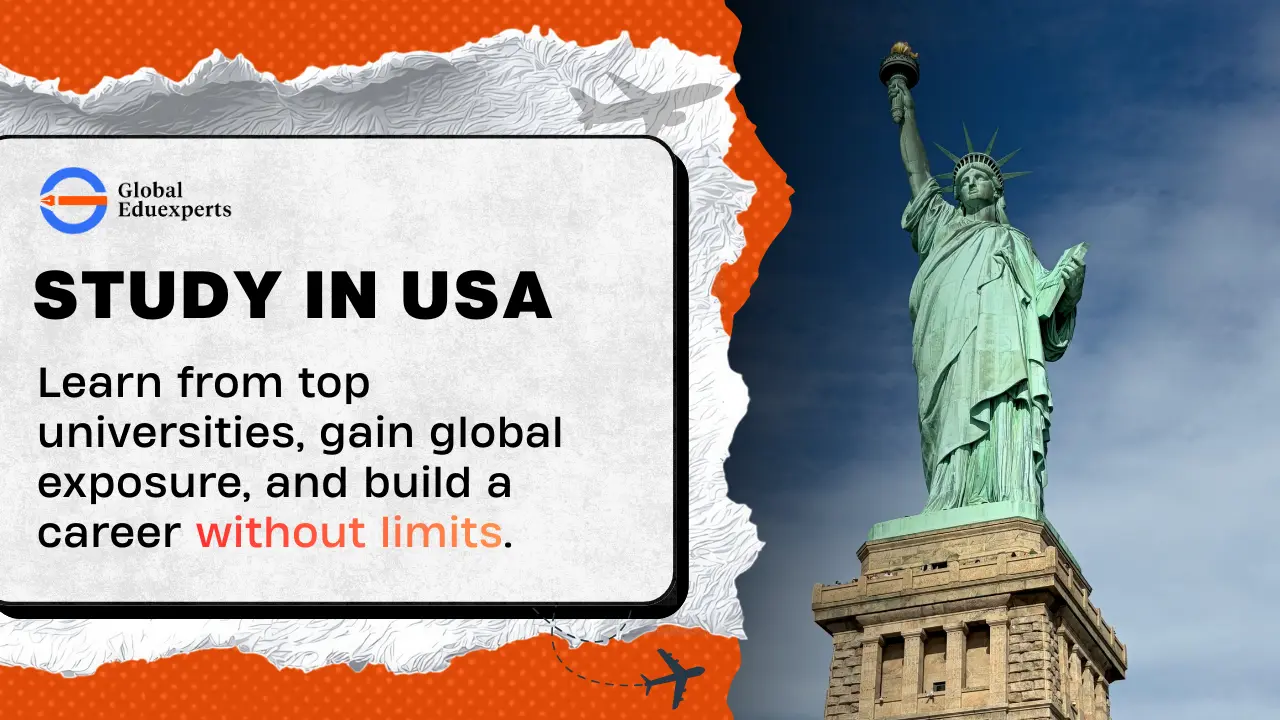
Studying in the USA offers students access to globally recognized education, flexible academic programs, and strong industry exposure. This service helps students understand eligibility, university selection, admission processes, visa preparation, and career pathways with clear, structured guidance. Whether you are planning a bachelor’s, master’s, MBA, or PhD program, GlobalEduExperts supports each stage of the journey with practical advice and transparent planning to help students make informed decisions about studying in America.

Why Students Today Are Choosing to Study in the USA

For many students, the idea to study in USA represents more than earning a degree. It reflects a search for global exposure, practical learning, and career opportunities that extend beyond borders. Yet, the decision often feels overwhelming at the beginning. Students compare universities, visa rules, costs, and career outcomes — and quickly realise how much information exists without clear direction.

Questions naturally follow. Is the USA still worth it? Which course actually leads to long-term growth? How early should planning begin? These uncertainties slow many students before the journey even starts.

This guide is designed to simplify that process. It helps students, professionals, and parents understand academic options, costs, admission pathways, and realistic expectations so they can approach studying in America with clarity rather than confusion.

Life in USA depending on city and lifestyle

Washington, D.C.
Capital
English
Language
+1
Dialing Code
$ U.S. Dollar (USD)
Currency
Approx. 341.7 million (2025 estimate)
Population
USD 20,000 to 45,000 per year
Tuition Fees
Appx USD 10,000 to 25,000 per year
Living Expenses
Fall (Aug to Sep - main intake), Spring (Jan to Feb), Summer (May to Jun - limited programs)
Intakes

Why Study in USA

Choosing to study in USA is often connected to long-term academic and career goals rather than just studying abroad. The United States continues to attract students from across the world because its education system combines flexibility, innovation, and strong industry integration. For Indian and international students, the appeal lies not only in university rankings but in how education prepares students for real-world challenges.

Education Quality and Learning Approach

Universities in the USA focus heavily on practical learning instead of rote memorization. Students are encouraged to participate in discussions, research projects, internships, and collaborative assignments. This approach helps students develop analytical thinking, communication skills, and independent problem-solving abilities — skills valued across global industries.

Many programs allow students to explore interdisciplinary subjects before finalizing specializations, giving them flexibility to shape their academic journey.

Academic Advantages and Flexibility

One of the biggest advantages of study in usa for international students is academic flexibility. Students can often:

  • Choose electives outside their core subject

  • Change majors during early semesters

  • Combine multiple disciplines

  • Participate in research alongside professors

This system benefits students who want to align education with evolving career interests rather than being locked into a single academic path.

Global Recognition of Degrees

Degrees earned while studying in America are widely recognized worldwide. Employers often value US education because it emphasizes innovation, research exposure, and practical application of knowledge. Whether students pursue a masters in usa for international students, an MBA, or a phd in usa, the qualification carries strong international credibility.

Industry Exposure and Career Readiness

US universities maintain close connections with industries through internships, co-op programs, and research collaborations. Students frequently gain exposure to real business environments before graduation.

Opportunities such as internships, campus recruitment events, and industry-led projects help bridge the gap between academics and professional careers, making study in usa for indian student a pathway focused on skill development as much as education.

Benefits of Study in USA

Academic Excellence and Research Opportunities
Universities in the USA focus strongly on innovation and research-led education. Students learn through projects, laboratory work, and academic collaboration, helping them develop analytical thinking and subject expertise beyond textbook learning.
Wide Range of Course Options
Students can choose from diverse programs across technology, business, healthcare, arts, and interdisciplinary fields. This flexibility allows learners to align education with evolving career interests instead of being restricted to a single academic path.
Industry Exposure During Studies
Many universities integrate internships, industry projects, and guest lectures into academic programs. This exposure helps students understand workplace expectations early and apply theoretical knowledge in practical professional environments.
Global Recognition of Degrees
A degree earned while studying in the USA is widely accepted across countries and industries. Employers value the practical learning approach and problem-solving skills developed through the American education system.
Multicultural Learning Environment
Students study alongside peers from different countries and cultures, improving cross-cultural communication skills and global awareness — qualities increasingly valued in international workplaces.
Personal Growth and Independence
Living abroad encourages students to manage academics, finances, and daily responsibilities independently, strengthening confidence, adaptability, and real-world decision-making skills.

Education System in USA

Education System Aspect Explanation
Study Structure Programs are typically semester-based and include core subjects, electives, research work, and practical assignments, allowing gradual academic specialization throughout the degree.
Credit / Learning System Students earn academic credits for each subject completed, and graduation depends on fulfilling total credit requirements rather than completing fixed yearly examinations.
Assessment Style Evaluation combines assignments, presentations, projects, quizzes, and exams, encouraging continuous learning and consistent academic engagement.
Flexibility of Courses Students can select electives across departments, explore interdisciplinary learning, and sometimes change majors during early semesters based on academic interests and goals.

Eligibility Criteria for Study in USA

Requirement Explanation Student Understanding
Academic Qualifications Applicants must complete required prior education, such as higher secondary education for bachelor’s programs or a recognized undergraduate degree for master’s and doctoral programs. Confirms academic readiness for university-level study
English Language Requirements Students must demonstrate English proficiency through tests like IELTS, TOEFL, or PTE to ensure they can understand coursework and communicate effectively in an academic environment. Verifies ability to study in an English-speaking country
Entrance Exams (If Applicable) Some universities or programs may require exams such as GRE or GMAT depending on course type, competitiveness, and institutional admission policies. Helps universities evaluate academic and analytical skills
Financial Preparedness Students must show proof of funds covering tuition fees, living expenses, and study duration as part of admission and visa assessment procedures. Ensures financial capability during studies abroad

Required Documents for Study in USA Application

Requirement Explanation Student Understanding
Passport A valid passport is mandatory for university applications, visa processing, and international travel identification. Serves as primary identity and travel document
Academic Transcripts Official mark sheets and certificates from previous institutions are required to verify academic performance and eligibility. Allows universities to assess educational background
SOP (Statement of Purpose) A written document explaining academic goals, career intentions, and reasons for choosing the program and country. Demonstrates motivation and clarity of purpose
LOR (Letter of Recommendation) Recommendation letters from professors or employers highlighting academic ability, skills, and character. Strengthens credibility of the application
Resume / CV A structured summary of academic achievements, internships, work experience, and relevant skills. Provides quick overview of applicant profile
Test Score Reports Official English test and entrance exam scores submitted as proof of meeting university admission requirements. Confirms eligibility criteria fulfillment
Financial Documents Bank statements, sponsorship letters, or loan approvals showing financial support for study and living expenses. Required for admission verification and visa approval

Visa Requirements for Study in USA

Stage Process Step Explanation Student Guidance
Application Stage Receive University Admission & I-20 Form After admission to a SEVP-approved university, students receive Form I-20, which confirms eligibility to apply for an F-1 student visa and contains program and financial details. Verify all details on the I-20 carefully before proceeding.
Application Stage Pay SEVIS Fee Students must pay the SEVIS I-901 fee before visa application. This registers the student in the U.S. immigration tracking system required for international students. Keep payment receipt safely; it is mandatory for the interview.
Application Stage Complete DS-160 Form The DS-160 is the official online non-immigrant visa application collecting personal, academic, and travel information submitted through the U.S. Department of State portal. Ensure details match passport and I-20 exactly to avoid delays.
Documentation Prepare Required Documents Students must organize passport, I-20, DS-160 confirmation, financial proof, academic records, and test scores for visa evaluation. Arrange documents in advance to reduce interview stress.
Visa Submission Pay Visa Fee & Schedule Appointment After DS-160 submission, students pay the visa application fee and book biometric and interview appointments at a U.S. embassy or consulate. Book early since appointment availability varies by season.
Interview (If Applicable) Attend Visa Interview Most F-1 applicants attend an in-person interview where officers evaluate study intent, financial readiness, and academic plans. Supporting documents must be presented when requested. Answer honestly and clearly; preparation improves confidence.
Processing Timeline Visa Decision & Passport Return Visa processing timelines vary. Interviews may be scheduled within weeks to months, and decisions typically take a few weeks depending on workload and checks. Apply early to avoid intake deadlines being affected.
Processing Timeline Entry Timeline Rules Student visas can be issued up to 365 days before program start, but entry to the USA is allowed only within 30 days before classes begin. Plan travel dates carefully according to visa rules.
Common Mistakes Incomplete or Inconsistent Information Mismatched data between DS-160, financial documents, and university records often leads to delays or additional administrative review. Double-check every form before submission.
Common Mistakes Late Visa Preparation Waiting until the last moment may result in unavailable interview slots or rushed documentation preparation. Start visa steps immediately after receiving admission.
Preparation Importance Clear Study Intent Visa officers assess whether the student has genuine academic goals aligned with the chosen program and future plans. Prepare to explain course choice logically and confidently.
Preparation Importance Organized Documentation Properly arranged documents help interviews proceed smoothly and demonstrate seriousness and preparedness. Maintain a structured document file for submission.

Study Abroad Process by GlobalEduExperts

Step Process Stage What We Do Student Benefit
1 Schedule a Free Consultation Students begin with a structured discussion to understand academic background, goals, preferred destinations, and budget considerations related to study in usa. Clear starting direction and realistic expectations
2 Receive a Personalized Plan Based on profile analysis, a tailored roadmap is created outlining timelines, test preparation strategy, university categories, and documentation milestones. Organized plan aligned with career goals
3 Profile Evaluation Academic scores, work experience, extracurricular activities, and English proficiency are assessed to determine strengths and improvement areas. Stronger application positioning
4 University Shortlisting Universities are shortlisted across ambitious, moderate, and safe options considering course fit, budget, and long-term career scope. Balanced admission strategy
5 Application to Selected Universities Accurate application submission with careful review of SOP, LOR, and supporting documents to ensure compliance with university requirements. Error-free and timely submissions
6 End-to-End Documentation Process Guidance on preparing academic records, financial proofs, recommendation letters, and other required documents throughout the admission journey. Reduced documentation errors and delays
7 Assistance with Loan & Finances Support in understanding tuition estimates, living costs, and education loan procedures without unrealistic financial assumptions. Better financial planning and preparedness
8 Visa Process Step-by-step assistance for SEVIS payment, DS-160 form, appointment scheduling, document preparation, and interview readiness for studying in America. Structured and confident visa application
9 Land to Your Desired University Travel planning guidance and final checklist preparation before departure to ensure a smooth transition to the university environment. Reduced pre-departure stress
10 Post Landing Accommodation Assistance Support in understanding accommodation options, initial settlement guidance, and basic living arrangements after arrival. Comfortable and informed transition abroad
Process of MetaApply

How We Work

Workflow Stage Process Area Explanation Student Advantage
Initial Interaction Communication Beginning The process starts with understanding the student’s academic background, goals, and concerns through structured discussions rather than quick recommendations or generic counselling. Personalized guidance from the first interaction
Planning Phase Goal Alignment Counsellors help students connect education choices with long-term career direction, ensuring decisions for study in usa are based on suitability instead of trends or peer influence. Clear academic direction and reduced confusion
Guidance Communication Structured Updates Students receive step-by-step updates during applications, document preparation, and university responses, maintaining clarity about timelines and next actions. Reduced uncertainty during the process
Application Stage Transparent Guidance Every requirement, deadline, and documentation step is explained openly, helping students understand both opportunities and limitations without unrealistic expectations. Informed decision-making and trust
Documentation Support Accuracy Monitoring Documents such as SOP, LOR, and application materials are reviewed carefully to maintain consistency and compliance with university standards. Stronger and well-prepared submissions
Ongoing Support Continuous Assistance Support continues across admission, visa preparation, and pre-departure stages, ensuring students are not left managing complex procedures independently. Consistent guidance throughout the journey
Communication Continuity Multi-Stage Follow-Up Regular follow-ups ensure students stay aligned with timelines, exam preparation, and university requirements during the study in usa for international students process. Better planning and timely action
Decision Support Honest Counselling Students are guided with realistic advice, including alternative pathways when required, prioritizing long-term success over short-term outcomes. Confidence built through honest recommendations
Relationship Approach Trust-Based Process The workflow focuses on clarity, accountability, and student understanding, creating a supportive environment rather than a transactional consultancy experience. Long-term trust and reassurance

Cost of Study in USA

Expense Type Approx Annual Cost (USD) Details for Student Understanding
Tuition Fees 20,000 – 45,000 Tuition varies depending on university type, program level, and specialization. STEM, MBA, and professional programs may have higher academic fees compared to general programs.
Living Expenses 10,000 – 18,000 Covers daily expenses such as food, local transportation, utilities, study materials, and personal spending based on lifestyle and city choice.
Accommodation 8,000 – 15,000 Costs differ between on-campus housing and shared off-campus apartments. Metropolitan cities generally have higher accommodation expenses than smaller towns.
Health Insurance 1,200 – 2,500 Most universities require mandatory student health insurance to cover medical emergencies and healthcare access during the study period.
Visa Fees 535 – 700 Includes visa application charges and related processing costs required for international students applying to study in usa.
Estimated Total 40,000 – 80,000 Overall yearly estimate combining tuition and living costs; actual expenses depend on university selection, city, and personal lifestyle decisions.


Important Note Explanation
Cost Nature All figures are indicative estimates intended for planning purposes only.
Variation Factors Expenses vary significantly based on university ranking, course type, geographic location, and individual lifestyle preferences.
Planning Approach Financial preparation and early budgeting often matter more than exact numbers when planning to study in usa for international students.

Career Opportunities After Studying in USA

Category Opportunity Area Explanation Career Direction for Students
Post-Study Work Options Practical Training Pathways Graduates may access structured training opportunities that allow them to gain professional experience related to their academic field after completing studies in the USA. Transition from academic learning to professional work exposure
Post-Study Work Options Skill Application Period Post-study work frameworks enable students to apply theoretical knowledge in real workplace environments while adapting to international professional standards. Development of industry-relevant experience
Post-Study Work Options Employer Sponsorship Pathways Some students explore long-term employment options through employer-supported work authorization processes depending on eligibility and job alignment. Potential long-term international career progression
Industry Demand Areas Technology & Computer Science Fields such as software development, data analytics, artificial intelligence, and cybersecurity continue to require skilled graduates with technical expertise. Roles in technology development and innovation sectors
Industry Demand Areas Business & Management Graduates from mba courses in usa and business programs often pursue roles in consulting, operations, finance, and project management across global organizations. Corporate and managerial career pathways
Industry Demand Areas Healthcare & Nursing Programs like nursing course in usa prepare students for healthcare environments focusing on patient care systems, clinical practices, and healthcare management support roles. Opportunities within healthcare institutions and services
Industry Demand Areas Engineering & Research Engineering graduates and students pursuing phd in usa contribute to research, product development, and innovation-driven industries. Research, development, and technical specialist roles
Skill-Based Opportunities Analytical & Problem-Solving Skills Academic programs emphasize case studies, research, and project work, helping students develop structured thinking and analytical decision-making abilities. Roles requiring critical thinking and strategic analysis
Skill-Based Opportunities Communication & Collaboration Skills Presentation-based assessments and teamwork improve communication abilities essential for multinational workplace environments. Client-facing and collaborative professional roles
Skill-Based Opportunities Leadership & Project Management Coursework and group assignments help students develop leadership, planning, and coordination skills valued across industries. Supervisory and coordination-focused positions
Career Pathways After Graduation Corporate Employment Graduates often pursue roles within multinational companies, startups, or global enterprises aligned with their academic specialization. Entry-level to growth-oriented professional careers
Career Pathways After Graduation Research & Academia Students completing advanced degrees may continue in research institutions, universities, or innovation labs contributing to academic and scientific advancement. Academic or research-oriented career tracks
Career Pathways After Graduation Entrepreneurship & Innovation Exposure to startup ecosystems and innovation centers encourages some graduates to explore entrepreneurial ventures or collaborative business initiatives. Business creation and innovation-led careers
Career Pathways After Graduation Global Mobility Opportunities International education experience may support career movement across different countries where globally recognized qualifications are valued. Flexible international career options

Student Success Stories

Student Profile Academic Goal Journey & Support Provided University Outcome Realistic Outcome
Engineering Graduate from India Master’s in Computer Science The student initially struggled with course selection due to multiple specialization options. Profile evaluation and structured counselling helped align interests with suitable computer science programs and realistic admission timelines. Admitted to a public research university in the USA Transitioned into a research-focused academic environment with internship exposure during studies
Working Professional (IT Background) MBA Program With several years of work experience but uncertainty about specialization, the student received career-oriented counselling and application guidance focusing on management programs matching professional goals. Accepted into an accredited business school offering MBA programs Developed leadership and management skills while building international professional networks
Nursing Student Healthcare Education The student required guidance on eligibility requirements and documentation for a nursing course in usa. Support included document preparation and application planning aligned with healthcare program expectations. Admission secured in a healthcare-focused university Gained exposure to international healthcare systems and clinical learning environments
Academic Research Aspirant PhD Program A student aiming for a phd in usa needed assistance identifying research-aligned universities and preparing academic documentation. Guidance focused on research proposals and faculty alignment. Accepted into a doctoral research program Began academic research work under faculty supervision with long-term academic career focus
Commerce Background Student Business Analytics Master’s The student was unsure about transitioning from commerce to analytics. Structured counselling helped bridge academic background with skill-based program choices and application strategy. Enrolled in a master’s program with analytics specialization Developed analytical and technical skills suited for data-driven business roles
Gap-Year Student Master’s Degree Abroad After a study gap, the student faced concerns about profile acceptance. Documentation explanation and SOP refinement helped present academic intent clearly to universities. Admission received from a mid-sized US university Successfully resumed academic journey with improved career direction and confidence

Career Opportunities After Studying in USA

Category Opportunity Area Explanation Career Direction for Students
Post-Study Work Options Practical Training Pathways Graduates may access structured training opportunities that allow them to gain professional experience related to their academic field after completing studies in the USA. Transition from academic learning to professional work exposure
Post-Study Work Options Skill Application Period Post-study work frameworks enable students to apply theoretical knowledge in real workplace environments while adapting to international professional standards. Development of industry-relevant experience
Post-Study Work Options Employer Sponsorship Pathways Some students explore long-term employment options through employer-supported work authorization processes depending on eligibility and job alignment. Potential long-term international career progression
Industry Demand Areas Technology & Computer Science Fields such as software development, data analytics, artificial intelligence, and cybersecurity continue to require skilled graduates with technical expertise. Roles in technology development and innovation sectors
Industry Demand Areas Business & Management Graduates from mba courses in usa and business programs often pursue roles in consulting, operations, finance, and project management across global organizations. Corporate and managerial career pathways
Industry Demand Areas Healthcare & Nursing Programs like nursing course in usa prepare students for healthcare environments focusing on patient care systems, clinical practices, and healthcare management support roles. Opportunities within healthcare institutions and services
Industry Demand Areas Engineering & Research Engineering graduates and students pursuing phd in usa contribute to research, product development, and innovation-driven industries. Research, development, and technical specialist roles
Skill-Based Opportunities Analytical & Problem-Solving Skills Academic programs emphasize case studies, research, and project work, helping students develop structured thinking and analytical decision-making abilities. Roles requiring critical thinking and strategic analysis
Skill-Based Opportunities Communication & Collaboration Skills Presentation-based assessments and teamwork improve communication abilities essential for multinational workplace environments. Client-facing and collaborative professional roles
Skill-Based Opportunities Leadership & Project Management Coursework and group assignments help students develop leadership, planning, and coordination skills valued across industries. Supervisory and coordination-focused positions
Career Pathways After Graduation Corporate Employment Graduates often pursue roles within multinational companies, startups, or global enterprises aligned with their academic specialization. Entry-level to growth-oriented professional careers
Career Pathways After Graduation Research & Academia Students completing advanced degrees may continue in research institutions, universities, or innovation labs contributing to academic and scientific advancement. Academic or research-oriented career tracks
Career Pathways After Graduation Entrepreneurship & Innovation Exposure to startup ecosystems and innovation centers encourages some graduates to explore entrepreneurial ventures or collaborative business initiatives. Business creation and innovation-led careers
Career Pathways After Graduation Global Mobility Opportunities International education experience may support career movement across different countries where globally recognized qualifications are valued. Flexible international career options

Please Note: All information is sourced from web and the data may vary. kindly refer to Official or Government websites for the most accurate details.

Study in USA for Indian Students 2025

Explore top USA universities, MBA, Masters, PhD & nursing courses. Expert study abroad consultants in Noida offering free counseling for USA education.

Frequently Asked Questions

Yes, many students still choose the USA because of its flexible education system, research opportunities, and global exposure. However, the decision depends on personal goals, academic readiness, and financial planning. The experience can be rewarding when students select the right course and university instead of following trends or peer decisions.

Ideally, students begin planning 10–12 months before their intended intake. This timeline allows enough space for English test preparation, university research, application writing, and visa documentation. Starting late is possible but may reduce available options and increase pressure during important stages of the process.

Strong academic performance helps, but universities often evaluate the overall profile. Projects, internships, purpose statements, and clarity of career goals also matter. Many students with average scores receive admissions when their course choice aligns realistically with their academic background and future plans.

All three tests are widely accepted, and the best choice depends on individual comfort with exam formats. Some students perform better in computer-based tests, while others prefer traditional formats. Understanding personal strengths and university requirements usually helps in selecting the most suitable exam.

Part-time work can help manage daily expenses and provide valuable international exposure, but it should not be considered the primary source of funding. Students are generally expected to arrange financial resources before arrival, ensuring academic focus remains the main priority during studies.

The USA hosts world-leading institutions across all disciplines

Popular Universities in USA

Let us find your Academic Home Abroad

Know Before you Go to USA

Exam Help Whatsapp
Exam Help Contact Support