
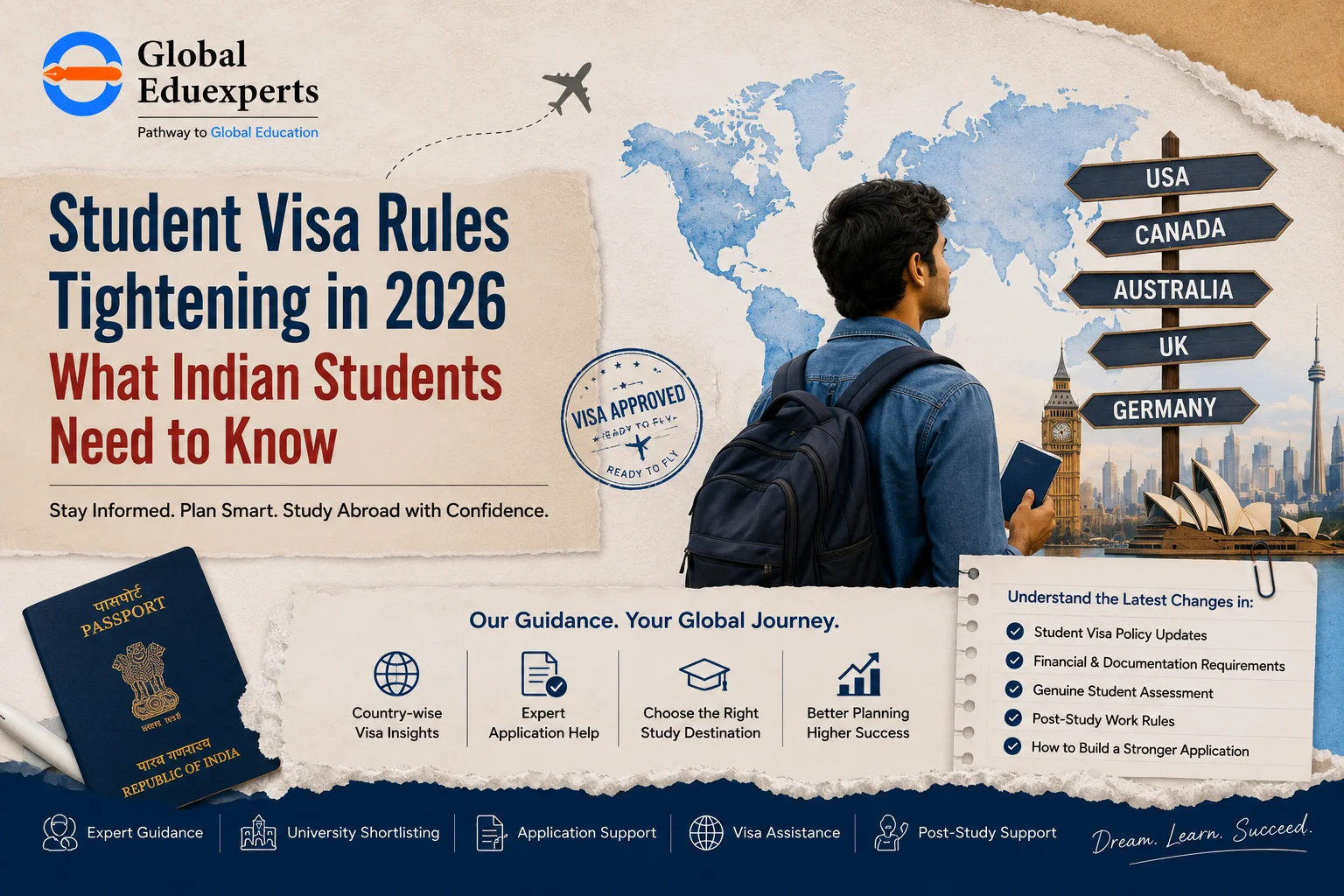
Understanding Student Visa Rules is essential for Indian students planning to study abroad in an evolving immigration landscape. This guide explains the latest student visa policy changes, compares visa requirements across leading study destinations, outlines common reasons for visa refusals, and provides practical guidance to help students prepare stronger applications, meet current eligibility requirements, and choose a study destination that supports their academic and long-term career goals.
For many years, choosing a study destination was largely about university rankings, tuition fees, and post-graduation career opportunities. Today, another factor has become just as important—Student Visa Rules. Governments across several popular study destinations are reviewing their immigration policies to ensure that student visas are used primarily for genuine education rather than as alternative immigration pathways. As a result, many countries have introduced stricter eligibility criteria, enhanced financial verification, and additional compliance requirements for international students.
These Student Visa Changes do not mean that studying abroad has become impossible. Instead, they signal a shift toward more transparent, documentation-focused application processes. Students who understand these evolving requirements and prepare accordingly continue to receive visas successfully. The biggest difference is that visa officers now expect stronger evidence that applicants are academically prepared, financially capable, and genuinely committed to completing their education.
Below are some of the major destinations where Countries Tightening Student Visa Rules has become an important discussion for students planning to study overseas.
| Country | Key Student Visa Changes | What Students Should Know |
|---|---|---|
| Canada | Increased financial proof, revised post-graduation policies, provincial intake limits | Early planning and complete documentation have become more important. |
| Australia | Stronger Genuine Student assessment, tighter compliance monitoring | Students should clearly explain their study plans and career objectives. |
| United Kingdom | Restrictions on dependent visas for many taught master's courses | Applicants should verify eligibility before making family plans. |
| United States | Greater scrutiny during interviews and document verification | Accurate financial documents and a clear academic purpose remain essential for F-1 visa approval. |
| Germany | Updated blocked account requirements and financial expectations | Students should monitor the latest financial thresholds before applying. |
| New Zealand | Periodic policy adjustments based on labor market and immigration priorities | Checking official visa updates before applying is recommended. |
One noticeable trend across these destinations is the growing emphasis on financial preparedness. Whether reviewing German student visa requirements, requirements for Australian student visa, or F1 visa requirements, immigration authorities increasingly expect applicants to demonstrate that they can support themselves throughout their studies without depending on unauthorized employment. This includes verified bank statements, education loans where applicable, scholarship documentation, or other acceptable financial evidence.
Academic intent has also become a much stronger consideration. Visa officers often assess whether the chosen course logically aligns with the student's previous education, work experience, and future career plans. A well-structured academic progression generally carries more credibility than selecting a program with little connection to previous qualifications. This approach helps authorities distinguish genuine students from applicants whose primary objective may be immigration rather than education.
Another important area of change involves post-study work expectations. Several countries continue to welcome skilled international graduates but are refining their immigration pathways to better match workforce needs. Instead of assuming that graduation automatically leads to long-term residency, students should carefully review current work permit policies, industry demand, and employment eligibility before selecting a destination. These evolving Student Visa Policy Changes encourage applicants to make decisions based on realistic career opportunities rather than outdated assumptions.
Many Indian students also follow Study Abroad Visa News closely, particularly when headlines mention visa restrictions or policy reforms. While these reports often create uncertainty, they rarely tell the complete story. In most cases, governments are not closing their doors to international education; they are introducing stronger verification systems to improve the quality and integrity of student visa programs. Genuine applicants who meet the published Student Visa Requirements generally continue to have strong opportunities to study abroad.
It is equally important to remember that visa policies can change throughout the year. Financial thresholds, processing timelines, eligible dependents, interview procedures, health insurance requirements, and documentation standards may all be updated without much notice. Relying on outdated information from social media or unofficial sources can result in avoidable mistakes during the application process. Students should always verify the latest Study Visa Updates before submitting their applications.
Policy changes often vary from one destination to another, so comparing country-specific visa guidance can make planning much easier. If you're still deciding where to apply, explore
STUDY IN USA,STUDY IN UK,STUDY IN AUSTRALIA, orSTUDY IN EUROPEto understand how admission pathways, visa expectations, and post-study opportunities differ before making your final choice.
For Indian students, these developments reinforce the importance of planning early rather than reacting at the last minute. Choosing a suitable university, preparing complete documentation, arranging finances, understanding country-specific requirements, and building a clear academic narrative all contribute to a stronger application. Instead of focusing solely on which destination appears easiest today, it is often more valuable to identify the country that best aligns with your educational objectives, financial situation, career aspirations, and long-term plans.
Ultimately, tighter Student Visa Rules are encouraging more thoughtful and well-prepared applications rather than discouraging international education. Students who stay informed, understand country-specific expectations, and submit accurate, transparent applications remain well positioned to pursue quality education abroad despite the evolving global immigration landscape.
International education continues to be a priority for millions of students, but governments are placing greater emphasis on ensuring that student visa programs serve their intended purpose. Over the past few years, several popular destinations have introduced Student Visa Rules that focus on stronger verification, financial transparency, and academic credibility. These changes are not designed to discourage genuine students. Instead, they aim to maintain the integrity of education systems while addressing broader immigration and labor market concerns.
For students planning to study abroad, understanding why these policies are evolving is just as important as knowing what the new rules are. When applicants understand the reasoning behind these changes, preparing a stronger visa application becomes much more straightforward.
One of the biggest reasons behind recent Student Visa Changes is the increasing emphasis on identifying genuine students. Many countries have reported cases where individuals applied for study visas primarily to access employment opportunities or immigration pathways rather than pursue education.
To address this, immigration authorities are asking more detailed questions about an applicant's academic background, career goals, university selection, and future plans. During visa assessments, officers often look for logical consistency between previous education, the chosen course, and long-term career objectives.
For example, a student with an engineering degree applying for a specialized master's program in engineering usually presents a clear academic progression. On the other hand, applying for an unrelated program without a convincing explanation may invite additional scrutiny.
A well-prepared Statement of Purpose (SOP), supporting academic documents, and a clearly defined career plan help demonstrate genuine study intent.
Another major factor behind changing Study Abroad Visa Rules is financial security. Governments want to ensure that international students can afford tuition fees and living expenses without facing financial hardship after arriving in the host country.
Today's Student Visa Requirements often involve more comprehensive financial documentation than they did several years ago. Depending on the destination, students may need to provide:
Countries such as Germany continue updating financial thresholds for blocked accounts, while Australia, Canada, the UK, and the USA regularly review their minimum financial expectations based on economic conditions.
Submitting complete and verifiable financial documents significantly strengthens a visa application and reduces unnecessary delays.
Many students focus only on achieving the minimum IELTS, TOEFL, or PTE score required by a university. However, immigration authorities increasingly view language proficiency as evidence of a student's ability to succeed academically.
Although each destination has its own requirements, stronger English language skills can improve overall application credibility, particularly during interviews or additional document reviews.
Some universities may accept alternative qualifications, but applicants should always verify country-specific language requirements before submitting their applications.
Meeting only the minimum score is often sufficient for admission, but stronger communication skills can provide additional confidence during the overall visa assessment process.
Recent Student Visa Policy Changes are also influenced by economic priorities. Governments regularly adjust immigration policies to balance education, employment opportunities, housing availability, and labor market demands.
For example, changes may include:
These policy adjustments allow governments to better manage international student numbers while continuing to attract qualified applicants who contribute positively to their education systems and economies.
Several countries have introduced or strengthened assessments that evaluate whether applicants genuinely intend to study.
For example, Australia's Genuine Student (GS) assessment focuses on understanding an applicant's educational objectives rather than simply reviewing documents. Similarly, students applying for an F1 visa may be asked detailed interview questions about their university choice, academic plans, finances, and future career goals.
These assessments are rarely about finding perfect answers. Instead, visa officers look for consistency between documents and the applicant's explanations.
Students should be prepared to confidently explain:
Clear, honest, and consistent responses usually leave a stronger impression than memorized answers.
One of the most common reasons applications face delays—or even refusals—is incomplete or inconsistent documentation.
Simple mistakes such as mismatched names, outdated financial records, incorrect academic information, missing translations, or incomplete forms can create unnecessary complications.
Before submitting a study visa application, students should carefully verify every document for accuracy.
A practical checklist includes:
| Document Area | What to Verify |
|---|---|
| Passport | Validity and personal information |
| Academic Records | Complete transcripts and certificates |
| Financial Documents | Recent, authentic, and sufficient funds |
| SOP | Consistent with academic and career plans |
| Language Test Results | Valid scores accepted by the institution |
| Admission Letter | Correct course and intake details |
| Visa Forms | Accurate personal and academic information |
Investing time in reviewing documents often prevents issues that are much harder to resolve later in the application process.
Immigration policies can change several times within a year. Financial thresholds, application procedures, health insurance rules, dependent eligibility, and processing requirements may all be revised based on government priorities.
Many students unknowingly rely on outdated advice shared through social media videos, online forums, or experiences from previous applicants. While such information can offer general insights, it should never replace the latest official guidance.
Following reliable Study Visa Updates and reviewing current requirements before submitting an application helps ensure that preparation is based on accurate information rather than assumptions.
Students often underestimate how much preparation contributes to visa success. Strong applications are rarely built in a few weeks. They are usually the result of careful planning over several months.
Meeting updated visa expectations starts with understanding the complete application process for your chosen destination. Detailed resources like
USA Visa,UK Visa,Australia Visa, andIreland Visaexplain country-specific documentation, eligibility requirements, and preparation steps that can help you submit a stronger and more confident application.
Starting early allows sufficient time to:
Early preparation also provides flexibility if additional documentation or clarification is requested during the application process.
Ultimately, tighter Student Visa Rules reflect a broader global effort to strengthen international education systems rather than reduce opportunities for genuine students. Applicants who understand the reasons behind these evolving policies, prepare complete documentation, demonstrate clear academic intent, and stay informed about the latest Student Visa Changes are far better positioned to navigate the application process with confidence. Instead of viewing stricter requirements as obstacles, students can treat them as an opportunity to present a well-prepared, credible, and thoughtful application that aligns with the expectations of today's immigration authorities.
One of the biggest mistakes students make during their study abroad planning is assuming that every country follows a similar visa process. While most destinations ask for proof of admission, financial capacity, and academic qualifications, the way they evaluate these documents can be very different. Understanding these differences early can save time, reduce unnecessary stress, and help you prepare a stronger application.
Although Student Visa Rules continue to evolve across major education destinations, one principle remains consistent: immigration authorities want to ensure that applicants are genuine students who are academically prepared and financially capable of completing their education.
Instead of looking for the "easiest" country, students should understand what each destination expects and whether they can realistically meet those expectations.
The United States remains one of the world's most popular study destinations, but obtaining an F-1 visa involves more than simply receiving a university admission letter.
Along with acceptance from a SEVP-approved institution, applicants must receive Form I-20, pay the SEVIS fee, complete the DS-160 application, and attend a visa interview at the U.S. Embassy or Consulate.
Unlike many countries where document submission forms the majority of the assessment, the U.S. places considerable importance on the visa interview. Officers often evaluate whether applicants clearly understand:
Strong interview preparation, honest responses, and complete documentation often make a significant difference during the assessment process.
Students should also remember that the American student visa cost includes multiple components, such as the visa application fee and the mandatory SEVIS fee, both of which should be considered while budgeting for study abroad.
Canada continues to attract thousands of Indian students because of its quality education and post-study opportunities. However, recent Student Visa Changes have placed greater emphasis on financial preparedness and documentation accuracy.
Applicants generally need to provide:
Canadian immigration officers carefully assess whether students have sufficient resources to support both tuition fees and living expenses.
Recent policy adjustments have also encouraged students to research provincial regulations, enrollment limits, and post-graduation work policies before making admission decisions. Careful planning has become more valuable than ever.
Australia has refined its visa assessment process by strengthening its Genuine Student (GS) evaluation, replacing earlier approaches with a stronger focus on academic purpose.
Today's requirements for Australian student visa applications go beyond submitting financial documents. Immigration officers consider whether applicants have realistic education goals and whether the chosen program supports their long-term career plans.
A standard application generally includes:
Students often ask about the Australian student visa age limit, but there is no universal maximum age for obtaining an Australian student visa. Instead, immigration authorities assess whether the applicant's study plans are genuine and appropriate based on their educational background, professional experience, and future objectives.
Applicants who can clearly explain why they are returning to education after a career gap, changing academic fields, or pursuing higher qualifications generally present stronger applications.
Germany has become increasingly attractive because of its affordable public universities and strong engineering, technology, and research programs.
However, German student visa requirements differ from many English-speaking destinations.
One of the most important requirements is demonstrating adequate financial support. Many students meet this requirement through a blocked account that contains the minimum amount specified by German authorities for living expenses.
Applicants usually prepare:
Germany places significant emphasis on financial independence. Students should regularly verify the latest blocked account amount, as it may be revised periodically.
Because document verification can sometimes take longer, starting preparations well before the intended intake is highly recommended.
The UK student visa process is generally structured and documentation-driven, making it relatively predictable when applications are prepared carefully.
Students normally require:
Recent Student Visa Policy Changes have mainly focused on dependent eligibility for certain student categories and strengthening compliance across educational institutions.
Applicants who understand their university's sponsorship requirements and prepare accurate documentation generally experience a smoother application process.
Although every destination has unique expectations, comparing them side by side helps students identify which country aligns best with their profile.
| Country | Main Visa Focus | Financial Proof | Interview | Typical Processing Considerations |
|---|---|---|---|---|
| USA | Academic intent and F-1 interview | Required | Yes | Interview availability and document consistency |
| Canada | Financial capability and complete documentation | Strong emphasis | Usually No | Biometrics and application review |
| Australia | Genuine Student assessment | Required | Case-dependent | Comprehensive document evaluation |
| Germany | Financial stability through blocked account | Very high importance | Sometimes | Document verification may take longer |
| UK | Documentation accuracy and CAS verification | Required where applicable | Usually No | Generally structured processing |
While processing timelines vary throughout the year, students should avoid relying on estimated durations found online. Application volumes, document verification, embassy workload, and seasonal demand can all influence processing times. Submitting applications several months before the academic intake provides greater flexibility if additional information is requested.
Despite differences between countries, certain documents appear in almost every study visa application.
These commonly include:
Preparing these documents early reduces last-minute complications and gives students enough time to correct any missing or inconsistent information.
Many students search for destinations with the highest approval rates or the simplest application process. While understandable, this approach can overlook factors that have a greater impact on long-term success.
Every country follows a different visa framework, which is why comparing admission requirements alongside visa rules is essential. Before applying, reviewing
USA Eligibility,UK Eligibility,Australia Eligibility, andIreland Eligibilitycan help you understand academic qualifications, language requirements, and other criteria expected from international students.
A better decision considers multiple aspects together:
Countries may periodically revise their Study Abroad Visa Rules, but a destination that aligns with your academic goals and professional ambitions usually offers better long-term value than choosing one based solely on perceived visa ease.
Ultimately, successful visa applications are rarely determined by choosing the country with the simplest process. They are built on careful planning, complete documentation, realistic financial preparation, and a clear academic purpose. Students who understand the specific Student Visa Requirements for their chosen destination—and prepare accordingly—are far more likely to navigate the application process confidently, regardless of whether they apply to the USA, Canada, Australia, Germany, or the United Kingdom.
Receiving admission from a university is a significant achievement, but it does not automatically guarantee a visa. Every year, many applicants are surprised when their study visa is refused despite meeting university admission requirements. In most cases, visa refusals are not caused by a single major problem but by several smaller issues that raise concerns during the assessment process.
As Student Visa Rules become more comprehensive, immigration authorities are placing greater emphasis on verifying whether applicants genuinely intend to study, possess adequate financial resources, and have submitted accurate documentation. Understanding the most common refusal reasons can help students avoid mistakes that may delay or negatively affect their study abroad plans.
The encouraging news is that many visa refusals are preventable with proper preparation and honest documentation.
Financial capability remains one of the most carefully reviewed parts of any student visa application. Immigration authorities want to be confident that students can pay their tuition fees and manage living expenses without facing financial hardship.
Problems often arise when applicants submit:
Simply showing money in a bank account is not always enough. Visa officers may also evaluate the source of funds, the financial stability of sponsors, and whether the available resources realistically cover the expected cost of education.
Preparing clear, transparent, and verifiable financial evidence significantly strengthens an application.
Many countries have strengthened their assessment of genuine students as part of recent Student Visa Policy Changes.
Visa officers now examine whether an applicant's educational choices make logical sense. They may consider questions such as:
For example, changing academic disciplines is not automatically a problem. However, applicants should provide a thoughtful explanation of why they are making that transition and how it fits into their long-term professional objectives.
A clear Statement of Purpose and consistent supporting documents help establish credibility.
One of the most avoidable reasons for visa refusal is documentation errors.
Even highly qualified students sometimes overlook simple administrative details that create unnecessary delays or additional scrutiny.
Common mistakes include:
Before submitting an application, students should carefully review every document several times. Having another experienced person review the file can often identify issues that are easy to overlook.
Accuracy is often just as important as eligibility.
Although not every country requires interviews, destinations such as the United States place considerable importance on personal interaction during the visa assessment.
For applicants meeting F1 visa requirements, interview preparation is often as important as document preparation.
Visa officers may ask questions about:
The objective is not to test memorization but to understand whether the applicant genuinely knows why they are pursuing international education.
Students who provide clear, confident, and honest responses generally create a stronger impression than those who rely on rehearsed answers.
Academic or career gaps are becoming more closely examined under evolving Student Visa Rules.
However, a gap itself is rarely the reason for refusal.
Many successful applicants have taken time away from formal education because of:
What matters most is whether the applicant can explain the gap honestly and provide supporting evidence where appropriate.
A logical academic timeline supported by employment records, certificates, or personal statements usually strengthens the application.
Consistency is something visa officers evaluate very carefully.
Even small differences between application forms, financial documents, Statements of Purpose, resumes, and interview responses can raise additional questions.
For example:
These inconsistencies may appear minor individually, but together they can reduce confidence in the overall application.
Reviewing all documents together before submission helps ensure every detail tells the same story.
Every destination has unique Student Visa Requirements, and applying the same preparation strategy to every country often creates problems.
For example:
Understanding country-specific expectations is far more effective than following generic advice that may not apply to your chosen destination.
Student immigration policies continue to evolve.
Many applicants unknowingly rely on advice shared by former students, outdated online videos, or social media discussions that no longer reflect current regulations.
Recent Study Visa Updates may include changes to:
Using outdated information can result in submitting incomplete applications even when students have good academic profiles.
Checking the latest official guidance before applying should always be part of the preparation process.
Rather than focusing only on avoiding rejection, students should work toward building an application that clearly demonstrates preparedness and credibility.
Some practical strategies include:
These steps may seem straightforward, but together they significantly improve the overall quality of an application.
| Common Issue | Why It Creates Concern | How to Reduce the Risk |
|---|---|---|
| Insufficient financial proof | Questions about ability to fund education | Submit complete, verifiable financial documents |
| Weak study purpose | Doubts about genuine academic intent | Explain career goals and course selection clearly |
| Documentation errors | Missing or inconsistent information | Review every document carefully before submission |
| Poor interview performance | Lack of confidence or inconsistent responses | Practice answering questions honestly and naturally |
| Unexplained academic gaps | Unclear educational progression | Provide supporting evidence and logical explanations |
| Country-specific requirements ignored | Incomplete application | Follow the latest visa guidelines for the chosen destination |
| Outdated information | Application may not meet current rules | Refer to the latest official visa updates before applying |
Visa preparation becomes much easier when you understand exactly what immigration authorities expect for your chosen destination. Practical guides such as
USA Visa,UK Visa, andAustralia Visaprovide additional insights into documentation, financial evidence, and application procedures that can help reduce common mistakes before submission.
Ultimately, stricter Student Visa Restrictions are encouraging applicants to submit more transparent, well-prepared, and academically credible applications rather than making international education inaccessible. Students who understand current visa expectations, maintain consistency across their documents, prepare financial evidence carefully, and present a genuine academic purpose are in a much stronger position to secure visa approval. Careful planning, honest communication, and attention to detail remain the most effective strategies for successfully navigating today's evolving student visa landscape.
It's natural to feel uncertain when news headlines frequently mention changing immigration policies, stricter visa assessments, or new eligibility requirements. Many Indian students begin questioning whether their preferred study destination is still the right choice or whether they should switch to another country with seemingly easier Student Visa Rules.
In reality, choosing a country based only on today's visa policies can be a short-term decision. Immigration regulations change regularly as governments respond to economic conditions, labor market demands, housing capacity, and national priorities. A country that appears easier today may introduce new policies next year, while another destination may simplify its process. Instead of chasing temporary trends, students should focus on selecting a destination that aligns with their education, career ambitions, financial situation, and long-term goals.
The strongest study abroad decisions are rarely based on visa ease alone—they are built on careful planning and realistic expectations.
Before comparing countries, ask yourself an important question:
Where do you want your education to take you?
Every study destination has strengths in different industries.
Choosing a destination because it supports your long-term profession usually creates better outcomes than selecting one simply because current Student Visa Changes appear more favorable.
Tuition fees are only one part of the overall investment.
Students should compare the total cost of studying, including:
For example, a university with lower tuition may be located in a city where living costs are significantly higher. On the other hand, a country with higher tuition may offer better part-time employment opportunities or longer post-study work options that improve long-term value.
Preparing a realistic financial plan helps students avoid unnecessary stress after arriving abroad.
Media reports often focus on new Student Visa Policy Changes, but they rarely explain the broader picture.
Governments regularly update immigration policies to improve compliance, manage student numbers, or respond to workforce shortages. These changes do not necessarily indicate that international students are no longer welcome.
Instead of reacting to every news update, students should ask practical questions such as:
Making decisions based on long-term educational value is usually more effective than following short-term visa trends.
Many students naturally consider what happens after graduation.
Although employment should not be the only reason for studying abroad, understanding post-study work opportunities helps students evaluate long-term career potential.
When comparing destinations, consider:
These opportunities differ considerably between countries and may also change over time.
Rather than assuming every graduate receives long-term work rights automatically, students should review the latest policies before making their final decision.
Some students search online for the country with the highest visa approval rate or the least restrictive application process.
While this may seem logical, visa approval depends far more on the applicant than the destination.
Immigration authorities generally evaluate:
A strong applicant often has good opportunities across multiple destinations, even when Student Visa Restrictions become stricter.
Instead of searching for the easiest country, focus on becoming the strongest possible applicant.
Each destination offers different advantages depending on a student's priorities.
| Country | Best Known For | Financial Consideration | Career Opportunities | Important Visa Consideration |
|---|---|---|---|---|
| USA | Research, technology, innovation | Higher tuition in many universities | Excellent across multiple industries | Strong emphasis on F-1 interview and academic intent |
| Canada | Balanced education and career opportunities | Moderate to high depending on province | Good graduate employment potential | Financial documentation and policy updates |
| Australia | Quality education and global recognition | Moderate to high | Strong demand in several professional sectors | Genuine Student assessment |
| Germany | Affordable education and engineering excellence | Lower tuition but financial proof required | Strong manufacturing and technology sectors | Blocked account and financial planning |
| UK | Globally recognized universities | Varies by institution and city | Strong business, finance, healthcare, and creative industries | CAS-based documentation and immigration compliance |
Rather than ranking countries from "best" to "worst," students should identify which destination matches their individual academic and professional objectives.
A university's reputation is important, but students should also examine what happens after graduation.
Useful questions include:
Sometimes a university with slightly lower international rankings provides stronger industry connections and better employment outcomes for a particular field.
Looking beyond rankings often leads to more informed decisions.
One of the biggest differences between successful applicants and those who struggle is their planning approach.
Students who focus only on obtaining a visa often overlook important academic and career considerations.
A stronger approach includes:
This process creates a much stronger foundation than choosing a destination solely because current visa approval rates appear favorable.
International education has always adapted to changing global circumstances.
Governments periodically review Study Abroad Visa Rules based on economic priorities, labor market requirements, housing availability, and immigration objectives. Students should expect these policies to evolve rather than remain fixed.
The best way to adapt is by staying informed, verifying official updates before applying, and remaining flexible if minor policy changes occur during the application process.
Students who understand that visa regulations are only one part of the broader study abroad journey are often better prepared to make confident decisions.
A changing visa policy is only one part of the decision. Comparing tuition fees, living expenses, scholarships, and career opportunities often provides a clearer picture of long-term value. Resources like
USA Cost,UK Cost,Australia Cost, along withUSA ScholarshipsandAustralia Scholarships, can help you evaluate destinations beyond short-term visa trends.
Ultimately, choosing the right destination is about much more than navigating changing Student Visa Rules. Indian students should evaluate universities, course quality, career opportunities, financial affordability, post-study work options, and long-term professional goals together before making a decision. While Student Visa Policy Changes may influence application procedures, genuine students who prepare thoroughly, meet country-specific requirements, and select destinations that align with their future aspirations continue to have excellent opportunities to build successful international education and career pathways.
Several popular study destinations, including Canada, Australia, the United Kingdom, the United States, and Germany, have introduced updates to their Student Visa Rules. These changes generally focus on stronger financial verification, genuine student assessments, updated documentation requirements, and immigration compliance rather than reducing opportunities for genuine international students.
Not necessarily. Recent Student Visa Changes are primarily aimed at ensuring applicants meet academic, financial, and immigration requirements. Indian students who choose recognized institutions, prepare complete documentation, demonstrate sufficient financial resources, and present a clear study plan continue to have strong opportunities to obtain a student visa and pursue higher education abroad.
Although requirements differ by country, most Student Visa Requirements include a valid passport, university admission letter, academic transcripts, proof of financial support, English language test results where applicable, health insurance, and supporting documents such as a Statement of Purpose. Accurate, complete, and consistent documentation significantly improves the quality of a visa application.
Students can improve their approval chances by preparing financial documents carefully, selecting a course that aligns with their academic background and career goals, submitting accurate information, staying updated with the latest Study Visa Updates, and understanding the specific visa requirements of their chosen country. Early preparation and honest documentation are among the most effective strategies.
No. While Student Visa Policy Changes are important, they should be only one factor in the decision-making process. Students should also compare education quality, tuition fees, living costs, scholarships, post-study work opportunities, career prospects, and long-term professional goals before selecting the most suitable study destination.


