
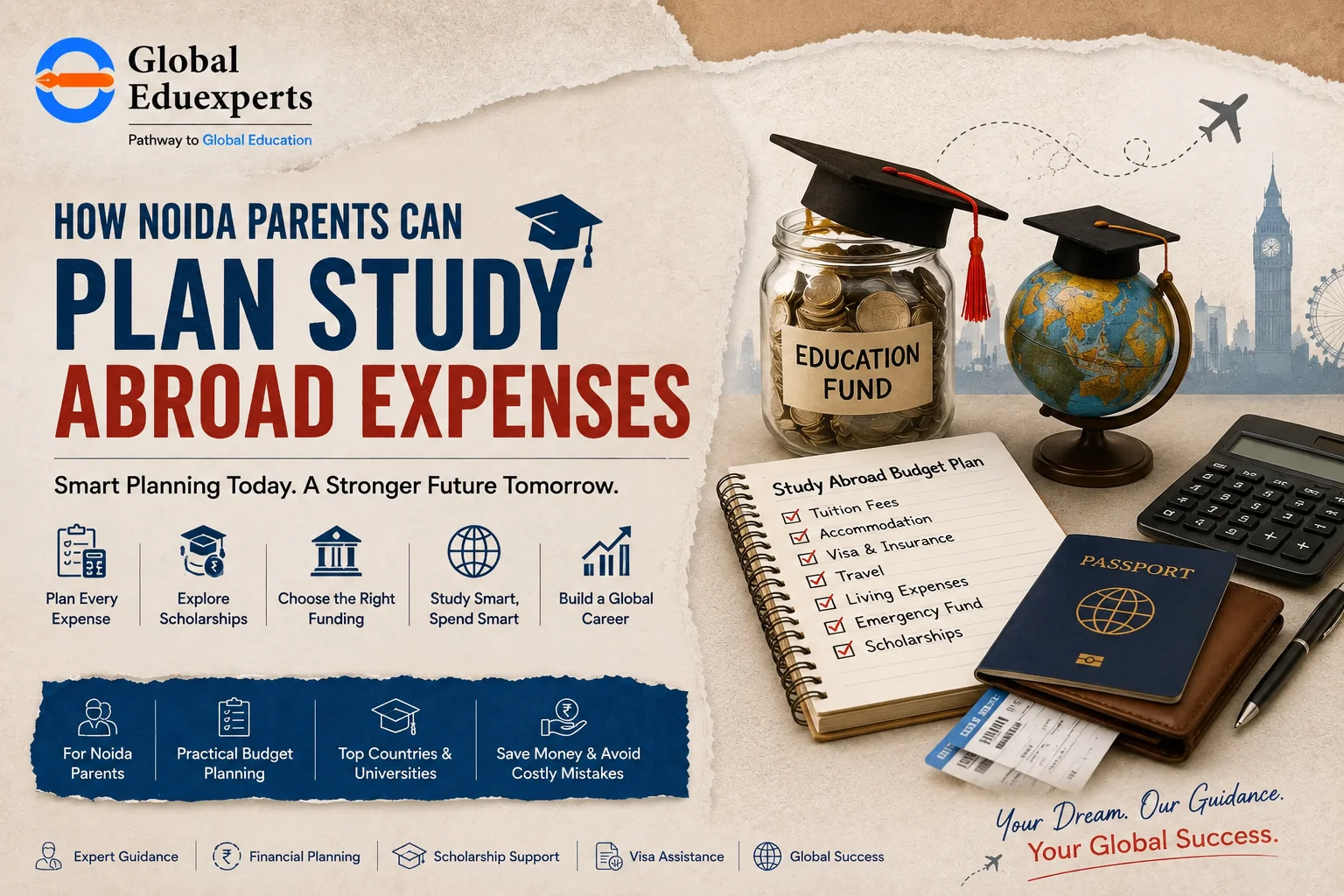
Planning study abroad expenses helps Noida parents make informed financial decisions before their child begins the overseas admission process. By understanding tuition fees, living costs, scholarships, education loans, visa expenses, and long-term career opportunities, families can create a realistic budget, reduce unnecessary expenses, and choose an affordable study destination that offers strong educational value and future career growth.
Many parents begin planning financially only after their child receives an admission offer. By that stage, application deadlines are approaching, visa appointments need to be booked, and multiple payments become due within a short period. A more practical approach is to start budgeting one to three years in advance, allowing enough time to build savings, explore funding options, and reduce financial pressure when admission season arrives.
One of the biggest misconceptions about study abroad expenses is that tuition fees represent the total cost. In reality, tuition is only one component of a much broader financial commitment. Parents should account for university application fees, English language proficiency tests, entrance examinations where applicable, visa charges, health insurance, accommodation deposits, airfare, daily living expenses, textbooks, local transportation, and an emergency reserve. Looking at the complete financial picture from the beginning helps avoid unexpected expenses later in the process.
A practical budgeting strategy starts by estimating the total cost rather than focusing on individual payments. Once your child has shortlisted countries and preferred universities, calculate the expected expenses for the first year and then project costs for the entire duration of the program. Countries such as the USA, UK, Australia, Canada, Ireland, and Germany differ significantly in tuition structures and living costs, making destination selection an important financial decision as well as an academic one.
Parents should also remember that accommodation expenses vary considerably. University residence halls, private apartments, shared housing, and homestays each have different costs and additional charges such as utility bills, internet, security deposits, and maintenance fees. These recurring expenses often have a greater long-term impact on the cost of studying abroad than families initially anticipate.
Travel costs deserve early planning too. Apart from the initial international flight, students may need domestic travel within the destination country, airport transfers, luggage upgrades, and occasional return visits during semester breaks. Booking flights closer to departure dates often results in higher prices, making advance financial planning particularly valuable.
Health insurance is another expense that should never be underestimated. Many universities require comprehensive medical insurance before enrolment, while several countries make insurance mandatory for international students during their stay. Parents should include these annual premiums in their education budget instead of treating them as optional expenses.
Another area frequently overlooked is currency fluctuation. Exchange rates rarely remain constant throughout a two-year master's program or a longer undergraduate degree. Even small changes in currency values can increase the total education cost considerably. Families who monitor exchange rates, maintain contingency funds, and plan foreign currency requirements gradually are generally better prepared for market fluctuations than those arranging large transfers at the last moment.
Creating a dedicated emergency fund is equally important. Unexpected medical situations, academic emergencies, delayed scholarship disbursements, temporary accommodation changes, or sudden travel requirements can arise without warning. Having a financial buffer provides peace of mind and prevents parents from making rushed borrowing decisions during emergencies.
Instead of waiting until admission letters arrive, many financial advisors recommend building a structured savings plan several years in advance. Regular monthly savings, annual education investments, and planned contributions often prove more manageable than arranging a large lump sum shortly before departure. Families considering an education loan for study abroad may also benefit from early financial planning, as maintaining a healthy credit profile and organizing income documentation can simplify the loan approval process when required.
Scholarships should be included in financial planning from the very beginning rather than viewed as a last-minute opportunity. Many universities and government organizations offer study abroad scholarships for Indian students based on academic merit, leadership achievements, research potential, or financial need. Preparing competitive scholarship applications often requires strong academic records, extracurricular achievements, recommendation letters, and timely submissions. Exploring international scholarships for Indian students early can significantly reduce the overall financial burden.
Parents should also have open discussions with their children about realistic education budgets. While university rankings are important, they should be balanced with affordability, future employability, scholarship opportunities, and expected return on investment. Selecting a university that offers strong career outcomes within the family's financial capacity is often a more sustainable decision than choosing an institution based solely on prestige.
For students considering specialized programs such as MBBS in abroad for Indian students at low cost, budgeting requires additional attention because clinical training, licensing examinations, accommodation, and country-specific regulations may introduce expenses beyond standard tuition fees. Understanding these requirements early helps families prepare more accurately.
Finally, budgeting for overseas education should be viewed as a long-term family financial project rather than a single admission expense. Starting early, estimating every major cost category, preparing for unexpected situations, researching scholarships, and seeking guidance from experienced foreign education consultants or a trusted study abroad consultant in Noida can help parents make informed financial decisions with greater confidence. Careful planning not only reduces financial stress but also allows students to focus on their education and career goals once they begin their international academic journey.
Building a budget becomes much easier when you compare country-wise education costs instead of relying on estimates. Exploring
USA Cost,UK Cost, andIreland Costgives parents a clearer understanding of tuition, accommodation, and everyday living expenses, helping them choose a destination that matches both their child's ambitions and the family's financial plan.
Financing an overseas education is one of the biggest decisions parents make during their child's study abroad journey. While many families immediately consider an education loan, others prefer using personal savings or aim to reduce costs through scholarships. There is no single approach that suits every family. The right decision depends on household income, long-term financial commitments, the total cost of the chosen program, and the student's future earning potential.
Rather than asking which option is the cheapest, parents should focus on which funding strategy is the most sustainable over the next five to ten years. A balanced financial plan can reduce stress during the course while protecting the family's long-term financial stability.
| Funding Option | Best Suited For | Key Advantages | Important Considerations |
|---|---|---|---|
| Self-Funding | Families with sufficient savings | No loan repayment or interest | May reduce emergency savings or future investments |
| Education Loan | Families seeking financial flexibility | Preserves personal savings and spreads expenses | Requires repayment with interest after studies |
| Scholarships | Academically strong or eligible students | Reduces overall education cost | Highly competitive and often covers only part of the expenses |
| Partial Funding | Most families | Combines savings, scholarships, and loans | Requires careful financial planning |
For families with adequate financial reserves, self-funding can be an attractive option because it eliminates future debt. Students graduate without repayment obligations, allowing them to focus on building their careers instead of managing loan installments. However, parents should avoid using their entire savings for education. Maintaining sufficient funds for retirement, healthcare, emergencies, and other family responsibilities remains equally important.
Using all available savings may appear financially sensible at first, but unexpected circumstances can arise during a two-year master's program or a longer undergraduate degree. Currency fluctuations, medical emergencies, additional academic requirements, or changing living expenses can increase the overall study abroad expenses beyond the original estimate. Preserving financial flexibility often proves more valuable than exhausting available funds.
For many Indian families, an education loan for study abroad provides a practical way to finance international education while maintaining financial stability at home. Instead of making large upfront payments, parents can distribute education costs over a longer repayment period. This approach is particularly useful when the selected program offers strong graduate employability and a realistic path toward higher future earnings.
Before choosing a loan, families should carefully compare interest rates, repayment schedules, moratorium periods, collateral requirements, processing charges, and early repayment policies. Looking beyond the advertised interest rate helps parents understand the true long-term cost of borrowing. Students entering industries with high salary potential may be able to repay loans more comfortably than those pursuing careers with longer earning timelines.
Scholarships remain one of the most effective ways to reduce the cost of studying abroad, yet many families begin searching for them too late. Universities, government bodies, research organizations, and private foundations offer numerous study abroad scholarships for Indian students based on academic excellence, leadership, research achievements, community involvement, financial need, or specific fields of study.
It is important to understand that scholarships vary significantly in value. Some cover only tuition fees, while others contribute toward accommodation, living expenses, travel, or research costs. Full scholarships are relatively limited, making it advisable for parents to build a financial plan that does not rely entirely on receiving one. Treating scholarship funding as a financial advantage rather than a guarantee creates a more realistic budgeting strategy.
Students should also explore international scholarships for Indian students offered by destination countries themselves. Several governments encourage international education by supporting talented students through competitive funding programs. Since application deadlines often fall months before university admissions close, researching scholarship opportunities early can improve the chances of securing financial assistance.
In many situations, a partial funding approach offers the greatest balance between affordability and financial security. Instead of depending exclusively on one source of funding, families combine personal savings, scholarships, and education loans to distribute financial responsibility more effectively. For example, savings may cover initial admission expenses, scholarships can reduce tuition fees, and a loan may finance the remaining education costs. This diversified approach reduces financial risk while preserving long-term stability.
Parents should also consider the expected return on investment before finalizing any financing decision. A program with higher tuition fees may still represent better value if graduates consistently secure well-paying jobs, while a lower-cost program with weaker employment outcomes may not necessarily provide the best financial outcome. Evaluating employability, internship opportunities, industry demand, and graduate salaries alongside funding options leads to more informed decisions.
Financial discussions should include students as well. Understanding education costs, scholarship responsibilities, loan obligations, and future repayment expectations helps students make thoughtful academic and career choices. When students recognize the investment being made in their education, they are often more motivated to maximize internship opportunities, develop professional skills, and prepare for successful careers after graduation.
Families pursuing specialized programs, including MBBS in abroad for Indian students at low cost, should pay particular attention to licensing examinations, internship requirements, and country-specific regulations that may introduce additional expenses after graduation. These long-term costs should be included in the overall financial planning rather than considered separately later.
Whether parents choose self-funding, loans, scholarships, or a combination of all three, the decision should support both the student's career aspirations and the family's financial well-being. Consulting experienced abroad education consultants, overseas education consultants, or a trusted study abroad consultant can help families compare funding options objectively, understand available scholarship opportunities, and create a practical financial plan that aligns with both immediate education needs and long-term financial goals.
Before deciding how to finance overseas education, it's worth exploring available funding opportunities alongside education costs. Resources like
USA Scholarships,UK Scholarships, andAustralia Scholarshipscan help parents understand how financial aid may reduce overall expenses and influence the best funding strategy for their family.
Planning an overseas education involves far more than selecting a university. Parents must compare countries, understand admission requirements, estimate total expenses, prepare documentation, apply for scholarships, manage visa procedures, and make several financial decisions within strict timelines. Without proper guidance, small mistakes made during the application process can lead to unnecessary expenses, delayed admissions, or even missed opportunities.
Working with an experienced study abroad consultant in Noida can help families approach these decisions more systematically. Beyond simplifying the admission process, professional guidance often helps parents allocate their education budget more efficiently by avoiding avoidable costs and making informed financial choices from the beginning.
One of the most common mistakes families make is applying to too many universities without a clear admission strategy. Every application usually involves university fees, document preparation, standardized tests, courier charges, and administrative expenses. Applying randomly in the hope of increasing admission chances can significantly increase overall study abroad expenses. A consultant helps students shortlist universities that match their academic profile, career objectives, and budget, reducing unnecessary applications while improving the likelihood of receiving suitable offers.
Choosing the right university also has a direct impact on long-term education costs. A higher tuition fee does not automatically guarantee better career opportunities. In many cases, universities with moderate tuition fees offer excellent academic quality, strong industry partnerships, and impressive graduate employment outcomes. Experienced abroad education consultants evaluate these factors together, helping families balance education quality with affordability instead of focusing solely on rankings.
Financial planning is another area where professional guidance adds value. Parents often calculate tuition fees accurately but overlook expenses such as accommodation deposits, health insurance, visa charges, travel costs, books, local transportation, and emergency funds. Developing a realistic financial estimate before applications begin allows families to understand the complete cost of studying abroad and prepare accordingly rather than facing unexpected financial pressure after admission.
Scholarship opportunities also require careful planning. Many universities and government organizations offer funding specifically for international students, but eligibility requirements, deadlines, and documentation vary widely. A knowledgeable study abroad consultant can help students identify suitable study abroad scholarships for Indian students, understand application timelines, and prepare stronger scholarship applications. Even partial scholarships can significantly reduce the total education investment when combined with careful financial planning.
Parents should also explore international scholarships for Indian students, which are offered by destination countries, educational foundations, and international organizations. Since many scholarship deadlines close well before university admissions, early guidance helps students avoid missing valuable funding opportunities.
Visa documentation is another stage where mistakes can become expensive. Incorrect financial documents, incomplete application forms, missing supporting evidence, or inaccurate information may result in processing delays, additional expenses, or even visa refusals. Working with experienced foreign education consultants helps ensure that documents are prepared accurately, financial requirements are properly understood, and application procedures are completed within the required timelines.
Education financing is equally important. Families frequently ask whether they should use savings, apply for an education loan for study abroad, or combine multiple funding sources. Rather than recommending a single approach, experienced consultants help parents compare financing options based on household income, expected education costs, scholarship availability, and future repayment capacity. This allows families to create a funding strategy that supports both educational goals and long-term financial stability.
Career-focused university selection can also reduce financial risk. Instead of concentrating only on tuition fees, professional consultants evaluate graduate employability, internship opportunities, post-study work options, industry demand, and long-term career prospects. Selecting a university with stronger employment outcomes may improve return on investment, even if the initial education cost is slightly higher.
Parents considering specialized courses should seek equally specialized guidance. Students planning MBBS in abroad for Indian students at low cost, for example, need to understand medical licensing requirements, internship regulations, recognition of degrees, and country-specific compliance before making a decision. Choosing a university based only on affordability without evaluating these factors can create significant challenges after graduation.
Another advantage of working with experienced overseas education consultants is access to practical insights developed through years of handling student applications. They understand common documentation issues, university expectations, changing admission trends, scholarship opportunities, and visa procedures that families encountering the process for the first time may not anticipate. This experience helps parents make better-informed decisions while avoiding costly trial-and-error approaches.
Ultimately, the value of a best consultancy for abroad studies lies not simply in completing application forms but in helping families make financially responsible decisions throughout the entire study abroad journey. From university shortlisting and scholarship planning to visa preparation and budgeting, informed guidance can reduce unnecessary expenses, minimize application risks, and help parents invest confidently in their child's international education. When planning begins early and every financial decision is carefully evaluated, studying abroad becomes a structured long-term investment rather than a series of expensive last-minute choices.
Expert guidance often begins with choosing the right destination and understanding its admission process. If you're comparing international options, explore
Study Abroad from Noida,Study in USA,Study in UK, andStudy in Australiato learn about university selection, admissions, and practical planning before making important financial commitments.
When parents begin planning for overseas education, tuition fees usually receive the most attention. Universities prominently display course fees, making them easy to compare across countries and institutions. However, tuition is only one part of the overall financial commitment. Numerous additional expenses arise before departure and continue throughout the student's academic journey. Failing to account for these hidden costs can place unexpected financial pressure on families, even when they have planned carefully for tuition.
Understanding every stage of the financial journey allows parents to estimate the true cost of studying abroad and avoid unpleasant surprises after receiving an admission offer.
| Expense Category | Why It Matters |
|---|---|
| English Proficiency Tests | Required for admission in many universities |
| University Application Fees | Often charged separately for each application |
| Document Verification & Translations | Required for academic and legal documents |
| Visa Application & Biometrics | Mandatory government processing costs |
| Health Insurance | Required by many universities and countries |
| Accommodation Deposits | Usually paid before arrival |
| Airfare | Seasonal price variations can significantly affect costs |
| Daily Living Expenses | Food, transport, internet, utilities, and personal spending |
| Currency Conversion Charges | Banking and exchange rate fluctuations increase expenses |
| Emergency Fund | Covers unexpected academic or personal situations |
One of the earliest costs families encounter involves standardized English language examinations. Many universities require IELTS, TOEFL, PTE Academic, or similar test scores as part of the admission process. Registration fees, preparation materials, coaching classes if required, and possible reattempts all contribute to overall study abroad expenses before university applications even begin.
Application fees themselves are another commonly underestimated expense. Since students often apply to multiple universities to improve admission prospects, these individual fees can quickly accumulate. Parents who develop a well-planned application strategy instead of submitting excessive applications can often reduce unnecessary spending while maintaining strong admission opportunities.
Document preparation also involves costs that families may overlook. Academic transcripts, degree certificates, notarization, certified translations, courier services, passport renewals, and document verification may all require separate payments. Although each expense appears relatively small, together they represent a meaningful part of the admission budget.
Visa-related expenses extend beyond the application fee itself. Depending on the destination country, students may need to pay for biometric appointments, medical examinations, police clearance certificates, document courier services, financial documentation, and additional government processing requirements. Missing or incorrect documentation can result in repeated appointments, increasing both costs and processing time.
Health insurance is another mandatory expense in many study destinations. Universities and immigration authorities frequently require international students to maintain approved medical insurance throughout their studies. The coverage requirements differ between countries, and parents should include annual insurance premiums in their financial planning instead of treating them as optional costs.
Accommodation often requires significant upfront payments before students even arrive overseas. Many landlords and university residences request advance rent, security deposits, booking fees, or administrative charges. These initial payments are separate from regular monthly housing expenses and can substantially increase the amount families need immediately before departure.
Travel costs deserve careful consideration as well. International airfare varies throughout the year depending on travel seasons, airline availability, and booking dates. Additional luggage charges, airport transfers, domestic transportation after arrival, and occasional return visits during holidays further increase the total education budget. Booking flights early often helps families secure better prices while providing greater flexibility.
Once students settle into their destination country, recurring living expenses become an important part of the overall financial picture. Food, groceries, transportation, mobile services, internet access, utilities, clothing suitable for local weather, study materials, and occasional social activities all contribute to monthly spending. While these individual expenses may seem manageable, they collectively represent a significant portion of the cost of studying abroad over several years.
Another hidden expense that many parents underestimate is currency conversion. Exchange rates fluctuate regularly, and banks or foreign exchange providers may charge conversion fees in addition to the prevailing exchange rate. Even relatively small movements in currency values can noticeably increase education costs when tuition, accommodation, and living expenses are paid in foreign currencies over multiple semesters.
Parents should also prepare for academic expenses that arise after enrolment. Laboratory fees, software licenses, field visits, professional certifications, graduation charges, student association fees, printing, project materials, and specialized equipment may not always be included in tuition. Reviewing the complete fee structure before accepting an admission offer helps families estimate these additional costs more accurately.
For students pursuing professional degrees such as MBBS in abroad for Indian students at low cost, additional financial planning may be necessary. Licensing examinations, clinical training requirements, internship expenses, and regulatory compliance costs can continue after graduation, making it important to consider the complete educational pathway rather than focusing only on tuition fees.
Perhaps the most important yet overlooked financial safeguard is maintaining an emergency fund. Unexpected medical situations, family emergencies, accommodation changes, delayed financial transfers, lost travel documents, or unforeseen academic requirements can arise at any stage. Having dedicated emergency savings reduces dependence on expensive short-term borrowing and provides greater peace of mind for both parents and students.
Many of these expenses become manageable when families begin financial planning early and seek reliable guidance from experienced overseas education consultants or a trusted study abroad consultant in Noida. A detailed financial roadmap helps parents understand where money will be spent, identify opportunities for savings, explore study abroad scholarships for Indian students, and evaluate whether an education loan for study abroad is necessary. Looking beyond tuition alone enables families to prepare confidently for every stage of the international education journey while avoiding financial surprises that could otherwise disrupt their child's academic plans.
Many hidden costs become easier to estimate once you understand each country's admission and visa requirements. Reviewing
USA Visa,UK Visa,Australia Visa, andIreland Visahelps parents prepare for documentation, visa-related expenses, and financial requirements that are often overlooked during the initial planning stage.
One of the biggest concerns for parents planning overseas education is finding a university that fits their budget without limiting their child's future career prospects. It is natural to assume that the most expensive universities offer the best opportunities, but this is not always the case. Many affordable institutions consistently produce graduates who secure rewarding careers because they focus on practical education, strong industry partnerships, and graduate employability rather than prestige alone.
Instead of asking, "Which country is the cheapest?", parents should ask, "Which destination offers the best long-term value?" Looking at education as an investment rather than simply an expense helps families make decisions that balance affordability with career growth.
| Comparison Factor | Why It Matters |
|---|---|
| Tuition Fees | Determines the initial education investment |
| Cost of Living | Influences monthly expenses throughout the course |
| Graduate Employability | Reflects job opportunities after graduation |
| Scholarships | Helps reduce the overall financial burden |
| Post-Study Work Rights | Allows students to gain international work experience |
| Industry Demand | Improves long-term career prospects |
| University Accreditation | Ensures global recognition of the qualification |
| Internship Opportunities | Builds practical experience before graduation |
Finding the right balance between affordability and career growth requires comparing more than tuition fees. Reading destination-specific guides such as
Study in Europe,Study in Ireland,Study in Dubai, andStudy in Asiacan help families evaluate education quality, living costs, post-study opportunities, and long-term return on investment before making a final decision.
Affordability should never be evaluated using tuition fees alone. A university with relatively low tuition may be located in a city where accommodation and daily living expenses are significantly higher. Conversely, a university with moderate tuition fees in a more affordable city may result in a lower overall cost of studying abroad over the duration of the program. Parents should compare the complete financial picture instead of focusing on a single expense.
Graduate employability is equally important. Some universities maintain strong relationships with employers through internships, research collaborations, career fairs, and campus recruitment programs. Students graduating from these institutions often find employment more quickly, improving the return on their education investment. Reviewing graduate employment statistics, internship availability, and employer partnerships provides far more useful insight than relying only on international rankings.
Post-study work opportunities also play a major role in long-term financial planning. Several countries allow international graduates to remain after completing their degrees to gain professional experience. This additional work period enables students to develop their careers, recover part of their education investment, and build valuable international experience before deciding on permanent employment or returning to India.
Scholarships can further improve affordability without compromising education quality. Many universities, governments, and private organizations offer study abroad scholarships for Indian students based on academic performance, leadership, research achievements, or financial need. Parents who begin scholarship planning early often discover opportunities that substantially reduce tuition fees or provide support for living expenses.
Students should also explore international scholarships for Indian students, particularly those funded by destination countries and educational foundations. These programs may cover full or partial tuition, research funding, accommodation assistance, or monthly living allowances. Applying well before university deadlines increases the likelihood of securing financial assistance.
Another important comparison involves public and private universities. Public universities in several countries often receive government funding, allowing them to offer lower tuition fees while maintaining high academic standards. Private universities, on the other hand, may provide smaller class sizes, specialized facilities, industry-focused programs, and additional student support services. Neither option is automatically better; parents should compare teaching quality, graduate outcomes, available scholarships, and total education costs before making a decision.
Career opportunities should remain central to every financial discussion. Selecting an affordable university is beneficial only if graduates have realistic employment prospects after completing their studies. Parents should evaluate the demand for graduates in their child's chosen field, internship opportunities during the program, professional networking opportunities, and the industries surrounding the university. A slightly higher education investment may deliver significantly stronger long-term career outcomes if graduates consistently secure well-paying positions.
Families should also consider the flexibility of the chosen destination. Countries with growing industries in technology, engineering, healthcare, finance, business analytics, renewable energy, and artificial intelligence often provide broader employment opportunities after graduation. Matching academic programs with industries experiencing sustained demand increases the likelihood of long-term career success.
Students planning professional courses require additional research. Families exploring MBBS in abroad for Indian students at low cost often focus primarily on affordable tuition, but medical education involves several additional considerations. Degree recognition, licensing examinations, internship opportunities, language requirements, and eligibility to practise medicine in India or other countries should all be evaluated before choosing a university. A lower tuition fee may not represent good value if graduates face significant licensing challenges later.
Parents should also avoid comparing universities solely through social media rankings or promotional advertisements. Speaking with current students, reviewing graduate employment reports, understanding alumni outcomes, and assessing employer reputation provide a much clearer picture of the actual value offered by a university.
Financial planning becomes more effective when families compare total return on investment rather than individual expenses. This includes tuition fees, living costs, scholarship availability, expected graduate salaries, post-study work rights, and long-term employability. Taking this broader approach helps parents identify destinations that are both affordable and capable of supporting sustainable career growth.
Making these comparisons independently can be challenging because every country follows different admission systems, scholarship criteria, visa regulations, and employment policies. Working with experienced abroad education consultants, foreign education consultants, or a trusted study abroad consultant in Noida can help parents evaluate universities objectively, compare realistic costs, identify funding opportunities, and select an institution that offers both academic quality and strong career potential. A thoughtful decision made before admission often has a far greater impact on future success than simply choosing the lowest tuition fee available.
The total budget depends on the destination country, university, course, and duration of study. Besides tuition fees, parents should include accommodation, visa charges, health insurance, airfare, daily living expenses, books, and emergency funds. Creating a detailed financial plan before applications begin helps families estimate the complete cost of studying abroad and avoid unexpected expenses later.
Neither option is universally better. Families with sufficient savings may prefer self-funding, while others benefit from an education loan for study abroad to manage expenses over time. Scholarships can significantly reduce education costs, but they are competitive. In many cases, combining savings, scholarships, and a loan provides the most practical and financially balanced solution.
An experienced study abroad consultant in Noida helps parents shortlist suitable universities, identify scholarship opportunities, avoid unnecessary application expenses, prepare accurate visa documentation, and create a realistic financial plan. Professional guidance often prevents costly mistakes, reduces delays, and helps families choose universities that offer strong career prospects without exceeding their planned education budget.
Many families focus only on tuition fees and overlook expenses such as English language tests, university application fees, document verification, visa processing, health insurance, accommodation deposits, airfare, local transportation, currency exchange charges, and emergency funds. Including these costs from the beginning provides a more accurate estimate of the total study abroad expenses.
Parents should compare universities based on graduate employability, industry connections, internship opportunities, scholarship availability, post-study work options, accreditation, and long-term return on investment rather than tuition fees alone. An affordable university with strong career outcomes often delivers better value than a more expensive institution with limited employment opportunities after graduation.


