
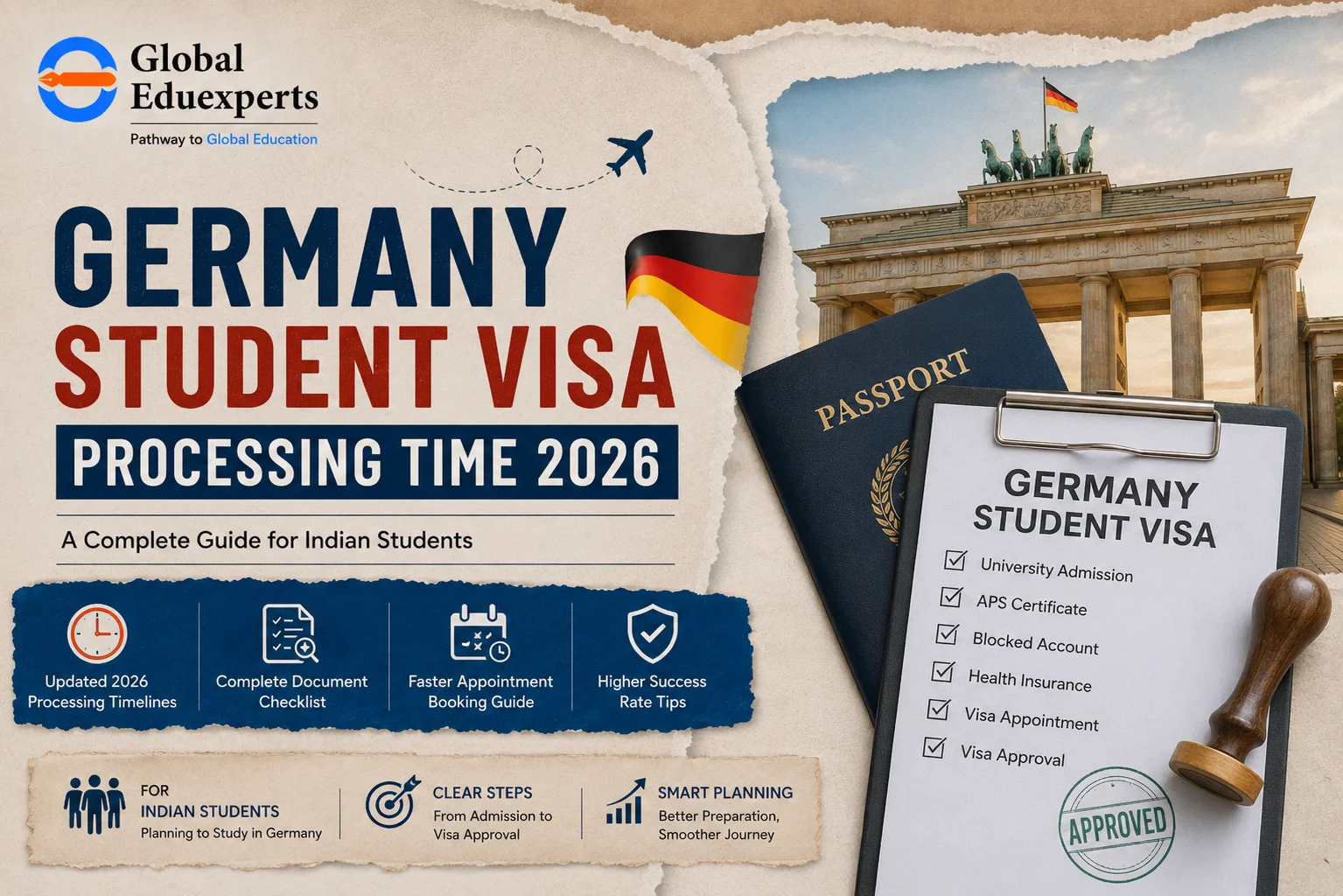
Planning a Germany student visa requires more than submitting an application. It involves understanding the visa processing timeline, preparing the right documents, completing APS verification, arranging financial proof, booking appointments, and meeting all immigration requirements. This guide helps Indian students navigate every stage of the Germany student visa process with practical advice, reducing avoidable delays while improving their chances of a smooth and timely visa approval.
Planning to study in Germany starts long before boarding a flight. One of the most common concerns among Indian students is understanding the Germany student visa processing time and knowing when to begin the application process. While many students focus on receiving their university admission letter, the visa timeline is equally important because even a small delay can affect travel plans, accommodation bookings, and university enrollment deadlines.
There is no single processing timeline that applies to every applicant. The actual duration depends on several factors, including document verification, appointment availability, embassy workload, and the completeness of the application. Students who prepare early generally experience fewer complications than those who wait until the last few weeks before their course begins.
| Stage | Estimated Timeline |
|---|---|
| University Admission | Varies by university |
| APS Certificate Verification | Several weeks depending on application volume |
| Blocked Account & Financial Preparation | 1–3 weeks |
| Germany Student Visa Appointment | Depends on appointment availability |
| Visa Processing After Submission | Typically 4–12 weeks |
| Passport Collection | Usually a few days after visa approval |
The Germany student visa processing time 2026 is expected to remain broadly similar to previous admission cycles, although individual timelines may vary depending on the German Embassy or Consulate handling the application. During peak admission periods, especially before the winter semester, students should expect longer waiting times because thousands of international applicants submit visa requests within a short period.
For German student visa processing time for Indian students, one of the biggest factors is appointment availability. Even before the visa application is reviewed, students may need to wait several weeks to secure an appointment at the appropriate German mission. This is why experienced advisors often recommend beginning visa preparation immediately after receiving university admission rather than waiting until every document is finalized.
Although every application follows the same general procedure, processing times can differ because not every application requires the same level of verification. Understanding these factors allows students to plan more effectively and avoid preventable delays.
The Academic Evaluation Centre (APS) certificate has become an important part of the admission and visa process for Indian students. Applications cannot progress without successful APS verification where required. Delays in obtaining the certificate naturally postpone every stage that follows, including visa submission.
Students who apply for APS certification well before university deadlines generally avoid unnecessary pressure later in the admission process.
One of the most common reasons for extended Germany study visa processing time is incomplete documentation. Missing financial records, unsigned forms, inconsistent academic information, or outdated certificates often require additional verification.
Before attending the visa appointment, students should carefully review every required document rather than assuming minor omissions will be accepted later.
Although requirements may differ slightly depending on individual circumstances, applicants are generally expected to prepare:
Preparing these Germany student visa documents well in advance reduces the possibility of additional requests from the embassy.
Visa demand changes throughout the year. Students applying for the Winter Intake often face longer waiting periods because most international admissions occur during this period.
During high-volume months, embassies process significantly larger numbers of applications, which naturally increases overall processing times.
Submitting the application early is one of the simplest ways to avoid seasonal delays.
Germany requires students to demonstrate that they have sufficient financial resources to support themselves during their studies.
If financial documents require clarification or additional verification, processing may take longer. Parents and students should ensure all financial evidence is complete, consistent, and prepared according to the latest embassy requirements.
Some applications may require further academic or administrative verification before a final decision is made. These additional checks do not necessarily indicate a problem with the application but can extend processing beyond the average timeline.
Students should avoid making irreversible travel bookings until the visa has been approved.
While applicants cannot influence embassy processing speed, they can reduce the chances of unnecessary delays through careful preparation.
Start the process early. Waiting until the university semester is about to begin often creates avoidable pressure. Beginning preparations several months in advance allows sufficient time for APS verification, financial planning, appointments, and document collection.
Book appointments as soon as possible. Appointment availability is often more unpredictable than visa processing itself. Once admission documents are available, students should secure their Germany student visa appointment without unnecessary delay.
Prepare every document carefully. Small inconsistencies between application forms, financial records, passports, or academic documents may result in additional verification requests.
Respond quickly to embassy communication. If further information is requested, providing accurate responses promptly helps prevent additional waiting.
Avoid relying on unofficial timelines. Every student's circumstances are different. Comparing processing times shared on social media or discussion forums can create unrealistic expectations.
Many students assume that receiving a university admission letter guarantees they will begin classes on time. In reality, admission is only one milestone in the overall journey. Visa appointments, financial preparation, APS certification, and embassy processing all require careful coordination.
Families who prepare each stage systematically are generally able to manage unexpected delays more comfortably than those working against tight deadlines.
Working with an experienced study abroad consultant can also simplify the process. Reputable overseas education consultants and foreign education consultants help students understand document requirements, organize application timelines, prepare financial records, and monitor important milestones throughout the Germany student visa application process. While no abroad consultancy or best consultancy for abroad studies can guarantee faster visa approval, experienced guidance often reduces avoidable mistakes that commonly lead to delays.
Visa timelines are only one part of planning your move to Germany. Before scheduling appointments, it helps to understand admission requirements and overall study planning. Explore
STUDY IN EUROPEto compare education pathways or readSTUDY IN IRELANDandIreland Visaif you're also evaluating other European destinations before making a final decision.
Ultimately, the Germany student visa processing time is influenced by preparation as much as processing. Students who begin early, organize documents carefully, secure appointments promptly, and follow official requirements are usually in the strongest position to complete the visa process smoothly and arrive in Germany well before their academic program begins.
Receiving an admission letter from a German university is an important milestone, but it is only one part of the journey. The next stage—preparing a complete and accurate visa application—requires careful attention to detail. Many students assume that simply collecting the required paperwork is enough, but in practice, the quality, consistency, and accuracy of the documents play a major role in how smoothly the application progresses.
Most delays in the Germany student visa application process are not caused by complex immigration rules. They occur because documents are incomplete, financial records are inconsistent, forms contain errors, or required certificates are submitted late. Preparing every document well in advance gives students enough time to verify information and correct mistakes before attending their visa appointment.
| Document | Purpose |
|---|---|
| Valid Passport | Confirms identity and travel eligibility |
| University Admission Letter | Proof of admission to a recognized institution |
| APS Certificate | Academic verification for eligible Indian applicants |
| Financial Proof / Blocked Account | Demonstrates sufficient funds for living expenses |
| Health Insurance | Mandatory medical coverage in Germany |
| Academic Certificates & Transcripts | Verifies educational qualifications |
| Passport-sized Photographs | Required for visa application |
| Completed Visa Application Form | Official visa request |
| Proof of Visa Fee Payment (if applicable) | Confirms application processing |
Every document should be reviewed carefully before submission. Even minor inconsistencies between names, dates, addresses, or academic records may require additional verification, extending the overall Germany student visa processing time.
The admission letter forms the foundation of the visa application because it confirms that the student has secured a place at a recognized German educational institution.
Parents and students should verify that the course name, university details, intake period, and personal information are accurate before submitting the document. If any corrections are required, they should be requested from the university immediately rather than after the visa application has been submitted.
Document preparation becomes much easier when you understand how different countries structure their visa requirements. Reviewing resources like
UK Visa,Australia Visa, andUSA Visaoffers useful perspective on financial documentation, visa procedures, and supporting paperwork while helping you prepare a more organized international application.
For many Indian applicants, the APS Certificate has become an essential requirement before proceeding with the Germany student visa application.
The APS (Academic Evaluation Centre) verifies academic credentials issued in India before they are accepted for further processing. Since APS verification itself can take several weeks depending on application volume, students should begin this process as early as possible instead of waiting until university admission is confirmed.
Delays in obtaining the APS certificate frequently affect both visa appointments and university enrollment timelines.
Germany requires international students to demonstrate that they have sufficient financial resources to support themselves during their studies.
For many applicants, this requirement is fulfilled through a blocked account established according to German regulations. The blocked account assures immigration authorities that students have access to funds for accommodation, food, transportation, and other essential living expenses while studying in Germany.
Students should ensure that financial records are complete, consistent, and prepared according to the latest Germany student visa requirements. Missing bank documentation or discrepancies in financial information can lead to additional clarification requests.
Health insurance is not simply recommended—it is an essential part of the visa process.
Students should arrange insurance that satisfies German visa requirements and provides coverage from the beginning of their stay. Policies should clearly indicate coverage dates and meet the standards accepted by German authorities.
Leaving health insurance until the final stage often delays visa submission because additional documentation may be required.
Academic records help immigration authorities verify the student's educational background.
These documents generally include:
Students should confirm that all documents are complete, legible, and consistent with the information provided in university applications and visa forms.
The passport should remain valid well beyond the intended period of study.
Parents should carefully check:
Simple errors in personal information can create unnecessary administrative complications during document verification.
One of the most avoidable reasons for delayed processing is inaccurate application forms.
Students should review every entry carefully before submission, ensuring consistency across:
Even minor differences in names, addresses, or dates can require additional verification.
Many visa applications are delayed not because applicants are ineligible but because preventable documentation mistakes require additional clarification.
Students often begin collecting documents only after receiving admission confirmation.
In reality, many requirements—including APS verification, passport renewal, financial preparation, and health insurance—can be completed much earlier.
Starting early creates flexibility if additional documents become necessary.
Financial proof is one of the most carefully reviewed parts of the application.
Incomplete blocked account documentation, missing supporting evidence, or inconsistencies between submitted financial records frequently result in additional processing time.
All documents should present identical personal information.
Differences in name spelling, passport details, addresses, academic records, or dates may require additional verification before the application proceeds.
Visa requirements occasionally change as immigration procedures evolve.
Students should always verify the latest Germany student visa documents required by the appropriate German Embassy or Consulate before attending their appointment instead of relying solely on older online checklists.
Presenting documents in an unstructured manner creates unnecessary confusion during submission.
Many successful applicants prepare separate folders for:
A well-organized application demonstrates careful preparation and makes the review process smoother.
Although no applicant can influence embassy processing speed, they can significantly improve the quality of their application.
Useful preparation includes:
These simple habits reduce unnecessary delays and improve the overall efficiency of the Germany student visa application process.
Many students also choose to work with an experienced study abroad consultant or overseas education consultants during the documentation stage. A knowledgeable foreign education consultant can review application forms, verify document completeness, explain changing Germany student visa requirements, and identify potential issues before submission. While no abroad consultancy or best consultancy for abroad studies can guarantee visa approval, professional document review often helps students avoid common mistakes that delay applications.
Ultimately, preparing Germany student visa documents is less about collecting paperwork and more about presenting a complete, accurate, and well-organized application. Students who begin early, verify every document carefully, and follow official requirements systematically place themselves in a much stronger position for a smooth visa process and timely arrival in Germany.
For many Indian students, securing university admission is only half the journey. The next challenge is obtaining a Germany student visa appointment and preparing for the visa interview with confidence. Even well-prepared applicants sometimes underestimate how much time appointment scheduling, document verification, and embassy procedures can take. As a result, students who receive admission offers on time occasionally find themselves rushing through the visa process or worrying about missing their university's reporting date.
The good news is that most appointment-related problems can be minimized through early planning. While students cannot control appointment availability or embassy processing speed, they can control when they begin preparations, how well they organize their documents, and how confidently they approach the interview.
| Step | What Happens |
|---|---|
| Receive University Admission | Confirm acceptance from a recognized German university |
| Complete APS Verification | Obtain APS certificate where applicable |
| Prepare Financial Documents | Arrange blocked account and financial proof |
| Book Visa Appointment | Schedule through the designated German mission or authorized visa process |
| Attend Appointment | Submit documents, biometrics, and application |
| Visa Interview (if applicable) | Answer questions about studies and future plans |
| Application Review | Embassy verifies submitted information |
| Passport Collection | Receive passport after the decision is finalized |
Although the overall Germany student visa application process is straightforward, appointment availability often becomes the first major challenge. Demand is especially high before the Winter Intake, when thousands of students submit applications within a limited period.
Students who wait until every document is perfectly organized before attempting to schedule an appointment sometimes discover that available slots have already filled up. A more practical approach is to monitor appointment availability as soon as admission is confirmed while continuing to complete the remaining documentation.
Students often compare interview processes before committing to a destination. Reading guides such as
USA Eligibility,UK Eligibility, andAustralia Eligibilitycan help you understand admission expectations, academic requirements, and visa preparation across major study destinations, making it easier to evaluate which country best fits your academic profile.
Many applicants ask why one student receives an appointment quickly while another waits several weeks.
Several factors influence availability:
The German student visa processing time for Indian students often begins long before the embassy reviews the application. Simply obtaining an appointment may require patience during peak admission months.
For this reason, experienced advisors recommend beginning visa planning immediately after receiving admission rather than treating the appointment as the final step.
Even if an appointment is secured early, students should ensure that essential documents are already progressing.
Preparation should include:
Having these documents ready before the appointment reduces unnecessary stress and helps avoid rescheduling because of incomplete paperwork.
On the appointment day, applicants typically submit their documents, complete identity verification procedures, and provide biometric information if required.
The appointment itself is usually administrative rather than lengthy. Embassy officials review submitted documents, verify personal information, and ensure that the application meets the required standards before moving it into the processing stage.
Students should arrive early, carry both original documents and photocopies where requested, and organize their paperwork in the same order recommended by the embassy.
A well-organized file creates a smoother submission experience for both the applicant and the reviewing officer.
Most applicants complete biometric verification as part of the visa procedure.
This generally includes:
The biometric process is usually straightforward and only takes a short time. Students simply need to follow the instructions provided during the appointment.
Many applicants become anxious when they hear about visa interviews.
In reality, the purpose of the interview is not to make the process difficult. Instead, it allows officials to understand whether the student's education plans are genuine and whether the information submitted in the application is accurate.
The interview is often conversational rather than confrontational.
Applicants who understand their own academic plans generally answer confidently without memorizing prepared responses.
Although every interview is different, students are frequently asked about topics such as:
These questions are designed to assess whether the student has carefully planned their education rather than simply applying for a visa.
Clear, honest, and consistent answers are usually more effective than rehearsed responses.
Students often assume they need perfect answers.
In reality, confidence usually comes from preparation rather than memorization.
Helpful preparation includes:
When answers naturally match the submitted documentation, interviews generally proceed much more smoothly.
Certain avoidable mistakes frequently create unnecessary complications.
Students sometimes begin preparing only after securing an appointment.
By then, obtaining missing financial documents, insurance, or APS verification may become difficult.
Missing documents may require additional visits or delay processing.
Every document should be checked several days before the appointment instead of the previous evening.
Applicants should answer questions honestly.
Information discussed during the interview should match the details provided in university applications and visa documents.
Embassies occasionally update document requirements or appointment procedures.
Students should always review the latest instructions before attending their scheduled appointment.
A successful appointment is usually the result of careful preparation rather than luck.
Students can improve the experience by:
These simple habits reduce unnecessary stress while supporting a smoother Germany study visa processing time.
Many students also seek guidance from an experienced study abroad consultant during the appointment preparation stage. Reputable overseas education consultants, abroad education consultants, and foreign education consultants often help applicants review documentation, explain embassy procedures, prepare for interview questions, and organize the complete application before submission. While no abroad consultancy or best consultancy for abroad studies can guarantee appointment availability or visa approval, experienced guidance often helps students avoid the common errors that delay applications.
Ultimately, booking a Germany student visa appointment is not simply about finding an available slot. It is about reaching that appointment fully prepared—with organized documents, realistic expectations, and a clear understanding of your academic goals. Students who plan early, prepare carefully, and approach the process with confidence usually experience a smoother visa journey and are better positioned to begin their studies in Germany on schedule.
Applying for a German student visa is a structured process that involves several stages, each depending on the successful completion of the previous one. Many students focus only on receiving an admission letter, only to realize later that visa preparation requires additional documentation, financial planning, verification procedures, and careful scheduling. Missing even one step can delay the entire process and, in some cases, affect the student's ability to begin classes on time.
The most successful applicants treat the visa process as a timeline rather than a single application. Planning every stage early allows enough time to handle unexpected delays without compromising travel or university reporting dates.
| Stage | What You Need to Do |
|---|---|
| 1. Secure University Admission | Receive an offer letter from a recognized German university |
| 2. Apply for APS Certificate | Complete academic verification (where applicable) |
| 3. Arrange Financial Proof | Open a blocked account or prepare accepted financial evidence |
| 4. Purchase Health Insurance | Obtain insurance that meets German visa requirements |
| 5. Prepare Visa Documents | Organize all required supporting documents |
| 6. Book Visa Appointment | Schedule submission with the appropriate German mission |
| 7. Attend Appointment | Submit documents, biometrics, and complete the application |
| 8. Visa Processing | Embassy verifies the application |
| 9. Receive Visa | Collect passport after approval |
| 10. Travel to Germany | Complete university registration after arrival |
| 11. Apply for Residence Permit | Register with local authorities and obtain a residence permit |
Understanding this sequence helps students prepare each stage without unnecessary stress.
Everything begins with an official admission letter from a recognized German institution.
Before accepting the offer, students should carefully review:
Keeping digital and printed copies of the admission letter is important because it will be required throughout the Germany student visa application process.
If you're still deciding whether Germany is the right destination, comparing complete study pathways can provide greater clarity. Visit
STUDY IN EUROPEalongsideSTUDY IN UKandSTUDY IN AUSTRALIAto understand how admissions, visa procedures, costs, and post-study opportunities differ before submitting your final university applications.
For Indian applicants, the APS Certificate has become an important requirement before visa processing.
APS verifies academic qualifications issued in India and confirms their authenticity.
Because APS processing may require several weeks, students should begin this stage immediately after deciding to study in Germany rather than waiting until every other document is ready.
Early APS preparation helps prevent unnecessary delays later in the visa process.
Germany requires international students to demonstrate that they can financially support themselves during their studies.
For many applicants, this involves opening a blocked account that satisfies the financial requirements established by German authorities.
Students should ensure that:
Accurate financial preparation is one of the most important Germany student visa requirements.
Health insurance is another essential requirement before visa submission.
Students should obtain a policy that complies with German immigration regulations and provides coverage beginning from their arrival in Germany.
Waiting until the last minute to arrange insurance often delays the application because supporting documents may require additional verification.
Before booking the visa appointment, applicants should prepare every required document carefully.
Typical Germany student visa documents include:
Organizing documents in a logical order makes the submission process significantly easier.
Students should also keep digital copies of every document in case additional information is requested later.
After essential documents have been prepared, students should secure their Germany student visa appointment as early as possible.
Appointment availability varies throughout the year.
Demand increases considerably before the Winter Intake, making early booking especially important.
Students should avoid waiting until every document has been finalized before monitoring appointment availability.
On the scheduled day, applicants submit their documents, complete identity verification, and provide biometric information where required.
The appointment generally includes:
Applicants should arrive early, remain organized, and answer any questions honestly and confidently.
After submission, the embassy reviews the application.
The Germany student visa processing time depends on several factors, including:
Students should avoid making non-refundable travel arrangements until the visa has been officially approved.
Patience is important during this stage because additional document requests may occasionally arise.
Once the application has been approved, students receive their passport with the visa.
Before making travel arrangements, applicants should verify:
Any discrepancies should be reported immediately.
Visa approval does not complete the entire immigration process.
After arriving in Germany, students should:
These administrative steps help students begin their academic journey smoothly.
The student visa generally allows entry into Germany, but students staying for longer academic programs usually need to apply for a residence permit after arrival.
The residence permit allows students to legally remain in Germany for the duration of their studies and must be obtained according to local immigration requirements.
Students should complete this process promptly after arriving rather than waiting until their initial visa approaches expiration.
Many delays occur because students underestimate the importance of planning every stage.
Common issues include:
Most of these problems can be avoided simply by following a structured timeline.
A realistic approach is to spread preparations over several months instead of trying to complete everything after admission.
A well-planned schedule usually includes:
This approach gives students flexibility if unexpected delays occur during the Germany study visa processing time.
Many students also choose to work with an experienced study abroad consultant during this process. Professional overseas education consultants, abroad education consultants, and foreign education consultants can help organize timelines, review Germany student visa documents, explain changing immigration requirements, and monitor important milestones. While no abroad consultancy or best consultancy for abroad studies can influence embassy decisions, experienced guidance often helps students complete every stage of the application accurately and on time.
Ultimately, the Germany student visa application process is most successful when viewed as a carefully planned journey rather than a last-minute checklist. Students who prepare documents early, complete APS verification on time, organize financial proof, secure appointments promptly, and understand the steps after arriving in Germany are far more likely to experience a smooth transition from university admission to beginning their studies with confidence.
A Germany student visa is approved based on whether the applicant meets the country's immigration and education requirements—not simply because they have received admission from a university. Many students assume that once an offer letter arrives, the visa process becomes straightforward. In reality, immigration officers carefully assess whether the student has genuine academic intentions, sufficient financial resources, complete documentation, and a realistic plan for studying in Germany.
Although there is no officially guaranteed Germany student visa success rate for every applicant, students who prepare systematically and submit a complete, accurate application generally have a stronger chance of a smooth approval process. The goal should never be to "increase" the approval rate through shortcuts but to present a genuine, well-prepared application that satisfies every requirement.
Choosing the right destination is just as important as preparing a strong visa application. Students frequently compare career opportunities, education costs, and scholarships before making a final decision. Exploring
STUDY IN USA,USA Scholarships,UK Scholarships, andAustralia Scholarshipscan help you evaluate funding opportunities alongside long-term career prospects across leading study destinations.
| Factor | Why It Matters |
|---|---|
| Genuine University Admission | Confirms the student's academic purpose |
| Complete Documentation | Reduces requests for additional verification |
| Financial Planning | Demonstrates the ability to support studies |
| APS Certificate | Verifies academic qualifications where required |
| Clear Academic Background | Shows consistency in educational progression |
| Interview Preparation | Helps explain study plans confidently |
| Accurate Application Forms | Prevents avoidable processing delays |
| Professional Guidance | Helps identify and correct application errors |
The strongest applications are usually built months before the visa appointment. Students who rush through financial preparation, document collection, or university selection often create avoidable problems that could have been prevented with better planning.
One of the first areas visa officers evaluate is whether the chosen course makes academic and professional sense for the applicant.
Students should be able to explain:
Choosing a course simply because it appears popular or because someone else recommended it may create inconsistencies during the interview if the academic progression is unclear.
A logical connection between previous education, future career plans, and the selected program strengthens the overall application.
Not every university is equally suitable for every student.
Parents and students should compare institutions based on:
Making informed decisions during university selection often improves confidence throughout the entire visa process because students clearly understand why they have chosen a particular institution.
Financial preparation is one of the most carefully reviewed parts of the application.
Students should ensure that:
The objective is not only to satisfy visa requirements but also to demonstrate that the student can comfortably support themselves while studying in Germany.
Parents should avoid making last-minute financial arrangements that appear inconsistent with the rest of the application.
Most delays occur because applications require additional clarification rather than because students are academically ineligible.
Applicants should carefully review:
Names, dates, addresses, and academic information should remain consistent across every submitted document.
Simple administrative mistakes often create unnecessary delays in the Germany student visa application process.
Many students become nervous about the visa interview because they expect difficult questions.
In practice, immigration officers are usually interested in understanding whether the applicant genuinely intends to study in Germany.
Students should be prepared to discuss:
Honest, well-informed answers are generally far more effective than memorized responses.
Understanding common mistakes helps applicants avoid repeating them.
Some of the most frequent issues include:
Most of these situations can be prevented through early planning and careful organization.
The Germany visa process involves several interconnected stages, including university admissions, APS verification, financial preparation, visa documentation, and appointment scheduling. For students managing these requirements for the first time, experienced guidance can make the process more organized and less stressful.
A reliable study abroad consultant helps students understand each stage, prepare accurate documentation, create realistic timelines, and make informed decisions based on individual academic and career goals. Rather than focusing only on securing admissions, experienced consultants guide students through the complete journey—from university selection to visa preparation and pre-departure planning.
Not every consultancy offers the same level of expertise.
Before making a decision, students should compare:
| What to Evaluate | Why It Is Important |
|---|---|
| Counselling Experience | Supports informed university selection |
| Transparency | Builds trust throughout the process |
| Documentation Support | Reduces avoidable application errors |
| Visa Guidance | Helps students understand current requirements |
| Scholarship Assistance | Identifies funding opportunities |
| Student Reviews | Reflects service quality |
| Post-Admission Support | Assists beyond university acceptance |
A trustworthy consultant explains both opportunities and challenges honestly instead of making unrealistic promises.
One of the biggest warning signs is a consultancy that promises guaranteed visa approval.
Visa decisions are made solely by German immigration authorities after evaluating each application individually.
No study abroad consultant, overseas consultancy, abroad education consultants, foreign education consultants, or best consultancy for abroad studies can guarantee an approval outcome.
Professional guidance improves preparation—not embassy decisions.
Students should always choose advisors who emphasize accurate documentation, realistic planning, and ethical counselling rather than marketing claims.
Working with experienced professionals often helps students avoid mistakes that are difficult to identify on their own.
Experienced consultants commonly assist with:
This structured approach minimizes administrative errors and allows students to complete every stage with greater confidence.
Ultimately, improving the Germany student visa success rate is not about finding shortcuts—it is about careful preparation, genuine academic planning, accurate documentation, and responsible financial management. Students who choose the right course, prepare every document thoroughly, understand the visa process, and seek guidance from a trusted study abroad consultant where needed are far more likely to submit a strong application. A well-planned approach not only supports visa approval but also lays the foundation for a successful academic experience and long-term career growth in Germany.
The Germany student visa processing time generally ranges from 4 to 12 weeks after submitting a complete application, although timelines may vary depending on embassy workload, APS verification, appointment availability, and document verification. Students should begin the visa process several months before their course starts to avoid delays during peak admission seasons.
Applicants typically need a valid passport, university admission letter, APS Certificate (where applicable), blocked account or financial proof, health insurance, academic transcripts, passport-sized photographs, and completed visa application forms. Preparing accurate and complete Germany student visa documents before the appointment helps reduce processing delays and minimizes the chances of additional document requests.
Students should monitor appointment availability immediately after receiving university admission instead of waiting until all documents are finalized. Completing APS verification, arranging financial proof, and preparing supporting documents early allows applicants to book the earliest available Germany student visa appointment and submit their application without unnecessary delays during busy admission periods.
Common reasons include incomplete documentation, inconsistent financial records, delayed APS verification, incorrect application forms, insufficient financial proof, and unclear academic or career plans during the interview. Careful preparation, accurate documentation, and following the official Germany student visa requirements significantly improve the overall application quality and reduce avoidable delays.
Working with an experienced study abroad consultant can help students organize documents, understand visa requirements, prepare financial evidence, review application forms, and manage timelines more effectively. While no consultant can guarantee visa approval, professional guidance often reduces common application errors and helps students complete the Germany student visa application process with greater confidence and accuracy.


