
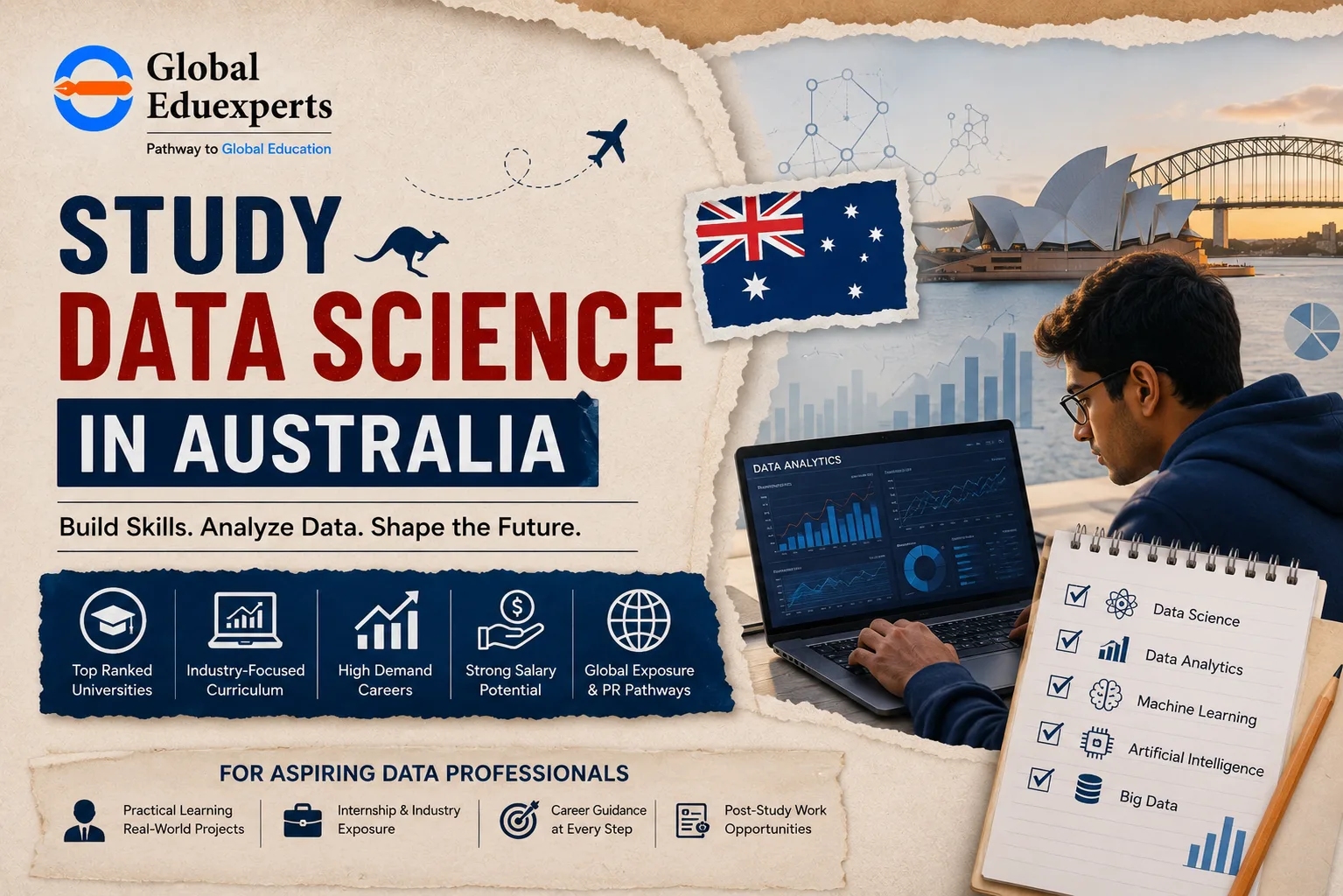
Studying Data Science in Australia gives students access to globally recognized universities, industry-focused learning, and career opportunities in fields such as artificial intelligence, machine learning, business analytics, and big data. It helps Indian students understand admission requirements, university selection, specialization options, tuition costs, scholarships, student visas, and post-study career pathways, enabling them to make informed decisions and build a strong foundation for a successful international career in the rapidly growing data and technology industry.
One of the biggest mistakes students make when they decide to Study Data Science in Australia is choosing a program based solely on university rankings or tuition fees. In reality, the specialization you select can influence the type of projects you work on, the industries you enter, and even your long-term career progression. Australia's universities offer a wide range of postgraduate programs, but each specialization is designed for different career objectives and skill sets.
Before applying for Masters in Data Science in Australia, take time to understand what kind of work you genuinely enjoy. Some students love building predictive models, while others prefer solving business problems through data visualization or developing AI-powered applications. Your interests, academic background, and future career plans should all play a role in selecting the right program.
The table below provides a practical comparison to help you make an informed decision.
| Specialization | Best For | Core Skills You'll Learn | Common Career Opportunities |
|---|---|---|---|
| Data Science | Students interested in end-to-end data solutions | Python, R, Statistics, Machine Learning, Data Engineering | Data Scientist, Senior Data Scientist, Research Scientist |
| Data Analytics | Students who enjoy interpreting business data | SQL, Power BI, Tableau, Excel, Data Visualization | Data Analyst, Business Analyst, Reporting Analyst |
| Artificial Intelligence | Students passionate about intelligent systems | Deep Learning, NLP, Computer Vision, AI Algorithms | AI Engineer, NLP Engineer, Computer Vision Specialist |
| Machine Learning | Students with strong programming and mathematics skills | Predictive Modeling, Neural Networks, ML Frameworks | Machine Learning Engineer, ML Researcher |
| Business Analytics | Students aiming for management and strategy roles | Business Intelligence, Forecasting, Decision Analytics | Business Intelligence Analyst, Strategy Consultant |
| Big Data Analytics | Students interested in handling massive datasets | Hadoop, Spark, Cloud Computing, Distributed Systems | Big Data Engineer, Cloud Data Engineer |
If you're looking for flexibility across multiple industries, a general Data Science Courses in Australia program is often the strongest option. These programs combine statistics, programming, machine learning, cloud technologies, and business problem-solving into one curriculum.
Graduates can work in sectors such as banking, healthcare, e-commerce, cybersecurity, consulting, government, logistics, mining, and technology. Because of this broad applicability, many international students choose Data Science in Australia for International Students as it provides access to a wide range of career paths instead of limiting them to one niche.
Choosing the right specialization becomes much easier when you also understand how Australia's education system is structured. Before finalizing a program, explore our guides on
Study in Australia,Australia Eligibility, andAustralia Scholarshipsto compare admission requirements, available financial support, and course pathways that align with your long-term career goals.
Students who enjoy finding patterns in business data rather than building advanced algorithms may find Data Analytics to be a better fit. Programs such as a master of data analytics in Australia focus on converting raw information into practical business insights.
Typical coursework includes:
Graduates frequently work with marketing teams, finance departments, retail organizations, consulting firms, and multinational companies where decision-making depends heavily on accurate reporting.
Artificial Intelligence has become one of Australia's fastest-growing technology sectors. Students choosing this pathway focus on developing systems capable of learning, reasoning, and automating complex tasks.
Subjects often include:
This specialization suits students with strong programming skills who want to work on advanced technology projects in research organizations, technology companies, healthcare innovation, autonomous systems, and AI product development.
Although closely related to data science, Machine Learning places greater emphasis on developing predictive models and intelligent algorithms.
Students pursuing MS in Data Science in Australia with a machine learning concentration typically study:
This specialization is particularly valuable for careers involving recommendation systems, fraud detection, financial forecasting, medical diagnostics, and autonomous technologies.
Business Analytics combines data skills with strategic decision-making. Rather than focusing purely on coding, students learn how organizations use data to improve operations, increase profitability, and reduce business risks.
This specialization is well suited for students who eventually want leadership positions or consulting careers.
Industries hiring Business Analytics graduates include:
Many professionals with previous business experience choose masters in data analytics australia because it complements their existing knowledge without requiring them to become full-time software developers.
As organizations generate enormous volumes of information every day, specialists capable of managing large datasets remain in high demand.
Big Data programs usually cover:
This specialization is particularly relevant for students interested in cloud computing, enterprise architecture, and infrastructure engineering.
Choosing between data science masters in australia, data analytics masters australia, or AI-focused programs becomes much easier when you start with your long-term career objective instead of the course title.
| Career Goal | Recommended Specialization |
|---|---|
| Become a Data Scientist | Data Science |
| Work as a Business Analyst | Business Analytics |
| Build AI Products | Artificial Intelligence |
| Develop Predictive Models | Machine Learning |
| Create Business Dashboards | Data Analytics |
| Manage Enterprise Data Systems | Big Data Analytics |
Rather than selecting a program because it is popular, evaluate the curriculum, industry projects, internship opportunities, software tools taught, and graduate employment outcomes. Even among the Top Universities for Data Science in Australia, the course structure can vary significantly. Reading subject lists, elective options, and capstone project details often provides a clearer picture than university rankings alone.
For Indian students planning to Study Data Science in Australia, this approach can lead to better academic satisfaction and stronger career outcomes. A specialization that aligns with your interests and professional goals not only makes learning more meaningful but also helps you build a profile that employers value after graduation. Whether you're considering MS in Data Science Australia, a master in data analytics australia, or another postgraduate pathway, choosing the right specialization is one of the most important decisions you'll make before submitting your application.
For many students, the decision to pursue a Masters in Data Science in Australia goes beyond choosing a university. It's a significant financial and career investment. Tuition fees, living expenses, time away from work, and relocation costs all add up, making it natural to ask whether the degree will deliver long-term value.
The answer depends on more than just the university's reputation. Your return on investment (ROI) is influenced by factors such as the skills you develop, internship experience, networking opportunities, the demand for data professionals, and how effectively you position yourself in the Australian job market after graduation. Students who approach their degree strategically often see stronger outcomes than those who rely solely on academic qualifications.
When evaluating whether to Study Data Science in Australia, it's important to look beyond tuition fees. A meaningful ROI considers both the financial investment and the long-term career opportunities the degree creates.
Your overall investment may include:
On the return side, graduates gain far more than a qualification. They benefit from internationally recognised education, practical industry exposure, stronger technical capabilities, professional networking opportunities, and access to one of the world's most advanced technology job markets.
Return on investment depends on much more than graduate salaries. It's equally important to understand tuition fees, living expenses, visa planning, and scholarship opportunities before making a decision. Our detailed resources on
Australia Cost,Australia Visa, andAustralia Scholarshipsprovide practical insights that help students create a realistic study budget and prepare for life in Australia.
For many students, the real value comes from the career growth they experience over the years rather than the first job they secure after graduation.
Australia continues to invest heavily in digital transformation across both public and private sectors. Organisations increasingly rely on data to improve customer experiences, automate processes, strengthen cybersecurity, optimise operations, and support business decisions. As a result, demand for professionals with expertise in analytics, artificial intelligence, cloud technologies, and machine learning has expanded across multiple industries.
Graduates from Data Science Courses in Australia can find opportunities in sectors such as:
Rather than hiring only "Data Scientists," employers now recruit professionals under a variety of job titles, creating broader opportunities for graduates with the right technical and analytical skills.
Completing an MS in Data Science in Australia can open the door to diverse career paths depending on your specialization, technical expertise, and industry experience.
Some of the most common roles include:
| Job Role | Typical Responsibilities |
|---|---|
| Data Scientist | Build predictive models, analyse large datasets, generate business insights |
| Data Analyst | Interpret business data, create dashboards, prepare reports |
| Machine Learning Engineer | Develop intelligent algorithms and AI solutions |
| Business Intelligence Analyst | Design reporting systems and support strategic decisions |
| AI Engineer | Build automation, NLP, and computer vision applications |
| Data Engineer | Design data pipelines and manage large-scale databases |
| Analytics Consultant | Help organisations solve business challenges using data |
Students interested in Data Science Jobs in Australia After Graduation should remember that employers often assess practical skills alongside academic performance. Experience with Python, SQL, Power BI, Tableau, cloud platforms, GitHub portfolios, internships, and real-world projects can significantly improve employability.
Salary is an important part of ROI, but it should be viewed in the context of experience, location, industry, and technical expertise. Entry-level graduates generally begin with competitive salaries, while professionals who continue building specialised skills often see substantial salary growth over time.
A general salary progression looks like this:
| Experience Level | Estimated Annual Salary (AUD) |
|---|---|
| Graduate / Entry Level | 70,000 – 95,000 |
| Mid-Level Professional | 95,000 – 130,000 |
| Senior Data Professional | 130,000 – 170,000+ |
| Lead Data Scientist / AI Specialist | 170,000+ (role and industry dependent) |
High-demand industries such as fintech, cloud computing, healthcare technology, cybersecurity, consulting, and enterprise software frequently offer stronger compensation packages for experienced professionals with specialised expertise.
This is one of the most common misconceptions among international students.
A data science masters in australia can strengthen your profile considerably, but it does not automatically guarantee employment. Recruiters increasingly look for candidates who can demonstrate practical problem-solving abilities rather than academic knowledge alone.
Students who tend to perform better in the job market often:
In many cases, these activities become the differentiating factors during the hiring process.
One of the advantages of studying in Australia is the opportunity to combine academic learning with practical industry exposure. Many universities incorporate internships, consulting projects, or industry collaborations into their programs.
An internship can help you:
For many graduates, internship experience becomes a key factor in securing their first professional role after completing their degree.
Australia offers eligible international graduates the opportunity to remain in the country after completing their studies through post-study work arrangements, subject to the latest government policies and visa eligibility requirements.
This additional time can be valuable for:
Since immigration policies may change over time, students should always verify the latest eligibility requirements before planning their long-term pathway.
Many Indian students also ask whether completing an Australia data science masters automatically leads to Permanent Residency (PR).
The reality is more nuanced.
A master's degree can strengthen your profile, but PR eligibility depends on multiple factors, including:
Rather than viewing a degree as a direct pathway to PR, it is more accurate to see it as one component of a broader migration profile. Students should treat education and immigration planning as related but separate decisions.
For Indian students considering Study Data Science in Australia, the degree can offer strong long-term value when approached with realistic expectations and a clear career plan.
It is likely to be a worthwhile investment if you:
On the other hand, students who expect the degree alone to secure a high-paying job may find the transition more challenging. The Australian technology sector values practical capability, adaptability, and continuous learning as much as formal education.
Ultimately, the ROI of MS in Data Science Australia is shaped not just by the qualification you earn, but by the skills you develop, the experience you gain, and the professional profile you build throughout your academic journey. Those who combine technical expertise with real-world application are often best positioned to benefit from Australia's growing demand for data professionals.
Meeting the minimum admission requirements is only the starting point when applying for a Masters in Data Science in Australia. Popular universities often receive applications from students with similar academic scores, English language test results, and educational backgrounds. What frequently sets successful applicants apart is the overall strength of their profile.
Admissions committees don't just evaluate whether you're eligible—they also look for evidence that you can succeed in a technically demanding program and contribute meaningfully to the university community. A well-rounded application demonstrates academic readiness, practical problem-solving ability, consistency, and a genuine interest in the field of data science.
Whether you're a recent graduate or a working professional planning to Study Data Science in Australia, investing time in building your profile before applying can improve both your admission prospects and your future employability.
A strong profile is only one part of a successful application. Understanding university admission expectations and preparing the required documents early can make the process much smoother. You can continue your planning with our comprehensive guides on
Australia Eligibility,Study in Australia, andAustralia Visato stay well prepared from application through visa approval.
Many students assume they will learn everything after enrolling, but having a solid technical foundation makes your application more competitive and helps you adapt more quickly to postgraduate coursework.
Before applying, try to develop practical knowledge in areas such as:
You don't need to be an expert in every area, but demonstrating familiarity with these skills shows that you're prepared for the academic rigor of Data Science Courses in Australia.
Universities appreciate applicants who can apply knowledge rather than simply list technical skills on a resume. One of the best ways to demonstrate this is by creating a portfolio of personal or academic projects.
Your portfolio could include:
Instead of focusing on the number of projects, aim to showcase quality, problem-solving ability, and clear documentation. Even two or three well-executed projects can leave a stronger impression than a long list of incomplete work.
For students applying for an MS in Data Science in Australia, a GitHub profile serves as a practical showcase of coding ability and project development.
A well-maintained GitHub profile may include:
Admissions teams may not always review every repository in detail, but a structured GitHub profile reflects initiative, consistency, and genuine interest in the field.
Certifications are not mandatory for admission, but they can strengthen your profile, particularly if you're transitioning from a different academic background or have limited professional experience.
Relevant certifications may cover topics such as:
The goal isn't to collect certificates but to develop practical skills that complement your undergraduate education and support your application for data science masters in australia.
Professional experience helps demonstrate how you've applied technical knowledge in real-world situations. Even a short internship can add significant value to your application.
Experience may include:
If you already have work experience in IT, engineering, finance, mathematics, business, or analytics, explain how your responsibilities connect to your future goals in data science.
A Statement of Purpose is more than a personal introduction. It helps universities understand your academic journey, career ambitions, motivation for choosing the program, and reasons for selecting Australia as your study destination.
An effective SOP typically explains:
Avoid writing a generic SOP that could apply to any university. Admissions teams value authenticity, clarity, and a logical connection between your past experiences and future aspirations.
Letters of Recommendation provide independent insight into your academic performance, technical capability, work ethic, and potential for postgraduate study.
Choose recommenders who know your work well, such as:
A detailed recommendation based on genuine interactions is generally more valuable than a generic letter from someone with a senior designation but limited knowledge of your abilities.
Many applicants worry that study gaps, career breaks, or changes in academic direction will negatively affect their chances. In reality, universities are often more interested in how you explain these periods than the gaps themselves.
If applicable, provide a clear and honest explanation covering:
A transparent explanation supported by evidence is generally more effective than leaving unexplained gaps in your application.
Technical expertise alone is rarely enough in today's data-driven workplaces. Data professionals are expected to communicate insights to stakeholders, collaborate with cross-functional teams, and present findings clearly.
You can strengthen these abilities by:
These experiences not only support your admission profile but also prepare you for future interviews and workplace responsibilities.
A strong application is often the result of careful planning rather than last-minute preparation. Organising your documents early reduces unnecessary stress and allows enough time to refine each component before submission.
Before applying for Eligibility for Masters in Data Science in Australia, make sure you have:
| Application Component | Why It Matters |
|---|---|
| Academic transcripts | Demonstrate academic performance and subject background |
| English language test scores | Meet university language requirements |
| Statement of Purpose | Explain your motivation and career goals |
| Letters of Recommendation | Validate your academic or professional capabilities |
| Updated resume | Highlight education, projects, internships, and technical skills |
| Project portfolio | Showcase practical problem-solving experience |
| GitHub profile | Demonstrate coding ability and technical engagement |
| Certifications | Strengthen technical knowledge and continuous learning |
Review every document carefully before submission to ensure consistency across your application.
Many students applying for Data Science in Australia for International Students concentrate solely on eligibility criteria, believing that meeting the minimum academic requirements is enough. In competitive admissions, however, universities often look beyond grades to identify applicants who show curiosity, initiative, and the ability to thrive in a challenging learning environment.
Building technical skills, completing meaningful projects, maintaining a professional portfolio, gaining practical experience, writing a thoughtful SOP, and presenting a well-organised application collectively create a stronger profile. Whether you're applying for an MS in Data Science Australia, a master of data analytics in australia, or a related postgraduate program, these efforts can significantly improve your chances of receiving an admission offer while also preparing you for the demands of the industry after graduation.
Yes, Australia is one of the preferred destinations for Indian students pursuing higher education in data science. Its universities offer industry-focused curricula, modern research facilities, internship opportunities, and strong links with technology companies. Combined with post-study work options and growing demand for skilled data professionals, Study Data Science in Australia can provide excellent academic and long-term career opportunities.
The Eligibility for Masters in Data Science in Australia generally includes a recognized bachelor's degree, academic transcripts, proof of English proficiency through IELTS, PTE, or TOEFL, and supporting documents such as a Statement of Purpose (SOP), Letters of Recommendation (LORs), and a resume. Some universities may also consider relevant work experience or require prerequisite subjects like mathematics, statistics, or programming.
The Cost of Studying Data Science in Australia depends on the university, city, and lifestyle. Students should budget for tuition fees, accommodation, food, transportation, Overseas Student Health Cover (OSHC), visa charges, and personal expenses. Planning your finances in advance and exploring scholarships or education loans can help manage the overall cost of studying in Australia.
Graduates can pursue a variety of Data Science Jobs in Australia After Graduation, including roles such as Data Scientist, Data Analyst, Machine Learning Engineer, AI Engineer, Business Intelligence Analyst, and Data Engineer. Employment opportunities are available across industries including finance, healthcare, retail, government, consulting, technology, telecommunications, and logistics, depending on your skills and practical experience.
To strengthen your application for Masters in Data Science in Australia, focus on building technical skills in Python, SQL, and statistics, complete practical projects, maintain a GitHub portfolio, earn relevant certifications, and write a personalized Statement of Purpose. Strong academic performance, meaningful internships, and well-written Letters of Recommendation can also make your application more competitive.


