
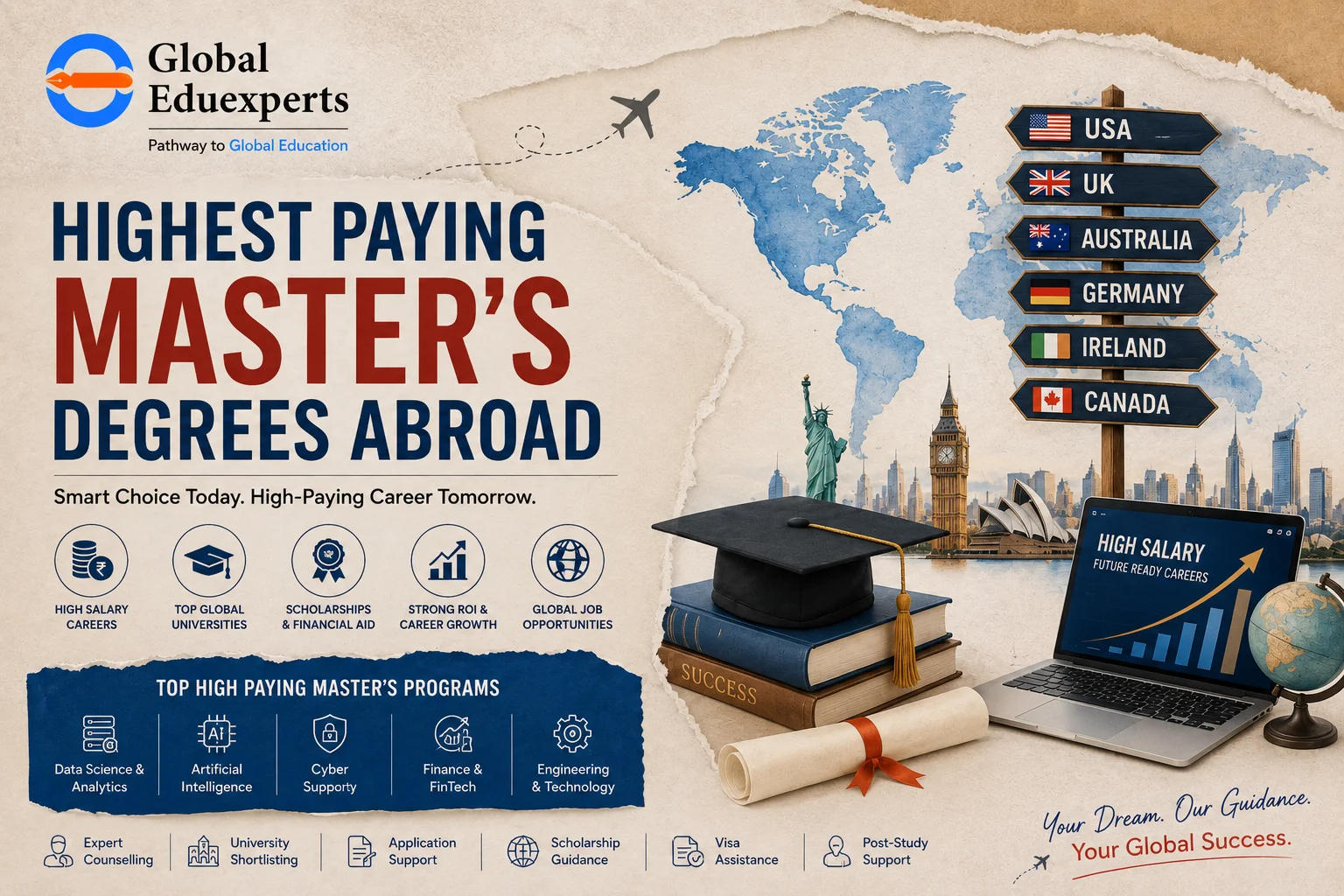
Pursuing one of the highest paying master's degrees abroad helps Indian students build specialized skills that are in demand across global industries such as technology, finance, engineering, healthcare, and business. By comparing countries, universities, career opportunities, tuition costs, scholarships, and post-study work options, students can choose a master's program that offers strong return on investment, higher earning potential, and long-term international career growth.
Choosing a master's degree abroad has become less about selecting the most popular course and more about identifying a program that delivers long-term career growth. While university rankings and destination countries remain important, employers today place greater value on specialized skills that solve real business and technology challenges. That shift has changed which degrees offer the strongest earning potential after graduation.
For Indian students, the highest paying master's degrees are typically found in industries facing global talent shortages. Fields such as Artificial Intelligence, Data Science, Cybersecurity, Finance, Healthcare, Engineering, and Business Analytics continue to attract employers willing to offer competitive salaries because these skills are difficult to replace and are needed across multiple sectors. Recent hiring projections also show Computer Science, Engineering, Finance, and MBA graduates among the most sought-after master's-level candidates across major employers.
Another important trend is that salary potential no longer depends solely on the degree title. The specialization you choose, the country where you study, internship opportunities, and your ability to gain practical experience often influence your career outcomes more than attending a globally famous university. A student completing a specialized master's in AI with strong industry exposure may receive better job offers than someone pursuing a broad degree without practical experience.
| Master's Degree | Major Industries | Career Outlook |
|---|---|---|
| Artificial Intelligence | AI, Automation, Robotics | Extremely High |
| Data Science & Analytics | Technology, Healthcare, Finance | Very High |
| Computer Science | Software, Cloud, Product Development | Very High |
| Cybersecurity | Government, Banking, IT | Very High |
| Business Analytics | Consulting, Retail, Technology | High |
| MBA (Top Universities) | Management, Strategy, Finance | High |
| Finance & FinTech | Banking, Investment, FinTech | High |
| Engineering (Robotics, Electrical, Mechanical) | Manufacturing, Automotive, Energy | High |
| Healthcare Management | Hospitals, Pharmaceuticals | Growing |
| Biotechnology & Biomedical Sciences | Research, Healthcare, Pharma | Growing |
One reason these highest salary master's courses continue to perform well is that they are supported by long-term industry demand rather than temporary hiring trends. Artificial Intelligence is transforming healthcare, finance, manufacturing, logistics, education, and retail. Cybersecurity has become a priority for organizations managing digital infrastructure, while Data Science is now essential for companies making decisions based on customer behavior and operational data. As businesses continue investing in technology, professionals with advanced technical expertise remain in short supply, creating strong salary opportunities. Recent studies also show AI, Data Science, and Cybersecurity among the fastest-growing postgraduate fields worldwide.
Business-focused master's programs have also evolved significantly. Traditional MBA programs remain valuable, particularly from well-recognized universities with strong employer networks. However, specialized programs such as Business Analytics, Financial Technology, Supply Chain Management, and Digital Transformation are increasingly becoming attractive alternatives because they combine management knowledge with technical and analytical skills that employers actively seek.
Healthcare is another sector offering excellent long-term prospects. Aging populations across Europe, Australia, and North America continue to increase demand for professionals in Healthcare Management, Public Health, Biomedical Engineering, and Biotechnology. These programs often provide stable employment opportunities while offering competitive salaries and international career mobility.
Engineering continues to deliver strong returns, particularly in emerging areas such as Renewable Energy, Robotics, Semiconductor Technology, Aerospace Engineering, and Advanced Manufacturing. Countries investing heavily in industrial innovation are actively recruiting graduates with these specialized skills, creating opportunities that extend well beyond traditional engineering roles.
For students exploring high paying courses after graduation, one common mistake is assuming that salary alone should determine their decision. The most successful graduates usually choose a master's program that matches both their existing strengths and future industry demand. A highly paid profession still requires genuine interest, continuous learning, and adaptability to remain competitive throughout a career.
Indian students should also evaluate where demand for their specialization is strongest. While the United States continues to offer excellent opportunities in technology and research, European countries are increasingly attracting Indian students through expanding employment opportunities, competitive education costs, and favorable post-study work pathways in several sectors.
Ultimately, the best master's degrees abroad are those that combine four essential factors: strong employer demand, practical industry exposure, globally transferable skills, and sustainable career growth. Students who assess these factors alongside salary expectations are far more likely to build successful international careers than those who focus only on short-term earning potential.
Choosing a high-paying specialization is only the first step. Before shortlisting universities, it's worth exploring country-specific admission requirements, popular programs, and career opportunities through guides like
Study in USA,Study in UK,Study in Australia,USA Courses, andUK Courses. These resources can help you identify where your preferred master's degree has the strongest job market.
Many students begin searching for high paying courses after graduation with one question in mind: Which master's degree will help me earn the highest salary? While income is an important consideration, experienced education consultants often encourage students to look one step further. The real measure of success is return on investment (ROI)—how quickly your education pays for itself through career opportunities, salary growth, and long-term employability.
A master's degree abroad represents a significant financial commitment. Tuition fees, accommodation, insurance, travel, and everyday living expenses can add up quickly. Choosing a program simply because it is popular or because someone else recommended it may not produce the outcome you expect. Instead, students should compare total education costs against expected salaries, job demand, and long-term career progression before making a decision.
Programs in Artificial Intelligence, Data Science, Computer Science, Cybersecurity, Finance, Business Analytics, and Engineering consistently rank among the best master's courses for high salary because they prepare graduates for industries experiencing global talent shortages. Employers are often willing to offer attractive compensation packages for professionals who possess advanced technical knowledge and practical problem-solving skills. Global hiring data continues to show strong employer demand for graduates in technology, engineering, business, and finance-related disciplines.
| Master's Program | Average Investment | Career Demand | ROI Potential |
|---|---|---|---|
| Artificial Intelligence | High | Excellent | Very High |
| Data Science & Analytics | High | Excellent | Very High |
| Computer Science | Medium to High | Excellent | Very High |
| Cybersecurity | Medium | Excellent | Very High |
| Business Analytics | Medium | High | High |
| Finance & FinTech | Medium | High | High |
| MBA (Leading Universities) | High | High | High |
| Engineering (Specialized Fields) | Medium | High | High |
| Healthcare Management | Medium | Growing | High |
| Biotechnology | Medium | Growing | Moderate to High |
One pattern becomes clear when comparing these programs: the courses with the strongest ROI are usually connected to industries that continue hiring regardless of short-term economic changes. Businesses still require cybersecurity professionals to protect digital infrastructure, hospitals continue expanding healthcare management teams, financial institutions invest in data-driven decision-making, and technology companies consistently recruit specialists in software development, cloud computing, and artificial intelligence.
However, tuition fees alone do not determine whether a program offers good value. Some countries charge relatively high tuition but also provide excellent graduate salaries and extensive post-study work opportunities. Others offer affordable education with lower living costs, allowing students to recover their investment even if starting salaries are slightly lower. Looking at both sides of the equation gives a much clearer picture than comparing fees alone.
For example, a master's degree costing more initially may still deliver stronger financial returns if graduates secure well-paid jobs soon after completing their studies. On the other hand, an inexpensive course may appear attractive at first but offer limited career prospects if employer demand is weak. Evaluating both education costs and employment outcomes helps students make more informed decisions rather than focusing on tuition alone.
Another factor that influences ROI is the availability of internships and industry placements during the program. Many employers prefer graduates with practical experience, and universities that integrate internships into their curriculum often improve graduate employability. Students who build professional networks while studying frequently enter the job market with stronger resumes and better salary negotiation opportunities.
Scholarships also play an important role in improving financial returns. Merit-based scholarships, government funding, research assistantships, and university grants can significantly reduce education costs. Even a partial scholarship lowers the overall investment, allowing graduates to achieve positive returns much sooner after entering the workforce.
Location should also be considered carefully. The best countries for master's abroad often combine high-quality education with strong employment markets, post-study work rights, and industries actively recruiting international graduates. Countries such as the United States, the United Kingdom, Australia, Germany, Ireland, and several European nations continue attracting Indian students because they provide access to globally recognized universities and expanding career opportunities across multiple sectors.
Students planning masters abroad for Indian students should avoid choosing a program based solely on salary rankings published online. A course offering excellent salaries will only produce strong outcomes if it matches your academic background, technical abilities, career interests, and willingness to continue learning after graduation. Employers increasingly value professionals who combine specialized knowledge with communication skills, adaptability, and practical experience.
Ultimately, the best postgraduate courses abroad are those that balance three important factors: reasonable education costs, strong employer demand, and sustainable long-term career growth. When these elements come together, a master's degree becomes more than an academic qualification—it becomes an investment that continues generating value throughout your professional career.
Return on investment depends on much more than salary alone. Comparing tuition fees, scholarships, and living expenses can give you a clearer financial picture before applying. You may find it helpful to review
USA Cost,UK Cost,Australia Cost,USA Scholarships, andUK Scholarshipsto understand how education costs differ across leading study destinations.
Choosing the right country is just as important as choosing the right master's degree. Two students may graduate with the same qualification, but their career outcomes can differ significantly depending on the country's job market, industry demand, post-study work opportunities, and immigration policies. That is why students planning study abroad master's programs should evaluate destinations based on long-term career prospects rather than university rankings alone.
The countries that consistently attract Indian students combine globally recognized education, strong employer demand, practical learning opportunities, and clear pathways to gain professional work experience after graduation. While salary expectations vary by industry and location, countries with mature economies and skill shortages generally offer better employment opportunities for qualified master's graduates.
| Country | Popular Fields | Graduate Salary Potential | Post-Study Work Opportunities |
|---|---|---|---|
| USA | AI, Computer Science, Finance, Engineering | Very High | Excellent |
| UK | Business, Data Science, Healthcare, Finance | High | Strong |
| Australia | Engineering, IT, Healthcare, Business | High | Strong |
| Germany | Engineering, Automotive, Manufacturing, AI | High | Good |
| Ireland | Technology, Pharmaceuticals, Finance | High | Growing |
| Canada | Data Science, Engineering, Healthcare, Business | High | Strong |
The United States continues to be one of the most attractive destinations for students pursuing highest paying master's degrees. Home to leading technology companies, financial institutions, research organizations, and multinational corporations, the country offers outstanding opportunities in Artificial Intelligence, Computer Science, Business Analytics, Engineering, and Finance. Graduates from accredited universities often benefit from strong industry partnerships, research exposure, and internship opportunities that can lead directly to full-time employment. Although tuition fees are generally higher than in many other countries, the earning potential in technology, healthcare, consulting, and financial services often provides a favorable long-term return on investment for skilled professionals.
The United Kingdom has strengthened its position among international students by combining world-class universities with a growing employment market. Programs in Business Management, Finance, Healthcare, Data Science, and Law remain particularly popular. The UK's Graduate Route visa allows eligible international students to remain in the country after completing their studies to gain valuable work experience, making it easier to transition from education into employment. This combination of academic quality and post-study work opportunities continues to attract students seeking international careers.
Australia remains one of the best countries for master's abroad because of its practical education system and strong demand across healthcare, engineering, information technology, construction, and business sectors. Universities work closely with industry partners, allowing students to gain practical experience during their studies. Australia's post-study work rights also provide graduates with additional time to build professional experience before deciding whether to continue their careers in the country or explore opportunities elsewhere.
Germany offers a different advantage. Instead of focusing primarily on high salaries, it provides excellent value through affordable education, particularly at many public universities, combined with a strong industrial economy. Students pursuing Engineering, Robotics, Automotive Technology, Artificial Intelligence, Renewable Energy, and Manufacturing often find excellent career prospects after graduation. Germany's globally respected engineering sector continues to recruit highly skilled graduates capable of supporting advanced manufacturing and industrial innovation.
Ireland has emerged as one of Europe's fastest-growing destinations for international students. Global technology companies, pharmaceutical organizations, financial institutions, and medical device manufacturers have established significant operations there, creating strong demand for graduates in Data Analytics, Software Engineering, Biotechnology, Cloud Computing, and Finance. Because of its relatively smaller population and expanding economy, Ireland continues to experience shortages in several high-skilled professions, improving employment prospects for qualified international graduates.
Canada has traditionally remained a preferred destination for masters abroad for Indian students because of its welcoming education system, multicultural environment, and strong employment opportunities across healthcare, engineering, information technology, business, and skilled trades. Canadian universities emphasize applied learning, research collaboration, and internship opportunities, helping graduates develop practical skills that employers value. While immigration policies continue to evolve, Canada remains an attractive option for students seeking both quality education and international work experience.
When comparing countries, students should avoid focusing only on headline salary figures. A graduate earning a higher salary in one country may also face significantly higher housing costs, taxation, transportation expenses, and overall living costs. In contrast, another destination may offer slightly lower salaries but allow graduates to save more because of lower day-to-day expenses. Looking at disposable income rather than salary alone provides a more realistic understanding of financial outcomes.
Employment opportunities also depend heavily on your chosen specialization. Artificial Intelligence graduates may find the strongest opportunities in the United States and Canada, while Mechanical Engineering students often benefit from Germany's industrial sector. Healthcare professionals may discover growing demand across Australia, the UK, and Canada, whereas Finance and Business graduates frequently explore opportunities in the United States, the United Kingdom, and Ireland. Matching your field of study with a country's strongest industries can significantly improve your employment prospects after graduation.
Another important consideration is post-study work policy. Many countries now recognize the economic contribution of international graduates and have introduced work pathways that allow students to gain professional experience after completing their degrees. These opportunities not only improve career prospects but also help graduates recover their education investment through full-time employment before deciding on their long-term career plans.
Ultimately, there is no single destination that is best for every student. The right choice depends on your career goals, academic background, preferred industry, financial planning, and willingness to adapt to a new professional environment. Students who evaluate university quality alongside industry demand, graduate employability, work rights, and long-term career opportunities are more likely to build successful international careers than those who base their decision on rankings or salary figures alone.
Once you've narrowed down your preferred destination, understanding the complete admission journey becomes much easier with dedicated country guides. Explore
Study in USA,Study in UK,Study in Ireland,Study in Europe, andStudy in Australiato compare universities, post-study work opportunities, and application requirements before making your final decision.
One of the biggest mistakes students make when planning a master's abroad is choosing a course because it is currently popular. Every year, thousands of students apply for programs that are trending on social media or recommended by friends without asking a more important question: Will this degree still be valuable five or ten years from now?
A master's degree is not just an academic qualification—it is an investment in your future career. The program you choose will influence the industries you can enter, the skills you develop, your earning potential, and even the countries where you'll find the best job opportunities. For Indian students, selecting the right specialization requires balancing personal interests with global employment trends rather than following temporary market hype.
Students planning masters abroad for Indian students should begin by understanding where they want their career to be after graduation. Someone who enjoys solving technical problems may thrive in Artificial Intelligence, Cybersecurity, or Data Science, while a student with strong leadership and communication skills may find greater success in Business Analytics, Finance, Marketing, or Management. Your long-term career goals should shape your academic decisions—not the other way around.
Before selecting a master's program, ask yourself a few practical questions:
Answering these questions early often prevents costly mistakes later.
| Decision Factor | Why It Matters |
|---|---|
| Career Goals | Aligns education with long-term ambitions |
| Industry Demand | Improves employment opportunities |
| Personal Interest | Supports long-term career satisfaction |
| Future Job Growth | Reduces career uncertainty |
| Salary Potential | Improves return on investment |
| Practical Learning | Builds employable skills |
| Internship Opportunities | Increases chances of full-time employment |
| Global Skill Demand | Creates international career flexibility |
The most successful graduates usually choose programs that sit at the intersection of three important factors: they enjoy the subject, employers need those skills, and the industry is expected to continue growing. When all three align, career progression becomes much more sustainable than chasing a profession based only on salary expectations.
Technology-related disciplines continue to demonstrate this balance. Artificial Intelligence, Cloud Computing, Cybersecurity, Data Science, Robotics, and Software Engineering remain among the fastest-growing fields because businesses across healthcare, finance, manufacturing, retail, and education are investing heavily in digital transformation. Professionals with these skills are likely to remain in demand for many years rather than only during short-term hiring cycles.
Healthcare is another example of a future-focused sector. Aging populations, expanding healthcare systems, biotechnology research, and digital health innovations continue creating demand for specialists in Healthcare Management, Public Health, Biomedical Engineering, and Pharmaceutical Sciences. These professions often provide stable employment while allowing graduates to build careers across multiple countries.
Business-related degrees also remain valuable, but specialization has become increasingly important. General management programs still offer strong opportunities, particularly from highly ranked universities, yet employers increasingly seek graduates with expertise in Business Analytics, Financial Technology, Supply Chain Management, Sustainability, and Digital Transformation. These programs combine business knowledge with technical capabilities that modern organizations require.
Students should also avoid assuming that every high-paying profession suits every individual. A degree in Artificial Intelligence may generate excellent salaries, but it also requires strong analytical thinking, programming skills, and continuous learning. Likewise, Finance demands comfort with numbers, risk analysis, and economic decision-making. Choosing a specialization that aligns with your strengths usually leads to better academic performance and stronger career outcomes.
Future demand should also be evaluated at the country level. Different countries specialize in different industries. Germany continues to excel in engineering and advanced manufacturing, Ireland has become a major technology and pharmaceutical hub, Australia experiences ongoing demand across healthcare and engineering, while the United States remains a leader in innovation, research, finance, and technology. Matching your specialization with the country's strongest industries often improves graduate employability.
Practical experience has become just as valuable as academic knowledge. Universities that offer internships, research projects, industry collaborations, cooperative education programs, or placement opportunities allow students to develop workplace skills before graduation. Employers increasingly prioritize graduates who can demonstrate real-world experience alongside academic achievement.
Students should also think beyond their first job after graduation. The most valuable master's degrees are those that continue opening doors throughout your career. Skills such as data analysis, problem-solving, digital technologies, leadership, communication, project management, and strategic decision-making remain transferable across industries, allowing professionals to adapt as the job market evolves.
Finally, resist the pressure to copy someone else's journey. A course that works exceptionally well for one student may not produce the same results for another because career success depends on individual interests, abilities, work ethic, and professional goals. The right master's degree is not necessarily the one with the highest salary—it is the one that allows you to build expertise in a field where you can continue learning, growing, and creating long-term value.
For Indian students planning a master's abroad, the smartest decision is one based on careful research rather than short-term trends. By choosing a specialization that aligns with future industry demand, personal strengths, and global career opportunities, students position themselves for sustained professional growth instead of simply pursuing the highest-paying job available today.
After selecting a specialization, the next step is ensuring you meet the admission requirements for your chosen destination. Reviewing
USA Eligibility,UK Eligibility,Australia Eligibility, andIreland Eligibilitycan help you understand academic qualifications, English language requirements, and other important criteria before starting your application.
For many students, the goal of pursuing a master's degree abroad is not simply to earn another qualification—it is to build a career that offers financial stability, professional growth, and opportunities to work on meaningful projects. While salary is an important factor, the highest paying careers after master's usually belong to industries where advanced knowledge, specialized skills, and continuous innovation create long-term demand for qualified professionals.
Today's global job market rewards expertise more than general knowledge. Employers are investing in professionals who can solve complex business challenges, develop new technologies, manage digital transformation, improve healthcare systems, and make data-driven decisions. As a result, graduates with specialized master's degrees often enter careers that offer both attractive starting salaries and strong long-term earning potential.
| Master's Degree | Common Career Roles | Long-Term Salary Potential |
|---|---|---|
| Artificial Intelligence | AI Engineer, Machine Learning Engineer, AI Researcher | Very High |
| Data Science | Data Scientist, Data Engineer, Analytics Consultant | Very High |
| Computer Science | Software Engineer, Cloud Architect, Solutions Engineer | Very High |
| Cybersecurity | Security Consultant, Cybersecurity Analyst, Security Architect | Very High |
| Finance & FinTech | Investment Analyst, Financial Consultant, Risk Manager | High |
| Business Analytics | Business Analyst, Product Analyst, Strategy Consultant | High |
| MBA | Management Consultant, Operations Manager, Business Leader | High |
| Engineering | Robotics Engineer, Systems Engineer, Design Engineer | High |
| Healthcare Management | Hospital Administrator, Healthcare Consultant | High |
| Biotechnology | Clinical Research Manager, Biomedical Scientist | Growing |
Artificial Intelligence continues to lead many global salary rankings because organizations across nearly every industry are integrating AI into their operations. Companies require professionals who can build intelligent systems, automate business processes, develop predictive models, and improve customer experiences. Graduates specializing in Machine Learning, Natural Language Processing, and Computer Vision are particularly sought after as AI adoption expands worldwide.
Data Science follows a similar pattern. Businesses generate enormous amounts of information every day, but converting that data into business decisions requires skilled professionals. Data Scientists, Analytics Consultants, and Data Engineers help organizations identify trends, improve operational efficiency, and guide strategic planning. Since data-driven decision-making has become central to modern business, demand for these professionals continues to grow across finance, healthcare, retail, manufacturing, sports, and government.
Computer Science remains one of the most reliable pathways to a master's degree with highest salary. Beyond traditional software development, graduates now work in cloud computing, distributed systems, artificial intelligence, blockchain, mobile applications, enterprise software, and digital infrastructure. As organizations continue modernizing their technology platforms, experienced software professionals often enjoy significant career progression and strong salary growth throughout their careers.
Cybersecurity has transformed from a specialized IT function into a strategic business priority. Every organization handling customer information, financial transactions, or digital infrastructure faces growing cybersecurity risks. Consequently, Security Analysts, Ethical Hackers, Cloud Security Specialists, and Security Architects remain among the most in-demand professionals globally. As cyber threats continue evolving, experienced cybersecurity professionals are expected to remain valuable for many years.
Finance has also evolved considerably over the last decade. Traditional banking careers remain attractive, but emerging areas such as Financial Technology (FinTech), Investment Analytics, Risk Management, Financial Modeling, and Digital Payments have created entirely new career paths. Graduates with quantitative skills, financial expertise, and knowledge of emerging technologies often secure excellent opportunities across investment firms, multinational corporations, fintech startups, and consulting organizations.
Business Analytics has become increasingly important because companies now rely heavily on data to improve business performance. Professionals who understand both business strategy and analytics frequently bridge the gap between technical teams and executive decision-makers. This combination of technical understanding and business knowledge makes Business Analytics graduates valuable across consulting, retail, healthcare, finance, and technology sectors.
Engineering continues to provide rewarding careers, especially in specialized disciplines rather than general engineering roles. Robotics, Renewable Energy, Semiconductor Technology, Aerospace Engineering, Industrial Automation, and Smart Manufacturing are expanding rapidly as governments and private companies invest in infrastructure, sustainability, and advanced production technologies. Graduates in these fields often benefit from stable employment and strong international demand.
Healthcare-related master's degrees also deserve attention. Population growth, aging societies, medical innovation, and expanding healthcare systems continue creating opportunities for Healthcare Managers, Public Health Specialists, Biomedical Engineers, Clinical Researchers, and Pharmaceutical Professionals. Unlike industries that experience rapid fluctuations, healthcare often maintains consistent demand regardless of broader economic conditions.
While salary expectations naturally vary between countries and employers, career progression usually follows a predictable pattern. Many graduates begin in technical or specialist roles, gain practical experience during their first few years, and gradually move into senior positions involving leadership, project management, consulting, or strategic decision-making. As expertise grows, compensation often increases significantly beyond entry-level salaries.
Students should also understand that earning potential depends on much more than their degree. Employers evaluate practical experience, internships, communication skills, certifications, problem-solving ability, and adaptability alongside academic qualifications. Two graduates with the same master's degree may experience very different career outcomes depending on how effectively they apply their knowledge in professional environments.
Another important consideration is career longevity. Some professions experience temporary hiring booms before demand declines, while others continue expanding over decades because they address long-term economic and technological needs. Fields such as Artificial Intelligence, Cybersecurity, Healthcare, Renewable Energy, Advanced Engineering, and Data Science are widely expected to remain among the fastest-growing industries globally, making them attractive choices for students seeking sustainable career growth.
Ultimately, the highest paying careers after master's are rarely created by choosing the most expensive university or the highest-ranked course alone. They result from selecting a specialization that aligns with future industry demand, developing practical skills throughout the program, gaining relevant work experience, and remaining committed to continuous learning after graduation. Students who focus on building expertise rather than simply chasing salary are often the ones who achieve the strongest long-term professional and financial success.
Strong career outcomes begin with choosing the right country and completing a smooth admission process. If you're planning to pursue one of these in-demand master's programs, guides on
USA Visa,UK Visa,Australia Visa, andIreland Visaexplain the documentation and visa process that international students should prepare for well before departure.
Choosing a master's degree abroad involves much more than selecting a university with a well-known name. The decisions you make before submitting your application can influence your career opportunities for years after graduation. Many students compare tuition fees or university rankings but overlook factors that have an even greater impact on employability, salary growth, and long-term professional success.
A university can provide an excellent education, but if it lacks strong industry connections, internship opportunities, or graduate employability support, students may find it more difficult to transition into the job market. On the other hand, a university with strong employer partnerships, practical learning, and career services can significantly improve your chances of securing a high-paying job after graduation.
For students planning a masters program abroad, comparing universities from a career perspective rather than only an academic perspective often leads to better long-term outcomes.
| Factor | Why It Matters |
|---|---|
| University Reputation | Influences employer recognition and networking opportunities |
| Accreditation | Ensures global acceptance of the qualification |
| Internship Opportunities | Provides practical industry experience before graduation |
| Graduate Employability | Indicates how successfully students secure jobs after completing the course |
| Industry Partnerships | Improves access to placements and recruitment opportunities |
| Tuition Fees | Affects the overall return on investment |
| Cost of Living | Impacts your total education expenses and financial planning |
| Scholarships | Reduces education costs and improves ROI |
| Post-Study Work Rights | Allows graduates to gain professional experience after completing the degree |
| Alumni Network | Helps with mentorship, referrals, and career development |
One of the first aspects students should evaluate is the university's reputation within their chosen industry rather than relying solely on global rankings. A university may rank highly overall but have limited recognition in a particular field. Conversely, some institutions have excellent reputations among employers in Engineering, Computer Science, Healthcare, or Business because of their strong academic departments and industry collaborations. Researching employer partnerships often provides more practical insights than rankings alone.
Accreditation is equally important. A recognized and accredited university ensures that your degree is accepted by employers, professional organizations, and higher education institutions around the world. This becomes particularly valuable if you plan to work internationally or pursue further education after completing your master's degree.
Internships and practical learning opportunities have become major differentiators in today's job market. Employers increasingly prefer graduates who already understand workplace expectations and have experience applying theoretical knowledge to real business problems. Universities that integrate internships, industry projects, research collaborations, cooperative education programs, or live consulting assignments often help students build stronger professional profiles before graduation.
Graduate employability deserves careful attention as well. Instead of only asking where students study, ask where graduates work after completing the program. Universities that consistently place graduates in multinational companies, research organizations, technology firms, financial institutions, or healthcare providers demonstrate stronger connections with employers and better career support services.
Industry partnerships often create opportunities that are not immediately visible on university websites. Collaboration with technology companies, engineering firms, consulting organizations, pharmaceutical companies, hospitals, or financial institutions can lead to guest lectures, research projects, internships, networking events, and campus recruitment activities. These experiences frequently help students transition more smoothly into full-time employment.
Financial planning should extend beyond tuition fees. While tuition is a major expense, it represents only one part of the total investment. Accommodation, food, transportation, health insurance, study materials, visa fees, and personal expenses vary significantly between countries and cities. A university with lower tuition may not necessarily be more affordable if living costs are substantially higher.
Scholarships can make a considerable difference to your overall return on investment. Many universities, governments, and private organizations offer merit-based, need-based, research, and diversity scholarships for international students. Applying for scholarships early not only reduces financial pressure but also allows graduates to recover their education investment more quickly after entering the workforce.
Another important consideration is post-study work opportunities. Many students choose study abroad master's programs because they want to gain international work experience after graduation. Countries that provide clear post-study work pathways allow graduates to develop professional experience, strengthen their resumes, and often improve their earning potential before deciding on their long-term career plans.
Career support services are often underestimated during the university selection process. Dedicated career centers, resume workshops, interview preparation, networking events, employer fairs, and alumni mentoring programs can significantly improve a student's confidence and job search strategy. Universities that actively support graduate employment often produce stronger career outcomes than institutions that focus primarily on academic instruction.
The strength of a university's alumni network can also influence long-term career growth. Graduates working across different industries and countries often become valuable sources of mentorship, professional advice, referrals, and networking opportunities. A well-connected alumni community can open doors that are difficult to access through traditional job applications alone.
Students should also consider how frequently the curriculum is updated. Industries such as Artificial Intelligence, Cybersecurity, Data Science, Renewable Energy, and Digital Marketing evolve rapidly. Universities that regularly revise course content, incorporate emerging technologies, and involve industry professionals in curriculum development often prepare graduates more effectively for changing workplace requirements.
Finally, avoid making decisions based solely on social media trends, promotional advertisements, or recommendations from friends. Every student's academic background, financial situation, career aspirations, and learning preferences are different. A university that is the perfect fit for one student may not necessarily be the best choice for another.
The most successful students compare multiple factors before making their final decision. They look beyond rankings and evaluate employability, practical learning, financial planning, employer connections, industry demand, and long-term career opportunities together. Taking this broader approach helps maximize both salary potential and professional growth, ensuring that a master's degree abroad becomes a valuable investment rather than simply an academic achievement.
The highest paying master's degrees typically include Artificial Intelligence, Data Science, Computer Science, Cybersecurity, Business Analytics, Finance, and specialized Engineering programs. However, earning potential depends on several factors, including your skills, work experience, country of study, university reputation, and the industry's demand rather than the degree title alone.
There is no single best destination for every student. The USA, UK, Australia, Germany, Ireland, and Canada all offer excellent study abroad master's programs with strong employment prospects. The ideal country depends on your chosen specialization, career goals, tuition budget, post-study work opportunities, and the industries where your skills are most in demand.
Some of the most rewarding high paying courses after graduation include Artificial Intelligence, Data Science, Cybersecurity, Computer Science, Finance, Business Analytics, Healthcare Management, and Engineering. These fields continue to experience global demand, offer competitive salaries, and provide strong long-term career growth across multiple industries.
Indian students should select a master's program by evaluating future industry demand, career goals, personal interests, university reputation, internship opportunities, graduate employability, and expected return on investment. Avoid choosing a course simply because it is trending, and instead focus on programs that align with your long-term professional aspirations.
A master's abroad can provide excellent value when chosen carefully. Students who select universities with strong employer connections, practical learning opportunities, internships, and high graduate employability often recover their education investment through better career opportunities and higher salaries. Careful financial planning and choosing the right specialization are essential for maximizing long-term return on investment.


