
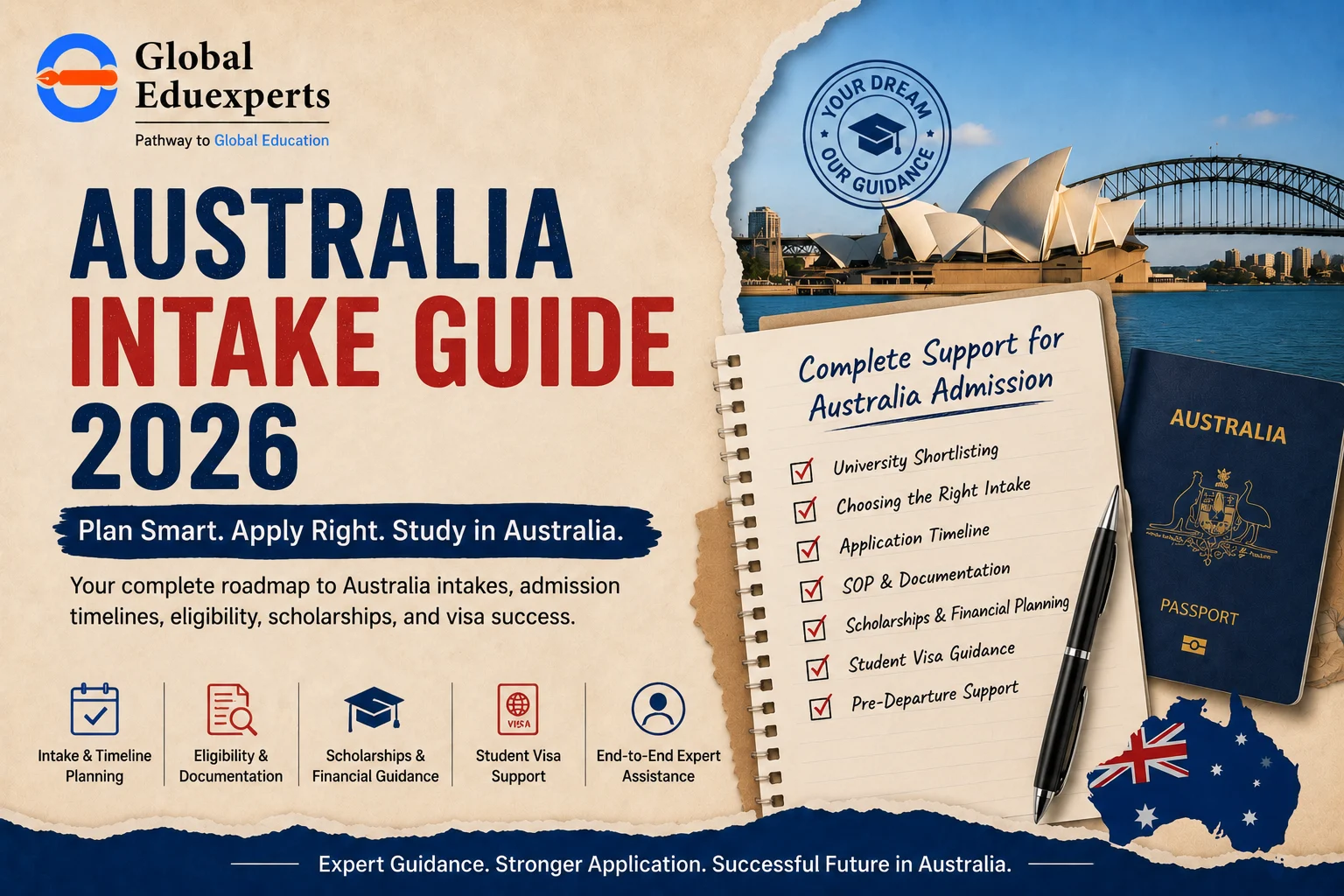
An Australia Intake Guide helps students understand the complete university admission process, including the February, July, and November intakes, application timelines, eligibility requirements, required documents, scholarships, and student visa preparation. It supports Indian students in choosing the most suitable intake, planning each stage of their application effectively, and creating a structured roadmap for a smooth transition to studying and living in Australia.
Choosing the right Australia intake 2026 is one of the earliest and most important decisions you'll make while planning to study abroad. Many students begin by selecting a university or course, only to realize later that the intake they wanted has already closed or doesn't offer their preferred program. Good planning starts with understanding how Australian university intakes work and how they influence your admission timeline, course availability, scholarship opportunities, and even your visa preparation.
Unlike some countries that admit students only once a year, Australian universities generally offer multiple entry points. This flexibility allows international students to start their education at different times depending on their academic readiness, financial planning, and application progress. However, not every university follows the same schedule, and not every course is available in every intake.
Understanding these differences early can help you avoid unnecessary delays and choose an admission cycle that fits both your academic background and long-term career goals.
An intake refers to the period during which universities accept new students into academic programs. Each intake has its own application deadlines, admission schedules, orientation dates, and semester commencement.
For Australia university intakes 2026, most institutions accept international students through three primary admission cycles:
| Intake | Typical Start Period | Availability |
|---|---|---|
| February Intake | February | Major intake with the widest course selection |
| July Intake | July | Second major intake with strong program availability |
| November Intake | November | Limited intake offered by selected universities and courses |
Although these months are commonly referred to as February, July, and November intakes, actual commencement dates may vary slightly between universities.
Before applying, always verify the exact academic calendar of your chosen institution.
The February intake Australia 2026 is the largest and most popular admission cycle for both domestic and international students.
Most universities launch the majority of their undergraduate and postgraduate programs during this intake, making it the preferred option for students who want maximum flexibility.
Students choosing the February intake usually benefit from:
Because this is the busiest admission period, application competition is generally higher.
Students planning for the February intake often begin preparing their applications several months in advance, including English language tests, document collection, university shortlisting, and visa preparation.
If you have recently completed your Class 12 education or undergraduate degree, this intake usually aligns well with your academic timeline.
The July intake Australia 2026 serves as the second major admission cycle and offers an excellent alternative for students who are unable to apply in February.
Many leading Australian universities continue to offer a substantial number of undergraduate and postgraduate programs during this intake.
Students often choose July because they need additional time to:
Contrary to a common misconception, the July intake is not considered less valuable than February.
Graduates receive the same qualification regardless of the intake through which they begin their studies.
For students interested in healthcare, searches such as july intake for nursing in Australia and bachelor of nursing July intake in Australia have become increasingly common because many universities continue to admit nursing students during this period. However, course availability varies by institution, so applicants should review university-specific admission schedules before planning.
The November intake Australia 2026 is considerably smaller than the February and July admission cycles.
Only selected universities and specific programs participate in this intake.
It can be a suitable option for students who:
However, students should understand that:
Rather than assuming every university offers a November intake, applicants should confirm availability directly with their preferred institution.
Understanding the difference between major and minor intakes helps students make more informed decisions.
Major admission cycles generally include:
In Australia, February and July are generally considered major intakes.
Minor admission cycles usually include:
November is commonly regarded as a minor intake for most universities.
This does not reduce the quality of education—it simply means fewer academic programs begin during this period.
One of the biggest misconceptions among applicants is that every Australian university offers identical admission schedules.
In reality, universities decide:
For example, a university may offer:
Because of these differences, university selection should always happen alongside intake planning rather than afterward.
Course availability is one of the most practical reasons for understanding Australia intake 2026 before submitting applications.
Popular disciplines such as:
are generally available across major intakes.
However, specialized programs—including certain healthcare, education, architecture, research, and clinical disciplines—may only admit students once or twice each year.
Applicants searching for bachelor of nursing intake in Australian university should pay particular attention to individual university schedules, as nursing admissions often depend on clinical placement capacity, accreditation requirements, and institutional planning.
Checking intake availability before preparing your application can prevent unnecessary delays.
Another factor worth considering is application competition.
February usually receives the largest number of international applications because it aligns with academic calendars in many countries, including India.
July also attracts significant interest but may experience slightly lower competition depending on the course and institution.
November typically sees fewer applications because of its limited course offerings.
However, lower competition should never be the primary reason for selecting an intake.
Choosing an intake that supports your academic readiness and career planning is generally a more effective strategy than simply trying to avoid competition.
There is no universal "best" intake.
The right choice depends on your individual circumstances.
Consider the following factors before deciding:
Have you already completed your previous qualification, or are your final results still pending?
Students waiting for examination results often benefit from selecting the next available intake rather than rushing an incomplete application.
Confirm that your preferred course actually starts during your chosen intake.
Do not assume every program runs throughout the year.
If you still need to take IELTS, PTE, or another accepted English proficiency examination, choose an intake that gives you enough preparation time.
Submitting rushed test scores may reduce your admission options.
International education involves tuition fees, accommodation, travel, insurance, and living expenses.
Selecting an intake that allows sufficient time for financial planning can reduce unnecessary pressure later in the admission process.
Students planning internships, research opportunities, or professional placements should consider how different academic calendars align with recruitment cycles within their chosen industry.
Long-term planning often produces better outcomes than selecting the earliest available intake.
One of the biggest advantages of understanding the Australia intake guide early is flexibility. Students who begin planning several months before their preferred intake usually have more time to compare universities, strengthen applications, prepare financial documents, apply for scholarships, and complete visa formalities without unnecessary stress.
Waiting until application deadlines are close often limits course options and reduces the time available for careful decision-making.
Understanding Australia intake 2026 is about more than knowing academic start dates. Each intake offers different opportunities in terms of course availability, university participation, scholarships, and application timelines. February and July remain the two major admission cycles with the widest program selection, while November provides an additional opportunity for students applying to eligible universities and courses.
Rather than choosing an intake based solely on popularity, evaluate your academic background, preferred program, financial preparedness, and career goals together. A well-timed application allows you to prepare every stage of your study abroad journey more confidently and increases the likelihood of securing admission into a course that genuinely supports your future aspirations.
Once you've identified the intake that matches your academic plans, it's helpful to understand how the complete admission journey works. Exploring
STUDY IN AUSTRALIAgives a broader view of universities, popular programs, and student life, whileAustralia Eligibilityexplains admission requirements that can influence which intake is the most suitable for your qualifications.
One of the biggest reasons students miss their preferred Australia intake 2026 is not academic performance—it is late planning. Many applicants spend months deciding where to study, only to realize they have very little time left for English language tests, document collection, scholarships, or visa processing. By then, application deadlines may have passed, or the best course options may already be full.
Studying in Australia involves several stages that must happen in the right order. Universities need time to assess applications, scholarship committees have separate deadlines, and student visa processing can vary depending on the season and the completeness of your documents.
A structured Australia admission timeline 2026 helps students stay ahead instead of rushing through important decisions. Whether you are targeting the February, July, or November intake, beginning preparations early gives you more university choices, greater scholarship opportunities, and enough time to submit a strong application.
Applying to an Australian university is not a one-day process. It includes researching universities, comparing courses, preparing financial documents, appearing for English language tests, writing application essays, obtaining offer letters, accepting admissions, arranging accommodation, and completing visa formalities.
When each stage is planned properly, students can:
Students who begin early generally have more flexibility than those trying to complete everything within a few weeks.
The February intake Australia 2026 is the largest admission cycle, making early preparation particularly important.
This is the ideal time to begin your study abroad planning.
Focus on:
Students often underestimate how much time university research requires. Comparing institutions carefully now helps avoid rushed decisions later.
Most Australian universities require proof of English language proficiency.
Depending on university requirements, students may prepare for:
Taking the examination early allows enough time to improve scores if a second attempt becomes necessary.
Once your university shortlist is ready, begin collecting important documents.
Common requirements include:
Many universities process applications faster when complete documentation is submitted from the beginning.
This is generally the best period to submit applications for the February intake.
Applying early offers several advantages:
Popular programs may close admissions well before official deadlines once available seats are filled.
Universities begin reviewing applications and issuing:
Students should carefully review:
This is also the stage where students finalize their preferred university.
After accepting the university offer, students receive their Confirmation of Enrolment (CoE), which is required for the Australian student visa application.
During this period students should:
Applying early helps reduce unnecessary pressure before departure.
Once the visa is approved, attention shifts toward relocation.
Students should complete:
Arriving before orientation allows students to settle comfortably before classes begin.
Students planning for the July intake Australia 2026 follow a similar process but on a different calendar.
Since the November intake Australia 2026 is available only for selected universities and programs, early confirmation of course availability is especially important.
Students generally begin planning approximately eight to ten months before the intended intake.
A typical schedule includes:
| Timeline | Activity |
|---|---|
| January–March 2026 | University research and course selection |
| March–May 2026 | English language tests and document preparation |
| May–July 2026 | Submit university applications |
| July–September 2026 | Receive offers and complete admission formalities |
| September–October 2026 | Student visa application and travel planning |
| November 2026 | Arrival and commencement of studies |
Always verify university-specific deadlines, as November admissions differ significantly between institutions.
Many students focus entirely on admission deadlines and overlook scholarship applications.
In reality, several university scholarships close weeks or even months before standard admission deadlines.
Students interested in financial assistance should begin researching scholarships during the university shortlisting stage rather than after receiving admission offers.
Early applicants generally have access to:
Missing scholarship deadlines may increase the overall cost of studying abroad.
Many applicants assume collecting documents takes only a few days.
In practice, obtaining official transcripts, recommendation letters, financial certificates, passport renewals, employment records, or notarized documents may require several weeks.
Preparing these documents early helps prevent delays later in the admission process.
A complete application generally creates a stronger first impression than submitting incomplete paperwork followed by multiple updates.
Student visa processing timelines vary throughout the year depending on application volume and document verification.
Delaying visa submission can affect:
Students who receive university offers early are usually in a better position to complete visa formalities comfortably without unnecessary pressure.
Finding suitable accommodation becomes more competitive as each intake approaches.
After receiving your visa, begin exploring options such as:
Early booking generally provides more choices and helps students secure housing closer to campus.
Many admission delays happen because students underestimate how long each stage actually takes.
Some of the most common mistakes include:
Avoiding these mistakes allows the entire admission journey to move more smoothly.
A practical rule followed by many successful applicants is to start planning at least 8 to 12 months before their intended intake. Early preparation provides enough time to compare universities carefully, improve English test scores if necessary, strengthen application documents, and complete financial and visa requirements without rushing.
Students who plan ahead also have greater flexibility if unexpected delays arise during admissions, documentation, or visa processing.
Following a structured Australia admission timeline 2026 is one of the most effective ways to reduce stress and improve your chances of securing admission into your preferred university. From researching courses and preparing English language test scores to meeting application deadlines, applying for scholarships, arranging visas, and booking accommodation, every stage depends on timely preparation.
Rather than treating university admission as a series of last-minute tasks, approach it as a planned journey. Beginning early gives you more opportunities, stronger applications, better financial planning, and enough time to prepare confidently for life as an international student in Australia.
A well-planned timeline works best when every milestone is backed by accurate information. Before submitting applications, reviewing
Australia Visahelps you understand visa preparation alongside university deadlines, whileAustralia Scholarshipscan help you identify funding opportunities that often have earlier closing dates than course applications.
Choosing between the February, July, and November intakes is one of the earliest decisions students make while planning to study in Australia. Many applicants assume all intakes offer the same courses, scholarship opportunities, and admission flexibility. In reality, each intake has its own advantages, limitations, and level of competition.
The right choice depends on much more than the month you begin your studies. Course availability, university participation, application deadlines, internship opportunities, graduation timelines, and even your personal academic situation should all influence the decision.
Rather than asking, "Which intake is the best?" a more useful question is, "Which intake fits my academic profile and career plans?" Understanding these differences helps students make informed decisions instead of simply following the most popular admission cycle.
Australian universities generally admit international students through three main intakes.
Although all three lead to the same qualification, the student experience can differ depending on when you begin your studies.
| Feature | February Intake | July Intake | November Intake |
|---|---|---|---|
| Popularity | Highest | High | Limited |
| University Participation | Almost all universities | Most universities | Selected universities |
| Course Availability | Maximum | Very Good | Limited |
| Scholarship Availability | Highest | Good | Limited |
| Student Competition | High | Moderate to High | Lower |
| Class Size | Larger | Moderate | Smaller |
| Program Choices | Extensive | Wide | Course-specific |
| Internship Timing | Excellent | Good | Depends on program |
| Ideal For | Most students | Students who missed February | Students with specific course availability |
Each intake serves a different group of students, making careful planning more valuable than simply choosing the earliest available session.
The February intake Australia 2026 is often considered the main academic session across Australian universities.
Most institutions launch their largest selection of undergraduate and postgraduate programs during this intake.
Students usually find:
Because of these advantages, competition is naturally higher.
Students planning for highly competitive courses such as:
often prioritize the February intake because universities typically offer the greatest number of seats.
Beginning your studies in February offers several practical benefits beyond admission itself.
These include:
For first-time international students, this intake usually provides the smoothest transition into university life.
Many students mistakenly view the July intake Australia 2026 as a backup option.
In reality, it is a major admission cycle supported by a large number of Australian universities.
Many popular courses remain available during July, including programs in:
Students who complete their previous studies later in the year often find July to be a more convenient starting point.
The July intake offers flexibility for students who:
Instead of rushing an application, many students use the additional months to strengthen their admission profile.
A stronger application submitted in July often performs better than a rushed February submission.
The November intake Australia 2026 is much smaller than the other two.
Only selected universities participate, and course availability is more limited.
However, that does not make it a poor option.
Students interested in specific diplomas, vocational programs, pathway courses, or selected postgraduate degrees may find suitable opportunities during this intake.
Before planning for November, always verify that:
Since availability varies significantly, careful research becomes even more important.
One of the biggest differences between Australian intakes is the number of available programs.
Typically offers:
Generally includes:
Usually limited to:
Students applying for highly specialized degrees should always confirm intake availability directly with their chosen university.
Scholarships are another factor many students overlook.
Although scholarship availability depends on the university, the general trend is:
Offers the largest number of:
Provides a good number of scholarship opportunities, although some high-value awards may already be allocated during the main admission cycle.
Scholarship options are usually fewer because fewer programs participate.
Students who require significant financial assistance often benefit from applying during February or July.
Deadlines vary between universities, but planning early remains important regardless of intake.
A general planning schedule looks like this:
| Intake | Recommended Preparation Start |
|---|---|
| February | 8–12 months before classes |
| July | 8–10 months before classes |
| November | 8–10 months before classes |
Beginning early allows enough time for:
Waiting until official deadlines approach often reduces available choices.
Students frequently ask whether the intake affects internship opportunities.
The answer depends more on the university calendar and employer recruitment cycles than the intake itself.
However:
February students often experience:
July students still receive excellent internship opportunities but may encounter slightly different recruitment schedules depending on their university.
November students should carefully review internship structures, particularly if their course includes mandatory industry placements.
The intake itself rarely limits employability, but planning internship timing remains important.
Many applicants assume smaller intakes automatically mean higher admission chances.
In practice, university admission decisions depend primarily on:
A smaller intake may receive fewer applications, but it also usually offers fewer seats.
Rather than focusing on acceptance rates alone, students should prioritize submitting a complete, well-prepared application.
The learning environment may differ slightly between intakes.
Students often experience:
Usually offers:
Where available, students may benefit from:
All three intakes lead to the same degree, with similar academic standards.
A common misconception is that graduating from one intake provides better career prospects than another.
Australian employers generally evaluate:
rather than the month a student started university.
Graduates from February, July, and November intakes receive the same qualification from the same institution.
The intake itself does not determine future employability.
The answer depends entirely on your personal situation.
The February intake is usually ideal if you:
The July intake works well if you:
The November intake may suit you if:
There is no universally "best" intake. The right choice is the one that matches your academic readiness, career plans, financial preparation, and preferred course availability.
While the February intake Australia 2026 remains the most comprehensive option, the July and November intakes continue to provide excellent opportunities for many international students. Instead of choosing an intake simply because it is the most popular, evaluate your academic timeline, course availability, scholarship goals, visa preparation, and long-term career plans.
Students who align their intake with their individual circumstances often enjoy a smoother admission journey, stronger applications, and a more confident start to their studies in Australia. Early planning and informed decision-making will always have a greater impact on success than the intake month itself.
Choosing an intake often comes down to balancing academic goals with affordability and long-term opportunities. Students comparing different admission cycles usually benefit from reviewing
Australia CostalongsideSTUDY IN AUSTRALIA, making it easier to understand how tuition fees, living expenses, and university choices vary across programs and locations.
Applying for an Australian university is more than meeting an application deadline. Every stage—from checking academic eligibility to receiving your student visa—depends on accurate documentation and careful planning. Many students who miss their preferred intake are academically qualified but lose valuable time because of incomplete paperwork, delayed English test results, financial documentation issues, or late visa applications.
For students planning the Australia intake 2026, understanding the complete admission and visa process early can make the journey much smoother. Universities and the Australian Government evaluate different aspects of your application, and every document should support your intention to study, your academic preparedness, and your ability to live in Australia during your course.
Instead of collecting documents after receiving an offer letter, successful applicants usually prepare most of their paperwork several months in advance.
Academic eligibility varies depending on the university, course level, and field of study.
Generally, Australian institutions evaluate:
For undergraduate programs, students usually need to complete higher secondary education or an equivalent qualification.
For postgraduate programs, applicants normally require:
Some professional programs such as Nursing, Engineering, Teaching, Health Sciences, and Architecture may also have subject-specific admission requirements.
Meeting the minimum eligibility criteria does not automatically guarantee admission. Universities often assess the overall strength of the application rather than relying solely on academic scores.
Since English is the primary language of instruction in Australia, international students must demonstrate sufficient language proficiency.
Most universities accept one or more internationally recognized English language tests.
Commonly accepted examinations include:
Required scores depend on:
For example, programs in healthcare, education, law, and nursing often require higher English proficiency than general business or management courses.
Students should check the exact score requirements for their chosen university before booking an examination.
Many students wonder which English test is better.
The answer depends on:
Some students perform better in IELTS because of its familiar structure, while others find PTE more convenient due to its computer-based format and faster results.
The best test is the one accepted by your preferred university and one that reflects your language ability accurately.
One of the most important parts of an Australian university application is the Statement of Purpose (SOP).
Unlike academic transcripts, the SOP allows applicants to explain the story behind their application.
A strong SOP generally covers:
Universities and visa officers expect the SOP to be original, realistic, and consistent with the rest of the application.
Copied templates, generic statements, or unsupported claims can weaken an otherwise strong application.
A well-written SOP should reflect your own educational journey rather than trying to impress with overly complex language.
Financial preparation plays an important role during both admission and student visa processing.
Applicants should be prepared to demonstrate that they have sufficient financial resources to cover:
Supporting financial documents may include:
The financial information submitted should be genuine, current, and consistent across all supporting documents.
Large unexplained deposits shortly before submitting a visa application may require additional clarification.
After meeting the university's admission conditions and completing the required formalities, eligible students receive a Confirmation of Enrolment (CoE).
The CoE is one of the most important documents for an Australian student visa application.
It confirms:
Without a valid CoE, students generally cannot proceed with their student visa application.
Applicants should carefully review all information on the CoE to ensure there are no errors before lodging their visa application.
Australia introduced the Genuine Student (GS) requirement to help assess whether applicants genuinely intend to study in Australia.
Rather than focusing only on documents, immigration authorities also consider the overall credibility of the student's educational plans.
The GS assessment may include factors such as:
Applicants should provide honest and consistent information throughout the admission and visa process.
The goal is not to write what visa officers want to hear but to clearly explain why the chosen course makes sense for your academic and professional future.
Many students underestimate how long the complete admission and visa process can take.
Starting early provides flexibility if additional documents or clarifications become necessary.
A typical timeline may look like this:
| Stage | Recommended Timeline |
|---|---|
| Research universities | 10–12 months before intake |
| Shortlist courses | 9–10 months before intake |
| English language test | 8–10 months before intake |
| Prepare application documents | 8–9 months before intake |
| Submit university applications | 7–9 months before intake |
| Receive offer letter | 1–6 weeks (varies) |
| Accept offer and receive CoE | After fulfilling admission conditions |
| Lodge student visa application | Ideally 2–4 months before course commencement |
| Arrange accommodation and travel | After visa approval |
Actual processing times vary depending on application volume, document verification, and individual circumstances.
Beginning preparations early helps reduce unnecessary pressure later in the admission cycle.
While individual universities may request additional paperwork, applicants generally prepare the following documents:
Preparing these documents in advance helps avoid last-minute delays.
Once admission is confirmed, students generally prepare additional documentation for their student visa application.
These may include:
Applicants should ensure every document is current, complete, and consistent with the information submitted to the university.
Many delays occur because of avoidable errors rather than eligibility issues.
Some of the most common admission mistakes include:
Small mistakes can significantly slow down application processing.
Carefully reviewing every document before submission often prevents unnecessary delays.
Student visa applications may also face delays if important details are overlooked.
Frequently observed issues include:
Many of these issues can be avoided through careful preparation and document verification.
Students planning for Australia intake 2026 often find the process much easier when they follow a structured preparation timeline.
Helpful practices include:
Early preparation creates more flexibility if universities request additional information or if visa processing takes longer than expected.
Applying for an Australian university involves several connected stages, from proving academic eligibility and English proficiency to preparing financial evidence and meeting the Genuine Student (GS) requirement. None of these steps should be treated as an isolated checklist. Each document supports the overall credibility of your application and helps universities and immigration authorities understand your study plans.
Students targeting the Australia intake 2026 usually benefit from beginning preparations 8–12 months in advance. A well-organized application, accurate documentation, a thoughtful SOP, timely acceptance of the offer, and an early student visa submission can significantly reduce stress and improve the likelihood of joining the preferred intake without unnecessary delays.
Preparing documents becomes much easier when you understand exactly what universities and immigration authorities expect. Before finalizing your application, reviewing
Australia Eligibilityhelps clarify academic and language requirements, whileAustralia Visaprovides additional guidance on documentation, visa timelines, and common application mistakes that can delay approval.
Studying in Australia rarely becomes successful because of one good application. It is usually the result of careful planning carried out over several months. Students who begin early often have more university options, better scholarship opportunities, smoother visa processing, and enough time to prepare financially before moving abroad.
Every year, many Indian students miss their preferred Australia intake 2026 simply because they started too late. Some delay taking an English language test, others wait until application deadlines approach, while many only begin arranging finances after receiving an admission offer. These delays can reduce available course options and increase unnecessary stress.
A well-planned admission journey gives students greater flexibility at every stage—from selecting the right university to settling comfortably in Australia after arrival.
Before comparing universities or tuition fees, the first step is understanding where you want your education to take you.
Ask yourself practical questions such as:
Students often choose courses based on popularity rather than suitability. While trending programs can be attractive, the right course is one that aligns with your academic background, interests, and future career plans.
Having a clear objective also strengthens your university application, Statement of Purpose (SOP), and Genuine Student (GS) assessment.
Australia has many highly regarded universities, but the best university is not necessarily the one with the highest ranking.
A balanced shortlist should consider multiple factors rather than reputation alone.
Some important considerations include:
Instead of applying to only one institution, many students prepare a shortlist that includes:
This approach provides flexibility if admission outcomes differ from expectations.
One of the biggest decisions students make is selecting the most suitable intake.
Australia generally offers three admission periods:
The February intake is the largest admission cycle.
It usually offers:
Students completing school or university during the previous academic year often find February the most convenient option.
The July intake is another major admission cycle.
It is suitable for students who:
Many universities offer a wide selection of undergraduate and postgraduate programs during this intake.
The November intake is comparatively smaller.
It may be appropriate for:
Availability varies considerably between universities.
The best intake depends on your academic readiness rather than simply choosing the earliest available option.
Financial planning should begin well before submitting university applications.
Many expenses occur throughout the admission process, not only after receiving a visa.
Students should estimate costs such as:
Preparing a detailed budget helps families understand the complete investment involved instead of focusing only on tuition fees.
Unexpected costs are easier to manage when included in the original financial plan.
Scholarships can significantly reduce the overall cost of studying in Australia, but many students miss opportunities because they apply too late.
Scholarships may be available through:
Some scholarships require separate applications, while others automatically consider eligible applicants during admission.
Checking scholarship eligibility several months before application deadlines gives students a much better chance of receiving financial assistance.
Many Indian students finance their overseas education through education loans.
Before applying, compare:
Students should also understand which expenses the loan covers, including tuition, accommodation, travel, insurance, and living costs.
Starting the loan process early helps avoid delays when universities request tuition payments before issuing the Confirmation of Enrolment (CoE).
Last-minute document collection is one of the most common reasons applications become delayed.
A well-organized folder should include:
Keeping both digital and physical copies organized makes the admission and visa process considerably easier.
Finding suitable accommodation should begin soon after receiving the student visa.
Students generally choose between:
While affordability is important, other practical factors also deserve attention.
These include:
Booking accommodation too late can reduce available choices, particularly before major intakes.
Studying abroad involves adjusting to a completely new environment.
Preparing before departure can make the transition much smoother.
Students should spend time understanding:
Small preparations before travelling often reduce stress during the first few weeks after arrival.
The final weeks before departure usually become very busy.
A structured checklist helps ensure nothing important is overlooked.
A useful pre-departure checklist may include:
Keeping both printed and digital copies of essential documents is always advisable.
Every student has different goals, finances, academic qualifications, and timelines.
Instead of copying someone else's plan, create a roadmap that reflects your own circumstances.
An example roadmap could look like this:
| Timeline | Planning Activity |
|---|---|
| 10–12 months before intake | Research universities and courses |
| 9–10 months | Prepare for IELTS, PTE, or TOEFL |
| 8–9 months | Collect academic documents and financial records |
| 7–8 months | Submit university applications |
| 6–7 months | Receive offers and apply for scholarships |
| 5–6 months | Arrange education loan or financial support |
| 4–5 months | Accept offer and receive CoE |
| 3–4 months | Lodge student visa application |
| 2 months | Arrange accommodation and flights |
| 1 month | Complete pre-departure preparations |
Following a personalized schedule helps students stay organized without feeling overwhelmed by multiple deadlines.
Even capable students sometimes make avoidable mistakes that affect their admission journey.
Some of the most common include:
Recognizing these issues early allows students to prepare more effectively.
Receiving an offer letter is only the beginning of an international education journey.
Successful students often think beyond university admission and consider questions such as:
Looking beyond admission helps students make decisions that continue to benefit them long after graduation.
Planning for the Australia intake 2026 is most effective when approached as a step-by-step journey rather than a race against deadlines. Students who define clear career goals, shortlist universities carefully, select the right intake, prepare finances early, explore scholarship opportunities, organize documents, and complete visa formalities in advance are generally better positioned for a smooth transition to studying in Australia.
A personalized admission roadmap also provides flexibility when plans change. Whether it involves improving English language scores, securing an education loan, or arranging accommodation, early preparation allows students to make informed decisions with confidence and begin their Australian education on a strong foundation.
Building a successful study plan involves more than choosing an intake. As you finalize your roadmap, explore
Australia Scholarshipsto identify financial support options and revisitSTUDY IN AUSTRALIAfor practical insights on universities, course selection, student life, and preparing for a smooth transition from India to Australia.
The best Australia intake 2026 depends on your academic background, preferred course, and preparation timeline. The February intake offers the widest range of universities, courses, and scholarship opportunities, while the July intake is another strong option for students needing extra preparation time. The November intake is available for selected programs and universities, making it suitable for applicants with specific academic plans.
Ideally, students should begin planning 8 to 12 months before their preferred intake. This provides enough time to research universities, prepare for IELTS, PTE, or TOEFL, gather academic documents, apply for scholarships, arrange finances, submit university applications, and complete the Australian student visa process without unnecessary delays or last-minute pressure.
Most universities require academic transcripts, degree or school certificates, a valid passport, English language test scores, a Statement of Purpose (SOP), and, where applicable, Letters of Recommendation and work experience documents. After receiving an admission offer, students generally need financial documents, Overseas Student Health Cover (OSHC), and a Confirmation of Enrolment (CoE) to apply for an Australian student visa.
Yes. Many Australian universities offer merit-based scholarships, faculty awards, and international student grants. Some scholarships require separate applications, while others automatically consider eligible students during the admission process. Since scholarship deadlines may close before regular admission deadlines, it is advisable to research and apply early to maximize your chances of receiving financial assistance.
Choosing the right intake depends on several factors, including course availability, university participation, academic readiness, financial planning, and career goals. February is ideal for students seeking the widest selection of programs, while July provides excellent flexibility for those needing additional preparation time. November is suitable for selected courses offered by specific universities, so applicants should always verify intake availability before applying.


