
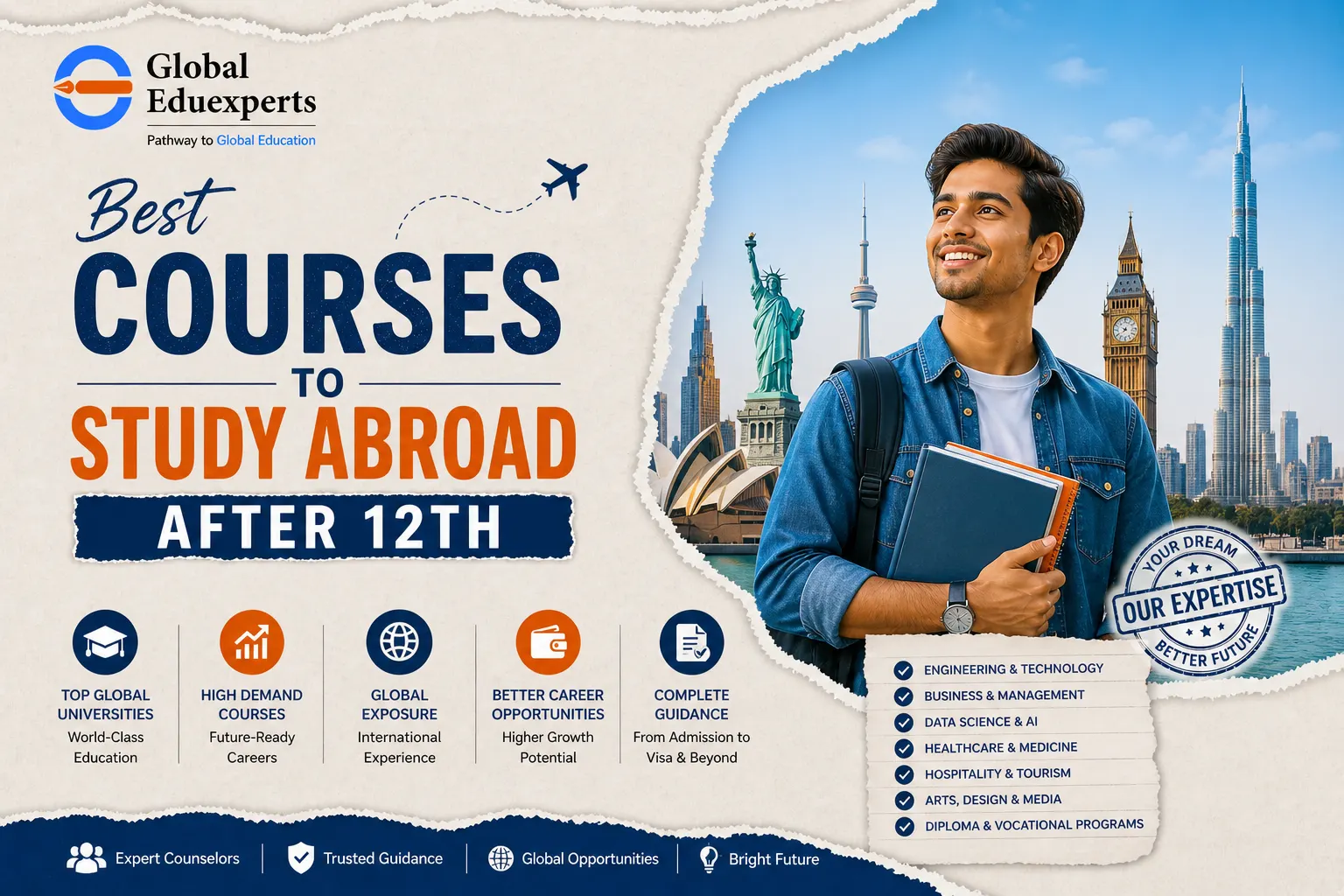
Guidance for the best courses to study abroad after 12th helps Indian students choose suitable international education pathways based on career goals, industry demand, budget, and future opportunities. It supports students exploring undergraduate, diploma, vocational, business, healthcare, engineering, technology, and arts programs across global study destinations, helping them make informed academic and career-focused decisions for long-term professional growth.
For many students, the decision to study abroad starts immediately after 12th.
And honestly, this stage feels exciting… but also confusing.
Because students suddenly face too many choices:
At the same time, everyone seems to ask the same question:
Which are the best courses to study abroad after 12th?
But the answer is rarely simple.
Because the “best” course depends heavily on:
And students who understand this early usually make much better decisions later.
Indian students increasingly explore international education because they want:
For some students, studying abroad also creates:
That’s why searches around study abroad courses after 12th continue growing every year.
This part becomes extremely important after 12th.
Unlike postgraduate education, undergraduate course selection often builds the foundation for:
For example:
That’s why students researching career oriented courses abroad after 12th should think beyond short-term popularity.
This happens constantly now.
Students choose courses because:
Then later, they realize they are not genuinely interested in the field itself.
And honestly, that creates long-term problems.
Because studying abroad is already demanding:
Choosing the wrong course adds even more pressure.
Students exploring best countries and courses after 12th should understand that:
So the course and country should be evaluated together — not separately.
Another important reality:
Industry demand changes over time.
Today, many students explore:
These are often considered high demand courses to study abroad after 12th because global industries continue expanding in these areas.
But demand alone should never decide the future.
If you are exploring best courses abroad for indian students after 12th, the better question is not:
Which course is trending right now?
It should be:
Which course realistically matches my strengths, interests, and the industries likely to grow over the next several years?
Because international education is not only about going abroad.
It’s about building a sustainable future after graduation too.
Explore Study in USA opportunities for globally recognized education, career-focused programs, and international exposure after 12th.
Students planning international education after 12th usually want clarity on one thing first:
Which courses actually have strong career demand globally?
And honestly, that’s a practical question.
Because studying abroad involves:
So students naturally want courses that connect with industries actively hiring worldwide.
That’s why searches around high demand courses to study abroad after 12th have increased significantly.
But students should understand something important early:
A course may have high demand globally… and still not be the right fit personally.
Technology-related fields remain among the most preferred globally.
Students commonly explore:
Why?
Because industries everywhere now depend heavily on:
Students researching top courses after 12th for international students often prioritize technical programs because they connect strongly with future-focused industries.
This shift has become impossible to ignore.
Companies increasingly rely on:
That’s why students exploring career oriented courses abroad after 12th often move toward:
These programs usually suit students who enjoy:
Not every student wants technical industries.
Business-related programs continue attracting students interested in:
Global business environments continue creating opportunities for graduates with:
That’s one reason business programs remain among the best courses abroad for indian students after 12th.
Healthcare-related education remains important worldwide.
Students commonly explore:
These industries often provide:
But healthcare education usually requires:
Engineering remains one of the most established international study pathways.
Popular branches often include:
Students exploring undergraduate courses abroad after 12th often prefer engineering because it combines technical learning with broad global applicability.
Students interested in people-oriented industries often explore:
Countries connected strongly with tourism and global business continue creating opportunities in these sectors.
The field suits students who enjoy:
This happens very often now.
Students choose courses because:
Later, they realize the actual work environment does not suit them.
And that becomes difficult long term.
If you are exploring study abroad courses after 12th, the better question is not:
Which course has the highest demand globally?
It should be:
Which high-demand field realistically matches my strengths, interests, and long-term career goals?
Because industry demand matters.
But sustainable career growth depends on whether students can genuinely grow inside that industry over time.
Explore USA Courses to compare high-demand programs in technology, business, healthcare, engineering, and data science.
Science students usually face one of the toughest decisions after 12th.
Not because opportunities are limited.
Because there are too many directions available.
Engineering, medicine, AI, biotechnology, healthcare, data science, IT… every field seems promising in different ways. And once students start researching best courses to study abroad after 12th, the confusion increases even more.
Because every country, university, and counselor seems to recommend something different.
Engineering continues to attract science students globally because it offers:
Students commonly explore:
Many students researching undergraduate courses abroad after 12th choose engineering because it creates flexibility across industries later.
But engineering abroad is becoming increasingly skill-focused.
Practical projects, internships, and technical adaptability matter much more now than degree titles alone.
This shift has become very noticeable over the last few years.
Students increasingly move toward:
Why?
Because industries across the world now depend heavily on:
That’s why technical programs are often considered among the high demand courses to study abroad after 12th.
But students should understand something honestly:
These fields require continuous learning even after graduation.
Technology changes extremely fast.
Students interested in biology and research often explore:
These industries are growing because of:
The field suits students who enjoy:
Medical education abroad attracts many Indian students every year.
Students commonly explore:
Healthcare fields usually offer:
But students often underestimate:
Healthcare is rewarding… but demanding.
Students exploring best countries and courses after 12th should understand:
The course and destination should always be evaluated together.
This happens constantly now.
Students choose science programs because:
Later, they realize they do not actually enjoy the work itself.
And honestly, technical and healthcare industries become difficult without genuine interest.
If you are exploring professional courses abroad after 12th, the better question is not:
Which science course has the highest salary?
It should be:
Which field realistically matches my abilities, learning style, and long-term career interests?
Because science education abroad can create excellent opportunities.
But long-term success usually comes from students who stay genuinely interested and adaptable within their chosen field.
Explore Ireland Courses for STEM-focused education opportunities in engineering, biotechnology, AI, healthcare, and technology sectors.
Commerce students usually reach a point after 12th where everything feels uncertain.
Because commerce is broad.
Very broad.
Students suddenly start comparing:
And once they begin researching best courses to study abroad after 12th, the confusion increases even more because every country promotes different strengths.
BBA and management-related programs continue attracting students globally because they create flexibility across industries.
Students commonly explore:
These programs usually focus on:
That’s why they are often considered among the career oriented courses abroad after 12th.
But students should understand something honestly:
Business education rewards communication skills heavily.
Not just academic scores.
Students interested in numbers, analysis, and corporate systems often move toward:
Global industries continue needing professionals who understand:
That’s one reason finance remains one of the best courses abroad for indian students after 12th in commerce streams.
The field tends to suit students who:
Economics earlier felt limited to academic or government-focused careers for many students.
That perception has changed.
Now economics graduates often move into:
Students who enjoy:
…often perform well in economics-related programs abroad.
This shift has become very noticeable.
Modern marketing now includes:
Students researching study abroad courses after 12th increasingly explore marketing because businesses worldwide now depend heavily on digital visibility and customer engagement.
But marketing careers require:
The field changes quickly.
Students choosing international education often naturally become interested in:
That’s why International Business programs continue growing.
Studying abroad itself often helps students understand:
Which becomes useful professionally later.
Students exploring best countries and courses after 12th should know:
So destination selection matters almost as much as the course itself.
This happens constantly now.
Students choose business programs because:
But many students never ask themselves:
And honestly, that matters a lot long term.
If you are exploring undergraduate courses abroad after 12th, the better question is not:
Which commerce course pays the most?
It should be:
Which business or commerce field realistically matches my strengths, personality, and long-term career interests?
Because commerce education abroad creates strong opportunities.
But sustainable growth usually happens when students genuinely fit the professional environment they are preparing for.
Explore UK Courses to compare international business, finance, economics, and management programs for global career opportunities.
Arts and humanities students often face a strange kind of pressure after 12th.
Not because opportunities are missing.
But because people still underestimate how broad and career-focused these fields have become globally.
Students interested in:
…often hear confusing advice like:
But honestly, global industries have changed a lot.
And many best courses to study abroad after 12th today come directly from arts, creativity, communication, and people-focused industries.
Students increasingly move toward psychology because modern workplaces and societies now focus heavily on:
Programs commonly include:
The field suits students who:
And globally, psychology careers are expanding much faster than many students realize.
Media education is no longer limited to traditional journalism.
Now the field includes:
Students researching career oriented courses abroad after 12th often explore media because businesses worldwide now depend heavily on communication and digital visibility.
The industry rewards:
But it also moves extremely fast.
Design-related education abroad has become highly specialized.
Students commonly explore:
Countries with strong creative industries often provide:
The field suits students who genuinely enjoy:
Students interested in:
…often choose International Relations programs abroad.
These courses usually combine:
Students exploring study abroad courses after 12th sometimes prefer this field because studying internationally itself creates exposure to multicultural perspectives.
Arts and humanities students also move toward:
These sectors continue growing globally because international business and travel industries depend heavily on communication and service management.
The field rewards students who enjoy:
This is important.
Creative fields may look exciting online, but professional growth requires:
Students choosing creative programs only because they “sound interesting” often struggle later without genuine passion for the work itself.
Some students choose courses based only on:
Later, they either lose interest or feel disconnected from the industry environment.
And honestly, humanities and creative industries require strong personal alignment.
If you are exploring professional courses abroad after 12th, the better question is not:
Which arts course looks the most creative or exciting?
It should be:
Which field realistically matches my personality, communication style, interests, and long-term career direction?
Because arts and humanities education abroad can create excellent international opportunities.
But long-term success usually comes from students who genuinely connect with the work they are preparing for.
Explore Study in Europe opportunities for arts, communication, design, humanities, and globally connected education pathways.
Not every student wants a long academic journey immediately after 12th.
Some students are looking for something more practical:
That’s where diploma courses abroad after 12th and short-term international programs become important.
And honestly, these pathways are becoming much more popular now because students are thinking more practically about careers and finances.
Unlike traditional long-degree programs, diploma and vocational courses are generally designed around:
Students often explore diploma programs in fields like:
These are often considered among the career oriented courses abroad after 12th because they connect directly with practical industries.
There are several reasons students move toward shorter education pathways:
For some students, this route feels more financially realistic than committing immediately to a 3–4 year international degree.
Students in diploma and vocational programs often experience:
The learning environment usually feels more career-focused from the beginning.
That’s one reason students researching study abroad courses after 12th increasingly explore vocational education options alongside traditional universities.
Some industries consistently attract diploma students because employers value practical skills heavily.
| Diploma Area | Why Students Choose It | Career Direction |
|---|---|---|
| Hospitality & Tourism | Quick industry entry | Hotel Operations, Guest Services |
| IT & Networking | Growing digital industries | Technical Support, Networking |
| Business & Management | Broad corporate exposure | Administration, Operations |
| Graphic & Digital Design | Creative industry growth | Visual Communication, Media |
| Healthcare Support | Stable workforce demand | Allied Healthcare Roles |
Students exploring high demand courses to study abroad after 12th often choose diploma pathways in these industries because of quicker workforce access.
Some students focus only on:
That creates problems later.
A low-cost program without:
…may not help professionally afterward.
The better approach is evaluating:
Not only tuition fees.
This is important.
Diploma and vocational pathways may help students enter industries faster.
But long-term growth still depends on:
The course creates the entry point.
Career growth still requires continuous effort afterward.
Students exploring best countries and courses after 12th often notice:
So the destination matters almost as much as the course itself.
If you are exploring top courses after 12th for international students, the better question is not:
Which course finishes the fastest?
It should be:
Which diploma or vocational pathway builds practical skills that can realistically support my future career growth?
Because shorter programs help students enter industries quickly.
But long-term success still depends on choosing a field that remains sustainable professionally over time.
Explore Study in Asia opportunities for affordable diploma, vocational, and career-oriented international education pathways.
One of the biggest mistakes students make after 12th is choosing a country first… and only later thinking seriously about the course.
But honestly, the country and the course should always be connected.
Because every destination has:
That’s why students researching best courses to study abroad after 12th should compare both the country and the career pathway together.
The USA continues attracting students interested in:
American universities often provide:
Students exploring high demand courses to study abroad after 12th often prefer the USA for technology-focused careers because global tech companies remain heavily connected there.
But costs can become significant, especially in private universities and major cities.
The UK is especially popular for:
Students often choose the UK because:
The UK also suits students who prefer:
Canada remains one of the most preferred destinations for Indian students.
Students commonly explore:
The country is often chosen because of:
Students researching best countries and courses after 12th frequently compare Canada because it balances education and settlement-focused planning.
Australia attracts students interested in:
The education system usually emphasizes:
Students often describe Australia as:
Ireland has become increasingly popular because of:
Students commonly explore:
The country feels especially attractive for students interested in:
Dubai has become important for students exploring:
Students often prefer Dubai because:
Dubai works particularly well for students wanting:
This is important.
Students sometimes search:
Which country is best overall after 12th?
But honestly, there is no universal answer.
Because:
The “best” country depends heavily on:
If you are exploring study abroad courses after 12th, the better question is not:
Which country is most popular?
It should be:
Which country realistically supports the course, industry, and future career I want to build?
Because studying abroad is not only about moving internationally.
It’s about choosing an environment where education and career opportunities align properly over time.
Explore Study in Australia opportunities for globally recognized education, practical learning, and career-focused international programs.
This is usually the stage where students begin asking practical questions instead of only exploring dreams.
Because once the idea of studying abroad becomes serious, students immediately start wondering:
And honestly, this part creates confusion for many students because every country and university seems to have different rules.
But the good part is this:
Most international undergraduate admissions follow a fairly structured process.
The first thing universities usually evaluate is academic performance in 12th grade.
Different programs expect different levels of preparation.
For example:
Students exploring undergraduate courses abroad after 12th should understand that eligibility is not only about passing marks.
Course relevance matters too.
Since most international programs are taught in English, universities often ask for language proficiency scores.
Common accepted tests include:
Typical score expectations may vary depending on:
| English Test | Common Score Range |
|---|---|
| IELTS | 5.5 – 7.0 |
| PTE Academic | 50 – 65 |
| TOEFL | 70 – 100+ |
Some universities may offer waivers under specific conditions, but students should never assume waivers apply automatically.
Many students focus only on marks.
But universities abroad often also evaluate:
Students researching study abroad courses after 12th sometimes underestimate how important these documents become during admissions.
A strong SOP helps universities understand:
International education requires financial preparation.
Universities and visa authorities commonly expect:
Students often focus heavily on admission… but visa approval later depends significantly on financial clarity too.
Applications commonly require:
Creative programs may additionally require:
Students exploring best countries and courses after 12th should understand:
That’s why students should prepare profiles strategically rather than applying randomly everywhere.
This happens constantly.
Students assume:
Neither is fully true.
Universities often evaluate:
A balanced and realistic profile matters more than students initially realize.
If you are exploring best courses abroad for indian students after 12th, the better question is not:
Do I meet the minimum requirements somehow?
It should be:
Does my academic profile, communication ability, and career direction realistically align with the course and country I’m applying for?
Because studying abroad is not only about getting admission.
It’s about entering a system where the student can realistically adapt and grow afterward too.
Understand USA Eligibility requirements including academics, English proficiency, admission criteria, and application documentation.
This is usually the point where studying abroad starts feeling real for families.
Because once students shortlist countries and courses, the next question becomes unavoidable:
How much will all of this actually cost?
And honestly, there is no single answer.
The total expense depends heavily on:
That’s why students researching best courses to study abroad after 12th should evaluate finances carefully before making emotional decisions.
Not all international programs cost the same.
For example:
| Course Type | Approximate Tuition Trend |
|---|---|
| Engineering & Technology | Moderate to high |
| Medicine & Healthcare | High |
| Business & Management | Moderate to high |
| Arts & Humanities | Moderate |
| Diploma & Vocational Programs | Lower to moderate |
Students exploring career oriented courses abroad after 12th should compare total investment — not only course popularity.
This part matters a lot.
Different countries create very different financial realities.
For example:
Students researching best countries and courses after 12th should compare:
Not just tuition fees alone.
Students often underestimate housing costs initially.
Accommodation options commonly include:
And honestly, city choice changes the budget heavily.
For example:
Accommodation usually becomes one of the biggest long-term financial commitments.
Students also need to plan for:
Even small daily spending habits become important over long study durations.
This is where realistic budgeting matters more than students initially expect.
Many students hope scholarships will solve most financial pressure.
Scholarships absolutely help.
But students should understand:
Students exploring study abroad courses after 12th should treat scholarships as support — not guaranteed financial replacement.
Students in many countries work part-time during studies.
This may help with:
But students should not depend entirely on part-time work for:
Academic pressure and visa regulations still need to be managed realistically.
Some families focus only on:
Others focus only on:
Both approaches can create problems later.
The better approach is balancing:
Together.
If you are exploring best courses abroad for indian students after 12th, the better question is not:
Which option costs the least?
It should be:
Which course and country combination creates a realistic balance between affordability, career growth, and long-term value?
Because studying abroad is not only an educational decision.
It’s also a long-term financial and career investment.
Explore UK Cost guidance to understand tuition fees, accommodation expenses, and overall student budgeting for international education.
This is usually the most important decision students make after 12th.
And honestly, it’s also the one most students rush.
Because once students start researching best courses to study abroad after 12th, they quickly become surrounded by:
After a while, the process becomes overwhelming.
Everyone seems confident about what students “should” choose.
But the reality is much more personal than that.
A very common mistake happens here.
Students first choose:
Then later try adjusting their career goals around that decision.
That approach usually creates confusion later.
The smarter process is:
Because the course should support the future.
Not just current trends.
Students researching high demand courses to study abroad after 12th often focus only on:
And yes, industry demand matters.
Fields like:
…are growing globally.
But demand alone cannot guarantee satisfaction or long-term success.
A student forcing themselves into a field they dislike usually struggles eventually — no matter how “in demand” the industry appears online.
This part gets ignored surprisingly often.
Students rarely ask themselves:
Instead, they often choose based on external pressure.
And honestly, that creates long-term frustration.
Because every professional field demands different abilities:
The student’s personality matters more than most people admit.
Students exploring best countries and courses after 12th should understand:
That’s why the country and course should always be evaluated together.
This happens constantly now.
Students select courses because:
Later, they realize:
And honestly, international education becomes very difficult without genuine interest in the field itself.
Students sometimes focus only on:
But the more important question is:
What happens after graduation?
Students should evaluate:
Because course selection affects professional life for years afterward.
If you are exploring study abroad courses after 12th, the better question is not:
Which course is trending right now?
It should be:
Which course realistically matches my abilities, interests, financial situation, and long-term career direction?
Because studying abroad is not only about leaving India for education.
It’s about building a future that remains sustainable professionally and personally over time.
Explore Dubai Courses to compare career-focused programs connected with business, technology, hospitality, and international industries.
The best courses to study abroad after 12th usually depend on career goals, interests, and industry demand. Popular options include Computer Science, Engineering, Business Management, Data Science, Healthcare, Hospitality, Artificial Intelligence, and Finance. Students should choose courses based on long-term career growth, practical skills, and personal strengths instead of selecting programs only because they are trending online.
There is no single “best” country for every student. The USA is strong for technology and research, the UK for business and finance, Canada for practical education and PR pathways, Australia for industry-focused learning, and Ireland for STEM programs. Students exploring best countries and courses after 12th should compare costs, career opportunities, and education systems carefully before deciding.
Yes, average academic scores do not automatically prevent students from studying abroad. Universities often evaluate multiple factors including academic consistency, English language skills, SOP quality, extracurricular activities, and career direction. Students exploring study abroad courses after 12th should focus on building a balanced application profile rather than assuming only top scorers receive opportunities abroad.
The total cost depends on the country, course, university, and lifestyle. Expenses usually include tuition fees, accommodation, food, transportation, insurance, and personal costs. Professional programs like medicine and MBA pathways are generally more expensive, while diploma and vocational programs may cost less. Scholarships and part-time work can help reduce financial pressure for international students.
Yes, diploma courses abroad after 12th can help students develop practical and industry-focused skills faster. These programs are commonly chosen in hospitality, IT, business, healthcare support, and design sectors. However, students should choose recognized institutions and career-relevant programs because long-term employability depends on practical skills, industry demand, and professional adaptability.


