
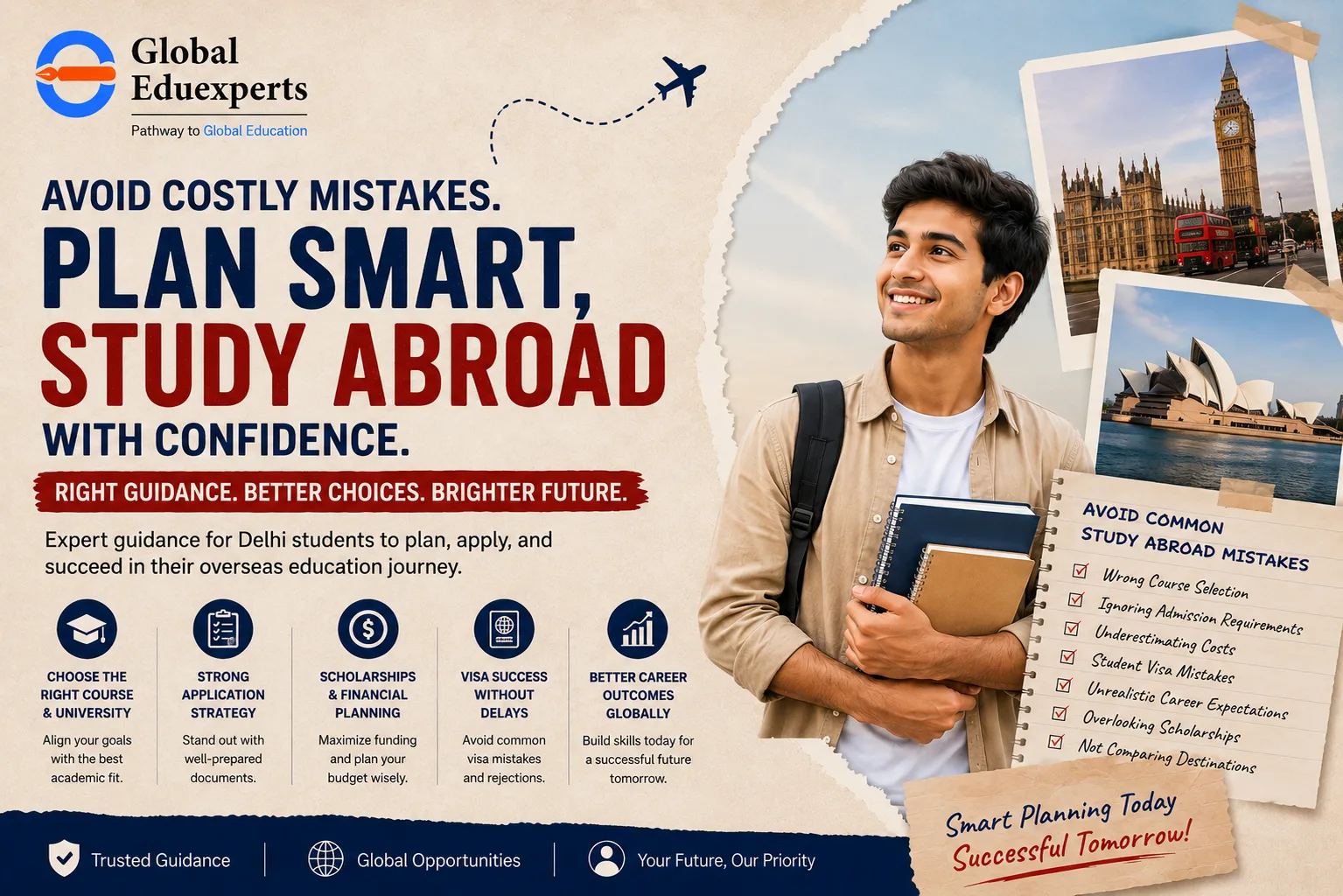
Planning to study abroad requires careful research, informed decision-making, and a clear understanding of admissions, finances, visas, and career opportunities. The guidance helps students identify common planning mistakes, choose suitable universities and courses, prepare stronger applications, manage study-abroad expenses effectively, and build a personalized roadmap that supports successful international education and long-term professional growth.
Many students begin planning their overseas education with excitement, but enthusiasm alone is rarely enough to make informed decisions. The availability of online information, social media content, and countless university advertisements has made studying abroad appear simpler than it actually is. Behind every successful international education journey is careful research, realistic planning, and a clear understanding of academic, financial, and career-related factors.
Students searching for Common Mistakes Delhi Students Make While Planning Overseas Education often discover that many challenges arise long before they submit a university application. Small oversights during the planning stage can lead to missed deadlines, unsuitable university choices, higher expenses, or delayed admissions. While most mistakes are avoidable, they usually happen because students rely on incomplete information or make decisions without considering their long-term goals.
Recognizing these common pitfalls early helps students build a stronger foundation for a successful study-abroad experience.
International education has become more accessible than ever before. Students now have opportunities to apply to universities across multiple countries, compare courses online, and communicate directly with institutions.
However, greater accessibility has also increased competition.
Universities receive applications from students across the world, making admissions more competitive than in previous years. As a result, applicants who prepare early and present well-organized applications often have an advantage over those who begin the process at the last minute.
| Factor | Impact on Students |
|---|---|
| More International Applicants | Higher competition for admissions |
| Limited Scholarship Seats | Earlier preparation required |
| Selective Universities | Stronger academic profiles needed |
| Competitive Courses | Better planning becomes essential |
Students who understand these realities are generally better prepared to meet university expectations.
One of the most common Study Abroad Planning Mistakes for Delhi Students is treating social media as the primary source of guidance.
Short videos, influencer experiences, and online discussions can provide useful insights, but they rarely present the complete picture.
For example, a student may describe an excellent experience at a university, while another student at the same institution may have completely different academic or career outcomes.
Social media content often focuses on:
It may not explain:
Students should use social media for general awareness while relying on official university information and verified guidance for important decisions.
Many applicants underestimate the time required to prepare a strong study-abroad application.
Important tasks include:
When students rush through these steps, simple mistakes become more likely.
Planning several months in advance allows students to complete each stage more carefully.
Every university, country, and course offers a different learning environment.
Students who spend limited time researching may overlook important details such as:
| Research Area | Why It Matters |
|---|---|
| Course Curriculum | Matches career goals |
| University Reputation | Academic credibility |
| Industry Exposure | Practical learning opportunities |
| Graduate Outcomes | Employability prospects |
Careful research helps students identify options that align with both academic interests and long-term career objectives.
Many students follow trends when selecting study destinations or courses.
Popular countries and universities often attract attention because of rankings or social media visibility. However, what works well for one student may not be the right choice for another.
Students should consider:
Making decisions based solely on popularity can lead to dissatisfaction later.
International universities regularly update their admission criteria.
Changes may involve:
Students who rely on outdated information may find themselves unprepared during the application process.
One of the most effective Overseas Education Planning Tips for Delhi Students is to verify admission requirements directly from official university sources before beginning an application.
English language proficiency tests and other standardized examinations require adequate preparation.
Many students postpone test preparation until admission deadlines approach.
This often creates unnecessary pressure.
| Benefit | Result |
|---|---|
| Better Scores | Stronger applications |
| More Test Attempts | Greater flexibility |
| Reduced Stress | Better planning |
| Scholarship Eligibility | Improved opportunities |
Preparing early allows students to improve performance without rushing.
Another major challenge involves budgeting.
Students sometimes calculate only tuition fees while overlooking additional expenses.
Important costs include:
These expenses can significantly affect the total cost of education.
Many Study Abroad Financial Planning Mistakes occur because families begin budgeting after receiving admission offers rather than during the research stage.
International admissions require multiple documents that must be prepared carefully.
Examples include:
Even small documentation errors may delay application processing.
Students researching Study Abroad Document and SOP Mistakes often discover that attention to detail is just as important as academic performance.
A common pattern among applicants is choosing the same destination or university as friends.
While studying alongside familiar people may seem appealing, every student's goals differ.
Questions worth considering include:
Independent decision-making generally leads to more satisfying educational outcomes.
Many students begin searching for scholarships only after receiving admission offers.
Unfortunately, numerous scholarship deadlines close much earlier.
Early scholarship planning allows students to:
Scholarships can substantially reduce overall education costs, particularly for students with strong academic profiles.
Some students choose courses without fully understanding where those qualifications may lead professionally.
Instead of focusing only on admission, students should also evaluate:
Career-focused planning usually results in more informed academic decisions.
Studying abroad creates valuable opportunities, but it does not automatically guarantee immediate employment or exceptionally high salaries.
Success depends on several factors, including:
Students with realistic expectations are generally better prepared to adapt to international education and professional environments.
Students researching Mistakes Indian Students Make Before Studying Abroad, Common Study Abroad Application Mistakes to Avoid, Wrong Course and University Selection for Indian Students, Student Visa Mistakes Indian Students Should Avoid, and How to Avoid Study Abroad Mistakes Before Applying Overseas often discover that most challenges originate during the planning stage rather than after reaching their destination.
Successful overseas education begins with informed decision-making, thorough research, realistic financial planning, and early preparation. Rather than rushing into applications or following popular trends, students should take time to evaluate universities, courses, admission requirements, career opportunities, and overall affordability. A structured approach not only reduces the likelihood of costly mistakes but also creates a stronger foundation for achieving long-term academic and professional goals abroad.
Many planning mistakes can be avoided by understanding how different destinations, admission systems, and application processes actually work. Students beginning their research often find it helpful to explore
STUDY ABROAD FROM DELHIfor a complete planning roadmap and compare destination-specific guidance throughSTUDY IN USA,STUDY IN UK,STUDY IN AUSTRALIA, andSTUDY IN EUROPEbefore narrowing their options.
Selecting a university is often one of the most exciting stages of planning an international education. Students spend hours browsing rankings, watching campus tours, comparing countries, and discussing options with friends. However, one of the most frequent Common Mistakes Delhi Students Make While Planning Overseas Education is focusing on the university name before understanding whether the course actually supports their career ambitions.
A globally recognized university can certainly provide valuable opportunities, but attending a prestigious institution alone does not guarantee career satisfaction or professional success. The quality of the curriculum, industry exposure, practical learning opportunities, and alignment with personal interests often have a much greater influence on long-term outcomes.
Students who take time to evaluate both the course and the university together are generally better prepared to make decisions that support their academic goals and future careers.
University rankings are useful because they provide information about academic reputation, research output, and institutional performance.
However, rankings should never become the only reason for selecting a university.
A university ranked highly overall may not necessarily offer the strongest program in a student's chosen discipline.
For example:
Students should treat rankings as one reference point rather than the final deciding factor.
| Evaluation Factor | Why It Matters |
|---|---|
| Course Curriculum | Determines practical learning |
| Faculty Expertise | Influences academic quality |
| Internship Opportunities | Improves employability |
| Graduate Outcomes | Reflects career success |
| Industry Collaboration | Builds professional experience |
Looking beyond rankings often leads to better academic decisions.
Every admission cycle brings new trends.
One year, Artificial Intelligence attracts widespread attention.
Another year, Business Analytics or Data Science becomes the most discussed field.
While these industries offer excellent opportunities, they are not automatically the right fit for every student.
Many Wrong Course and University Selection for Indian Students cases occur because applicants choose programs based on popularity rather than personal strengths.
Questions worth asking include:
Choosing a course simply because it is trending often leads to reduced motivation and lower academic satisfaction.
Successful course selection usually begins with career planning rather than university selection.
Students should first identify the type of professional role they hope to achieve after graduation.
When career goals become the starting point, university selection becomes much more focused.
Instead of applying to every well-known institution, students can shortlist universities that offer programs aligned with their long-term objectives.
Many courses share similar names while offering completely different learning experiences.
For example, two universities may both offer a Master's in Data Science.
However, their curricula may differ significantly.
One program may emphasize:
Another may focus more on:
| Area | Importance |
|---|---|
| Core Subjects | High |
| Practical Projects | High |
| Internship Components | High |
| Industry Certifications | Moderate to High |
| Research Opportunities | Moderate |
Reviewing detailed course content helps students understand what they will actually study.
A university that is ideal for one student may not suit another.
The right fit depends on several personal factors.
Students should consider:
Some universities emphasize academic research.
Others prioritize applied learning and employer collaboration.
Choosing an institution that matches personal learning preferences often results in a more rewarding educational experience.
One of the strongest indicators of course quality is the university's relationship with employers.
Universities maintaining active industry partnerships often provide students with:
| Benefit | Career Impact |
|---|---|
| Practical Experience | High |
| Professional Networking | High |
| Skill Development | High |
| Graduate Employability | High |
Students who gain practical experience during their studies often transition more smoothly into professional roles.
Many applicants compare tuition fees and rankings but overlook graduate outcomes.
A more useful question is:
"What happens after students complete this course?"
Universities frequently publish information regarding:
These indicators often provide better insight into long-term educational value than rankings alone.
Some students become excited about a program before reviewing admission expectations.
This can create disappointment later.
Admission requirements may include:
Students researching Common Study Abroad Application Mistakes to Avoid often discover that understanding eligibility early saves considerable time during the application process.
Students occasionally choose courses based solely on expected salaries.
While financial considerations are important, long-term motivation also matters.
Completing a demanding international degree requires:
Studying a subject that genuinely interests the student often improves academic performance and overall satisfaction.
Many students assume the most popular study destinations automatically provide the strongest programs across every discipline.
In reality, different countries have developed expertise in different academic fields.
Students should compare:
Country popularity should complement academic decision-making rather than replace it.
A balanced comparison includes more than promotional brochures.
Students should evaluate:
| Evaluation Area | Priority |
|---|---|
| Course Quality | High |
| Employability | High |
| Industry Exposure | High |
| Student Support | Moderate |
| Research Opportunities | Moderate |
Using multiple evaluation criteria reduces the likelihood of making decisions based on incomplete information.
Prestige can influence first impressions.
However, employers often place greater importance on:
A university that helps students develop these competencies may provide greater career value than one chosen solely because of its international reputation.
Students should evaluate educational investment based on long-term outcomes rather than immediate recognition.
Many Study Abroad Planning Mistakes for Delhi Students happen because applicants rush through the university selection process.
Good research involves:
Students who invest time in research usually make more confident and practical decisions.
Students researching Mistakes Indian Students Make Before Studying Abroad, Wrong Course and University Selection for Indian Students, Study Abroad Planning Mistakes for Delhi Students, and How to Avoid Study Abroad Mistakes Before Applying Overseas often realize that selecting the right course is one of the most important decisions in the entire study-abroad journey.
The strongest academic choices are rarely based on rankings or trends alone. Instead, they result from careful evaluation of career objectives, curriculum quality, industry connections, graduate employability, and personal interests. By focusing on long-term career development rather than short-term popularity, students can choose universities and programs that provide meaningful academic experiences and stronger professional opportunities after graduation.
Choosing a university should always begin with your career goals rather than rankings alone. Reviewing destination-specific course options like
USA CoursesandUk Coursescan help you understand which programs align with your interests, while broader guides such asSTUDY IN IRELANDandSTUDY IN EUROPEoffer additional academic pathways that many students overlook.
One of the most preventable yet costly mistakes students make while planning international education is underestimating the admission process itself. Many applicants spend weeks comparing countries and universities but dedicate very little time to understanding what those institutions actually expect from applicants.
Every university has its own admission policies, academic prerequisites, document requirements, and application deadlines. Assuming that the same requirements apply everywhere can lead to incomplete applications, missed opportunities, and unnecessary delays.
Among the Common Mistakes Delhi Students Make While Planning Overseas Education, overlooking admission requirements is one of the most frequent reasons students fail to secure admission to their preferred universities, even when they have good academic records.
Successful applications are rarely built in a few weeks. They are usually the result of structured planning that begins several months before the first application is submitted.
Many students believe that meeting the basic academic percentage requirement is enough to qualify for admission.
In reality, universities evaluate applicants using multiple criteria.
These may include:
| Requirement | Importance |
|---|---|
| Academic Performance | High |
| Subject Eligibility | High |
| English Language Scores | High |
| Supporting Documents | High |
| Additional Qualifications | Varies by Course |
Reviewing admission requirements carefully before applying helps students avoid unnecessary rejections.
Every course has its own academic expectations.
For example:
Students researching Study Abroad Planning Mistakes for Delhi Students often discover that applying without verifying subject eligibility wastes both time and application fees.
Checking eligibility early allows students to focus on universities where they meet the admission criteria.
English proficiency tests are an essential part of the admission process for many international universities.
Common examinations include:
Although students may already communicate comfortably in English, these standardized tests evaluate specific language skills under structured conditions.
| Benefit | Outcome |
|---|---|
| Better Scores | Stronger applications |
| Multiple Test Attempts | Greater flexibility |
| Reduced Stress | Better planning |
| Scholarship Eligibility | Improved opportunities |
Waiting until application deadlines approach often leaves little time for score improvement.
Depending on the country and course, universities may request additional standardized examinations.
Examples include:
Not every university requires these exams, but students should verify requirements for each institution individually.
Assuming that standardized tests are unnecessary without checking official admission criteria can become a significant application mistake.
The Statement of Purpose (SOP) is one of the most important parts of many international applications.
Rather than repeating academic achievements, a good SOP explains:
Students searching for Study Abroad Document and SOP Mistakes often realize that writing an effective SOP requires several revisions rather than a single draft.
Universities often use the SOP to understand the applicant beyond grades and test scores.
Letters of Recommendation (LORs) require coordination with teachers, professors, or employers.
Many students delay this step until application deadlines become very close.
As a result:
Requesting recommendation letters well in advance gives referees enough time to prepare thoughtful and personalized evaluations.
One of the most common Common Study Abroad Application Mistakes to Avoid is assuming that every university follows the same admission schedule.
Different institutions may have:
| Activity | Planning Importance |
|---|---|
| University Shortlisting | High |
| Test Registration | High |
| SOP Preparation | High |
| Document Collection | High |
| Application Submission | High |
Maintaining a detailed application calendar reduces the risk of missing important deadlines.
International applications require multiple official documents.
Typical requirements include:
Some documents may require:
Students who begin document preparation early usually experience a smoother application process.
Rushing an application often creates avoidable mistakes.
Examples include:
| Mistake | Possible Impact |
|---|---|
| Missing Documents | Application delays |
| Incorrect Information | Verification issues |
| Weak SOP | Reduced competitiveness |
| Missed Deadline | Lost admission opportunity |
Careful review before submission helps minimize these risks.
Many students focus only on university admission dates.
However, scholarship applications frequently close much earlier.
Missing scholarship deadlines can significantly increase the total cost of education.
Students should prepare separate timelines for:
Early organization improves access to financial support opportunities.
Admission committees often evaluate applications holistically.
Strong applicants usually demonstrate:
Well-prepared applications reflect professionalism and commitment, qualities that universities value during the selection process.
One effective strategy is creating a structured application checklist.
Students who follow organized processes generally experience fewer unexpected problems.
Some applicants treat admissions as an administrative task.
In reality, admission preparation involves:
Each stage influences the overall quality of the application.
Careful preparation allows students to present themselves more effectively to universities.
Students researching Mistakes Indian Students Make Before Studying Abroad, Student Visa Mistakes Indian Students Should Avoid, Study Abroad Document and SOP Mistakes, Study Abroad Planning Mistakes for Delhi Students, and How to Avoid Study Abroad Mistakes Before Applying Overseas often discover that successful international admissions begin long before the application portal opens.
Understanding academic eligibility, preparing English language tests, organizing documents, writing a thoughtful Statement of Purpose, requesting recommendation letters in advance, and tracking application deadlines all contribute to a stronger application. Rather than rushing through the admission process, students who prepare systematically are better positioned to meet university expectations, compete for scholarships, and reduce the likelihood of avoidable errors that can delay or weaken their study-abroad plans.
Every country follows its own admission framework, so understanding eligibility requirements early can save valuable time. Students should compare official guidance through
USA Eligibility,UK Eligibility,Australia Eligibility, andIreland Eligibilityto understand academic expectations, English language requirements, and application timelines before preparing their documents.
When students begin planning an overseas education, tuition fees usually receive the most attention. University websites prominently display annual tuition costs, education fairs highlight scholarships, and most conversations revolve around course fees.
However, tuition is only one part of the financial commitment.
One of the most common Common Mistakes Delhi Students Make While Planning Overseas Education is assuming that paying university fees is enough to complete financial planning. In reality, international education involves several additional expenses that continue throughout the student's academic journey.
Accommodation, food, transportation, health insurance, visa applications, travel, study materials, and emergency expenses all contribute to the overall cost of studying abroad. Students who prepare realistic budgets before applying are generally more confident in choosing universities that fit both their career goals and their family's financial capacity.
Careful financial planning reduces uncertainty and helps families make informed decisions instead of reacting to unexpected expenses later.
The first figure students usually compare is annual tuition.
While tuition is an important expense, it rarely reflects the complete cost of studying abroad.
Two universities offering similar tuition fees may differ significantly in:
| Expense Category | Importance |
|---|---|
| Tuition Fees | High |
| Accommodation | High |
| Living Expenses | High |
| Health Insurance | High |
| Visa & Documentation | Moderate |
| Travel Costs | Moderate |
| Emergency Funds | High |
Looking at the complete financial picture provides a more accurate understanding of affordability.
Housing costs vary considerably between countries, cities, and even neighborhoods within the same destination.
Students may choose from:
Each option has different financial implications.
Accommodation expenses may include:
Many Study Abroad Financial Planning Mistakes happen because students estimate rent without accounting for these additional housing-related expenses.
Everyday spending may seem manageable initially, but small recurring costs accumulate over time.
Students should budget for:
| Expense | Frequency |
|---|---|
| Food | Weekly |
| Groceries | Weekly |
| Phone Bills | Monthly |
| Household Items | Monthly |
Building realistic estimates helps students manage finances more comfortably throughout their studies.
Many international destinations require students to maintain valid health insurance throughout their academic program.
Health coverage protects students during:
Students should understand:
Ignoring insurance costs can create unexpected financial pressure after arrival.
Before students even begin their academic journey, several administrative expenses arise.
Common costs include:
Although these are one-time expenses, they should still form part of the overall education budget.
Many students underestimate how much these preliminary requirements can contribute to total costs.
Airfare is another expense that is often overlooked during early planning.
Travel costs may include:
Students should consider long-term travel requirements instead of budgeting only for their first journey abroad.
One reason budgets frequently exceed expectations is the presence of smaller costs that students fail to anticipate.
Examples include:
| Expense | Planning Importance |
|---|---|
| Study Materials | Moderate |
| Software | Moderate |
| Student Services | Moderate |
| Graduation Fees | Low to Moderate |
Individually these expenses appear small, but collectively they can become significant over an academic year.
Unexpected situations can arise at any stage of international education.
Examples include:
Students who maintain an emergency reserve often manage these situations with less financial stress.
An emergency fund provides flexibility when unforeseen expenses occur.
Many students believe scholarships are available only to exceptional academic performers.
In reality, universities and organizations may offer different forms of financial assistance.
These can include:
Students who begin scholarship research early usually have access to more funding opportunities than those who wait until admission offers arrive.
Education loans help many families make overseas education financially possible.
However, borrowing decisions should be based on the complete cost of education rather than tuition fees alone.
Families should evaluate:
Responsible financial planning reduces unnecessary borrowing while improving long-term financial stability.
Students paying international tuition and living expenses should remember that exchange rates change over time.
Even small fluctuations may affect:
Planning with some financial flexibility helps families manage unexpected currency variations more comfortably.
Some students assume that the country with the lowest tuition automatically offers the most affordable education.
However, affordability depends on multiple factors.
Students should compare:
| Factor | Importance |
|---|---|
| Tuition | High |
| Cost of Living | High |
| Scholarships | High |
| Graduate Employment | High |
| Return on Investment | High |
A slightly more expensive destination may provide stronger career opportunities that improve long-term value.
Financial planning should begin before students submit university applications.
An effective budget typically includes:
Preparing this budget early allows families to compare universities realistically rather than relying on assumptions.
It also helps students identify where scholarships or education loans may be required.
Managing education expenses does not end once admission is secured.
Students continue making financial decisions throughout their studies.
Good budgeting habits often include:
Developing financial discipline during university can also benefit students long after graduation.
Students researching Study Abroad Financial Planning Mistakes, Common Study Abroad Application Mistakes to Avoid, Mistakes Indian Students Make Before Studying Abroad, Overseas Education Planning Tips for Delhi Students, and How to Avoid Study Abroad Mistakes Before Applying Overseas often realize that affordability is determined by far more than tuition fees alone.
A complete financial plan should account for accommodation, living expenses, health insurance, visa charges, travel, educational resources, emergency reserves, and potential currency fluctuations alongside university costs. By understanding the full financial commitment before submitting applications, students can compare destinations more accurately, explore scholarships and education loans where appropriate, and avoid unexpected financial challenges during their overseas education journey. Careful budgeting not only supports smoother academic experiences but also helps families make confident, well-informed decisions about investing in international education.
Creating a realistic budget becomes much easier when you compare country-wise expenses instead of relying on general estimates. Detailed resources like
USA Cost,UK Cost,Australia Cost,Ireland Cost, andDubai Costprovide a clearer picture of tuition fees, accommodation, and living expenses, helping families make financially informed decisions.
Receiving an admission offer from a university is an important milestone, but it is not the final step in the study-abroad process. Before students can begin their international education, they must successfully complete the student visa process. This stage requires careful attention because even minor errors in documentation or preparation can lead to delays, additional requests for information, or, in some cases, visa refusals.
Among the Common Mistakes Delhi Students Make While Planning Overseas Education, visa-related mistakes are particularly significant because they often occur after months of preparation. A student may secure admission to a preferred university, arrange finances, and plan accommodation, yet still face difficulties if visa requirements are not understood properly.
Although visa procedures vary between countries, one principle remains consistent: well-prepared applications are generally processed more smoothly than rushed or incomplete submissions.
Many applicants assume that visa procedures are similar across different destinations.
In reality, every country has its own requirements regarding:
Students should avoid relying on general advice and instead review the official visa requirements applicable to their chosen destination.
| Visa Requirement | Varies by Country |
|---|---|
| Financial Documentation | Yes |
| Medical Requirements | Yes |
| English Language Evidence | Yes |
| Visa Interview | Yes |
| Processing Time | Yes |
Understanding these differences early helps students prepare more effectively.
A visa application is supported by several official documents.
Missing or inaccurate documentation is among the most frequent Student Visa Mistakes Indian Students Should Avoid.
Typical visa documents may include:
Even a single missing document can delay processing while additional information is requested.
Students should carefully review document checklists before submitting their applications.
Visa authorities often require applicants to demonstrate that they have sufficient financial resources to support their education and living expenses.
Financial evidence may include:
| Requirement | Purpose |
|---|---|
| Tuition Funding | Education expenses |
| Living Expense Support | Daily financial stability |
| Genuine Source of Funds | Financial credibility |
| Required Documentation | Visa compliance |
Providing incomplete or inconsistent financial information may result in additional scrutiny during visa processing.
Students sometimes make simple mistakes while completing application forms.
Examples include:
These errors may appear minor but can delay application processing.
Before submission, applicants should carefully review every detail to ensure consistency across all documents.
One of the most common Study Abroad Planning Mistakes for Delhi Students is assuming that visas will be issued quickly.
Visa processing times vary depending on:
Applying close to university reporting dates increases the risk of travel disruptions if processing takes longer than expected.
Beginning the visa process early provides valuable flexibility.
Some countries conduct interviews as part of the student visa process.
The purpose is generally to understand:
Applicants do not need rehearsed answers, but they should be familiar with their own academic plans and application details.
Visa applications often involve multiple documents prepared over several months.
Information should remain consistent across:
Differences in dates, personal details, or educational history may require additional clarification.
Maintaining consistency throughout the application process helps avoid unnecessary complications.
Every destination introduces unique visa expectations.
Some countries may request:
Students researching How to Avoid Study Abroad Mistakes Before Applying Overseas should always verify country-specific requirements directly through official government sources.
General advice may not reflect current visa procedures.
Financial documentation often requires coordination with:
These documents may take time to obtain.
Waiting until the final weeks before submission often creates avoidable pressure.
Preparing financial records early allows students to review them carefully before application.
One detail frequently overlooked is passport validity.
Students should confirm:
Renewing a passport shortly before visa submission can introduce unnecessary delays.
Checking passport status early is a simple but valuable precaution.
Applicants who maintain organized records often complete visa applications more efficiently.
Keeping both digital and printed copies of important documents can also simplify future reference.
Friends, relatives, and online communities often share visa experiences.
While these experiences may be helpful, every application is unique.
Students should avoid making important decisions based solely on:
Official immigration authorities remain the most reliable source for current visa requirements.
Students sometimes believe that admission to a university automatically guarantees visa approval.
However, visa authorities conduct their own independent assessment.
They generally evaluate:
A carefully prepared application improves overall confidence during the process.
Visa preparation becomes much easier when students develop a clear timeline.
| Activity | Recommended Timing |
|---|---|
| Review Visa Requirements | Immediately After Admission |
| Collect Financial Documents | Early |
| Complete Medical Requirements | If Required |
| Submit Visa Application | Well Before Travel |
| Prepare for Interview | Before Appointment |
Early organization reduces last-minute pressure and allows sufficient time to respond if additional information is requested.
Students researching Student Visa Mistakes Indian Students Should Avoid, Study Abroad Document and SOP Mistakes, Common Study Abroad Application Mistakes to Avoid, Mistakes Indian Students Make Before Studying Abroad, and Overseas Education Planning Tips for Delhi Students often discover that visa-related problems usually stem from avoidable planning mistakes rather than complex immigration procedures.
Preparing accurate documentation, arranging clear financial evidence, understanding country-specific requirements, reviewing application forms carefully, and allowing sufficient processing time all contribute to a smoother visa experience. Rather than treating the visa stage as a final formality, students should approach it with the same level of preparation they apply to university admissions. Careful planning not only reduces delays but also allows students to begin their overseas education with greater confidence and peace of mind.
Visa preparation should never begin at the last minute because documentation requirements differ from one country to another. Before submitting applications, reviewing destination-specific information such as
USA Visa,UK Visa,Australia Visa,Ireland Visa, andDubai Visahelps students understand the process and prepare more confidently.
One of the biggest misconceptions surrounding international education is the belief that earning a foreign degree automatically leads to a high-paying job immediately after graduation. Social media success stories, online salary discussions, and promotional content often highlight exceptional outcomes, but they rarely reflect the broader realities of today's global job market.
A degree from an international university can certainly improve career opportunities, expand professional networks, and strengthen technical knowledge. However, long-term success depends on far more than the name of the university on a certificate.
Among the Common Mistakes Delhi Students Make While Planning Overseas Education, unrealistic expectations about employment and salaries frequently lead to disappointment after graduation. Students who understand how international job markets actually function are generally better prepared to build sustainable careers rather than expecting instant results.
International education should be viewed as the beginning of a professional journey rather than the final destination.
A foreign qualification can strengthen a student's profile, but employers usually evaluate candidates using multiple criteria.
These often include:
Graduates who combine academic performance with professional experience generally become stronger candidates during recruitment.
| Hiring Factor | Importance |
|---|---|
| Relevant Skills | High |
| Internship Experience | High |
| Communication | High |
| Academic Performance | Moderate to High |
| Practical Knowledge | High |
Students should focus on developing employable skills throughout their studies rather than relying solely on the degree itself.
Many students begin researching overseas education by comparing salary figures published online.
While salary information can be useful, it often lacks important context.
Actual earnings vary based on:
Two graduates with identical degrees may receive different salary offers depending on their experience, skills, and the demand within their chosen field.
Rather than expecting a specific salary immediately after graduation, students should understand how careers typically progress over time.
Some graduates expect to begin their careers in senior or highly specialized positions.
In reality, most professionals start with entry-level roles that allow them to gain workplace experience.
These early positions help graduates develop:
| Career Stage | Primary Focus |
|---|---|
| Graduate Role | Learning and adaptation |
| Early Career | Skill development |
| Mid-Level Position | Increased responsibility |
| Senior Position | Leadership and specialization |
Students who approach their first job as a learning opportunity often experience stronger long-term career growth.
International education has become increasingly popular, meaning graduates now compete in diverse and competitive job markets.
Applicants may compete with:
This competition encourages employers to evaluate candidates beyond academic qualifications alone.
Students researching Mistakes Indian Students Make Before Studying Abroad often discover that continuous learning remains essential even after earning an international degree.
One of the most valuable ways to strengthen a professional profile during university is through internships.
Internships help students:
| Benefit | Career Impact |
|---|---|
| Professional Experience | High |
| Industry Exposure | High |
| Networking | High |
| Confidence | High |
Many employers value relevant internship experience because it demonstrates that candidates understand real working environments.
Academic excellence alone may not be sufficient in competitive recruitment processes.
Employers increasingly look for graduates who demonstrate:
Students who actively participate in projects, workshops, student organizations, and internships often develop these skills more effectively.
These experiences frequently become valuable discussion points during interviews.
Many countries offer post-study work pathways that allow graduates to gain professional experience after completing their degrees.
However, students should understand that these opportunities generally provide permission to seek employment rather than guaranteeing a job.
Several factors influence employment success, including:
Understanding this distinction helps students develop realistic expectations while planning their careers.
Professional relationships often play an important role in career development.
Students can build networks through:
Networking is not simply about finding jobs.
It also provides opportunities to:
Students who begin networking during university often gain valuable career insights before graduation.
A common Study Abroad Planning Mistakes for Delhi Students is waiting until the final semester to begin thinking about employment.
Career preparation should ideally begin much earlier.
Early preparation allows students to graduate with stronger professional profiles.
Many families calculate ROI by comparing tuition costs with expected salaries.
While income is an important consideration, return on investment also includes:
| Factor | Importance |
|---|---|
| Employability | High |
| Career Growth | High |
| Salary Progression | High |
| Skill Development | High |
| Global Opportunities | High |
A degree that creates sustainable long-term career growth often provides stronger value than one judged solely by the first salary offer.
Industries continue evolving rapidly.
Graduates who remain competitive often continue learning through:
Continuous skill development helps professionals adapt to changing employer expectations throughout their careers.
Students frequently compare their progress with classmates or social media influencers.
However, career journeys differ significantly based on:
Success should be measured against personal career objectives rather than someone else's timeline.
This mindset reduces unnecessary pressure and encourages consistent professional development.
International careers rarely develop overnight.
Professional growth usually involves:
Graduates who remain adaptable often identify new opportunities as industries evolve.
Patience, resilience, and continuous improvement frequently contribute more to long-term success than short-term salary expectations.
Students researching Study Abroad Planning Mistakes for Delhi Students, Common Study Abroad Application Mistakes to Avoid, Mistakes Indian Students Make Before Studying Abroad, Overseas Education Planning Tips for Delhi Students, and How to Avoid Study Abroad Mistakes Before Applying Overseas often realize that an international degree is one important step within a much larger career journey.
Rather than expecting immediate high salaries or guaranteed employment, students should focus on developing practical skills, gaining internship experience, understanding industry expectations, and building professional networks throughout their studies. Long-term career success is usually shaped by continuous learning, adaptability, and informed decision-making rather than the university name alone. By approaching overseas education with realistic expectations and a structured career plan, students are better positioned to maximize both their educational investment and their future professional opportunities.
Career outcomes often depend on selecting the right country and program rather than expecting similar opportunities everywhere. Exploring education destinations like
STUDY IN EUROPE,STUDY IN IRELAND,STUDY IN AUSTRALIA, andSTUDY IN USAallows students to compare industries, post-study work opportunities, and long-term career potential before making an informed decision.
When students begin researching international education, they often focus on a small group of well-known destinations. Countries like the USA, the UK, Canada, and Australia naturally receive significant attention because of their global reputation and long history of welcoming international students. While these destinations continue to offer excellent educational opportunities, limiting the search to only the most popular choices can sometimes prevent students from discovering options that better match their academic goals, financial situation, and long-term career plans.
Among the Common Mistakes Delhi Students Make While Planning Overseas Education, overlooking scholarships, failing to compare countries objectively, and ignoring emerging study destinations are mistakes that can significantly influence both educational outcomes and financial investment.
A successful study-abroad plan is rarely built around popularity alone. It is built around finding the right combination of academic quality, affordability, employability, and long-term career opportunities.
Many students begin their research with a fixed destination already in mind.
Often, the decision is influenced by:
While these factors may provide useful ideas, they should not become the only basis for selecting a country.
Every destination offers different strengths.
Some countries excel in:
Choosing a destination that aligns with a student's academic interests and career ambitions usually creates better long-term outcomes than simply following popular trends.
One of the most common Study Abroad Planning Mistakes for Delhi Students is searching for scholarships only after receiving university admission offers.
Many scholarship opportunities have separate application processes and earlier deadlines.
Students who begin scholarship planning during the university shortlisting stage often have access to significantly more funding opportunities.
| Benefit | Impact |
|---|---|
| Lower Education Costs | High |
| Reduced Loan Dependency | High |
| More University Options | High |
| Better Financial Planning | High |
Early preparation gives students sufficient time to prepare stronger scholarship applications.
The global education landscape has changed considerably over the past decade.
Many countries have expanded their international education systems while investing heavily in research, innovation, and graduate employability.
Students who compare multiple destinations often discover attractive opportunities in countries that receive less public attention.
These destinations may offer:
Keeping an open mind during the research stage often leads to better educational choices.
Some students automatically assume that the most popular destinations provide the best value.
However, affordability depends on much more than tuition fees.
Students should compare:
| Factor | Importance |
|---|---|
| Tuition Fees | High |
| Living Expenses | High |
| Scholarships | High |
| Employment Opportunities | High |
| Overall ROI | High |
A destination with moderate tuition and lower living costs may provide stronger overall value than one with higher educational expenses.
Many students choose a destination without understanding what happens after graduation.
Post-study work opportunities vary considerably between countries.
Students should research:
Understanding these policies helps students build more realistic long-term career plans.
One of the most practical Overseas Education Planning Tips for Delhi Students is evaluating career opportunities before selecting a country rather than after graduation.
Universities do far more than deliver academic programs.
The surrounding ecosystem also contributes to the overall learning experience.
Important considerations include:
| Feature | Student Benefit |
|---|---|
| Industry Collaboration | Internship opportunities |
| Research Environment | Practical learning |
| Career Support | Graduate employment |
| Professional Networks | Career development |
Students should consider how universities support career growth beyond the classroom.
International rankings provide useful information, but they rarely tell the complete story.
Students should also evaluate:
A university ranked slightly lower overall may offer stronger opportunities in a student's chosen field.
Practical evaluation often produces more informed decisions than rankings alone.
Several countries have strengthened their international education systems by introducing:
Students who research beyond traditional destinations frequently discover universities offering excellent academic quality with competitive costs.
Remaining open to alternative options increases the likelihood of finding programs that match individual priorities.
There is no universally "best" country for every student.
Some students prioritize:
These questions encourage more personalized decision-making.
Many students compare countries using tuition fees alone.
However, scholarship availability can significantly change the overall financial picture.
For example:
Students should compare:
This broader perspective often results in better financial planning.
Choosing the least expensive destination is not always the most economical decision.
Students should evaluate long-term value by considering:
A university that creates stronger career opportunities may justify higher educational costs through improved long-term outcomes.
Students should base decisions on credible sources rather than assumptions.
Useful research areas include:
Relying solely on online opinions or social media trends can create an incomplete understanding of available options.
Thorough research leads to more confident decision-making.
Students who remain flexible during the planning process often discover opportunities they had not initially considered.
Instead of limiting applications to one country, many successful applicants compare several destinations before making a final decision.
This approach allows students to evaluate:
Having multiple options often results in stronger educational outcomes.
Students researching Study Abroad Planning Mistakes for Delhi Students, Mistakes Indian Students Make Before Studying Abroad, Study Abroad Financial Planning Mistakes, Common Study Abroad Application Mistakes to Avoid, and How to Avoid Study Abroad Mistakes Before Applying Overseas often realize that successful international education depends on informed comparison rather than destination popularity.
Evaluating scholarships, comparing university ecosystems, understanding post-study work opportunities, researching emerging education destinations, and assessing long-term career value allow students to make decisions based on evidence rather than trends. Instead of asking which country is the most popular, students should ask which destination best supports their academic interests, financial capacity, and future career goals. That shift in perspective often leads to smarter investments and more rewarding international education experiences.
Many students discover better opportunities after comparing scholarships alongside tuition costs instead of focusing only on university rankings. Resources such as
USA scholarships,UK Scholarships,Australia Scholarships, together with destination guides likeSTUDY IN EUROPEandSTUDY IN ASIA, help students evaluate funding options and explore countries that offer excellent long-term value.
Planning to study abroad is one of the most important educational decisions a student can make. It involves much more than choosing a country or completing university applications. Every decision—from selecting a course to arranging finances and preparing documents—can influence future academic and career opportunities.
Students who approach overseas education with a structured plan are generally better prepared to handle admissions, visas, finances, and career planning. In contrast, those who rely on assumptions, last-minute decisions, or incomplete information often face avoidable challenges during the application process.
Many of the Common Mistakes Delhi Students Make While Planning Overseas Education can be prevented by following a step-by-step strategy that focuses on long-term goals rather than short-term trends. Careful planning helps students make informed choices, reduce unnecessary stress, and build a stronger foundation for international success.
One of the biggest planning mistakes is selecting a country before deciding what career you want to build.
Instead of asking,
"Which country is the most popular?"
students should begin by asking,
"What kind of professional do I want to become?"
Career goals help determine:
When career planning comes first, every other decision becomes more logical and focused.
| Step | Purpose |
|---|---|
| Identify Career Goal | Long-term direction |
| Select Relevant Course | Skill development |
| Compare Countries | Industry opportunities |
| Shortlist Universities | Academic quality |
This approach reduces the chances of making decisions based solely on trends.
Applying to universities without comparing them properly often results in missed opportunities.
Rather than selecting institutions based only on rankings, students should evaluate several important factors.
These include:
A carefully researched shortlist improves both admission chances and long-term satisfaction.
Every study destination has unique strengths.
Students should compare countries based on practical considerations rather than popularity.
Important comparison areas include:
| Evaluation Area | Importance |
|---|---|
| Academic Quality | High |
| Affordability | High |
| Graduate Employment | High |
| Post-Study Work | High |
| Lifestyle | Moderate |
Looking at the complete picture helps students identify destinations that offer better overall value.
Financial planning should begin long before submitting university applications.
Instead of calculating tuition fees alone, families should estimate the complete cost of studying abroad.
A realistic budget should include:
Students who prepare comprehensive budgets are better equipped to compare universities based on affordability rather than assumptions.
One of the most valuable Overseas Education Planning Tips for Delhi Students is discussing finances openly with family before finalizing university choices.
Many scholarship deadlines close before regular university admissions.
Students who wait until receiving admission offers often miss valuable funding opportunities.
Scholarship planning should begin while researching universities.
Useful scholarship sources include:
Early preparation also provides more time to strengthen scholarship applications through better academic records, stronger Statements of Purpose, and improved supporting documents.
Submitting applications randomly can reduce the likelihood of receiving suitable admission offers.
A balanced strategy often includes:
Students should also create a timeline covering:
| Activity | Recommended Stage |
|---|---|
| University Research | Early |
| English Language Test | Early |
| SOP Preparation | Mid-Planning |
| Application Submission | Before Deadlines |
| Visa Process | After Admission |
A structured timeline reduces last-minute pressure and improves organization.
Document management is often overlooked until application deadlines approach.
Students should prepare digital and printed copies of important records, including:
Maintaining an organized document folder saves time throughout the admission and visa process.
It also minimizes the risk of missing important paperwork.
Students receive advice from many different sources.
These may include:
While these perspectives can be useful, important academic decisions should always be supported by verified information.
Official university websites, government education portals, and experienced education professionals generally provide more reliable guidance than unverified online discussions.
Students should compare multiple sources before making major decisions.
Preparing for international education involves more than obtaining admission.
Students can strengthen their future employability by developing:
Participating in internships, certifications, online courses, or volunteer activities before departure also helps students adapt more quickly to international academic environments.
Sometimes first-choice universities or scholarships may not work out exactly as expected.
Students should prepare alternative options rather than depending entirely on one application.
Flexibility may include:
Having several well-researched options reduces stress during the admission process.
Admission is only the beginning of an international education journey.
Students should also prepare for:
Those who begin preparing for employment during university often graduate with stronger professional profiles.
Building these plans early creates better long-term outcomes.
Every student's background, finances, interests, and career ambitions are different.
While it is useful to learn from alumni and current international students, personal decisions should always reflect individual circumstances.
Questions worth asking include:
Personalized planning generally produces better results than simply following someone else's path.
There is rarely a single decision that determines study-abroad success.
Instead, success usually comes from making many well-informed decisions throughout the planning process.
Students who remain organized, prepare early, compare options carefully, and continue learning throughout the application journey are generally better positioned to achieve their academic objectives.
Careful preparation also reduces stress because important tasks are completed gradually rather than under tight deadlines.
Students researching Common Mistakes Delhi Students Make While Planning Overseas Education, Study Abroad Planning Mistakes for Delhi Students, Common Study Abroad Application Mistakes to Avoid, Study Abroad Financial Planning Mistakes, and How to Avoid Study Abroad Mistakes Before Applying Overseas often realize that successful overseas education begins with thoughtful planning rather than hurried decision-making.
A career-first approach, carefully shortlisted universities, realistic country comparisons, comprehensive financial preparation, organized documentation, early scholarship research, and a structured application strategy all contribute to a stronger study-abroad experience. Rather than following trends or relying on assumptions, students who build a personalized roadmap based on their academic interests, financial situation, and long-term career aspirations are more likely to make confident decisions and create lasting value from their international education journey.
A successful study abroad journey usually begins with comparing destinations, eligibility, budgets, and career opportunities in one structured plan. Students looking for personalized guidance can first review
STUDY ABROAD FROM DELHI, then compare destinations likeSTUDY IN USA,STUDY IN UK,STUDY IN AUSTRALIA, andSTUDY IN EUROPEto build a roadmap that matches both their academic goals and future career aspirations.
One of the biggest mistakes is choosing a course or university based only on popularity, rankings, or social media recommendations. Students should instead evaluate their career goals, academic interests, university curriculum, employability outcomes, admission requirements, and overall affordability before making a final decision. Careful planning usually leads to better academic and professional outcomes.
It is generally advisable to begin planning at least 12 to 18 months before your intended intake. This provides enough time to research universities, prepare for English language tests or standardized exams, arrange financial documents, apply for scholarships, write a strong Statement of Purpose, and complete visa requirements without unnecessary pressure.
Students can reduce application mistakes by thoroughly researching university requirements, preparing documents early, tracking admission deadlines, verifying eligibility criteria, and reviewing every application before submission. Maintaining an organized checklist for documents, language test scores, recommendation letters, and financial records helps ensure that important details are not overlooked during the application process.
Not necessarily. The ideal destination depends on your chosen course, career objectives, budget, scholarship opportunities, post-study work options, and long-term employment prospects. Comparing multiple countries instead of focusing only on popular destinations helps students identify universities that offer stronger academic value and better career opportunities for their individual goals.
A successful study abroad plan starts with defining clear career goals, selecting the right course, comparing countries and universities, preparing a realistic financial budget, applying for scholarships early, organizing application documents, and understanding visa requirements. Beginning the planning process well in advance allows students to make informed decisions and avoid many of the common mistakes that delay or complicate overseas education.


