
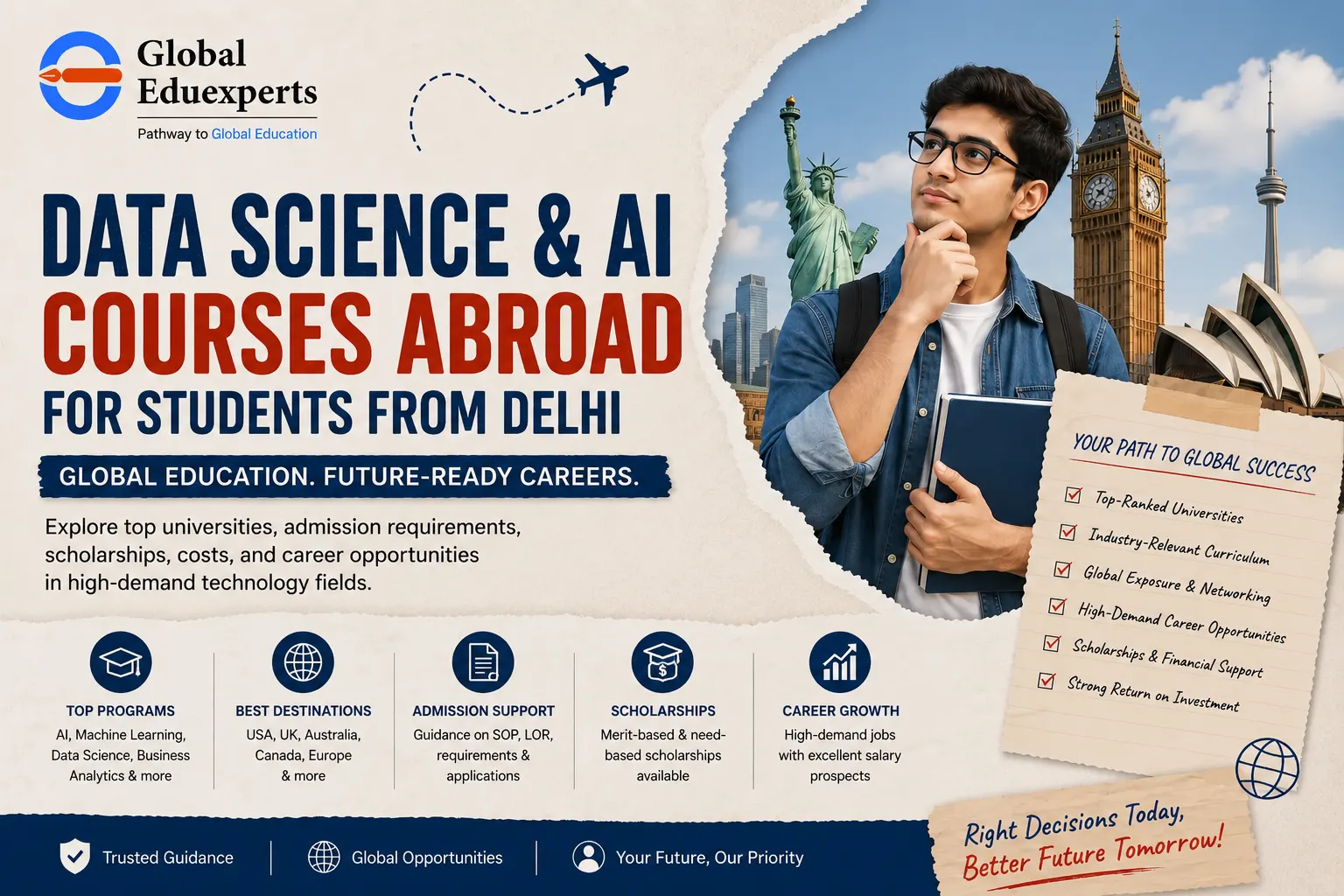
Students interested in Artificial Intelligence, Machine Learning, Data Science, and Business Analytics can use this guidance to identify suitable international programs, compare universities and study destinations, understand admission requirements, evaluate costs and scholarships, and explore career opportunities in high-growth technology sectors. The outcome is a well-informed study-abroad plan that aligns academic choices with future industry demand, technical skill development, and long-term career growth.
Few academic fields have experienced growth as rapid and widespread as Data Science and Artificial Intelligence.
Over the last decade, organizations across almost every industry have transformed the way they operate by adopting digital technologies, automation, advanced analytics, and intelligent systems. What was once considered a specialized area of technology has now become a critical business function influencing decision-making, innovation, and long-term competitiveness.
As businesses increasingly rely on data and artificial intelligence to solve complex challenges, the demand for skilled professionals continues to grow. This trend explains why Data Science and AI Courses Abroad for Students From Delhi are becoming some of the most sought-after study-abroad options in 2026.
Students are no longer choosing these programs simply because they are popular. They are choosing them because they offer strong career prospects, global relevance, and opportunities to work on technologies that are shaping the future.
Every day, organizations generate enormous amounts of information.
From online transactions and healthcare records to social media interactions and business operations, data has become one of the most valuable assets in the modern economy.
However, data alone has limited value unless professionals can analyze it, interpret it, and use it to support better decisions.
This is where Data Science plays a crucial role.
| Area | Impact |
|---|---|
| Business Strategy | High |
| Customer Insights | High |
| Product Development | High |
| Operational Efficiency | High |
| Risk Management | High |
Organizations that effectively use data often gain a significant competitive advantage.
As a result, companies are actively seeking professionals with advanced analytical and technical skills.
Artificial Intelligence is no longer limited to research laboratories or technology companies.
Today, AI is being used across industries to improve productivity, automate repetitive tasks, enhance customer experiences, and support decision-making.
Healthcare
Finance
Manufacturing
Retail
Education
Transportation
Telecommunications
This broad adoption has created strong demand for professionals who understand AI systems and their practical applications.
Students interested in Study Artificial Intelligence Abroad After Graduation From Delhi are increasingly recognizing the long-term value of developing expertise in this rapidly expanding field.
Organizations worldwide are investing heavily in digital transformation initiatives.
Businesses are adopting technologies such as:
Cloud Computing
Artificial Intelligence
Machine Learning
Big Data Analytics
Automation Platforms
Internet of Things (IoT)
These investments require skilled professionals who can design, implement, and manage advanced technological systems.
| Business Need | Technology Role |
|---|---|
| Automation | AI and Machine Learning |
| Data Utilization | Data Science |
| Decision Making | Business Analytics |
| Customer Experience | AI Applications |
Students with relevant technical skills are often well-positioned to contribute to these initiatives.
One of the biggest reasons students choose AI and Data Science programs is the growing demand for qualified professionals.
Organizations are increasingly competing for talent capable of working with complex datasets, predictive models, and intelligent technologies.
Data Scientist
AI Engineer
Machine Learning Engineer
Data Analyst
Business Intelligence Analyst
AI Researcher
Data Engineer
| Benefit | Business Impact |
|---|---|
| Better decision-making | High |
| Process automation | High |
| Innovation support | High |
| Competitive advantage | High |
This demand is expected to continue as technology becomes more integrated into daily business operations.
A common misconception is that Data Science and AI careers are limited to technology companies.
In reality, these skills are increasingly important across a wide range of sectors.
Banking and Financial Services
Healthcare
E-commerce
Logistics
Manufacturing
Government Organizations
Consulting Firms
Because data and technology influence nearly every industry, graduates often have diverse career options available to them.
Machine Learning is one of the most important branches of Artificial Intelligence.
It enables systems to learn from data, identify patterns, and improve performance over time.
As businesses collect more information, machine learning technologies are becoming essential for:
Forecasting demand
Detecting fraud
Personalizing customer experiences
Improving operational efficiency
This explains the growing popularity of AI and Machine Learning Courses Abroad for Delhi Students.
Students who develop machine learning expertise often gain exposure to one of the most influential technologies shaping the future workforce.
One reason Data Science remains attractive is its combination of technical and business applications.
Professionals in this field do more than work with numbers.
They help organizations answer important questions such as:
What trends are emerging?
Which customers are most valuable?
How can operations become more efficient?
What business opportunities exist?
Statistical Analysis
Data Visualization
Predictive Modeling
Programming
Business Intelligence
Data Engineering
This combination of technical and strategic skills makes Data Science highly relevant across industries.
Many students interested in technology also want exposure to business strategy.
This has increased interest in Data Analytics and Business Analytics Courses Abroad.
Business Analytics focuses on using data to support organizational decision-making and strategic planning.
| Advantage | Outcome |
|---|---|
| Data-driven decision making | Better business performance |
| Strategic insights | Competitive advantage |
| Cross-functional applications | Broad career opportunities |
The field appeals to students who enjoy both analytical thinking and business problem-solving.
Technology changes rapidly, but analytical and problem-solving skills remain valuable across industries.
Graduates with Data Science and AI expertise often find opportunities in multiple career paths rather than being restricted to a single profession.
Multiple industry options
Diverse job roles
Global employability
Continuous learning opportunities
This flexibility contributes significantly to the long-term appeal of these programs.
Students pursuing AI and Data Science abroad often gain access to advanced research environments.
Many international universities actively invest in:
Artificial Intelligence Research
Robotics
Computer Vision
Natural Language Processing
Advanced Analytics
These opportunities allow students to work on technologies that may influence future industries and societal development.
| Area | Benefit |
|---|---|
| Innovation | High |
| Technical expertise | High |
| Industry relevance | High |
Research exposure can strengthen both academic and professional development.
Several emerging technologies are expected to shape future job markets.
These include:
Artificial Intelligence
Machine Learning
Generative AI
Automation
Predictive Analytics
Intelligent Systems
As organizations adopt these technologies, the need for skilled professionals continues to increase.
Students pursuing High Demand AI Courses Abroad With Job Opportunities are often positioning themselves for careers in industries undergoing rapid transformation.
Students increasingly view international education as an opportunity to gain exposure to advanced academic environments, diverse perspectives, and global industry trends.
Many universities abroad offer:
Specialized AI programs
Industry-focused curricula
Research opportunities
Collaborative projects
Access to innovation ecosystems
This makes studying abroad an attractive option for students interested in emerging technologies.
While salary should never be the only reason for selecting a course, earning potential remains an important consideration.
Many AI and Data Science roles are associated with strong compensation because organizations place significant value on these skills.
| Factor | Importance |
|---|---|
| Technical expertise | High |
| Industry demand | High |
| Problem-solving skills | High |
| Continuous learning | High |
Students who combine strong technical knowledge with practical experience often benefit from strong career progression opportunities.
Few technologies are expected to influence the future workforce as significantly as Artificial Intelligence and Data Science.
Businesses, governments, healthcare systems, and research organizations continue investing heavily in these areas because of their ability to improve efficiency, support innovation, and create new opportunities.
For students researching MS in Data Science Abroad for Indian Students, Computer Science with AI Specialization Abroad 2026, and Best Countries for Data Science and AI Courses Abroad, the growing demand for analytical and AI-related expertise provides a compelling reason to explore these fields.
The strongest advantage of studying Data Science and Artificial Intelligence is not simply the popularity of the discipline. It is the opportunity to develop skills that are increasingly relevant across industries, adaptable to future workforce changes, and aligned with some of the most significant technological developments of the coming decade.
As digital transformation continues accelerating worldwide, professionals who can understand data, build intelligent systems, and solve complex business challenges are likely to remain valuable contributors to organizations across the global economy.
Artificial Intelligence and Data Science are no longer niche academic disciplines reserved for researchers and technology specialists.
Today, they are among the most influential fields shaping business, healthcare, finance, manufacturing, education, transportation, and countless other industries. Organizations across the world are investing heavily in intelligent systems, predictive analytics, automation, and advanced technologies to improve decision-making and gain competitive advantages.
As a result, universities have expanded their offerings significantly, creating specialized programs that address different areas within AI and Data Science.
For students exploring Data Science and AI Courses Abroad for Students From Delhi, understanding the differences between these programs is essential. While many courses appear similar on the surface, each specialization focuses on different skills, career pathways, and industry applications.
Choosing the right program requires understanding not only what is currently popular but also which field aligns with personal interests, technical strengths, and long-term career goals.
Artificial Intelligence is one of the most recognized and rapidly evolving areas of modern technology.
AI focuses on developing systems capable of performing tasks that traditionally required human intelligence, such as reasoning, learning, problem-solving, language understanding, and decision-making.
Intelligent Systems
Machine Learning
Deep Learning
Computer Vision
Natural Language Processing
Robotics Applications
| Advantage | Value |
|---|---|
| Future-focused skills | High |
| Industry demand | High |
| Research opportunities | High |
| Cross-industry applications | High |
Students interested in innovation and advanced technologies often view AI as one of the most exciting study-abroad pathways.
Machine Learning is a specialized branch of Artificial Intelligence that focuses on enabling systems to learn from data and improve their performance over time.
Rather than relying entirely on predefined rules, machine learning models identify patterns and make predictions based on large datasets.
Predictive Modeling
Supervised Learning
Unsupervised Learning
Reinforcement Learning
Algorithm Development
| Factor | Career Relevance |
|---|---|
| Automation | High |
| Data-driven systems | High |
| Industry demand | High |
This explains the growing interest in AI and Machine Learning Courses Abroad for Delhi Students.
Students with strong analytical and mathematical interests often find Machine Learning particularly rewarding.
Data Science has become one of the most sought-after academic and professional disciplines worldwide.
Organizations collect enormous amounts of information every day, but the value of that information depends on the ability to analyze and interpret it effectively.
Data Scientists help organizations transform raw data into actionable insights.
Statistical Analysis
Data Visualization
Predictive Analytics
Programming
Data Engineering
Business Intelligence
| Benefit | Professional Value |
|---|---|
| Broad industry relevance | High |
| Strong employability | High |
| Diverse career options | High |
Students considering an MS in Data Science Abroad for Indian Students often appreciate the field's flexibility and global applicability.
Deep Learning is one of the most advanced areas within Artificial Intelligence.
It focuses on developing neural networks capable of learning complex patterns from massive datasets.
Many of today's most impressive AI applications rely on deep learning technologies.
Speech Recognition
Image Recognition
Autonomous Systems
Recommendation Engines
Generative AI
| Area | Industry Impact |
|---|---|
| Automation | High |
| AI innovation | High |
| Research advancement | High |
Students interested in advanced AI development often explore Deep Learning specializations.
Not every student interested in data wants to pursue a highly technical career.
Business Analytics offers a practical alternative that combines analytical thinking with business strategy.
The field focuses on using data to improve organizational performance and support decision-making.
Business Intelligence
Data Interpretation
Strategic Analysis
Performance Measurement
Predictive Business Models
| Advantage | Outcome |
|---|---|
| Business relevance | High |
| Industry versatility | High |
| Analytical skill development | High |
This explains the increasing popularity of Data Analytics and Business Analytics Courses Abroad.
Natural Language Processing (NLP) focuses on enabling computers to understand, interpret, and generate human language.
Many technologies people use every day rely on NLP.
Chatbots
Virtual Assistants
Language Translation
Sentiment Analysis
Voice Recognition Systems
| Driver | Importance |
|---|---|
| AI adoption | High |
| Communication technologies | High |
| Automation needs | High |
Students interested in language technologies and artificial intelligence often find NLP fascinating.
Computer Vision focuses on enabling machines to interpret and analyze visual information.
The field combines Artificial Intelligence, Machine Learning, and image-processing technologies.
Facial Recognition
Medical Imaging
Autonomous Vehicles
Quality Control Systems
Security Technologies
| Area | Growth Potential |
|---|---|
| Healthcare | High |
| Manufacturing | High |
| Transportation | High |
As visual data becomes increasingly important, demand for Computer Vision expertise continues to grow.
Universities worldwide are increasingly developing highly specialized AI-focused programs.
Rather than offering broad technology degrees, many institutions now provide targeted programs in specific areas of Artificial Intelligence.
AI for Healthcare
AI in Finance
Robotics and Intelligent Systems
Applied Artificial Intelligence
Responsible AI
These specialized pathways allow students to combine AI expertise with industry-specific knowledge.
Many students prefer a broader academic foundation before specializing.
This has increased interest in Computer Science with AI Specialization Abroad 2026.
These programs combine traditional computer science education with advanced AI training.
Software Engineering
Algorithms
Database Systems
Artificial Intelligence
Machine Learning
| Advantage | Outcome |
|---|---|
| Strong technical foundation | Career flexibility |
| AI specialization | Future relevance |
| Multiple career pathways | Broad opportunities |
Students who want both breadth and specialization often choose this route.
One reason students pursue international AI and Data Science education is exposure to practical learning opportunities.
Many leading universities collaborate closely with industry partners.
Research Projects
Industry Case Studies
Applied Analytics Projects
Internship Opportunities
Technology Innovation Labs
These experiences help students understand how theoretical concepts apply in real-world environments.
Artificial Intelligence and Data Science remain highly research-driven fields.
Students studying abroad often gain access to advanced research facilities and collaborative projects.
Generative AI
Ethical AI
Machine Learning Applications
Autonomous Systems
Data Analytics Innovation
Research exposure can significantly enhance technical expertise and professional development.
Many students assume all AI and Data Science degrees are similar.
In reality, programs often differ significantly in focus.
Do I enjoy mathematics and statistics?
Am I interested in programming?
Do I prefer research or practical applications?
Do I want a technical or business-oriented role?
The answers often help identify the most suitable specialization.
Students increasingly evaluate programs based on future industry demand.
Several areas continue receiving significant investment globally.
| Field | Demand Outlook |
|---|---|
| Artificial Intelligence | Strong |
| Machine Learning | Strong |
| Data Science | Strong |
| Business Analytics | Strong |
| Computer Vision | Growing |
| Natural Language Processing | Growing |
These trends contribute to the ongoing popularity of AI-related study-abroad programs.
Many students select programs solely because Artificial Intelligence is trending.
However, success in these fields requires genuine interest and aptitude.
| Mistake | Potential Consequence |
|---|---|
| Following trends blindly | Poor fit |
| Ignoring technical requirements | Academic challenges |
| Limited research | Weak decisions |
| Unrealistic expectations | Career dissatisfaction |
A thoughtful evaluation process generally produces better outcomes.
Artificial Intelligence and Data Science continue influencing how organizations operate, innovate, and compete.
For students researching Best Data Science Universities Abroad for Indian Students, High Demand AI Courses Abroad With Job Opportunities, and Best Countries for Data Science and AI Courses Abroad, understanding the range of available programs is an important first step.
Whether the focus is Artificial Intelligence, Machine Learning, Data Science, Deep Learning, Business Analytics, Natural Language Processing, Computer Vision, or Computer Science with AI specialization, each pathway offers unique opportunities and challenges.
The best program is not necessarily the most popular one. It is the course that aligns with a student's interests, strengths, technical abilities, and long-term career ambitions while remaining relevant to the industries shaping the future of work.
Choosing the right country is one of the most important decisions for students planning to pursue Data Science and Artificial Intelligence abroad.
While course content and university reputation matter significantly, the country itself influences academic exposure, research opportunities, industry access, internship availability, post-study work options, and long-term career prospects.
Many students focus only on university rankings when evaluating study destinations. However, successful outcomes often depend on a combination of factors including industry ecosystems, innovation environments, employer connections, and opportunities to apply technical skills in real-world settings.
For students exploring Data Science and AI Courses Abroad for Students From Delhi, understanding the strengths of different destinations can help create a more informed and practical study-abroad strategy.
Each country offers unique advantages, and the best choice depends on individual goals, career interests, budget considerations, and preferred learning environments.
Artificial Intelligence and Data Science are closely connected to innovation, research, and technology-driven industries.
As a result, students often benefit from studying in countries that actively invest in:
Artificial Intelligence research
Technology startups
Digital transformation
Advanced analytics
Innovation ecosystems
| Factor | Importance |
|---|---|
| University quality | High |
| Research opportunities | High |
| Industry partnerships | High |
| Post-study work options | High |
| Technology ecosystem | High |
Students should evaluate countries based on long-term career opportunities rather than destination popularity alone.
The United States remains one of the most influential destinations for students pursuing Artificial Intelligence and Data Science.
Many of the world's leading technology companies, research institutions, and innovation hubs are located in the USA.
Strong research infrastructure
Advanced AI laboratories
Technology-driven economy
Industry-focused education
Diverse academic offerings
Silicon Valley
Seattle
Boston
Austin
New York
These regions continue attracting global investment in Artificial Intelligence, Machine Learning, Cloud Computing, and Data Science.
| Area | Advantage |
|---|---|
| Research | Excellent |
| Innovation | Excellent |
| Industry exposure | Excellent |
| Technology ecosystem | Excellent |
Students interested in advanced research and cutting-edge innovation often view the USA as a leading destination.
The United Kingdom has established itself as one of the most respected destinations for higher education.
Its universities have a long history of academic excellence and continue investing heavily in Artificial Intelligence and data-driven research.
Globally recognized universities
Strong research culture
One-year master's programs
Expanding AI initiatives
International student diversity
Artificial Intelligence
Data Analytics
Business Analytics
FinTech
Computer Science
| Factor | Benefit |
|---|---|
| Program duration | Efficient |
| Academic reputation | Strong |
| Industry access | Strong |
| Research quality | Strong |
Students seeking high-quality education within shorter program timelines often consider the UK attractive.
Australia continues to attract international students because of its strong academic standards, practical learning approach, and growing technology sector.
Australian universities increasingly emphasize industry collaboration and real-world applications of AI and Data Science.
Industry-integrated learning
Applied research opportunities
Multicultural environment
Strong student support systems
Growing technology workforce
Data Science
Artificial Intelligence
Cybersecurity
Business Analytics
Software Engineering
| Area | Value |
|---|---|
| Employability focus | High |
| Practical learning | High |
| Industry partnerships | High |
Students interested in combining academic learning with practical industry exposure often find Australia appealing.
Ireland has become one of Europe's fastest-growing technology destinations.
Many multinational technology companies have established significant operations there, creating strong connections between universities and industry.
Expanding technology sector
Strong international employer presence
Growing innovation ecosystem
English-speaking environment
Artificial Intelligence
Cloud Computing
Software Development
Data Analytics
Technology Consulting
| Factor | Advantage |
|---|---|
| Technology investment | Strong |
| Industry exposure | Strong |
| International workforce | Strong |
Students interested in technology careers within Europe increasingly consider Ireland a strategic option.
Europe is not a single education system but a collection of countries with unique strengths and academic traditions.
Many European universities are actively investing in Artificial Intelligence, Machine Learning, and advanced analytics research.
Diverse academic environments
Specialized technology programs
Research-focused institutions
International collaboration opportunities
Artificial Intelligence
Robotics
Sustainability and AI
Advanced Analytics
Data Engineering
| Area | Benefit |
|---|---|
| Research collaboration | High |
| Academic diversity | High |
| Innovation ecosystems | High |
Students seeking specialized academic pathways often find Europe particularly attractive.
Research plays a significant role in AI and Data Science education.
Students interested in innovation often look for universities that actively contribute to technological advancement.
Machine Learning
Generative AI
Computer Vision
Natural Language Processing
Autonomous Systems
| Destination | Research Strength |
|---|---|
| USA | Excellent |
| UK | Strong |
| Australia | Strong |
| Ireland | Growing |
| Europe | Strong |
Research-intensive environments can provide valuable exposure to emerging technologies.
Modern AI and Data Science education extends beyond classroom learning.
Many universities now collaborate closely with employers to provide practical experiences.
Internship Programs
Research Partnerships
Industry Projects
Technology Labs
Innovation Challenges
These opportunities help students understand how theoretical concepts are applied in professional settings.
Many students evaluate destinations based on opportunities available after graduation.
Post-study work pathways allow graduates to gain international experience and apply their skills in real-world environments.
Professional development
Industry experience
Networking opportunities
Career progression
While post-study options vary between countries, they remain an important consideration during destination selection.
AI and Data Science careers often thrive in locations where innovation ecosystems are well developed.
Students frequently benefit from proximity to:
Technology companies
Research organizations
Startup communities
Innovation centers
| Destination | Notable Ecosystems |
|---|---|
| USA | Silicon Valley, Seattle |
| UK | London, Cambridge |
| Australia | Sydney, Melbourne |
| Ireland | Dublin |
| Europe | Multiple innovation clusters |
Access to these ecosystems can influence internship and employment opportunities.
Students should recognize that learning approaches vary internationally.
Research intensity
Practical application focus
Industry engagement
Program structure
Assessment methods
Understanding these differences helps students choose environments that match their preferred learning style.
The best destination depends on what students hope to achieve professionally.
Advanced laboratories
Research-intensive universities
Innovation-driven programs
Internship opportunities
Employer partnerships
Practical learning environments
The ideal destination aligns with both academic and professional objectives.
Many students focus too heavily on rankings or social media trends.
| Mistake | Impact |
|---|---|
| Choosing based only on rankings | Limited perspective |
| Ignoring industry ecosystem | Missed opportunities |
| Overlooking costs | Financial challenges |
| Following trends blindly | Poor fit |
A broader evaluation often leads to better decisions.
Students often search for the "best" destination for Artificial Intelligence and Data Science.
In reality, each country offers different advantages.
The USA provides world-leading technology ecosystems and research opportunities.
The UK combines academic excellence with efficient master's programs.
Australia emphasizes practical learning and industry engagement.
Ireland offers access to a rapidly growing technology environment.
Europe provides diverse academic pathways and strong research collaborations.
For students researching Best Countries for Data Science and AI Courses Abroad, Best Data Science Universities Abroad for Indian Students, and Study Artificial Intelligence Abroad After Graduation From Delhi, the most effective approach is to match destination strengths with individual goals.
The right country is not necessarily the most popular one. It is the destination that supports a student's academic interests, career ambitions, financial considerations, and long-term professional development in the evolving world of Artificial Intelligence and Data Science.
The rapid growth of Artificial Intelligence, Machine Learning, and Data Science has encouraged universities worldwide to invest heavily in technology-focused education, advanced research facilities, and industry collaboration initiatives.
As a result, students now have access to a wide range of specialized programs designed to prepare graduates for careers in some of the fastest-growing sectors of the global economy.
However, choosing a university for Data Science or AI is not simply about selecting the institution with the highest ranking.
A university that performs exceptionally well in business, law, or medicine may not necessarily be the strongest option for Artificial Intelligence or Data Science. Students need to look beyond overall rankings and evaluate factors that directly influence learning quality, research opportunities, employability outcomes, and career development.
For students researching Data Science and AI Courses Abroad for Students From Delhi, understanding how universities differ can significantly improve the shortlisting process and lead to more informed decisions.
Artificial Intelligence and Data Science are highly dynamic disciplines.
Technologies evolve rapidly, industry requirements change frequently, and employers increasingly seek graduates with both theoretical knowledge and practical experience.
The right university can provide:
Access to advanced research
Industry-focused learning
Specialized faculty expertise
Professional networking opportunities
Exposure to emerging technologies
| Factor | Impact |
|---|---|
| Academic quality | High |
| Career opportunities | High |
| Research exposure | High |
| Industry engagement | High |
| Employability outcomes | High |
University selection can influence both academic development and future career prospects.
Many students begin their search by reviewing international university rankings.
While rankings should not be the only factor considered, they can provide useful insights into academic reputation, research performance, and institutional resources.
Leading universities often attract:
Distinguished faculty
Research funding
Industry partnerships
International students
Global recruiters
These factors contribute to strong learning environments and professional opportunities.
| Area | Importance |
|---|---|
| Academic reputation | High |
| Research output | High |
| Faculty quality | High |
| Internationalization | High |
Students should use rankings as one evaluation tool rather than the sole basis for decision-making.
Artificial Intelligence and Machine Learning are research-driven fields.
Many of today's technological breakthroughs originate from university laboratories and academic research centers.
Students interested in innovation often benefit from studying at institutions that actively contribute to technological advancement.
Artificial Intelligence
Machine Learning
Deep Learning
Computer Vision
Natural Language Processing
Robotics
| Benefit | Value |
|---|---|
| Innovation exposure | High |
| Technical depth | High |
| Academic development | High |
Research-intensive environments can provide opportunities to work on real-world challenges and emerging technologies.
One factor that students frequently overlook is faculty quality.
In AI and Data Science programs, professors often contribute directly to research, industry innovation, and technological development.
Faculty members may bring experience from:
Research institutions
Technology companies
Government projects
International collaborations
| Area | Impact |
|---|---|
| Curriculum quality | High |
| Research opportunities | High |
| Industry relevance | High |
Learning from experts actively engaged in the field can significantly enhance educational outcomes.
Modern employers increasingly value practical experience alongside academic achievement.
As a result, many universities collaborate closely with industry partners.
Internship programs
Industry-sponsored projects
Innovation challenges
Corporate research initiatives
Technology labs
These experiences help students understand how classroom concepts are applied in professional environments.
| Advantage | Outcome |
|---|---|
| Real-world exposure | Improved employability |
| Networking opportunities | Professional growth |
| Practical skill development | Industry readiness |
Universities with strong industry connections often provide valuable career-building experiences.
The United States remains one of the most influential destinations for Artificial Intelligence education.
Many globally recognized universities continue leading AI research and innovation.
Artificial Intelligence
Machine Learning
Computer Science
Data Science
Robotics
| Factor | Advantage |
|---|---|
| Research infrastructure | Excellent |
| Technology ecosystem | Excellent |
| Industry partnerships | Excellent |
Students interested in advanced research and cutting-edge technology often explore US institutions.
The United Kingdom has a strong reputation for technology education and academic excellence.
Its universities continue investing heavily in Artificial Intelligence, Machine Learning, and Data Analytics research.
AI Research
Business Analytics
Data Science
Computational Technologies
| Area | Benefit |
|---|---|
| Academic reputation | Strong |
| Research quality | Strong |
| Industry integration | Strong |
Students often appreciate the combination of rigorous academics and relatively shorter master's programs.
Australia has become increasingly attractive for technology-focused international students.
Universities are strengthening programs in Artificial Intelligence, Data Science, Cybersecurity, and Business Analytics.
Industry-focused learning
Practical education models
Research initiatives
Growing technology sector
| Factor | Value |
|---|---|
| Employability focus | High |
| Industry engagement | High |
| Applied learning | High |
Students interested in balancing academic knowledge with practical application often find Australian universities appealing.
Ireland has developed into one of Europe's leading technology hubs.
Its universities maintain strong relationships with multinational organizations operating across the country.
Artificial Intelligence
Data Analytics
Cloud Technologies
Software Development
| Benefit | Impact |
|---|---|
| Industry proximity | High |
| Technology ecosystem | High |
| Career opportunities | High |
Students interested in technology careers within Europe often include Irish institutions on their shortlists.
Europe provides diverse educational opportunities through a wide range of institutions and research centers.
Many universities offer specialized programs tailored to emerging technology fields.
Machine Learning
Data Engineering
AI Ethics
Robotics
Advanced Analytics
| Area | Strength |
|---|---|
| Research collaboration | High |
| Academic diversity | High |
| Specialized programs | High |
Students seeking niche specializations often explore European options.
Many students focus exclusively on rankings while overlooking graduate outcomes.
A university's ability to prepare students for employment is often equally important.
What industries hire graduates?
Are internship opportunities available?
How strong are employer connections?
What practical learning opportunities exist?
| Indicator | Importance |
|---|---|
| Internship access | High |
| Industry partnerships | High |
| Career support services | High |
| Alumni networks | High |
Strong employability outcomes often reflect effective industry engagement.
AI and Data Science students frequently benefit from access to advanced facilities.
These resources support both academic learning and innovation.
AI Laboratories
Data Science Centers
Innovation Hubs
Robotics Facilities
Computational Research Centers
Access to modern facilities can enhance both learning and research opportunities.
Artificial Intelligence development is often driven by global collaboration.
Many universities participate in international partnerships involving:
Academic institutions
Research organizations
Technology companies
| Benefit | Outcome |
|---|---|
| Diverse perspectives | Better learning |
| Research opportunities | Greater exposure |
| Professional networks | Career growth |
Students often gain broader insights through internationally connected programs.
Many students unintentionally limit their options by focusing on a narrow set of factors.
| Mistake | Consequence |
|---|---|
| Looking only at rankings | Incomplete evaluation |
| Ignoring curriculum details | Poor academic fit |
| Overlooking industry links | Reduced opportunities |
| Focusing solely on prestige | Limited perspective |
A balanced evaluation process generally produces better outcomes.
An effective shortlist typically combines academic quality, affordability, career opportunities, and personal preferences.
Program curriculum
Faculty expertise
Research opportunities
Industry partnerships
Graduate outcomes
Cost considerations
Location preferences
This approach often leads to more informed decisions than relying on rankings alone.
Students often search for a single "best" university for Artificial Intelligence or Data Science.
In reality, the ideal institution varies from one student to another.
A research-focused student may prioritize innovation laboratories and academic publications.
A career-focused student may place greater importance on internships and employer partnerships.
Someone pursuing MS in Data Science Abroad for Indian Students, Computer Science with AI Specialization Abroad 2026, or High Demand AI Courses Abroad With Job Opportunities should evaluate universities based on how well they align with personal objectives rather than public perception alone.
The strongest university choice is usually the institution that combines academic excellence, practical learning, industry relevance, and long-term career support. When students consider these factors together, they are more likely to find programs that support both professional success and meaningful growth in the rapidly evolving fields of Artificial Intelligence, Machine Learning, and Data Science.
Artificial Intelligence and Data Science are among the most competitive study-abroad disciplines today.
As demand for these programs continues growing, universities are becoming increasingly selective in their admissions process. Students applying to AI and Data Science courses are often evaluated not only on academic performance but also on technical readiness, analytical ability, problem-solving skills, and overall potential to succeed in a challenging and rapidly evolving field.
For students planning to pursue Data Science and AI Courses Abroad for Students From Delhi, understanding admission requirements early can significantly improve application quality and increase the likelihood of receiving offers from competitive universities.
Although admission criteria vary across countries and institutions, several common requirements appear consistently in most Artificial Intelligence, Machine Learning, and Data Science programs.
Unlike some general academic disciplines, AI and Data Science programs often require students to demonstrate both academic capability and technical preparedness.
Universities want to ensure applicants can handle subjects such as:
Mathematics
Statistics
Programming
Data Analysis
Computational Thinking
Because these programs are technically demanding, admissions teams often look beyond grades alone when evaluating applications.
| Evaluation Area | Importance |
|---|---|
| Academic performance | High |
| Quantitative ability | High |
| Technical background | High |
| Motivation and goals | High |
| Communication skills | High |
A strong application usually demonstrates readiness across multiple areas.
Academic qualifications form the foundation of every university application.
Most Data Science and AI programs expect applicants to have completed a recognized bachelor's degree or equivalent qualification.
Computer Science
Information Technology
Engineering
Mathematics
Statistics
Physics
Electronics
In some cases, students from business, economics, or other disciplines may also be considered if they demonstrate strong quantitative skills.
| Requirement | Typical Importance |
|---|---|
| Undergraduate GPA | High |
| Subject performance | High |
| Quantitative coursework | High |
Strong academic consistency can significantly strengthen an application.
One of the most overlooked admission requirements for AI and Data Science programs is mathematical preparation.
Many students focus heavily on programming while underestimating the importance of mathematics.
Calculus
Linear Algebra
Probability
Statistics
Optimization Techniques
| Area | Application |
|---|---|
| Machine Learning | High |
| Data Modeling | High |
| Predictive Analytics | High |
| Artificial Intelligence | High |
Students with strong quantitative foundations often adapt more easily to advanced AI coursework.
Programming has become a fundamental skill for Data Science and Artificial Intelligence students.
While universities may not always require professional-level coding experience, familiarity with programming concepts is often beneficial.
Python
R
Java
C++
SQL
| Skill Area | Importance |
|---|---|
| Data Analysis | High |
| Machine Learning | High |
| AI Development | High |
Applicants with prior programming experience often demonstrate stronger readiness for technical programs.
Since most international AI and Data Science programs are taught in English, universities typically require proof of language proficiency.
IELTS
TOEFL
PTE Academic
Duolingo English Test (accepted by some institutions)
| Skill | Importance |
|---|---|
| Reading | High |
| Writing | High |
| Listening | High |
| Speaking | High |
Strong communication skills are important because students must often present research, participate in discussions, and collaborate on projects.
The Statement of Purpose is often one of the most influential parts of an application.
While grades and test scores demonstrate academic ability, the SOP helps universities understand the person behind the application.
Career goals
Academic interests
Motivation for studying AI or Data Science
Relevant experiences
Long-term plans
| Quality | Importance |
|---|---|
| Clarity | High |
| Authenticity | High |
| Goal alignment | High |
| Logical structure | High |
A well-written SOP should explain why the chosen program aligns with the applicant's future ambitions.
Most universities require recommendation letters as part of the application process.
These letters help admissions committees evaluate applicants from an external perspective.
University professors
Academic supervisors
Project mentors
Professional managers
| Attribute | Value |
|---|---|
| Academic ability | High |
| Technical skills | High |
| Work ethic | High |
| Problem-solving capability | High |
Personalized and detailed recommendations generally carry more weight than generic endorsements.
Graduate Record Examination (GRE) requirements have changed significantly in recent years.
Some universities continue to require GRE scores, while others have made them optional or removed them entirely.
Quantitative Reasoning
Analytical Writing
Verbal Reasoning
| Situation | Potential Benefit |
|---|---|
| Competitive programs | High |
| Lower GPA compensation | Moderate |
| Scholarship consideration | Moderate |
Students should carefully review university-specific requirements before applying.
Many AI and Data Science applicants have similar academic profiles.
Technical projects can help differentiate candidates.
Machine Learning Models
Data Visualization Projects
Predictive Analytics Applications
AI Research Initiatives
Programming Competitions
| Benefit | Impact |
|---|---|
| Demonstrates practical skills | High |
| Shows initiative | High |
| Strengthens technical profile | High |
Admissions teams often appreciate evidence of hands-on learning.
While portfolios are traditionally associated with creative disciplines, they are increasingly useful in technology-focused applications.
Students can showcase:
Coding projects
Research work
AI applications
Data science case studies
GitHub repositories
| Area | Advantage |
|---|---|
| Technical credibility | High |
| Skill demonstration | High |
| Practical experience | High |
A strong portfolio can provide tangible proof of technical competence.
Many students assume professional experience is mandatory for Data Science and AI programs.
In reality, requirements vary significantly.
Recent graduates
Final-year students
Early-career professionals
Experienced applicants
| Benefit | Value |
|---|---|
| Practical context | High |
| Industry exposure | High |
| Application strength | Moderate |
While not always essential, relevant experience can enhance an applicant's profile.
Students interested in research-focused universities may benefit from prior academic research experience.
Undergraduate thesis projects
Academic publications
Faculty-led research
Independent studies
| Area | Importance |
|---|---|
| Research-oriented programs | High |
| PhD pathways | High |
| Academic careers | High |
Research involvement demonstrates curiosity and analytical thinking.
Many students focus exclusively on grades when preparing applications.
However, leading universities typically use holistic evaluation methods.
Academic records
SOP quality
Recommendation letters
Technical projects
English proficiency
Relevant experience
A balanced profile often performs better than strength in only one area.
Strong students are sometimes rejected because of poor application planning.
Applying only to highly competitive institutions can limit opportunities.
Create a balanced list that includes:
Ambitious universities
Realistic universities
Safe universities
| Benefit | Outcome |
|---|---|
| Higher admission probability | Stronger results |
| More options | Better decision-making |
| Reduced risk | Greater flexibility |
Strategic planning often improves admission outcomes significantly.
Several recurring mistakes reduce the competitiveness of otherwise strong applications.
| Mistake | Consequence |
|---|---|
| Weak SOPs | Lower impact |
| Generic recommendations | Reduced credibility |
| Ignoring prerequisites | Eligibility concerns |
| Last-minute applications | Missed opportunities |
| Limited university research | Poor fit |
Avoiding these mistakes can substantially strengthen applications.
Data Science and Artificial Intelligence programs are becoming increasingly competitive worldwide.
Students interested in MS in Data Science Abroad for Indian Students, AI and Machine Learning Courses Abroad for Delhi Students, and Study Artificial Intelligence Abroad After Graduation From Delhi should begin preparing early.
Strong academic performance, mathematical readiness, programming knowledge, effective SOPs, compelling recommendations, and thoughtful application strategies all contribute to admission success.
The most competitive applicants are not necessarily those with perfect grades. They are students who demonstrate clear motivation, technical preparedness, intellectual curiosity, and a genuine commitment to building careers in Artificial Intelligence, Machine Learning, and Data Science.
Early preparation and a well-structured application process can significantly improve the chances of gaining admission to leading universities around the world.
One of the biggest reasons students are increasingly choosing Data Science and Artificial Intelligence programs abroad is the wide range of career opportunities available after graduation.
Artificial Intelligence is no longer a future concept being explored only by researchers and technology companies. It has become an integral part of modern business operations, healthcare systems, financial services, manufacturing processes, marketing strategies, and public services.
Similarly, Data Science has evolved into one of the most valuable business functions across industries. Organizations generate enormous amounts of information every day and require skilled professionals who can transform that data into meaningful insights.
As technology adoption continues accelerating worldwide, employers are actively searching for professionals who understand machine learning, predictive analytics, automation, and intelligent systems.
For students pursuing Data Science and AI Courses Abroad for Students From Delhi, the combination of global demand, career flexibility, and long-term growth potential makes these fields particularly attractive.
The modern economy is becoming increasingly data-driven.
Organizations now depend on data and intelligent technologies to:
Improve decision-making
Enhance customer experiences
Increase efficiency
Reduce operational costs
Support innovation
These priorities have created strong demand for professionals capable of designing, implementing, and managing AI-powered systems.
| Driver | Impact |
|---|---|
| Digital Transformation | High |
| Automation | High |
| Data Utilization | High |
| Artificial Intelligence Adoption | High |
| Technology Innovation | High |
As these trends continue, the need for qualified professionals is expected to remain strong.
Data Scientist remains one of the most recognized and sought-after roles within the technology sector.
Data Scientists help organizations understand complex information and uncover patterns that support strategic decision-making.
Data Analysis
Statistical Modeling
Predictive Analytics
Business Insights Generation
Data Visualization
| Skill Area | Importance |
|---|---|
| Statistics | High |
| Programming | High |
| Machine Learning | High |
| Data Visualization | High |
Because Data Scientists contribute directly to business decisions, their expertise is valued across multiple industries.
Artificial Intelligence Engineers focus on designing and implementing AI-powered solutions.
These professionals work with algorithms, machine learning models, and intelligent systems that automate processes and solve complex problems.
AI Model Development
Automation Systems
Intelligent Applications
Predictive Technologies
| Factor | Industry Demand |
|---|---|
| AI Adoption | High |
| Automation Needs | High |
| Innovation Initiatives | High |
Students interested in creating intelligent technologies often find AI Engineering particularly rewarding.
Machine Learning Engineers play a critical role in transforming theoretical models into practical solutions.
Their work focuses on developing systems that can learn from data and improve performance over time.
Algorithm Development
Model Deployment
Performance Optimization
Data Processing
| Business Need | Relevance |
|---|---|
| Automation | High |
| Personalization | High |
| Forecasting | High |
This role continues to attract students pursuing AI and Machine Learning Courses Abroad for Delhi Students.
Not every graduate enters highly technical AI roles.
Many students pursue careers that combine analytical skills with business decision-making.
Business Intelligence Analysts help organizations interpret data and identify opportunities for growth and improvement.
Business Reporting
Trend Analysis
Performance Monitoring
Strategic Recommendations
| Benefit | Organizational Impact |
|---|---|
| Better decisions | High |
| Operational efficiency | High |
| Strategic planning | High |
The position is particularly attractive to students interested in both technology and business.
Data Engineers focus on creating and maintaining the infrastructure that supports data analysis and AI applications.
Without effective data systems, advanced analytics and machine learning projects cannot function properly.
Data Pipeline Development
Database Management
Data Architecture
System Integration
| Area | Importance |
|---|---|
| Data Accessibility | High |
| System Reliability | High |
| Analytics Support | High |
As organizations continue expanding their data capabilities, demand for Data Engineers remains strong.
Students interested in innovation and academic exploration often pursue careers in AI research.
AI Researchers work on developing new algorithms, technologies, and applications that shape future advancements.
Deep Learning
Natural Language Processing
Computer Vision
Generative AI
Robotics
| Contribution | Impact |
|---|---|
| Innovation | High |
| Technological advancement | High |
| Industry transformation | High |
Research roles often appeal to students who enjoy experimentation and problem-solving.
Natural Language Processing (NLP) focuses on helping machines understand and interact with human language.
Many modern AI applications depend on NLP technologies.
Virtual Assistants
Chatbots
Language Translation
Sentiment Analysis
| Driver | Growth Potential |
|---|---|
| AI adoption | High |
| Communication technologies | High |
| Automation demand | High |
Students interested in language technologies often explore this specialized area.
Computer Vision allows machines to interpret and analyze visual information.
The technology is increasingly used in sectors such as healthcare, transportation, security, and manufacturing.
Medical Imaging
Autonomous Vehicles
Quality Inspection Systems
Facial Recognition Technologies
| Sector | Opportunity |
|---|---|
| Healthcare | High |
| Manufacturing | High |
| Transportation | High |
Computer Vision remains one of the fastest-growing AI specializations.
One of the biggest advantages of studying AI and Data Science is industry versatility.
Graduates are not restricted to technology companies alone.
Information Technology
Financial Services
Healthcare
E-commerce
Consulting
Telecommunications
Manufacturing
Government Organizations
Because data influences virtually every industry, career opportunities continue expanding.
Many organizations face challenges in finding professionals with advanced AI and Data Science skills.
This shortage contributes to strong employment opportunities across multiple markets.
| Driver | Importance |
|---|---|
| Digitalization | High |
| Data Growth | High |
| AI Integration | High |
| Automation Initiatives | High |
Students graduating with relevant technical expertise often enter industries actively seeking talent.
Salary is often a major consideration for students evaluating career options.
While compensation varies by country, employer, specialization, and experience level, AI and Data Science roles are generally associated with competitive earning potential.
Technical expertise
Industry sector
Geographic location
Professional experience
Specialized skills
| Skill | Market Demand |
|---|---|
| Machine Learning | High |
| Deep Learning | High |
| Data Engineering | High |
| Cloud Computing | High |
| AI Development | High |
Students who continuously develop their skills often improve long-term earning potential.
One reason AI and Data Science careers remain attractive is the opportunity for progression.
Professionals often move into increasingly specialized or leadership-oriented roles over time.
Data Analyst → Data Scientist
Data Scientist → Senior Data Scientist
AI Engineer → AI Architect
Business Analyst → Analytics Manager
Research Associate → AI Research Lead
The field offers multiple pathways depending on individual interests and strengths.
Students who study abroad often gain exposure to:
Global technology trends
International research environments
Diverse perspectives
Industry collaborations
These experiences can help graduates develop broader professional capabilities.
| Benefit | Value |
|---|---|
| Global perspective | High |
| Industry awareness | High |
| Technical development | High |
International education often complements technical skills with valuable professional experiences.
Artificial Intelligence continues evolving rapidly.
Several emerging fields are creating additional opportunities for graduates.
Generative AI
Responsible AI
AI Ethics
Healthcare AI
FinTech Analytics
Autonomous Systems
Students who stay updated with technological developments often position themselves for future opportunities.
Many students assume every AI professional must become a programmer or researcher.
In reality, the field includes a wide variety of career paths.
| Technical Roles | Business-Oriented Roles |
|---|---|
| AI Engineer | Business Intelligence Analyst |
| Data Scientist | Analytics Consultant |
| Data Engineer | Product Analyst |
| Machine Learning Engineer | Strategy Analyst |
This flexibility allows students to align career choices with personal strengths and interests.
The demand for professionals who can work with data, build intelligent systems, and support digital transformation continues growing worldwide.
For students researching MS in Data Science Abroad for Indian Students, High Demand AI Courses Abroad With Job Opportunities, and Study Artificial Intelligence Abroad After Graduation From Delhi, career opportunities extend far beyond traditional technology roles.
Whether pursuing a future as a Data Scientist, AI Engineer, Machine Learning Engineer, Data Engineer, Business Intelligence Analyst, AI Researcher, or specialist in emerging technologies, graduates often find themselves working in industries at the forefront of innovation.
The most valuable advantage of studying Data Science and Artificial Intelligence is not simply access to current job opportunities. It is the ability to develop skills that remain relevant as industries evolve, technologies advance, and organizations increasingly depend on data-driven decision-making.
Students who combine technical expertise, practical experience, and continuous learning are likely to remain highly sought after in the global workforce for years to come.
One of the most important questions students ask before pursuing an international degree in Artificial Intelligence or Data Science is whether the investment is financially worthwhile.
Unlike many traditional academic decisions, studying abroad involves significant expenses that extend beyond tuition fees. Students must also consider living costs, accommodation, health insurance, travel expenses, study materials, and other personal expenditures.
At the same time, AI and Data Science are among the most in-demand fields globally, creating strong career opportunities and attractive long-term earning potential.
For students considering Data Science and AI Courses Abroad for Students From Delhi, understanding the financial aspects of international education is essential for making informed decisions and avoiding unexpected challenges during the study journey.
A realistic evaluation of costs, funding options, and potential career outcomes can help students determine whether an international AI or Data Science degree aligns with their academic and financial goals.
Many students focus primarily on university rankings and course content while paying limited attention to the overall financial commitment.
However, insufficient financial planning can create stress during studies and impact academic performance.
Tuition Fees
Accommodation
Food and Daily Living
Health Insurance
Transportation
Study Materials
Visa and Application Costs
| Benefit | Impact |
|---|---|
| Better budgeting | High |
| Reduced financial stress | High |
| Stronger decision-making | High |
Understanding the full cost picture helps students create realistic expectations.
The largest expense for most international students is tuition.
Fees differ based on:
Country
University
Program Type
Duration of Study
Institutional Reputation
Artificial Intelligence and Data Science programs are often categorized as technology-focused degrees, which may have different fee structures than humanities or social science programs.
| Factor | Influence |
|---|---|
| University reputation | High |
| Program specialization | High |
| Country of study | High |
| Program duration | High |
Students should compare institutions carefully rather than assuming all programs within a country cost the same.
Different countries offer varying cost structures.
While some destinations may have higher tuition fees, they may also provide stronger employment opportunities or shorter program durations.
| Destination | Relative Tuition Level |
|---|---|
| USA | Higher |
| UK | Moderate to Higher |
| Australia | Moderate to Higher |
| Ireland | Moderate |
| Europe | Varies by country |
Students should evaluate total educational value rather than focusing only on tuition fees.
Many students underestimate living expenses when calculating study-abroad costs.
Depending on the city and lifestyle, living costs can represent a significant portion of the total budget.
Accommodation
Groceries
Utilities
Internet
Transportation
Personal Expenses
| Factor | Impact |
|---|---|
| City location | High |
| Housing choice | High |
| Lifestyle preferences | High |
Major metropolitan areas often have higher living expenses than smaller cities or regional locations.
Housing costs vary significantly across countries and cities.
Students generally choose from several accommodation options.
University Residence Halls
Shared Apartments
Private Rentals
Student Accommodation Providers
| Factor | Importance |
|---|---|
| Location | High |
| Accommodation type | High |
| Local demand | High |
Researching housing costs early can help avoid budgeting surprises.
Many countries require international students to maintain health insurance during their studies.
Health coverage helps protect students from unexpected medical expenses and may be a visa requirement.
Doctor Visits
Emergency Care
Hospital Treatment
Basic Medical Services
| Benefit | Importance |
|---|---|
| Financial protection | High |
| Visa compliance | High |
| Healthcare access | High |
Students should include insurance expenses in their overall financial planning.
Scholarships remain one of the most effective ways to lower the financial burden of studying abroad.
Many universities actively offer financial assistance to attract talented international students.
Merit-Based Scholarships
Academic Excellence Awards
Leadership Scholarships
Diversity Scholarships
University-Specific Grants
| Advantage | Benefit |
|---|---|
| Reduced tuition costs | High |
| Lower financial pressure | High |
| Improved affordability | High |
Students should begin scholarship research early because many opportunities have separate application deadlines.
As demand for technology talent increases, some universities provide scholarships specifically for students pursuing STEM-related fields.
Artificial Intelligence
Data Science
Machine Learning
Computer Science
Analytics
These awards may be based on academic performance, leadership potential, or research interests.
In addition to university funding, students may qualify for government-sponsored scholarships offered by various countries and organizations.
These programs often support international students pursuing advanced education in high-priority disciplines.
Tuition Support
Living Expense Assistance
Research Funding
Government scholarships can significantly reduce overall educational costs for eligible applicants.
For many students, education loans remain an important funding option.
Loans help cover tuition fees, living expenses, travel costs, and related educational expenditures.
| Benefit | Value |
|---|---|
| Immediate access to funding | High |
| Reduced upfront financial burden | High |
| Flexible repayment structures | Varies |
Students should carefully evaluate repayment obligations before making borrowing decisions.
Professionals with work experience occasionally receive financial support from employers seeking to develop specialized talent.
This is particularly relevant for students pursuing advanced technology or analytics programs.
Partial Tuition Support
Full Sponsorship Programs
Professional Development Funding
While not available to all students, employer sponsorship can significantly reduce educational costs.
A detailed budget helps students understand the true cost of studying abroad.
Tuition Fees
Accommodation
Food and Daily Living
Health Insurance
Transportation
Visa Costs
Emergency Fund
| Benefit | Outcome |
|---|---|
| Better financial control | High |
| Reduced stress | High |
| Improved planning | High |
Students who budget carefully often experience fewer financial challenges during their studies.
Many students evaluate international education solely based on future salary expectations.
While compensation is important, ROI should be viewed more broadly.
Career Growth
Employability
Skill Development
Industry Exposure
Professional Networks
| Area | Long-Term Value |
|---|---|
| Education quality | High |
| Career opportunities | High |
| Global exposure | High |
| Professional growth | High |
A strong ROI often comes from a combination of financial and professional benefits.
Artificial Intelligence and Data Science continue attracting attention because of their broad applicability across industries.
Organizations increasingly depend on data-driven decision-making and intelligent technologies.
Global demand
Industry relevance
Technology-driven growth
Career flexibility
Students who develop strong technical and analytical skills often benefit from diverse career opportunities after graduation.
When evaluating a program, students should consider both expenses and potential outcomes.
A lower-cost program is not automatically the best option if it provides limited career opportunities.
Similarly, a higher-cost program may offer stronger long-term value if it delivers exceptional academic quality and industry access.
What career pathways does the program support?
Are internship opportunities available?
What industries hire graduates?
How strong are employer relationships?
These factors often influence long-term return more than tuition alone.
Several financial planning mistakes occur frequently among study-abroad applicants.
| Mistake | Consequence |
|---|---|
| Underestimating living expenses | Budget pressure |
| Delaying scholarship applications | Missed opportunities |
| Ignoring hidden costs | Financial surprises |
| Overlooking emergency funds | Reduced flexibility |
Careful planning can help avoid many of these challenges.
Many students wait until receiving admission offers before considering finances.
A better approach is to begin financial planning early.
Research costs thoroughly
Compare destinations
Explore scholarships
Understand funding options
Create realistic budgets
Early preparation often provides more flexibility and stronger decision-making.
For students researching MS in Data Science Abroad for Indian Students, Study Data Science Abroad With Scholarships for Delhi Students, and High Demand AI Courses Abroad With Job Opportunities, cost should be evaluated alongside long-term outcomes.
The goal is not simply to find the cheapest option or the most prestigious university.
Instead, students should seek programs that offer a strong combination of academic quality, career opportunities, industry relevance, and financial sustainability.
A well-planned investment in Data Science or Artificial Intelligence education can provide valuable technical expertise, global exposure, professional growth, and access to industries that continue driving innovation worldwide.
When costs, funding opportunities, and future career prospects are carefully evaluated together, students are better positioned to make confident and financially responsible study-abroad decisions.
Artificial Intelligence and Data Science have become two of the most popular study-abroad fields in recent years.
The rapid growth of AI technologies, increasing demand for data-driven decision-making, and widespread discussions about future careers have encouraged thousands of students to explore these disciplines. However, the popularity of these programs has also created a new challenge: many students make decisions based on incomplete information, industry hype, or unrealistic expectations.
Choosing the wrong university, misunderstanding the curriculum, ignoring technical requirements, or selecting a program solely because it is trending can lead to academic difficulties and career dissatisfaction later.
For students considering Data Science and AI Courses Abroad for Students From Delhi, avoiding common mistakes is just as important as choosing the right university or destination.
A thoughtful and informed approach can significantly improve academic outcomes, career opportunities, and overall satisfaction with the study-abroad experience.
One of the most common mistakes students make is selecting universities solely because of their position in global rankings.
While rankings can provide useful information about academic reputation and research performance, they rarely tell the complete story.
A university that ranks highly overall may not necessarily offer the strongest Data Science or Artificial Intelligence program.
| Limitation | Impact |
|---|---|
| Focus on overall reputation | May overlook program quality |
| Limited insight into curriculum | Incomplete evaluation |
| No guarantee of career fit | Poor decision-making |
Students should evaluate program-specific strengths rather than relying exclusively on institutional rankings.
Many students focus on university names while spending little time reviewing the actual curriculum.
This can create problems later when students discover that the program does not align with their interests or career goals.
Does the program focus on AI, Data Science, or both?
How much programming is involved?
Are Machine Learning and Deep Learning included?
Does the curriculum emphasize theory or practical applications?
| Area | Importance |
|---|---|
| Technical skill development | High |
| Career preparation | High |
| Industry relevance | High |
The curriculum often has a greater impact on future opportunities than rankings alone.
Artificial Intelligence and Data Science are highly quantitative fields.
Many students are attracted to AI because of its popularity but underestimate the mathematical foundation required for success.
Statistics
Probability
Linear Algebra
Calculus
Optimization
Some applicants assume programming skills alone are enough.
In reality, mathematics plays a critical role in understanding machine learning algorithms and advanced analytical techniques.
Students should assess their comfort with quantitative subjects before selecting highly technical programs.
Another frequent mistake involves assuming that Data Science and AI programs will teach all technical skills from scratch.
While some introductory support may be available, many programs expect students to arrive with basic programming knowledge.
Python
R
SQL
Java
| Skill Area | Relevance |
|---|---|
| Data Analysis | High |
| Machine Learning | High |
| AI Development | High |
Students who build programming experience before enrollment often transition more smoothly into coursework.
Artificial Intelligence has become one of the most discussed technologies in the world.
As a result, many students choose AI programs simply because they appear popular or future-focused.
A trend does not automatically mean a course is the right fit.
Students should ask themselves:
Do I enjoy analytical problem-solving?
Am I interested in technology?
Do I enjoy mathematics and logic?
| Question | Importance |
|---|---|
| Personal interest | High |
| Academic strengths | High |
| Career goals | High |
Successful students typically choose programs that align with both market demand and personal aptitude.
The term "Artificial Intelligence" is often used broadly, but programs can differ significantly.
Some universities focus heavily on research and theoretical concepts.
Others emphasize practical applications and industry projects.
Artificial Intelligence
Machine Learning
Data Science
Business Analytics
Computer Vision
Natural Language Processing
Students should understand these differences before applying.
A mismatch between expectations and curriculum can lead to disappointment.
Many students begin researching AI and Data Science because they see reports highlighting attractive salaries.
While earning potential is certainly a consideration, salary should never be the sole decision-making factor.
| Consideration | Importance |
|---|---|
| Interest in subject | High |
| Skill development | High |
| Career growth | High |
| Salary potential | High |
Long-term success usually comes from expertise and engagement rather than pursuing income alone.
Some students focus entirely on admission without considering what happens after graduation.
Choosing a program without understanding career pathways can create uncertainty later.
Which industries hire graduates?
What job roles are available?
What skills are employers seeking?
How does the field evolve over time?
Career planning should begin before applications are submitted, not after graduation.
Modern employers increasingly value practical experience alongside academic achievement.
Yet many students fail to evaluate industry engagement when comparing universities.
Internships
Industry Projects
Research Collaborations
Corporate Partnerships
| Benefit | Impact |
|---|---|
| Practical learning | High |
| Employability | High |
| Networking opportunities | High |
Universities with strong industry relationships often provide additional career advantages.
Faculty members influence learning quality, research opportunities, and academic development.
However, students rarely investigate who will actually teach their courses.
Professors often contribute to:
AI research
Industry consulting
Innovation projects
Technology development
Learning from experts actively involved in the field can significantly enrich the educational experience.
Some students apply to highly competitive AI programs without reviewing eligibility requirements carefully.
Mathematics background
Programming experience
Academic prerequisites
English language proficiency
Technical coursework
Failure to meet these requirements can weaken applications or result in admission challenges.
Artificial Intelligence is often portrayed as a shortcut to high-paying jobs and rapid career success.
The reality is more nuanced.
Success in AI requires:
Continuous learning
Technical competence
Practical experience
Problem-solving ability
| Expectation | Reality |
|---|---|
| Instant career success | Requires effort and growth |
| Guaranteed high salary | Depends on skills and experience |
| Easy job placement | Competitive market |
Students should approach the field with realistic expectations.
Many students focus exclusively on academic performance while neglecting practical experience.
In technology fields, employers often value applied skills alongside formal qualifications.
AI Projects
Data Science Competitions
Research Work
Coding Challenges
Portfolio Development
These experiences can strengthen both university applications and future job prospects.
Students sometimes choose countries because they are widely discussed rather than because they are the best fit for their goals.
Different destinations offer different advantages.
Program quality
Research opportunities
Industry ecosystem
Budget considerations
Career pathways
The best destination is not always the most popular one.
Data Science and AI programs are increasingly competitive.
Many students delay preparation until application deadlines approach.
| Challenge | Result |
|---|---|
| Rushed applications | Lower quality |
| Missed scholarship opportunities | Increased costs |
| Weak university research | Poor choices |
Starting early allows students to make more informed decisions.
Avoiding mistakes often comes down to following a structured decision-making process.
Assess interests and strengths.
Research career pathways.
Compare program curricula.
Evaluate university strengths.
Understand admission requirements.
Consider costs and ROI.
Review industry opportunities.
Create a balanced shortlist.
This approach reduces the risk of making decisions based on assumptions or trends alone.
Students researching AI and Machine Learning Courses Abroad for Delhi Students, MS in Data Science Abroad for Indian Students, and High Demand AI Courses Abroad With Job Opportunities often encounter an overwhelming amount of information.
The challenge is not finding options—it is choosing the right one.
Successful students typically avoid chasing trends, focusing only on rankings, or making decisions based solely on salary expectations. Instead, they evaluate programs holistically, considering curriculum quality, technical requirements, industry relevance, career goals, and long-term opportunities.
Artificial Intelligence and Data Science offer exciting career possibilities, but the strongest outcomes usually come from careful planning and informed decision-making. By understanding common mistakes and taking a thoughtful approach, students can select programs that align with both their abilities and their future ambitions, creating a stronger foundation for academic success and professional growth.
Data Science and Artificial Intelligence courses abroad can be valuable for students interested in technology, analytics, and innovation-driven careers. These programs provide exposure to advanced research, industry-focused learning, practical projects, and global technology ecosystems. Their value depends on factors such as university quality, career goals, technical skills, and how effectively students apply their knowledge after graduation.
There is no single best country for every student. The USA is known for research and technology innovation, the UK offers strong academic programs and shorter master's degrees, Australia emphasizes practical learning, Ireland has a growing technology sector, and many European countries provide specialized AI and Data Science programs. The ideal destination depends on academic interests, budget, and career objectives.
Not always. While many universities prefer applicants from Computer Science, Engineering, Mathematics, Statistics, or related fields, some programs accept students from other academic backgrounds. However, a strong foundation in mathematics, analytical thinking, and basic programming knowledge can significantly improve admission prospects and help students succeed in technically demanding coursework.
Graduates can pursue roles such as Data Scientist, AI Engineer, Machine Learning Engineer, Data Engineer, Business Intelligence Analyst, AI Researcher, and Analytics Consultant. These professionals work across industries including technology, healthcare, finance, e-commerce, manufacturing, and consulting. Career growth often depends on technical expertise, practical experience, and continuous skill development throughout the professional journey.
The overall cost depends on the country, university, program duration, and lifestyle choices. Students should consider tuition fees, accommodation, health insurance, transportation, study materials, and daily living expenses. Scholarships, financial aid opportunities, and education loans can help reduce the financial burden. Evaluating both costs and long-term career outcomes is important when assessing return on investment.


