
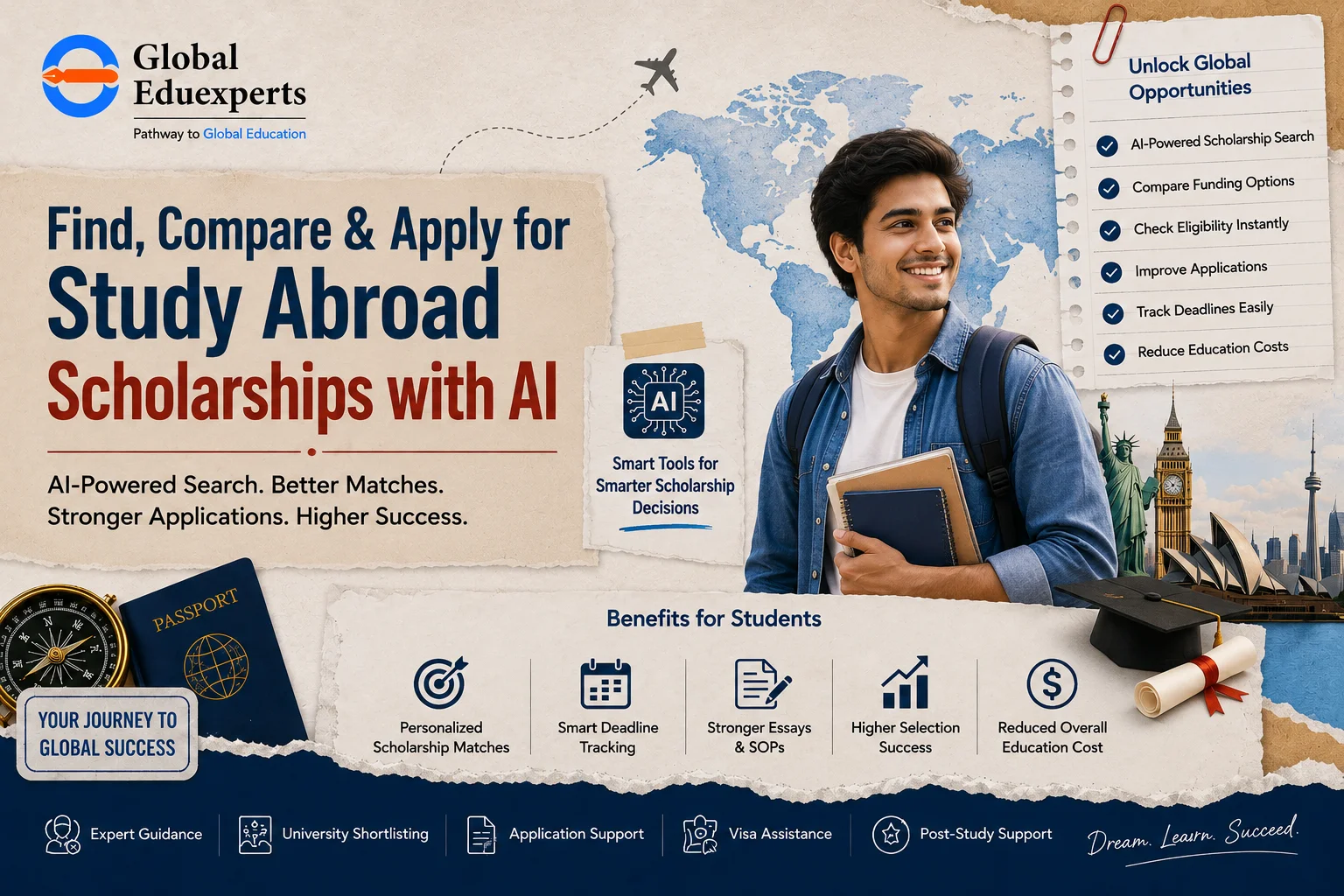
Finding the right study abroad scholarships becomes easier with AI-powered guidance that helps students discover funding opportunities based on their academic profile, compare eligibility and benefits across universities and countries, organize application deadlines, and prepare stronger scholarship applications. It helps Indian students make informed funding decisions, reduce the overall cost of international education, and improve their chances of securing scholarships through a more efficient and personalized application process.
For many students, finding scholarships is often more overwhelming than applying to universities themselves.
A simple online search for study abroad scholarships can produce thousands of results. Some are country-specific, some are university-funded, others are government-sponsored, and many have different eligibility rules, deadlines, funding amounts, and application requirements.
Manually researching every opportunity can take weeks, and even then, students often miss scholarships they were actually eligible for.
This is where Artificial Intelligence (AI) is changing the scholarship search process. Rather than replacing human decision-making, AI acts as a smart research assistant—helping students discover relevant funding opportunities faster, compare them more efficiently, and focus their efforts on scholarships that genuinely match their academic profile and career goals.
Instead of spending hours filtering information, students can spend more time preparing stronger applications.
Scholarships are offered by many different organizations, including:
Each scholarship has its own:
Trying to compare all of these manually often becomes confusing, especially for students applying to multiple countries.
This is one reason many deserving applicants miss valuable funding opportunities simply because they never discover them.
Traditional scholarship searches usually rely on basic keyword searches.
For example:
"Scholarships in Canada"
or
"Scholarships for Indian students."
These searches often generate thousands of unrelated results.
AI approaches the problem differently.
Instead of only searching keywords, AI can evaluate multiple factors together, such as:
Based on this information, AI helps narrow down scholarships for international students that are much more relevant to an individual's profile.
The result is a shorter, more useful list rather than an overwhelming collection of possibilities.
Not every scholarship is designed for every student.
Some scholarships are available only for:
AI helps identify which opportunities align most closely with your educational background and study plans.
Instead of reviewing hundreds of scholarship pages individually, students can quickly focus on opportunities where they are more likely to meet the eligibility criteria.
One of AI's biggest advantages is intelligent filtering.
Students can narrow scholarship options using multiple criteria simultaneously.
Examples include:
This filtering process allows students to compare study abroad scholarship opportunities without manually reviewing every available option.
It also reduces the risk of spending time preparing applications for scholarships that don't match their qualifications.
Many students begin their study abroad journey without deciding on a single destination.
They may compare:
Each destination offers different scholarship systems.
AI makes it easier to compare funding opportunities across multiple countries by organizing information according to factors such as:
Rather than researching each country separately, students gain a broader understanding of available international scholarships before making a final decision.
One of the biggest frustrations students experience is discovering late in the application process that they don't actually qualify.
Eligibility requirements often depend on factors such as:
AI can help organize these requirements and highlight scholarships where students are more likely to meet the basic criteria.
Although final eligibility is always determined by the scholarship provider, early filtering saves significant time and effort.
Scholarship applications often involve multiple deadlines.
Students may need to manage:
Keeping track of everything manually becomes difficult when applying to several universities.
AI-powered planning tools help students organize important dates, monitor application progress, and reduce the likelihood of missing important deadlines.
Good organization often becomes just as important as finding the scholarship itself.
Receiving multiple scholarship opportunities creates another challenge:
Which one offers the best value?
Students should compare factors beyond funding amount.
Important considerations include:
AI helps students evaluate these variables together, making comparisons more structured and practical.
Sometimes a scholarship covering fewer tuition costs may still provide greater overall value because it includes accommodation or living expenses.
Artificial Intelligence can process information much faster than manual research.
However, choosing a scholarship remains a personal decision.
Students should still carefully review:
AI should be viewed as a decision-support tool rather than a replacement for independent verification.
The final application should always rely on information published by the university or scholarship provider.
The number of available scholarships abroad continues growing every year, making manual research increasingly time-consuming.
Students now have access to far more funding opportunities than previous generations, but finding the right ones has also become more complicated.
AI helps simplify this process by reducing repetitive research and allowing students to focus on planning, preparation, and stronger applications.
Instead of searching randomly across dozens of websites, students receive more organized and relevant recommendations based on their educational goals.
Finding study abroad scholarships no longer has to involve endless online searches or comparing hundreds of unrelated funding options manually. AI helps students discover relevant opportunities more efficiently by matching scholarships with their academic background, preferred destination, career goals, and eligibility profile, allowing them to spend more time preparing competitive applications instead of searching for information.
For Indian students planning overseas education, combining AI-powered research with careful review of official scholarship requirements creates a more informed and efficient approach to securing study abroad funding. Rather than replacing thoughtful planning, AI makes the scholarship search process faster, more organized, and better aligned with each student's individual aspirations.
Finding a scholarship is only the first step. The real challenge begins when you discover that several scholarships appear to match your profile, but each offers different benefits, eligibility requirements, deadlines, and funding amounts.
Many students make the mistake of applying for the first scholarship they find without comparing whether it actually provides the best financial support or aligns with their academic goals.
Choosing the right study abroad scholarships requires more than checking whether tuition fees are covered. A scholarship should be evaluated as part of your overall education plan, considering living costs, university quality, career opportunities, and long-term value.
Artificial Intelligence (AI) makes this comparison process significantly easier by organizing complex information into a format that helps students make informed decisions instead of relying on guesswork.
Not all scholarships offer the same level of support.
Some cover only tuition fees, while others provide comprehensive financial assistance throughout your studies.
Students often compare scholarships based only on the total funding amount, but that doesn't always reveal which option provides better overall value.
Before applying, compare factors such as:
Looking at the complete package provides a much clearer picture than focusing on tuition alone.
Traditionally, students visit dozens of university websites, government portals, and scholarship databases.
Each source presents information differently, making comparisons difficult.
AI simplifies this process by helping organize scholarship information according to common criteria such as:
Instead of manually comparing hundreds of pages, students receive a structured overview that makes decision-making far more efficient.
Many students assume every scholarship covers full tuition.
In reality, funding varies considerably.
Scholarships generally fall into several categories:
Fully Funded Scholarships
These may include:
Partial Scholarships
These often cover:
Understanding this distinction helps students estimate how much personal funding they may still need during their studies.
AI makes these differences easier to identify when comparing multiple scholarships for international students.
Tuition represents only one part of studying abroad.
Depending on the destination country, students also need to budget for:
Sometimes a scholarship offering moderate tuition support but generous monthly living allowances provides greater financial relief than one covering tuition alone.
AI helps students compare total funding packages rather than evaluating only one expense category.
Every scholarship has specific eligibility requirements.
These may include:
Manually reviewing these requirements across dozens of scholarships can become time-consuming.
AI helps filter opportunities by comparing a student's profile with published eligibility criteria, allowing applicants to focus on scholarships where they are more likely to qualify.
Although scholarship providers always make the final eligibility decision, early comparison helps reduce unnecessary applications.
Every study destination has its own scholarship ecosystem.
For example:
Some countries emphasize:
Others focus on:
Some provide:
Others prioritize:
Students comparing destinations such as:
should evaluate funding opportunities alongside tuition fees, employment opportunities, and living costs.
AI helps organize scholarships abroad country by country, making comparisons much easier during the university selection process.
One of AI's greatest advantages is prioritization.
Instead of presenting every available scholarship equally, AI can identify opportunities that appear most relevant based on factors such as:
This allows students to spend more time preparing high-quality applications instead of submitting dozens of unsuitable ones.
A focused application strategy often produces better results than applying randomly.
Scholarship deadlines vary significantly.
Some applications close:
Students applying to multiple countries often struggle to manage overlapping timelines.
AI-powered planning tools help organize:
A clear timeline reduces the risk of missing important opportunities.
Students naturally focus on financial support.
However, scholarships also provide additional benefits that influence future career opportunities.
Questions worth asking include:
Sometimes these long-term advantages become more valuable than the funding itself.
Artificial Intelligence can compare information much faster than manual research.
However, students should always verify scholarship details directly from official university or scholarship websites.
Important information to confirm includes:
AI works best as a research assistant that helps organize information efficiently while students make the final decisions.
Many successful applicants don't receive funding because they applied to a single scholarship.
They succeed because they develop a thoughtful strategy.
This often includes:
A structured approach improves both efficiency and application quality.
Applying for study abroad scholarships should never be a race to submit the first application. Students who take time to compare funding, eligibility, living expense support, university quality, and long-term career benefits are often better positioned to choose scholarships that genuinely support their education goals.
Using AI to organize and compare international scholarships allows students to focus on opportunities that best match their academic profile while reducing time spent on unnecessary research. Combined with careful review of official scholarship guidelines, AI helps transform a complicated funding search into a more structured, informed, and confident decision-making process.
Finding the right scholarship is only half the journey. The quality of your application often determines whether you receive funding or miss the opportunity.
Every year, thousands of capable students are rejected—not because they lack academic potential, but because their applications are incomplete, poorly organized, or fail to communicate why they deserve financial support.
Artificial Intelligence (AI) cannot guarantee a scholarship, and it should never replace your own experiences or achievements. However, it can become a valuable assistant throughout the application process by helping you organize documents, improve writing, manage deadlines, and identify areas that need attention before submission.
Used responsibly, AI allows students to prepare stronger and more polished applications while keeping the final work authentic and personal.
Before writing essays or collecting documents, carefully read the scholarship guidelines.
Every scholarship has different expectations.
Some focus primarily on:
AI can help summarize lengthy scholarship guidelines into clear checklists, making it easier to understand exactly what the scholarship provider expects.
Starting with a clear understanding reduces the risk of preparing unnecessary documents or overlooking important requirements.
Many students underestimate how long document preparation takes.
A typical study abroad scholarship application may require:
Preparing these documents well before the deadline reduces unnecessary stress and gives you time to review everything carefully.
AI can help create personalized document checklists based on the scholarship and your academic profile.
A scholarship essay is often where students can distinguish themselves from other applicants.
Rather than repeating academic achievements already listed in your application, the essay should explain:
AI can assist by helping students:
The experiences, examples, and personal stories should always remain your own.
Scholarship committees value authenticity far more than perfectly polished but generic writing.
The Statement of Purpose (SOP) plays an important role in many scholarship applications.
A strong SOP explains:
AI can help students identify unclear sections, improve structure, simplify complex sentences, and eliminate unnecessary repetition.
However, the final SOP should reflect your genuine ambitions and personal experiences rather than content generated entirely by AI.
Admissions officers often recognize authentic writing because it demonstrates individual motivation rather than generic statements.
Managing multiple scholarship applications quickly becomes challenging.
Students may simultaneously track:
Missing a deadline by even one day may result in automatic rejection.
AI-powered planning tools can help students organize:
Good organization often improves application quality because students have more time to review their work before submission.
One of the biggest mistakes students make is submitting identical applications for every scholarship.
Different scholarship providers value different qualities.
Some prioritize:
Others emphasize:
AI can help compare scholarship objectives with your experiences, allowing you to emphasize the most relevant achievements without changing the truth of your application.
Customization demonstrates genuine interest and often creates a stronger impression.
Even excellent applications can lose credibility because of simple mistakes.
Before submitting, review:
AI-powered proofreading tools can identify many of these issues quickly.
Final proofreading should still be completed personally to ensure every document accurately reflects your intentions.
Many scholarship applications are rejected because of avoidable errors rather than lack of academic ability.
Some of the most common mistakes include:
Careful preparation often prevents these problems long before the application reaches the selection committee.
Artificial Intelligence should be viewed as an editing and planning assistant rather than a content creator.
It works best when helping students:
Your achievements, experiences, goals, and personal voice should remain completely authentic.
Scholarship committees evaluate applicants—not software.
A well-written application still depends on honest storytelling and thoughtful reflection.
Successful applicants rarely submit one application at the last minute.
Instead, they develop a structured plan.
This usually involves:
Using AI throughout this process allows students to work more efficiently without sacrificing quality.
The goal isn't simply to submit more applications—it's to submit stronger ones.
Applying for international scholarships and fully funded scholarships requires more than meeting eligibility requirements. Strong applications reflect careful planning, organized documentation, authentic writing, and attention to detail. AI supports this process by helping students manage deadlines, refine essays, strengthen SOPs, and review application materials, allowing them to focus on presenting their achievements clearly and confidently.
For Indian students pursuing study abroad scholarships, combining AI-assisted preparation with genuine personal experiences creates applications that are both professional and authentic. Technology can simplify the process, but thoughtful preparation, honest storytelling, and careful review remain the foundations of successful scholarship applications.
Receiving a scholarship isn't always about having the highest grades or the longest list of achievements. In many cases, the difference between a successful and unsuccessful application comes down to preparation.
Every scholarship committee reviews hundreds or even thousands of applications. When several applicants have similar academic records, small mistakes can quickly become deciding factors.
The encouraging part is that many of these mistakes are completely avoidable.
Students who understand the application process, prepare their documents carefully, and pay attention to details often submit much stronger applications than those who rush through the process at the last minute.
Artificial Intelligence (AI) can also play a useful role by helping students organize their applications, identify missing information, and improve the overall quality of their submissions without replacing their own experiences or achievements.
One of the most common mistakes is applying for scholarships without reading the eligibility requirements properly.
Students sometimes spend days preparing applications only to discover later that they don't meet the basic criteria.
Scholarships may have specific requirements related to:
Applying for scholarships that don't match your profile wastes valuable time that could be spent preparing stronger applications for opportunities where you have a realistic chance of success.
AI can help filter scholarships for international students based on your academic background and preferred destination, making it easier to focus on relevant opportunities first.
Many students apply only for the most well-known scholarships because those are the easiest to find online.
While prestigious scholarships are excellent opportunities, they also receive the highest number of applications.
As a result, competition becomes extremely intense.
Instead of focusing only on widely advertised programs, students should also explore:
Applying to a broader range of suitable opportunities often improves your overall chances of receiving financial support.
AI can help identify scholarships that students might otherwise overlook during manual research.
Deadlines are non-negotiable.
Unlike university admissions, scholarship providers rarely accept late applications.
Students often become busy managing:
Without proper planning, scholarship deadlines can easily be missed.
Creating a clear application calendar helps prevent unnecessary disappointment.
AI-powered planning tools can organize multiple application timelines, send reminders, and help students prioritize upcoming deadlines so nothing important is forgotten.
Scholarship essays provide an opportunity to explain who you are beyond your academic transcripts.
Unfortunately, many students write essays that sound almost identical.
Common examples include:
Scholarship committees read hundreds of applications every year.
Authentic stories about your educational journey, challenges, leadership experiences, and future ambitions are far more memorable than generic statements.
AI can assist with improving grammar, structure, and readability, but the ideas and experiences should always remain your own.
Even strong applicants may face rejection if required documents are missing.
Depending on the scholarship, applicants may need:
Submitting incomplete applications often results in automatic disqualification.
Creating a personalized checklist before beginning the application process helps ensure every document is prepared well in advance.
AI can generate document checklists and highlight missing items before submission.
Every scholarship has its own application guidelines.
These instructions may include:
Some students focus entirely on writing impressive essays but overlook simple instructions.
Failure to follow application guidelines may create the impression that the applicant lacks attention to detail.
Carefully reviewing every requirement before submission demonstrates professionalism and respect for the selection process.
Rushed applications often contain avoidable mistakes.
Students who begin preparing only a few days before the deadline frequently experience problems such as:
Starting early provides enough time to review your work, request feedback, and make thoughtful improvements.
Scholarship applications usually reflect the amount of preparation invested in them.
A common misconception is that one scholarship essay can be submitted everywhere.
In reality, different scholarship providers have different priorities.
Some emphasize:
Others focus on:
Students who tailor their applications to each scholarship often communicate a much clearer understanding of the provider's objectives.
Customization doesn't require changing your achievements—it means presenting the experiences that are most relevant for each opportunity.
Large scholarships naturally attract attention because of their generous funding.
However, smaller awards can also make a meaningful difference.
Several partial scholarships combined may significantly reduce overall education costs.
Students should avoid dismissing scholarships simply because they don't cover every expense.
Smaller funding opportunities often receive fewer applications, increasing the likelihood of success.
Artificial Intelligence is an excellent research and editing assistant.
However, it shouldn't become the author of your scholarship application.
Scholarship committees evaluate applicants based on:
Applications generated entirely by AI often sound generic and fail to communicate genuine personality.
The strongest applications use AI to improve clarity while keeping every experience truthful and personal.
Before submitting your application, ask yourself:
Taking one final review can prevent mistakes that might otherwise affect months of preparation.
Winning study abroad scholarships isn't only about academic performance. Scholarship committees also look for applicants who demonstrate planning, attention to detail, clear communication, and genuine motivation. Many unsuccessful applications fail because of avoidable mistakes such as missed deadlines, incomplete documentation, generic essays, or applying for scholarships without meeting the eligibility criteria.
For students pursuing international scholarships and fully funded scholarships, AI offers valuable support by organizing deadlines, identifying suitable opportunities, reviewing documents, and improving application quality. When combined with careful preparation and authentic personal storytelling, it helps students avoid common errors and submit applications that reflect their true potential rather than rushed or incomplete work.
Every student dreams of receiving a scholarship that reduces the financial burden of studying abroad. However, many believe scholarships are reserved only for students with perfect grades or extraordinary achievements.
In reality, scholarship selection is often much broader than that.
Many scholarship providers look for students who demonstrate academic commitment, clear career goals, leadership potential, community involvement, and a well-prepared application. While strong grades certainly help, thoughtful planning and a strategic approach can significantly improve your chances of success.
Artificial Intelligence (AI) cannot secure a scholarship on your behalf, but it can help you make smarter decisions throughout the process. From identifying suitable opportunities to organizing deadlines and refining applications, AI allows students to work more efficiently while keeping the final application authentic and personal.
The goal isn't simply to apply for more scholarships—it's to apply for the right scholarships in the right way.
One of the biggest differences between successful applicants and unsuccessful ones is planning.
Many students search for scholarships only after receiving a university offer.
A stronger approach is to begin scholarship research while shortlisting universities.
Your strategy should include:
Planning early provides more opportunities and reduces last-minute pressure.
AI can help organize this information into a structured roadmap, allowing students to focus on scholarships that best match their profile.
Many students submit one scholarship application and simply hope for the best.
A better approach is diversification.
Rather than depending on a single funding source, consider applying for:
Submitting multiple high-quality applications generally creates better funding opportunities than relying on a single highly competitive scholarship.
The emphasis should always remain on quality rather than quantity.
Not every university provides the same financial assistance.
Some institutions offer generous scholarships for international students, while others provide limited funding.
Before finalizing your university list, compare:
Sometimes choosing a university with slightly lower tuition fees and stronger scholarship programs produces a better overall financial outcome than selecting a prestigious institution with minimal funding support.
AI can help compare university scholarship options across different countries, making this evaluation faster and more organized.
Academic performance continues to play an important role in many study abroad scholarships.
Although every scholarship has different selection criteria, maintaining consistent academic results improves eligibility for a wider range of opportunities.
Students should focus on:
Scholarship committees often value steady academic growth as much as exceptionally high marks.
Scholarships increasingly evaluate students beyond academics.
Leadership, initiative, and community involvement often distinguish one applicant from another.
Examples include:
These experiences demonstrate qualities such as responsibility, teamwork, communication, and problem-solving.
A well-rounded profile often strengthens scholarship applications significantly.
One of the most effective ways to improve scholarship success is personalization.
Every scholarship has a different purpose.
Some reward:
Others recognize:
Instead of using the same essay repeatedly, tailor your application to reflect the scholarship's objectives.
AI can help identify recurring themes within scholarship requirements and suggest where your experiences align best, making it easier to customize each application while keeping your writing authentic.
Students applying to multiple universities often manage dozens of important dates.
These may include:
Missing a single scholarship deadline may eliminate months of preparation.
AI-powered planning tools help students:
Staying organized reduces stress and improves overall application quality.
Searching manually often produces thousands of scholarship results, many of which are irrelevant.
AI makes the process more focused by considering information such as:
Instead of presenting every available scholarship, AI helps prioritize opportunities where students appear most competitive.
This allows applicants to spend their time preparing stronger applications rather than searching endlessly for funding.
Scholarship preparation shouldn't stop after submitting one application.
Students can continue strengthening their profile by:
Every additional achievement may strengthen future scholarship applications.
Continuous improvement also benefits university admissions and long-term career development.
Receiving financial assistance is important, but scholarships often provide much more than tuition support.
Many programs also offer:
These experiences frequently create career opportunities long after graduation.
When comparing scholarships to study abroad, evaluate the complete educational experience rather than funding alone.
Instead of treating scholarship applications as isolated tasks, build a complete action plan.
A practical roadmap may look like this:
Step 1: Identify your preferred countries and universities.
Step 2: Research available scholarships.
Step 3: Check eligibility carefully.
Step 4: Prepare academic and financial documents.
Step 5: Write personalized essays and SOPs.
Step 6: Submit applications well before deadlines.
Step 7: Monitor results and prepare backup funding options.
Following a structured process makes scholarship applications far more manageable and reduces unnecessary stress throughout your study abroad journey.
Winning study abroad scholarships is rarely the result of luck alone. Students who research early, apply strategically, prepare personalized applications, and continuously strengthen their academic and extracurricular profiles often place themselves in a much stronger position than those who rely on last-minute applications or a single funding opportunity.
Artificial Intelligence enhances this process by helping students discover relevant opportunities, organize deadlines, compare universities, and receive personalized scholarship recommendations based on their academic profile and career goals. When combined with thoughtful preparation, authentic applications, and careful planning, AI becomes a valuable tool for reducing education costs and helping students secure meaningful financial support for their international education.
Yes. AI can make the scholarship search much more efficient by matching your academic profile, preferred country, course, and eligibility with relevant study abroad scholarships. It can also compare funding options, organize deadlines, and recommend scholarships that best suit your goals. However, students should always verify the final eligibility and application details through the official scholarship or university website.
AI cannot guarantee a scholarship, but it can improve the quality of your preparation. It helps organize application timelines, refine scholarship essays and SOPs, identify missing documents, and recommend suitable funding opportunities. Combined with strong academics, authentic applications, and careful planning, AI can help students submit more competitive applications for international scholarships.
Students should compare much more than the scholarship amount. Important factors include tuition fee coverage, living expense allowance, accommodation support, eligibility criteria, renewal conditions, application deadlines, university reputation, and career opportunities after graduation. Comparing these details helps students choose scholarships to study abroad that provide the best overall financial and educational value.
Not necessarily. Fully funded scholarships are highly competitive, and limiting yourself to only these opportunities may reduce your chances of receiving financial support. It's often a better strategy to apply for a combination of fully funded, partial, university-specific, merit-based, and external scholarships to maximize your overall funding opportunities.
Common mistakes include applying without checking eligibility, missing deadlines, submitting generic essays, providing incomplete documentation, relying only on popular scholarships, and failing to customize applications for each scholarship. Starting early, preparing documents carefully, and using AI to organize applications and track deadlines can help students avoid these errors and submit stronger scholarship applications.


