
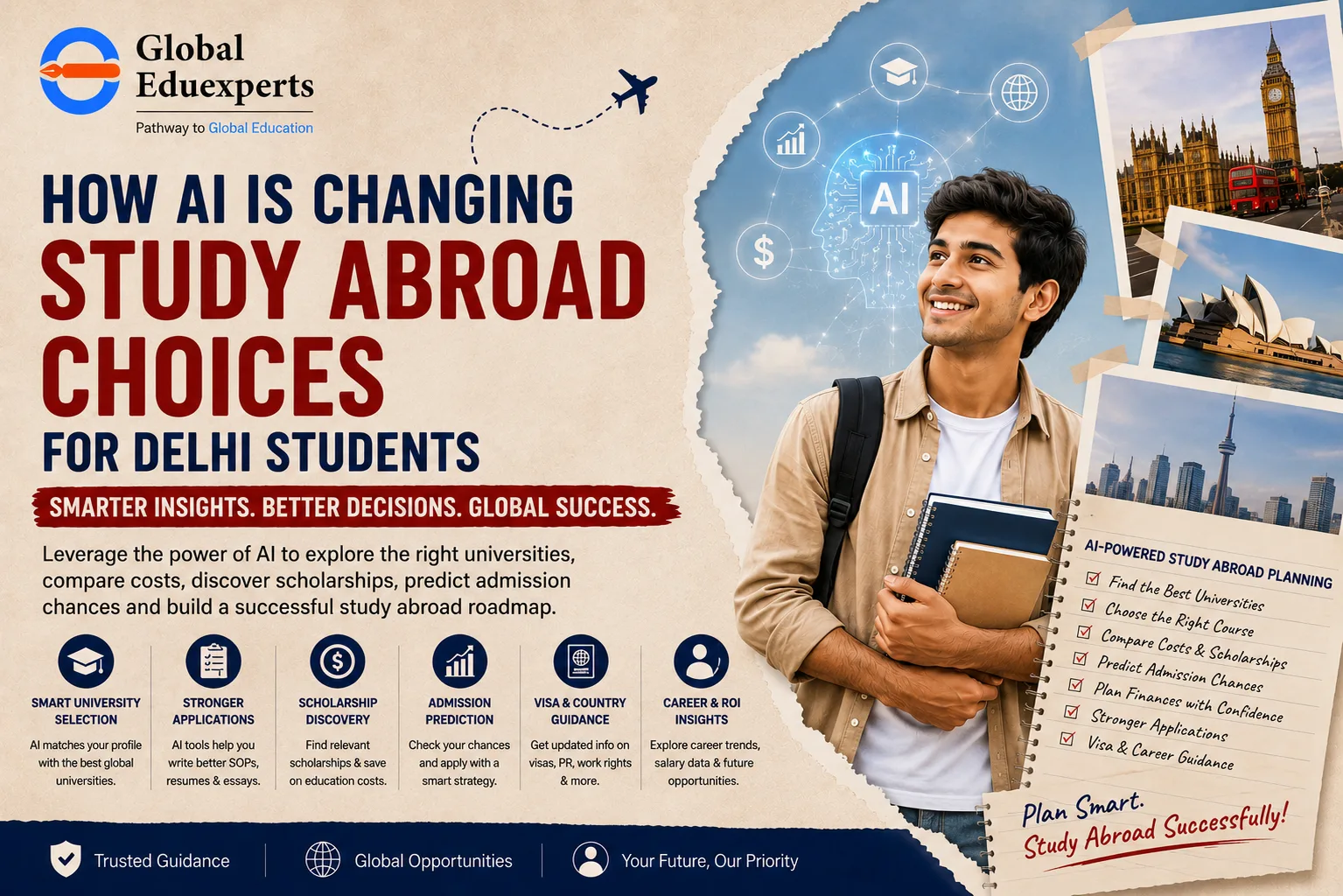
Artificial Intelligence is transforming the way students plan international education by making university research, course selection, scholarship discovery, financial planning, and application preparation faster and more personalized. Understanding how AI can support study abroad decisions—while balancing it with expert guidance and official information—helps students make smarter choices and build a successful overseas education strategy aligned with their academic and career goals.
Planning to study abroad has always involved countless decisions. Students need to compare countries, evaluate universities, understand admission requirements, estimate costs, explore scholarships, prepare documents, and think about long-term career opportunities. Just a few years ago, gathering this information meant visiting multiple websites, attending education fairs, speaking with counselors, and spending weeks researching different options.
Today, that process is changing rapidly.
Artificial Intelligence (AI) has become an important part of how students research international education. Instead of searching through hundreds of webpages individually, many students now use AI-powered platforms to organize information, compare options, and receive personalized recommendations within minutes. While AI does not replace careful research or professional guidance, it has significantly improved the speed and accessibility of study abroad planning.
The growing influence of AI explains How AI Is Changing Study Abroad Choices for Delhi Students and why technology is becoming an increasingly valuable support tool throughout the overseas education journey.
The way students research universities has changed considerably.
Rather than reading dozens of lengthy articles, many prefer receiving focused answers that relate directly to their academic background and career interests.
AI makes this possible by helping students quickly compare information based on questions such as:
Instead of presenting identical information to everyone, AI attempts to organize recommendations according to individual preferences.
This shift has made study abroad research far more efficient than traditional search methods alone.
One challenge many applicants face is information overload.
Thousands of universities, hundreds of courses, and multiple destination countries can make decision-making overwhelming.
AI-powered research tools simplify this process by filtering information according to selected criteria.
Students can compare factors such as:
| Research Area | AI Contribution |
|---|---|
| University Search | Personalized recommendations |
| Course Comparison | Faster filtering |
| Country Evaluation | Organized information |
| Admission Research | Simplified comparisons |
This allows students to spend more time evaluating options instead of collecting scattered information.
Every student has different priorities.
Some focus on affordability.
Others prioritize research opportunities, career growth, or international exposure.
Traditional search engines usually provide identical results for broad search queries.
AI attempts to understand individual goals before generating recommendations.
For example, a student interested in Artificial Intelligence may receive different university suggestions than someone planning to study Business Analytics or Healthcare.
This personalized approach is one reason many students are exploring AI-Based University Selection for Delhi Students during the early stages of planning.
Research that once required several days can often be completed much more quickly.
Students use AI to compare:
Rather than manually organizing large amounts of information, AI assists by summarizing data into easier-to-understand comparisons.
This improves efficiency without eliminating the need for independent verification.
Previously, many students met education consultants before conducting any independent research.
Today, the process is often reversed.
Students frequently use AI to understand:
As a result, they often arrive at counseling sessions with more specific questions and clearer expectations.
This allows discussions to focus on strategy rather than basic information gathering.
One noticeable trend is that students are comparing more countries than before.
Instead of considering only one or two destinations, AI enables faster comparison across multiple education systems.
Students can evaluate:
| Comparison Area | Importance |
|---|---|
| Tuition Costs | High |
| Living Expenses | High |
| Career Prospects | High |
| University Reputation | High |
| Work Opportunities | High |
Broader comparisons often result in more balanced decision-making.
Students increasingly understand that choosing a university is only one part of overseas education.
Career outcomes matter just as much.
Many applicants now use AI to research:
Although career information should always be verified through reliable sources, AI provides a useful starting point for understanding market trends.
This supports better long-term planning rather than decisions based solely on university rankings.
One important misconception is that AI automatically provides perfect recommendations.
In reality, the quality of AI-generated guidance depends on:
Students should treat AI as a research assistant rather than a final decision-maker.
Official university websites, admission offices, and verified education experts remain essential sources for confirming important information.
One reason How Indian Students Are Using AI for Overseas Education Planning continues to grow is because AI makes educational information more accessible.
Students from different backgrounds can now quickly learn about:
This broader access allows applicants to evaluate opportunities they may never have considered previously.
Perhaps the greatest advantage of AI is not simply providing answers.
It encourages students to ask better questions.
For example:
Instead of asking,
"Which country is best?"
students increasingly ask,
"Which country offers the strongest opportunities for my career goals and budget?"
Similarly, instead of searching,
"Best universities abroad,"
students now ask,
"Which universities match my academic profile and future plans?"
This shift toward personalized research often leads to more informed decision-making.
Although AI can organize information quickly, it cannot fully understand every personal circumstance.
Important decisions still require consideration of:
These factors require thoughtful evaluation beyond algorithmic recommendations.
Many students achieve the best results by combining AI research with careful planning and professional guidance.
Students entering the study abroad process today expect:
These expectations continue to shape how universities, education consultants, and technology providers support prospective international students.
As AI continues to evolve, its role in overseas education planning is likely to become even more sophisticated.
Students researching AI Tools for Study Abroad Planning for Indian Students, How Artificial Intelligence Helps Students Choose Universities Abroad, Using AI to Choose the Right Course Abroad, AI for Study Abroad Counseling and Career Guidance, and Benefits of AI in Study Abroad Decision Making are discovering that artificial intelligence is transforming the way international education decisions are made.
Rather than replacing independent research or expert guidance, AI is making study abroad planning faster, more personalized, and easier to navigate. By helping students compare universities, evaluate countries, understand admission requirements, and organize information efficiently, AI enables applicants to make better-informed decisions based on their individual academic profiles, financial circumstances, and long-term career aspirations. The most effective study-abroad plans are increasingly built by combining the speed of AI with careful human judgment and verified information from trusted educational sources.
As AI helps students explore international education more efficiently, it's equally important to understand the admission requirements and opportunities available across different destinations. Readers planning their next step can explore
STUDY ABROAD FROM DELHIfor a complete roadmap or compare destination-specific options throughSTUDY IN USA,STUDY IN UK,STUDY IN EUROPE, andSTUDY IN AUSTRALIAbefore narrowing their choices.
Choosing where to study abroad has never been a simple decision. Students must compare countries, universities, academic programs, tuition fees, scholarships, career opportunities, admission requirements, and long-term employment prospects. With thousands of universities and countless courses available worldwide, identifying the right combination can quickly become overwhelming.
Artificial Intelligence is helping simplify this process.
Instead of manually researching hundreds of websites, students are increasingly using AI-powered platforms to organize information, compare options, and receive recommendations that better match their academic background and career aspirations. While AI cannot decide which university is "best" for an individual, it can significantly reduce the time required to identify suitable options and highlight factors that deserve closer attention.
This growing shift demonstrates How Artificial Intelligence Helps Students Choose Universities Abroad by making the decision-making process more structured, personalized, and data-driven.
Traditional university searches often begin with country rankings or popular destinations.
AI approaches the process differently.
Most AI-powered planning tools first attempt to understand the student's profile by considering factors such as:
Instead of recommending identical universities to every applicant, AI generates suggestions based on individual priorities.
This personalized approach allows students to explore institutions that better align with their educational goals.
Selecting the right course is often more important than selecting the most famous university.
A student planning to become a Data Scientist requires a different educational pathway than someone pursuing International Business or Healthcare Management.
AI assists by connecting:
| Student Goal | AI Evaluation Focus |
|---|---|
| Technical Careers | Course specialization |
| Business Careers | Management programs |
| Research Interests | Research-focused universities |
| Budget Planning | Affordable options |
By focusing on career outcomes rather than popularity alone, students can make more informed academic decisions.
Many students begin with hundreds of potential universities.
Reducing this list manually requires significant time and research.
AI-powered systems can organize universities based on selected preferences, including:
Rather than replacing research, AI creates a practical shortlist that students can investigate further.
This is one reason AI-Based University Selection for Delhi Students is becoming increasingly popular during the early planning stage.
Every destination offers different advantages.
Some countries provide:
AI enables students to compare these variables much faster than traditional manual research.
| Comparison Area | Why It Matters |
|---|---|
| Tuition Fees | Financial planning |
| Living Costs | Budget management |
| Employment Opportunities | Career growth |
| Visa Policies | Long-term planning |
| Graduate Outcomes | Return on investment |
Instead of assuming one country is universally better, students can compare destinations according to their own priorities.
Many applicants focus only on internationally famous universities.
As a result, they often overlook institutions offering:
AI analyzes larger datasets than most students can review manually.
This allows recommendations to include universities that match academic requirements even if they are less widely recognized.
Broadening the search often leads to stronger educational opportunities.
Applying only to highly competitive universities can increase the risk of receiving no admission offers.
Many AI platforms now estimate admission probability by comparing:
Although these predictions are never guarantees, they provide useful planning guidance.
Students can then create balanced application lists containing:
This improves overall application strategy.
Students researching universities often spend weeks gathering information from multiple sources.
AI accelerates this process by organizing information into concise comparisons.
It can summarize:
This allows students to focus more attention on evaluating information rather than searching for it.
However, official university websites should always remain the primary source for confirming admission policies.
Every student has unique priorities.
For some, affordability is the most important consideration.
Others prioritize:
AI allows students to adjust search priorities based on their individual goals.
| Student Priority | AI Recommendation Focus |
|---|---|
| Low Budget | Affordable universities |
| Research Careers | Research-intensive institutions |
| Quick Employment | Industry-focused universities |
| Global Exposure | International learning environments |
This flexibility creates recommendations that are more relevant than generic university lists.
One interesting change is how students approach research itself.
Instead of asking,
"Which university is best?"
students increasingly ask,
"Which universities best fit my academic profile, career goals, and financial situation?"
Similarly, rather than searching,
"Best country for study abroad,"
students now ask,
"Which country offers the strongest opportunities for my chosen profession?"
These more focused questions generally produce more useful results.
One challenge during study abroad planning is the large number of available choices.
Students often feel overwhelmed by:
AI reduces this complexity by organizing information into manageable comparisons.
Students can then spend their time evaluating a smaller group of well-matched options instead of reviewing hundreds of possibilities.
Although AI provides useful recommendations, it cannot fully understand personal circumstances.
Important decisions still require consideration of factors such as:
Professional education counselors also contribute valuable insights based on experience, current admission trends, and country-specific knowledge.
Many students achieve stronger outcomes by combining AI-generated research with expert human guidance.
One of the greatest benefits of AI is helping students eliminate unsuitable choices early.
Instead of applying to universities that do not match their academic qualifications or financial capacity, AI can identify more realistic alternatives.
This reduces:
Students can then invest more effort in universities that genuinely fit their profile.
Students researching AI Tools for Study Abroad Planning for Indian Students, Using AI to Choose the Right Course Abroad, AI-Based University Selection for Delhi Students, Benefits of AI in Study Abroad Decision Making, and How Indian Students Are Using AI for Overseas Education Planning are finding that artificial intelligence is making university selection more personalized and efficient than ever before.
Rather than relying solely on rankings or general recommendations, AI enables students to compare countries, universities, and courses based on their academic background, career ambitions, financial situation, and admission profile. By simplifying research, supporting personalized shortlisting, and highlighting realistic educational opportunities, AI helps students make more informed study abroad decisions. When combined with independent verification and expert counseling, these technology-driven insights create a stronger foundation for choosing the right international education pathway.
Choosing the right destination becomes much easier when country-specific admission information is readily available. After using AI to shortlist options, reviewing pages like
USA Courses,UK Courses,Ireland Eligibility, andAustralia Eligibilityhelps students validate whether their academic background and career goals align with university expectations in each destination.
Preparing an international university application involves much more than completing an online form. Students must write a compelling Statement of Purpose (SOP), prepare a professional resume, collect academic documents, request recommendation letters, meet multiple deadlines, and ensure that every detail is accurate before submission. Managing these tasks simultaneously can become overwhelming, especially when applying to several universities across different countries.
Artificial Intelligence is helping simplify many of these responsibilities.
Instead of replacing students or education counselors, AI functions as a productivity tool that helps organize information, improve written content, track progress, and reduce repetitive administrative work. Many applicants now use AI during different stages of the application journey to save time while maintaining better organization.
This growing adoption explains why AI Tools for Study Abroad Planning for Indian Students are becoming an important part of international education preparation.
Writing a Statement of Purpose is one of the most challenging parts of many university applications.
Students often struggle with:
AI writing tools can help students create an initial structure, improve grammar, and suggest better organization.
However, the most effective SOPs remain personal.
Admission committees want to understand:
AI should therefore support writing rather than replace authentic storytelling.
A well-written SOP reflects the student's own journey, not generic AI-generated content.
Universities and scholarship committees often request resumes or academic CVs.
Many students are uncertain about:
AI tools can review resumes and recommend improvements such as:
| Resume Area | AI Support |
|---|---|
| Formatting | Better structure |
| Language | Improved clarity |
| Grammar | Error detection |
| Organization | Easier reading |
Students should still review every recommendation carefully to ensure accuracy.
International applications require numerous documents.
Examples include:
Keeping track of multiple files across several universities can become confusing.
AI-powered organization tools assist students by:
This improves efficiency and reduces the likelihood of overlooking important paperwork.
Different universities often follow different admission schedules.
Students applying to several institutions must monitor:
| Application Stage | Planning Importance |
|---|---|
| University Application | High |
| Scholarship Submission | High |
| Test Registration | High |
| Visa Preparation | High |
AI scheduling tools and digital planners help students organize these timelines in one place.
This minimizes the risk of missing important dates.
Application errors frequently occur because students manually enter large amounts of information.
Examples include:
AI can assist by reviewing applications for:
Although students should always complete a final review themselves, AI provides an additional layer of quality checking.
This contributes to more polished application submissions.
Many international applicants prepare documents in English even though it is not their first language.
AI language tools assist by improving:
This support allows students to communicate their ideas more effectively without changing the meaning of their experiences.
However, applicants should avoid using overly complex or unnatural language simply because AI recommends it.
Authenticity remains more valuable than sophisticated wording.
Some universities include interviews as part of the admission process.
Students often feel nervous because they are unsure about:
AI interview practice tools simulate interview scenarios by generating questions and providing feedback on responses.
Practicing regularly helps students improve confidence before real interviews.
Students applying to multiple universities frequently lose track of application status.
Questions often include:
AI-powered tracking systems help organize application progress.
Students can monitor:
This centralized overview simplifies application management considerably.
Many application activities involve repeated administrative work.
Examples include:
AI automates many of these repetitive tasks.
Students can then spend more time on activities requiring personal attention, including:
Automation therefore improves productivity rather than replacing thoughtful decision-making.
Students often spend hours searching for basic information across multiple university websites.
AI speeds up research by summarizing:
Instead of manually gathering information from dozens of sources, students receive organized summaries that simplify comparison.
Official university websites should still be consulted before making final decisions.
Despite rapid technological progress, AI cannot fully understand every student's personal situation.
Important decisions continue to depend on:
Similarly, experienced education counselors provide practical insights that AI cannot always replicate, particularly regarding changing admission trends and country-specific policies.
Students often benefit most when AI supports research while human expertise guides final decision-making.
One misconception is that AI can complete entire applications independently.
In reality, successful applications still require:
AI simply reduces repetitive work and highlights areas that require improvement.
Students remain responsible for every document they submit.
Students researching Best AI Tools for Study Abroad Applications in 2026, AI for Study Abroad Counseling and Career Guidance, Using AI to Choose the Right Course Abroad, How Indian Students Are Using AI for Overseas Education Planning, and Benefits of AI in Study Abroad Decision Making are discovering that artificial intelligence is becoming a valuable assistant throughout the application process.
By supporting SOP drafting, improving resumes, organizing documents, managing deadlines, strengthening interview preparation, enhancing language quality, and tracking application progress, AI helps students prepare more organized and accurate applications. At the same time, successful international admissions continue to depend on thoughtful planning, authentic personal stories, careful document verification, and informed human judgment. When used responsibly, AI increases efficiency without replacing the personal effort and decision-making that remain essential for a successful study abroad journey.
AI can certainly improve application preparation, but students should always confirm official admission and documentation requirements before submitting applications. Exploring
USA Eligibility,UK Eligibility,Ireland Visa, andAustralia Visagives applicants a clearer understanding of country-specific procedures while ensuring every document is prepared correctly.
Artificial Intelligence has changed the way students research international education. With just a few questions, AI can generate university recommendations, compare countries, explain admission requirements, estimate study costs, and even assist with application documents. These capabilities have encouraged many students to wonder whether AI can replace traditional study abroad counseling altogether.
The answer is more nuanced.
AI is an excellent research and planning assistant, but overseas education is rarely a process that can be managed by technology alone. Every student's academic background, financial situation, career aspirations, and personal circumstances are different. While AI can organize information quickly, experienced education counselors contribute context, practical experience, and personalized guidance that technology cannot always provide.
Understanding the strengths and limitations of both approaches helps explain AI vs Traditional Study Abroad Counseling for Delhi Students and why many applicants achieve better outcomes by combining technology with human expertise.
One of AI's greatest advantages is speed.
Students can receive answers to complex questions within seconds.
Examples include:
Instead of visiting multiple websites, AI organizes large amounts of information into concise responses.
This significantly reduces the time required during the initial research stage.
Information alone does not always lead to good decisions.
Experienced education counselors often understand practical realities that extend beyond published university requirements.
For example, they may provide guidance regarding:
This practical experience helps students make decisions that consider both published requirements and real-world admission practices.
Modern AI systems analyze information provided by students.
These may include:
Based on these details, AI generates recommendations that appear more personalized than traditional search engines.
| AI Capability | Student Benefit |
|---|---|
| Fast Research | Saves time |
| Personalized Suggestions | Better matching |
| Data Comparison | Easier evaluation |
| Information Organization | Improved clarity |
These strengths make AI particularly useful during the early stages of study abroad planning.
Students rarely make educational decisions based only on data.
Many personal considerations influence final choices, including:
Experienced counselors often recognize these factors during conversations.
They can ask follow-up questions, clarify uncertainties, and recommend alternatives that may not emerge through AI-generated responses alone.
Human interaction remains valuable because every student's situation is unique.
Although AI processes information efficiently, it does not make decisions.
Students remain responsible for evaluating recommendations carefully.
For example, AI may recommend universities based on academic compatibility, but students must still consider:
Decision-making requires thoughtful judgment that extends beyond algorithmic analysis.
One advantage of speaking with experienced counselors is the ability to ask follow-up questions.
Students frequently discuss topics such as:
These conversations often involve personal reflection rather than simple factual answers.
AI can support discussion, but meaningful decision-making often develops through dialogue.
Students researching AI Tools for Study Abroad Planning for Indian Students often use AI before meeting education consultants.
This preparation allows them to understand:
As a result, counseling sessions become more focused.
Instead of spending time discussing basic information, conversations can address more personalized concerns.
This creates a more productive planning process.
AI systems generate responses based on available information.
However, university policies change regularly.
Examples include:
Education professionals often monitor these updates closely.
Students should therefore verify important AI-generated information through:
Verification remains an essential part of responsible planning.
AI is particularly effective for repetitive tasks.
Students commonly use AI for:
| Task | AI Contribution |
|---|---|
| Writing Support | High |
| Organization | High |
| Scheduling | High |
| Information Search | High |
Automating routine activities allows students to spend more time making informed academic decisions.
Some study abroad cases involve unique circumstances.
For example:
These situations often require personalized strategies rather than general recommendations.
Experienced counselors evaluate the complete student profile before suggesting appropriate pathways.
This level of judgment remains difficult for AI to replicate consistently.
Artificial Intelligence identifies patterns within large datasets.
Counselors understand human context.
For example:
AI may identify universities matching academic scores.
A counselor may recognize that the student's communication skills, internship experience, or career ambitions suggest a different recommendation.
Both perspectives provide valuable insights.
Together they create more balanced decision-making.
Students sometimes assume AI should replace professional guidance entirely.
In practice, AI performs best when supporting—not replacing—human expertise.
A balanced planning process often looks like this:
This combination provides both efficiency and accuracy.
Many students now begin their overseas education journey using AI before consulting professionals.
This approach allows them to:
Counselors then help students:
Rather than competing with one another, AI and traditional counseling increasingly complement each other.
Students researching How Artificial Intelligence Helps Students Choose Universities Abroad, AI for Study Abroad Counseling and Career Guidance, Benefits of AI in Study Abroad Decision Making, How Indian Students Are Using AI for Overseas Education Planning, and AI vs Traditional Study Abroad Counseling for Delhi Students are discovering that neither approach is sufficient on its own.
Artificial Intelligence provides exceptional speed, organization, and personalized research support, making it easier to compare universities, courses, countries, and admission requirements. Traditional education counselors contribute practical experience, personalized advice, strategic planning, and an understanding of individual circumstances that technology alone cannot fully replicate. Students who combine AI-powered research with verified information and experienced human guidance are generally better equipped to make informed study abroad decisions, prepare stronger applications, and build international education plans that align with their long-term academic and career goals.
Technology makes research faster, but destination-specific guidance often completes the picture. Students comparing advice generated by AI with practical counseling insights may also find value in reviewing
STUDY IN EUROPE,STUDY IN IRELAND,STUDY IN USA, andSTUDY IN DUBAI, where country-focused information helps translate recommendations into realistic study plans.
Financial planning has always been one of the most important parts of studying abroad. Choosing the right university is not simply about academic reputation—it also involves understanding tuition fees, accommodation expenses, scholarship opportunities, healthcare costs, transportation, and the overall return on investment. For many Indian students and their families, comparing these financial factors across different countries can become one of the most time-consuming stages of the planning process.
Artificial Intelligence is making this process significantly easier.
Instead of manually collecting information from dozens of university websites and education portals, students now use AI-powered tools to organize financial data, compare destinations, estimate education costs, and identify scholarship opportunities much faster. While students should always verify important financial information through official sources, AI has become a valuable assistant for creating realistic study abroad budgets.
This growing trend explains why AI Tools for Study Abroad Planning for Indian Students are becoming increasingly important for students seeking affordable international education.
One of the first questions students ask is:
"Which country offers the best education within my budget?"
Answering that question manually requires comparing tuition fees across hundreds of universities.
AI simplifies this process by organizing information according to:
Instead of reviewing multiple websites individually, students receive structured comparisons that make financial evaluation much easier.
This allows applicants to identify universities that fit both their academic interests and financial capacity.
Many students initially compare destinations based only on annual tuition costs.
However, the actual cost of studying abroad depends on several additional factors.
AI helps students compare:
| Expense Category | Planning Importance |
|---|---|
| Tuition Fees | High |
| Accommodation | High |
| Living Costs | High |
| Transportation | Moderate |
| Health Insurance | High |
Looking at the complete financial picture helps students avoid unrealistic budgeting.
Scholarships are available through universities, governments, and international organizations.
Unfortunately, many students learn about these opportunities too late.
AI-powered search tools assist students by identifying scholarships based on factors such as:
Rather than searching multiple scholarship databases manually, students receive more targeted recommendations.
This supports stronger financial planning during the university selection stage.
Every student's financial situation is different.
Some families have fixed education budgets.
Others may combine:
AI budgeting tools allow students to estimate total educational expenses according to their own financial circumstances.
Instead of relying on general averages, students receive more personalized financial estimates.
This helps families make informed decisions before submitting university applications.
Living expenses vary significantly between countries and even between cities within the same country.
Students often underestimate costs related to:
AI helps organize estimated monthly costs based on selected destinations.
| Living Cost | Typical Planning Area |
|---|---|
| Accommodation | Monthly |
| Food | Monthly |
| Transportation | Monthly |
| Internet & Utilities | Monthly |
| Personal Expenses | Monthly |
Understanding these expenses early reduces the risk of financial surprises after arrival.
Students increasingly recognize that studying abroad should be viewed as a long-term investment.
Financial decisions should consider not only educational costs but also future career opportunities.
AI assists students by organizing information related to:
Although salary predictions should always be interpreted carefully, these comparisons help students evaluate long-term educational value.
This supports more balanced decision-making than focusing only on university rankings.
Students often choose destinations based on popularity.
AI encourages a more evidence-based approach.
Instead of asking,
"Which country is the most popular?"
students increasingly ask,
"Which country offers the strongest value for my academic goals and budget?"
This shift encourages students to compare measurable financial factors rather than relying solely on reputation.
Manually comparing several countries requires significant time.
AI can organize information across multiple destinations much faster.
Students commonly compare:
| Comparison Area | Student Benefit |
|---|---|
| Cost of Education | Financial planning |
| Scholarships | Lower expenses |
| Graduate Employment | Career growth |
| Living Costs | Budget accuracy |
Comprehensive comparisons help students identify destinations that provide better overall value.
Many students begin budgeting only after receiving university admission offers.
By then, scholarship deadlines or funding opportunities may already have passed.
AI encourages students to consider finances during the earliest planning stages.
This allows them to:
Earlier planning generally results in more informed application decisions.
Tuition fees represent only one part of studying abroad.
Students also need to budget for:
AI budgeting platforms often remind students to include these additional costs.
This creates more realistic financial planning than tuition-based comparisons alone.
Finding scholarships manually can be difficult because eligibility requirements differ across institutions.
AI helps filter opportunities based on:
Instead of reviewing hundreds of scholarship listings individually, students receive recommendations that are more relevant to their circumstances.
This saves considerable research time.
Although AI organizes financial information efficiently, students should never rely exclusively on AI-generated estimates.
Important details—including tuition fees, scholarship conditions, and living costs—change regularly.
Students should verify information through:
AI supports financial research, but official sources remain the most reliable reference for final planning.
Technology can compare costs quickly.
However, deciding whether a university represents good value still requires human judgment.
Students should consider:
The most affordable university is not always the best investment.
Likewise, the most expensive university is not automatically the highest-value option.
Balanced evaluation produces stronger decisions.
Students researching Best AI Tools for Study Abroad Applications in 2026, Benefits of AI in Study Abroad Decision Making, How Indian Students Are Using AI for Overseas Education Planning, AI-Based University Selection for Delhi Students, and Using AI to Choose the Right Course Abroad are increasingly using artificial intelligence to simplify one of the most challenging aspects of international education—financial planning.
By helping students compare tuition fees, estimate living expenses, discover scholarships, organize budgets, and evaluate long-term return on investment, AI makes study abroad planning more transparent and data-driven. While financial estimates should always be verified through official university and government sources, AI enables students to research more efficiently, identify affordable opportunities, and make informed educational decisions based on realistic financial expectations rather than assumptions or incomplete information.
Financial planning becomes much more meaningful when AI estimates are supported by country-specific cost information. Before making budgeting decisions, readers can compare
USA Cost,UK Cost,Australia Cost,Ireland Cost, andDubai Costto understand tuition fees, living expenses, and overall affordability across popular study destinations.
One of the most common questions students ask while planning to study abroad is, "What are my chances of getting admitted?" Closely followed by another equally important question: "Will this degree help me build a successful career?" Until recently, answering these questions required weeks of research, discussions with counselors, and comparisons across universities. Today, Artificial Intelligence is changing that process.
Modern AI tools can analyze academic profiles, compare admission requirements, identify suitable universities, evaluate employment trends, and organize large volumes of information within seconds. These capabilities make AI a valuable planning assistant. However, it is equally important to understand that AI predicts possibilities—not certainties.
Admission decisions are made by universities, and career success depends on many personal and professional factors that no algorithm can fully measure. Students who understand both the strengths and limitations of AI are generally better prepared to make realistic and informed study abroad decisions.
Before recommending universities, AI evaluates the information students provide.
This often includes:
Using these inputs, AI identifies universities where the applicant's profile appears competitive.
Instead of manually comparing hundreds of admission pages, students receive an organized list of institutions that deserve closer consideration.
This explains why AI-Based University Selection for Delhi Students has become increasingly popular during the early planning stage.
Some AI-powered platforms estimate admission probability by comparing a student's profile with historical admission trends and publicly available university data.
These estimates may consider factors such as:
| Admission Factor | AI Analysis |
|---|---|
| Academic Grades | Profile comparison |
| Test Scores | Eligibility matching |
| Course Selection | Competitiveness |
| University Requirements | Compatibility |
These predictions help students build balanced application strategies.
However, they should never be interpreted as guaranteed admission outcomes.
Universities evaluate each application individually.
A common application mistake is selecting only highly competitive universities or, conversely, limiting applications to institutions where admission appears very easy.
AI assists by organizing universities into different categories.
For example:
This balanced approach increases the likelihood of receiving multiple admission offers while allowing students to pursue their preferred universities.
Good academic scores certainly strengthen an application, but universities often evaluate several additional factors.
These may include:
AI reminds students that admission decisions are based on complete applicant profiles rather than grades alone.
This encourages applicants to strengthen every part of their application.
Students increasingly recognize that selecting a university should also involve evaluating future employment prospects.
AI assists by organizing information about:
Students interested in areas such as:
can quickly identify countries where these industries continue to expand.
This supports better long-term planning.
Instead of choosing programs solely because they are popular, students increasingly compare:
| Career Area | Student Benefit |
|---|---|
| Industry Demand | Better planning |
| Graduate Employment | Career insight |
| Internship Opportunities | Practical experience |
| Skill Trends | Future readiness |
Understanding employability helps students evaluate educational value beyond university rankings.
One feature attracting many students is AI-generated salary comparisons.
AI may summarize:
However, salary figures always depend on numerous variables, including:
Students should therefore treat salary estimates as general reference points rather than guaranteed outcomes.
A university degree creates opportunities, but career progression remains highly individual.
Many countries provide international graduates with opportunities to remain and seek employment after completing their studies.
AI simplifies comparison by organizing information related to:
Instead of reviewing multiple government websites individually, students receive summarized comparisons that help identify destinations supporting long-term career development.
These summaries should still be verified through official immigration authorities before making final decisions.
Job markets evolve rapidly.
New industries emerge while others experience slower growth.
AI continuously processes updated information from multiple sources to identify changing trends.
Students can explore:
This enables applicants to select programs with stronger long-term relevance.
Although AI processes enormous amounts of data, it cannot evaluate qualities such as:
These characteristics often influence career success just as much as academic qualifications.
Two students graduating from the same university may build completely different careers depending on their individual effort and professional development.
One misconception is that AI determines admission outcomes.
In reality, universities independently evaluate every application.
Admissions officers consider:
AI can estimate probability based on available information, but it cannot predict individual admission decisions with complete accuracy.
Students should therefore use AI as a planning tool rather than an admissions authority.
Experienced education counselors contribute valuable insights that complement AI-generated recommendations.
They often understand:
Students who combine AI research with professional guidance usually make more balanced decisions.
Technology provides efficiency.
Human expertise provides interpretation.
Together they create stronger planning.
Instead of asking,
"Can I get admitted?"
students increasingly ask,
"Will this university support the career I want five or ten years from now?"
AI encourages this broader perspective by helping students compare:
This shift supports more thoughtful decision-making throughout the study abroad journey.
Students researching How Artificial Intelligence Helps Students Choose Universities Abroad, AI Tools for Study Abroad Planning for Indian Students, Benefits of AI in Study Abroad Decision Making, AI for Study Abroad Counseling and Career Guidance, and How Indian Students Are Using AI for Overseas Education Planning are discovering that AI has become an effective assistant for evaluating admission possibilities and future career opportunities.
By analyzing academic profiles, organizing university comparisons, identifying industry trends, estimating admission probability, and summarizing employability insights, AI helps students make more informed study abroad decisions. At the same time, admission outcomes, career growth, and professional success continue to depend on personal preparation, authentic applications, changing market conditions, and informed human judgment. The most reliable study abroad strategies combine AI-powered analysis with official university information and experienced educational guidance to create realistic, personalized, and future-focused plans.
Admission predictions become more useful when combined with verified eligibility criteria and destination research. Students can strengthen their university shortlist by reviewing
USA Eligibility,UK Eligibility,Australia Eligibility, andSTUDY IN EUROPE, allowing them to compare academic expectations with AI-generated recommendations before applying.
Artificial Intelligence has made study abroad planning faster, more accessible, and far more personalized than ever before. Students can compare universities, research scholarships, estimate expenses, prepare application documents, and explore career opportunities within minutes. These advantages explain why AI has become an increasingly valuable planning tool for international education.
However, technology is only as effective as the way it is used.
Many students assume that AI always provides complete, accurate, and up-to-date information. Others rely entirely on AI-generated recommendations without checking official university websites or understanding the context behind the answers they receive. These habits can lead to poor decisions during one of the most important educational journeys of their lives.
Understanding the limitations of AI is just as important as understanding its strengths. Students who use AI responsibly generally make more informed decisions while avoiding many of the common mistakes that arise from overdependence on technology.
One of the biggest misconceptions is believing that AI can make study abroad decisions on behalf of students.
AI can certainly:
But it cannot determine:
These decisions require thoughtful human judgment.
Students should view AI as an intelligent research assistant rather than an admissions expert making final recommendations.
The quality of AI responses depends largely on the quality of the questions students ask.
For example,
Instead of asking:
"Which country is best?"
students receive more useful guidance by asking:
| Less Effective Prompt | More Effective Prompt |
|---|---|
| Best university abroad | Universities for Computer Science within ₹30 lakh budget |
| Best country | Countries offering strong Healthcare careers with scholarships |
| Cheap study abroad | Affordable Engineering programs with post-study work options |
Specific questions help AI generate recommendations that are far more relevant.
AI systems generate answers using available information and learned patterns.
Although they are often highly informative, they are not infallible.
Occasionally AI may provide:
Universities frequently update:
Students should therefore verify important details through official university websites before making any decisions.
One of the most common planning mistakes is relying entirely on AI summaries instead of reviewing university admissions pages.
AI may explain general eligibility requirements.
However, official university websites provide the latest information regarding:
These details should always be considered the primary reference.
AI helps simplify research.
Universities define the actual admission requirements.
Many students now use AI to draft Statements of Purpose.
While AI can improve grammar and organize ideas, simply copying generated content creates several problems.
Admission officers expect applications to reflect:
Generic AI-generated essays often lack authenticity.
Students should use AI to refine their writing rather than replace their own experiences.
A compelling application tells a personal story that only the applicant can write.
AI recommends universities based on the information it receives.
However, university selection should also consider factors such as:
These elements cannot always be measured through algorithms.
Students should supplement AI recommendations with independent research and conversations with current students or university representatives whenever possible.
Some students believe AI eliminates the need for professional counseling.
In reality, experienced education advisors often provide valuable insights regarding:
| AI Strength | Human Expertise |
|---|---|
| Fast information | Practical experience |
| Data comparison | Personalized strategy |
| Research support | Decision guidance |
| Organization | Individual advice |
Combining both approaches generally produces stronger study abroad plans.
Scholarships change regularly.
Eligibility criteria, funding amounts, and deadlines may be updated every admission cycle.
AI may identify useful scholarship opportunities, but students should always verify:
Official scholarship providers remain the most reliable source for current information.
Artificial Intelligence works with the information provided.
If important details are omitted, recommendations may become less accurate.
Students should include relevant information such as:
Providing complete context usually results in more meaningful recommendations.
Incomplete prompts often produce incomplete guidance.
University admissions evolve continuously.
Factors affecting admission include:
AI predictions are based on available information, but future admissions may differ.
Students should therefore treat admission probability as an estimate rather than a promise.
Flexibility remains important during university shortlisting.
AI significantly reduces research time.
However, students should still explore:
Independent research provides deeper understanding that complements AI-generated summaries.
Technology accelerates research—it does not eliminate the need for careful evaluation.
Students often upload sensitive information while using AI tools.
Examples include:
Students should avoid sharing confidential documents or sensitive personal information with public AI tools unless they understand the platform's privacy and data handling policies.
Protecting personal information remains an important part of responsible technology use.
Artificial Intelligence can organize enormous amounts of information quickly.
Students, however, remain responsible for asking:
Critical thinking transforms AI-generated information into well-informed decisions.
Technology provides speed.
Judgment provides confidence.
Students researching AI Tools for Study Abroad Planning for Indian Students, How Artificial Intelligence Helps Students Choose Universities Abroad, Benefits of AI in Study Abroad Decision Making, AI for Study Abroad Counseling and Career Guidance, and AI vs Traditional Study Abroad Counseling for Delhi Students are discovering that artificial intelligence delivers its greatest value when used thoughtfully rather than unquestioningly.
AI can simplify research, compare universities, organize application tasks, and identify educational opportunities, but it cannot replace independent verification, official university information, personal reflection, or experienced guidance. Students who ask specific questions, verify important details, personalize their applications, balance AI recommendations with human expertise, and continue researching beyond AI-generated responses are better positioned to avoid costly mistakes and build a more reliable, informed, and successful study abroad plan.
One of the easiest ways to avoid AI-related planning mistakes is to verify every recommendation using trusted resources. Reading
USA Visa,UK Visa,Australia Visa, andDubai Visahelps students cross-check country-specific regulations while reducing the risk of relying on outdated or incomplete AI-generated information.
Artificial Intelligence is rapidly becoming an important part of the study abroad journey. From comparing universities and researching scholarships to organizing application documents and estimating education costs, AI can simplify many tasks that once required weeks of manual research. Yet, the most successful international education plans are not created by technology alone. They result from combining AI-powered insights with careful planning, independent verification, and informed human judgment.
Students who understand how to use AI strategically are better equipped to make confident decisions, avoid unnecessary mistakes, and build applications that reflect both their academic strengths and long-term career ambitions. Instead of replacing the planning process, AI makes it more efficient, organized, and personalized.
The key is learning how to use AI as a decision-support tool rather than depending on it for every answer.
AI can only generate meaningful recommendations when it understands what the student is trying to achieve.
Before asking AI for university suggestions, students should define:
For example, a student interested in Artificial Intelligence, Cybersecurity, or Finance will receive very different recommendations than someone pursuing Architecture or Psychology.
The more specific the objective, the more relevant the AI-generated guidance becomes.
Researching thousands of universities manually is both time-consuming and confusing.
AI can quickly organize institutions based on factors such as:
Instead of presenting hundreds of options, AI helps students create a practical shortlist for further evaluation.
This saves valuable time while allowing students to focus on universities that genuinely match their profile.
Many students choose destinations based on popularity.
A smarter approach is to compare countries using measurable criteria.
AI can help organize information related to:
| Decision Area | Why It Matters |
|---|---|
| Tuition Fees | Budget planning |
| Living Expenses | Overall affordability |
| Career Opportunities | Long-term growth |
| Scholarships | Financial support |
| Post-Study Work | Employment potential |
Looking beyond rankings often leads to better educational decisions.
Once AI has helped identify suitable universities and countries, the next step is building a practical action plan. Students looking for destination-specific guidance can continue with
STUDY ABROAD FROM DELHIbefore exploring opportunities throughSTUDY IN USA,STUDY IN UK,STUDY IN EUROPE, orSTUDY IN IRELANDto move from research to confident application planning.
AI provides excellent summaries and comparisons.
However, students should always verify important information through official sources.
Before applying, confirm details such as:
University websites and official government portals remain the most reliable references for current information.
AI accelerates research.
Verification ensures accuracy.
Many students now rely on AI to prepare:
AI is particularly useful for:
However, admission officers are interested in authentic experiences and genuine career goals.
Students should use AI to strengthen their writing while ensuring that every application reflects their own voice, achievements, and aspirations.
A personalized application always creates a stronger impression than one that sounds generic.
Financial planning should begin long before submitting university applications.
AI helps students estimate:
| Planning Category | AI Support |
|---|---|
| Budget Estimation | High |
| Scholarship Search | High |
| Cost Comparison | High |
| Expense Organization | High |
Understanding the complete financial commitment helps families prepare realistic study abroad budgets.
Applying to multiple universities often involves managing numerous deadlines and documents.
AI-powered productivity tools can help students organize:
Maintaining a structured application timeline reduces the likelihood of missing important deadlines.
Good organization is often as valuable as strong academic credentials.
AI provides information quickly.
Education counselors provide interpretation.
Experienced professionals can help students understand:
| AI Contribution | Counselor Contribution |
|---|---|
| Fast research | Personalized advice |
| Data comparison | Strategic planning |
| University filtering | Practical experience |
| Application support | Individual guidance |
Students generally achieve better outcomes when they combine technology with professional expertise.
AI can help students understand visa procedures by organizing information related to:
However, visa regulations change regularly.
Students should always verify requirements through official immigration authorities before submitting applications.
Using AI for preparation while relying on official guidance for confirmation creates a more reliable visa strategy.
AI recommendations should serve as a starting point rather than the final answer.
Students should explore additional information including:
Independent research provides deeper understanding and often reveals important details that summary-based AI responses cannot fully capture.
Students frequently upload personal information while using digital tools.
Sensitive information such as:
should be handled carefully.
Students should use trusted platforms and avoid sharing confidential information unless they understand the platform's privacy practices.
Responsible technology use includes protecting personal data.
Artificial Intelligence can process large volumes of information quickly, but students should still ask important questions before making decisions:
Critical thinking transforms AI-generated suggestions into well-informed educational decisions.
The most successful study abroad journeys are rarely built around what is popular.
They are built around what is appropriate for the individual student.
A strong AI-assisted planning roadmap typically includes:
This structured approach reduces uncertainty and improves planning quality.
Students researching How AI Is Changing Study Abroad Choices for Delhi Students, AI Tools for Study Abroad Planning for Indian Students, How Artificial Intelligence Helps Students Choose Universities Abroad, Using AI to Choose the Right Course Abroad, AI for Study Abroad Counseling and Career Guidance, and Benefits of AI in Study Abroad Decision Making are discovering that artificial intelligence delivers the greatest value when used as part of a balanced planning strategy.
AI helps students research universities, compare destinations, estimate education costs, identify scholarships, organize applications, and prepare stronger documents with greater efficiency. However, successful overseas education planning still depends on thoughtful career planning, independent research, verified information from official sources, and expert human guidance. Students who combine technology with careful decision-making create personalized study abroad roadmaps that are more realistic, financially informed, and aligned with their long-term academic and professional goals.
Yes, AI can help students compare universities based on academic qualifications, career goals, budget, preferred countries, and admission requirements. It quickly organizes large amounts of information and suggests suitable options. However, students should always verify AI-generated recommendations through official university websites and use them alongside expert counseling before making final admission decisions.
AI and study abroad counselors serve different purposes. AI provides fast research, university comparisons, scholarship suggestions, and application support, while experienced counselors offer personalized advice, strategic planning, and practical insights based on changing admission trends. Combining AI with professional counseling generally helps students make more informed and balanced study abroad decisions.
AI can estimate admission probability by comparing a student's academic profile, test scores, work experience, and previous admission trends with university requirements. These predictions are useful for planning but are not guarantees. Final admission decisions are made by universities after reviewing the complete application, including documents, essays, recommendations, and overall applicant suitability.
Students should use AI to improve research, organize documents, prepare stronger Statements of Purpose, compare universities, and manage deadlines. They should avoid uploading sensitive personal information to public AI platforms and always verify admission requirements, tuition fees, scholarship details, and visa policies through official university and government sources before submitting applications.
The most effective approach is to use AI as a research and planning assistant rather than a replacement for independent thinking. Students should combine AI-powered university comparisons, financial planning, scholarship research, and application support with official information, personal career planning, and expert guidance to create a realistic and personalized roadmap for studying abroad.


