
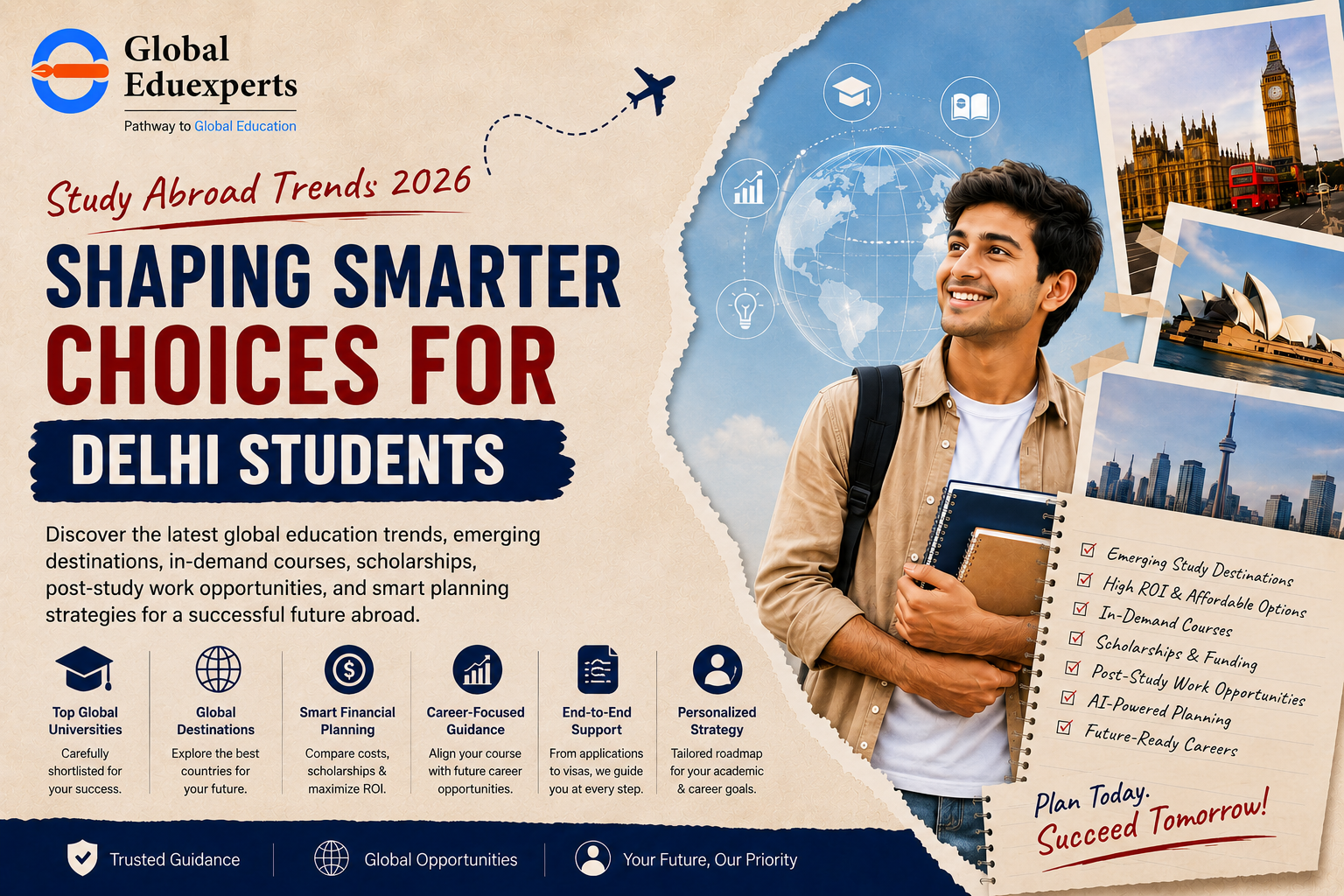
Studying abroad in 2026 requires more than choosing a popular destination—it demands informed planning based on evolving global education trends, career opportunities, affordability, and changing admission policies. This guide helps Delhi students and Indian applicants understand emerging study destinations, in-demand courses, scholarships, AI-powered planning tools, post-study work opportunities, and financial considerations, enabling them to make confident, future-focused decisions that support long-term academic and professional success.
Planning to study abroad has changed significantly over the past few years. Students are no longer selecting universities simply because a destination is popular or because friends have studied there. Today's applicants are asking different questions. They want to know whether a degree will lead to strong career opportunities, whether the investment is financially worthwhile, and how international education aligns with their long-term professional goals.
These changing priorities are shaping the Study Abroad Trends 2026 for Delhi Students, where decisions are increasingly based on research, employability, affordability, and future opportunities rather than reputation alone.
The global education landscape continues to evolve as universities introduce new programs, governments revise immigration policies, employers seek different skill sets, and technology changes how students research international education. Understanding these developments allows students to prepare more effectively and avoid making decisions based on outdated information.
A decade ago, many applicants focused primarily on university rankings.
Today, that approach is changing.
Students increasingly evaluate questions such as:
Rather than choosing the highest-ranked university available, students are comparing institutions that offer better industry connections, internships, practical learning, and stronger graduate employment outcomes.
This shift reflects a more career-focused approach to overseas education.
International education remains a significant financial investment.
As tuition fees and living expenses continue to rise across several destinations, families are paying much closer attention to overall education costs.
Students now compare:
| Planning Area | Why It Matters |
|---|---|
| Tuition Fees | Education budget |
| Living Expenses | Overall affordability |
| Scholarships | Reducing financial burden |
| Career Prospects | Long-term value |
This stronger financial awareness is one reason High ROI Study Abroad Trends for Delhi Students continue to gain attention.
Popular destinations such as the USA, UK, Australia, and Canada continue to attract large numbers of international students.
However, they are no longer the only options under consideration.
Many Indian students are also exploring:
These destinations often provide competitive education systems, growing employment opportunities, English-taught programs, and attractive tuition structures.
As awareness increases, students are making destination choices based on individual goals instead of following traditional preferences.
Visa regulations and post-study work policies continue to evolve across different countries.
Students are paying closer attention to factors such as:
Rather than evaluating universities alone, applicants increasingly assess whether a destination supports long-term professional growth after graduation.
Government policy updates therefore play an important role in study abroad planning.
Students no longer depend entirely on education fairs or printed brochures.
Digital platforms now provide immediate access to:
Artificial Intelligence has further accelerated this process by helping students organize research, compare universities, estimate costs, and understand admission requirements more efficiently.
Technology is making study abroad planning faster, but students still benefit from verifying information through official university sources.
Every student's priorities are different.
Some seek affordable education.
Others prioritize research opportunities, internships, global exposure, or international career prospects.
Instead of selecting destinations based solely on popularity, students increasingly evaluate universities according to:
Personalized decision-making has become one of the defining characteristics of modern overseas education planning.
As international education becomes more accessible, universities are receiving applications from students across the world.
This increased competition encourages applicants to prepare stronger applications.
Students now invest more effort in:
Preparing early allows students to improve their overall profile before application deadlines arrive.
Another important trend is the growing emphasis on practical skills.
Many employers now value graduates who demonstrate:
Students therefore increasingly choose universities offering:
Academic reputation remains important, but employability has become equally significant.
Course selection has become more strategic.
Instead of choosing programs based on current popularity, students are researching:
| Academic Field | Why Interest Is Growing |
| Artificial Intelligence | Rapid technological adoption |
| Data Science | Business demand |
| Cybersecurity | Global workforce shortage |
| Healthcare | Expanding healthcare systems |
| Business Analytics | Data-driven decision making |
Choosing courses with long-term relevance helps students prepare for evolving global job markets.
Students are becoming more proactive about reducing educational costs.
Rather than applying first and searching for funding later, many now research scholarships during the university selection process.
This allows applicants to compare:
Early financial planning creates greater flexibility when selecting universities.
Students planning overseas education today have access to far more information than previous generations.
Within a short period, they can compare:
While this improves decision-making, it also increases the importance of identifying reliable information sources.
Students should balance online research with official university websites and trusted educational guidance.
Global education trends continue to evolve each year.
Universities introduce new programs.
Governments revise immigration policies.
Industries develop new skill requirements.
Students who stay informed about these developments can adapt their study plans more effectively and identify opportunities that align with changing international education markets.
Understanding the Latest Study Abroad Trends for Indian Students 2026 allows applicants to make decisions based on current realities rather than outdated assumptions.
Students researching Study Abroad Trends 2026 for Delhi Students, Top Study Abroad Destinations for Delhi Students 2026, Best Countries to Study Abroad in 2026 for Indian Students, Study Abroad Trends in Europe USA UK Canada Australia 2026, Emerging Study Abroad Destinations for Indian Students, In-Demand Courses for Study Abroad in 2026, Post Study Work Trends for Indian Students Abroad 2026, and the Future of Overseas Education for Delhi Students are recognizing that successful international education planning now requires a broader perspective than ever before.
Modern study abroad decisions are increasingly influenced by affordability, employability, technology, evolving immigration policies, industry demand, and long-term career outcomes. Students who stay informed about these changing trends, research multiple destinations, evaluate return on investment, and prepare strategically are better positioned to choose universities and countries that support both their academic ambitions and future professional success.
Keeping up with global education changes becomes much easier when you also understand how different destinations are evolving. If you're planning from the NCR region, exploring
STUDY ABROAD FROM DELHIprovides localized guidance, while country overviews likeSTUDY IN EUROPE,STUDY IN USA, andSTUDY IN UKhelp you compare opportunities based on current education trends rather than outdated assumptions.
The way Delhi students choose study abroad destinations is changing rapidly. A few years ago, countries like the USA, UK, Australia, and Canada dominated almost every student's shortlist. While these destinations continue to attract international applicants, students are now exploring a much wider range of countries before making their final decision.
Several factors are driving this shift. Rising education costs, changing immigration policies, increasing scholarship opportunities, expanding English-taught programs, and stronger post-study work options have encouraged students to compare destinations more carefully than ever before.
Instead of asking, "Which country is the most popular?" students are increasingly asking, "Which country is the best fit for my career goals, budget, and future plans?"
This practical approach is shaping the Top Study Abroad Destinations for Delhi Students 2026 and redefining how international education decisions are made.
Europe has become one of the fastest-growing choices for Indian students.
Countries across the continent are attracting applicants because they combine:
Students also appreciate the opportunity to experience diverse cultures while studying within a highly connected region.
Rather than focusing on a single destination, many applicants now compare multiple European countries before deciding where to apply.
The United States continues to attract students seeking world-class education and cutting-edge research.
Its strengths include:
Students interested in technology, engineering, business, healthcare, and scientific research continue to consider the USA a preferred destination despite higher education costs.
However, applicants today pay much closer attention to return on investment, internship opportunities, and long-term career prospects before making their decision.
The United Kingdom remains popular because of its internationally respected education system and comparatively shorter postgraduate programs.
Many students appreciate:
For students seeking faster entry into the workforce, shorter program durations can significantly reduce overall education expenses.
Australia remains an attractive destination because it combines quality education with practical learning.
Students often choose Australia for:
Many universities emphasize internships, project-based learning, and employer engagement, making Australia particularly appealing for students seeking professional experience alongside their studies.
Ireland has seen remarkable growth among Indian students over the past few years.
Several reasons contribute to its increasing popularity:
Students pursuing Computer Science, Artificial Intelligence, Data Analytics, Business, and Healthcare increasingly view Ireland as an excellent combination of educational quality and career potential.
Dubai is attracting students looking for internationally recognized education closer to home.
Its growing popularity is supported by:
Students interested in Business, Hospitality, Aviation, Finance, and Management frequently include Dubai among their preferred study destinations.
Several Asian countries are strengthening their position in international education.
Students are increasingly exploring destinations offering:
Many universities across Asia now offer English-medium programs, making them more accessible for Indian students seeking quality education within comparatively lower budgets.
Choosing a country simply because many students apply there is becoming less common.
Today's applicants compare destinations using practical considerations.
| Decision Factor | Why Students Consider It |
|---|---|
| Tuition Fees | Budget planning |
| Living Costs | Overall affordability |
| Graduate Employment | Career growth |
| Post-Study Work | Professional opportunities |
| Scholarships | Financial support |
| Course Availability | Academic fit |
This shift reflects more informed and personalized decision-making.
Financial planning has become one of the biggest priorities for students and families.
Instead of evaluating tuition fees alone, applicants compare:
Countries offering better educational value often receive greater attention, even if they are not traditionally considered mainstream study destinations.
Graduates increasingly want international education to translate into meaningful career opportunities.
As a result, students carefully evaluate:
Destinations supporting professional development after graduation often become stronger choices than countries offering education alone.
Many students now select the country after identifying the right academic program.
For example:
Different countries have developed particular strengths in specific industries.
Understanding these specializations helps students align education with future career goals rather than relying solely on overall university rankings.
Modern applicants also evaluate lifestyle factors that influence their overall education experience.
Common considerations include:
These practical aspects contribute significantly to academic success and personal well-being throughout the study abroad journey.
Instead of applying immediately after identifying one country, students now conduct extensive comparisons.
Typical research includes:
Technology and AI-powered research tools have made this comparison process much faster, allowing students to evaluate several countries before creating a balanced application strategy.
One of the biggest changes in overseas education planning is the realization that there is no universal "best" destination.
The right choice depends on:
Students who match these factors carefully often achieve better educational and professional outcomes than those who simply follow popular trends.
Students researching Top Study Abroad Destinations for Delhi Students 2026, Best Countries to Study Abroad in 2026 for Indian Students, Study Abroad Trends in Europe USA UK Canada Australia 2026, Emerging Study Abroad Destinations for Indian Students, Latest Study Abroad Trends for Indian Students 2026, High ROI Study Abroad Trends for Delhi Students, Post Study Work Trends for Indian Students Abroad 2026, and the Future of Overseas Education for Delhi Students are discovering that successful destination selection involves balancing educational quality, affordability, employability, and long-term career opportunities.
The most informed students no longer choose countries based solely on popularity. They compare tuition costs, industry demand, graduate work opportunities, scholarships, quality of education, and future career prospects to identify destinations that align with both their personal ambitions and professional goals. This thoughtful approach is defining the next generation of international education planning.
Every destination has its own strengths, admission policies, and career advantages. Before narrowing your shortlist, compare dedicated guides like
STUDY IN IRELAND,STUDY IN AUSTRALIA,STUDY IN DUBAI,STUDY IN EUROPE, andSTUDY IN ASIAto understand tuition, lifestyle, employment prospects, and the type of international experience each destination offers.
Choosing the right country is only one part of planning an international education. Selecting the right course has become equally important. Students today understand that a globally recognized degree alone does not guarantee career success. Employers increasingly value practical skills, industry knowledge, and the ability to adapt to changing technologies and global markets.
As a result, Study Abroad Trends 2026 for Delhi Students show a clear shift toward career-oriented academic programs that align with future workforce demand rather than short-term popularity.
Students are researching industries experiencing rapid growth, identifying global skill shortages, and selecting courses that offer strong employment prospects after graduation. This approach allows them to maximize both educational value and long-term return on investment.
Artificial Intelligence is transforming industries across healthcare, finance, manufacturing, education, transportation, and retail.
Businesses worldwide are investing heavily in AI-driven technologies, creating demand for professionals who understand:
Universities have responded by introducing specialized undergraduate and postgraduate programs focused on Artificial Intelligence.
Students choosing AI often combine technical expertise with strong analytical and problem-solving skills, making them attractive candidates in a rapidly evolving global job market.
Every industry now generates enormous amounts of data.
Organizations need professionals who can analyze information, identify patterns, and support better business decisions.
Data Science programs typically include:
Graduates find opportunities across technology companies, healthcare organizations, financial institutions, consulting firms, and government agencies.
The growing importance of data-driven decision-making keeps Data Science among the most valuable international study options.
As businesses become increasingly digital, protecting information has become a global priority.
Cybersecurity professionals help organizations secure:
Increasing cyber threats continue to create workforce shortages worldwide.
Students pursuing Cybersecurity often benefit from excellent employability because demand extends across both public and private sectors.
Healthcare remains one of the world's fastest-growing sectors.
Ageing populations, medical innovation, and expanding healthcare systems continue to increase demand for qualified professionals.
Popular study areas include:
Many countries actively invest in healthcare infrastructure, making these programs attractive for students seeking stable long-term career opportunities.
Organizations increasingly rely on data to improve performance, customer experience, and strategic planning.
Business Analytics combines:
Graduates support organizations by converting business data into actionable insights.
Students interested in both technology and management often view Business Analytics as an excellent interdisciplinary choice.
Global investment in sustainability continues to accelerate.
Governments and businesses are focusing on:
Universities are expanding programs related to clean energy and environmental innovation.
Students interested in addressing climate challenges while building technical careers increasingly consider Renewable Energy an attractive field of study.
Engineering continues to offer excellent career opportunities across multiple industries.
Popular specializations include:
Modern engineering education increasingly emphasizes:
Students often prefer universities that combine classroom learning with research projects and industry placements.
Financial services continue to change rapidly through technology, digital banking, and international investment.
Students interested in Finance now study areas such as:
Strong quantitative skills combined with global financial knowledge continue to create diverse career opportunities.
Science, Technology, Engineering, and Mathematics remain among the strongest academic pathways for international students.
| Academic Area | Career Potential |
|---|---|
| Artificial Intelligence | Very High |
| Data Science | Very High |
| Cybersecurity | Very High |
| Engineering | High |
| Computer Science | Very High |
| Renewable Energy | High |
| Healthcare Technology | High |
STEM graduates often benefit from strong research opportunities, international employer demand, and expanding innovation-driven industries.
Instead of asking,
"Which course is popular?"
students increasingly ask,
"Which skills will employers need five or ten years from now?"
This change reflects a more strategic approach to overseas education.
Students evaluate:
Courses connected with long-term industry demand generally provide stronger employment opportunities after graduation.
Many universities now combine multiple disciplines within a single degree.
Examples include:
These interdisciplinary programs prepare graduates for increasingly complex workplaces where technical knowledge and business understanding often work together.
Students no longer evaluate curriculum alone.
They also compare opportunities such as:
Practical experience helps graduates transition more smoothly into professional employment after completing their studies.
Technology continues to reshape industries at an unprecedented pace.
Many students therefore choose courses that provide transferable skills rather than preparing them for a single profession.
Skills such as:
remain valuable across multiple industries and support long-term career adaptability.
Every student has different interests, strengths, and career ambitions.
The most suitable academic program should align with:
Selecting a course based solely on current popularity may not always produce the best long-term outcome.
Careful planning generally leads to stronger educational and career decisions.
Students researching In-Demand Courses for Study Abroad in 2026, Latest Study Abroad Trends for Indian Students 2026, Best Countries to Study Abroad in 2026 for Indian Students, High ROI Study Abroad Trends for Delhi Students, Study Abroad Trends in Europe USA UK Canada Australia 2026, and the Future of Overseas Education for Delhi Students are increasingly prioritizing programs that combine academic excellence with long-term employability.
Fields such as Artificial Intelligence, Data Science, Cybersecurity, Healthcare, Business Analytics, Renewable Energy, Engineering, Finance, and other STEM disciplines continue to shape international education choices because they align with evolving global industries and workforce needs. Students who carefully match their academic interests with future job market demand are better positioned to achieve both professional success and stronger returns on their educational investment.
Choosing a future-ready course becomes easier when you also understand where those programs are most established. Reading country-specific resources such as
USA CoursesandUk Courseshelps compare curriculum strengths, industry connections, and career pathways before selecting a university that matches your long-term professional goals.
For many Indian families, studying abroad is one of the biggest educational investments they will ever make. While university rankings and international exposure remain important, they are no longer the only factors influencing decisions. Students today are asking a much more practical question: Will the money invested in international education create meaningful long-term career opportunities?
This change in mindset has made Return on Investment (ROI) one of the defining Study Abroad Trends 2026 for Delhi Students. Instead of selecting universities based purely on reputation, students now compare education costs with future earning potential, graduate employability, internship opportunities, scholarship availability, and career growth.
The objective is no longer simply earning an international degree. It is choosing an education pathway that delivers academic value while supporting financial stability and long-term professional success.
Tuition fees remain one of the largest study abroad expenses, but they represent only one part of the overall financial picture.
Students now calculate the total cost of studying overseas by considering:
Evaluating total educational expenditure provides a far more realistic understanding of affordability than comparing tuition fees alone.
The cost of living varies significantly between countries and even between cities within the same destination.
Students now research factors such as:
| Expense Category | Importance in Planning |
|---|---|
| Tuition Fees | High |
| Accommodation | High |
| Living Expenses | High |
| Health Insurance | High |
| Transportation | Moderate |
| Personal Expenses | Moderate |
Understanding these recurring costs allows families to prepare realistic financial plans before applications begin.
Choosing the most famous university is no longer automatically considered the smartest decision.
Students increasingly compare questions such as:
A university with moderate tuition fees and strong employment outcomes may deliver better long-term value than a considerably more expensive institution.
This balanced evaluation reflects the growing importance of High ROI Study Abroad Trends for Delhi Students.
Scholarships are no longer viewed as optional bonuses.
Many students now consider them an essential part of their education strategy.
Applicants actively research:
Applying for scholarships early can substantially reduce the total cost of studying abroad and improve overall return on investment.
Students increasingly evaluate universities based on career outcomes rather than academic reputation alone.
Important considerations include:
Universities with strong employer relationships often provide students with valuable practical experience before graduation, improving career prospects after completing their studies.
Students understand that salary expectations vary across countries, industries, and professions.
Instead of focusing on the highest reported salaries, they increasingly compare:
Higher salaries do not always translate into better financial outcomes if living expenses are equally high.
A balanced comparison provides a more accurate understanding of long-term value.
Affordable education does not necessarily mean lower academic quality.
Many universities offering competitive tuition fees also provide:
Students increasingly recognize that educational value depends on the overall learning experience and career opportunities rather than tuition costs alone.
Country selection is increasingly influenced by employment opportunities after graduation.
Students compare destinations based on:
Countries investing in technology, healthcare, engineering, sustainability, and innovation often provide stronger career opportunities for international graduates.
This makes employability a central part of financial planning.
Previously, many students considered finances only after receiving admission offers.
Today's applicants begin budgeting much earlier.
They estimate:
| Planning Area | Purpose |
| Tuition Budget | Education affordability |
| Scholarship Research | Reduce expenses |
| Living Cost Estimate | Monthly budgeting |
| Education Loans | Funding support |
| Emergency Savings | Financial security |
Early planning helps families avoid unexpected financial pressure during the study period.
Rapid technological change has transformed the global job market.
Students increasingly choose courses that remain relevant across multiple industries.
Popular areas include:
Selecting future-oriented programs improves the likelihood of long-term career growth and strengthens overall educational return on investment.
Internships are becoming one of the most important factors in evaluating universities.
Students prefer institutions offering:
These experiences allow graduates to develop professional skills before entering the job market, improving employability immediately after graduation.
A study abroad decision increasingly includes long-term planning.
Applicants ask:
This broader perspective encourages more thoughtful educational investment.
Return on investment should never be measured only through income.
Students also evaluate benefits such as:
These advantages often contribute significantly to long-term career success, even if they cannot be measured immediately in financial terms.
Students researching Study Abroad Trends 2026 for Delhi Students, High ROI Study Abroad Trends for Delhi Students, Latest Study Abroad Trends for Indian Students 2026, Best Countries to Study Abroad in 2026 for Indian Students, Top Study Abroad Destinations for Delhi Students 2026, In-Demand Courses for Study Abroad in 2026, Post Study Work Trends for Indian Students Abroad 2026, and the Future of Overseas Education for Delhi Students are increasingly evaluating international education through the lens of long-term value rather than short-term prestige.
Modern study abroad planning now combines tuition fees, living expenses, scholarships, graduate employability, industry demand, career progression, and financial sustainability into a single decision-making process. Students who carefully compare both educational costs and future career outcomes are better positioned to choose universities that provide meaningful academic experiences, stronger employment opportunities, and a more sustainable return on their investment over the course of their professional lives.
A realistic financial comparison often changes the final decision. Reviewing resources like
USA Cost,UK Cost,Australia Cost,Ireland Cost, andDubai Costgives a clearer picture of tuition, accommodation, and everyday expenses, allowing families to evaluate long-term return on investment instead of focusing only on university rankings.
Planning to study abroad once involved collecting printed brochures, visiting multiple education fairs, scheduling in-person counseling sessions, and spending weeks researching universities. Today, the process looks very different. Artificial Intelligence, digital platforms, and online education technologies have transformed how students discover universities, compare countries, prepare applications, and communicate with institutions around the world.
For many applicants, technology has reduced the time required to research international education while making information more accessible than ever before. Instead of relying on a single source of information, students now compare universities, estimate education costs, attend virtual events, organize documents, and prepare applications from anywhere.
This shift is becoming one of the defining Study Abroad Trends 2026 for Delhi Students, where technology is improving efficiency while helping students make better-informed educational decisions.
One of the biggest challenges during study abroad planning is identifying universities that genuinely match a student's academic profile and career goals.
Artificial Intelligence simplifies this process by organizing information based on factors such as:
Instead of manually reviewing hundreds of university websites, students receive personalized recommendations that help narrow their search more efficiently.
This allows applicants to spend more time evaluating suitable universities rather than simply locating them.
Choosing between countries has become much easier with digital comparison tools.
Students can now compare destinations based on:
| Comparison Area | Student Benefit |
|---|---|
| Tuition Fees | Budget planning |
| Living Costs | Financial preparation |
| Graduate Employment | Career evaluation |
| Scholarships | Cost reduction |
| Post-Study Work | Long-term opportunities |
This structured comparison supports more balanced decision-making than relying on popularity alone.
Students often wonder whether their academic profile matches university expectations.
AI-powered platforms analyze information such as:
Based on historical admission trends and published university requirements, AI identifies institutions where students may have stronger admission prospects.
These predictions help applicants create balanced university shortlists while understanding that final admission decisions remain the responsibility of individual universities.
Applying to several universities simultaneously can become complicated.
Students must manage:
Digital application platforms help organize every stage of the admission process.
Many students now use online dashboards to monitor submission status, upload documents, and track university responses in one centralized location.
This reduces administrative confusion and improves overall application management.
Technology has also changed how students interact with education professionals.
Instead of relying exclusively on face-to-face meetings, many applicants now benefit from:
Students can receive expert advice regardless of their location, making overseas education planning more flexible and convenient.
Virtual counseling has expanded access to professional guidance without removing the value of personalized discussions.
International education fairs no longer require physical attendance.
Many universities now organize virtual events where students can:
These online events allow students to interact with multiple universities within a short period, making the research process both faster and more comprehensive.
Preparing study abroad applications involves managing numerous documents.
These commonly include:
Digital document management platforms help students organize, upload, and access files securely throughout the application process.
Maintaining well-organized digital records reduces the likelihood of missing important documentation.
Students no longer wait weeks for information through traditional communication channels.
Universities increasingly provide:
This faster communication helps applicants clarify admission requirements, understand course details, and monitor application progress more efficiently.
Financial planning has become more data-driven with AI-powered tools.
Students can estimate:
| Planning Area | Digital Advantage |
| Budget Estimation | Faster calculations |
| Scholarship Search | Better filtering |
| University Comparison | Organized information |
| Application Tracking | Improved efficiency |
These tools help students evaluate affordability before committing to a destination.
One major advantage of digital technology is accessibility.
Students are no longer restricted by office hours or physical locations.
They can:
This flexibility allows students to plan international education alongside their existing academic commitments.
Rather than replacing thoughtful planning, digital platforms provide students with better information.
Technology helps applicants:
Students still need to interpret information carefully, but technology reduces the effort required to collect and organize it.
Although AI and digital platforms continue to improve, successful study abroad planning still depends on informed human judgment.
Education counselors contribute valuable insights regarding:
Technology improves efficiency.
Professional guidance helps students interpret information and make decisions that align with their personal and professional goals.
The two approaches increasingly complement one another.
Students should remember that digital tools provide support rather than certainty.
Before making important decisions, applicants should always verify:
Official university websites and government sources remain the most reliable references for current information.
Using technology responsibly helps students avoid misinformation while benefiting from faster research and better organization.
Students researching Study Abroad Trends 2026 for Delhi Students, Latest Study Abroad Trends for Indian Students 2026, Top Study Abroad Destinations for Delhi Students 2026, Future of Overseas Education for Delhi Students, High ROI Study Abroad Trends for Delhi Students, and Post Study Work Trends for Indian Students Abroad 2026 are increasingly discovering that Artificial Intelligence and digital platforms have become valuable partners throughout the international education journey.
From AI-powered university research and admission prediction to virtual counseling, online university fairs, digital documentation, and application management, technology is making overseas education planning faster, more organized, and more accessible. At the same time, the most successful study abroad decisions continue to combine these technological advantages with careful research, verified information, thoughtful financial planning, and experienced guidance to create personalized strategies that support long-term academic and career success.
Technology can simplify research, but accurate planning still depends on verified admission information. Once you've shortlisted a destination using digital tools, it's worth reviewing practical guides such as
USA Eligibility,UK Eligibility,Australia Eligibility,Ireland Eligibility, andDubai Eligibilityto confirm academic requirements before submitting applications.
International education is becoming more accessible than ever before. While studying abroad was once considered financially challenging for many families, universities and governments across the world are introducing new initiatives that make overseas education achievable for a wider range of students. Scholarships, flexible admission pathways, multiple intake options, English-taught degree programs, and simplified application processes are reshaping how Indian students approach global education.
These developments are becoming an important part of the Study Abroad Trends 2026 for Delhi Students, allowing applicants to focus on finding universities that match both their academic goals and financial circumstances.
Rather than limiting opportunities, today's international education landscape provides students with more choices, greater flexibility, and improved access to globally recognized qualifications.
Universities around the world increasingly reward academic excellence through merit-based scholarships.
These scholarships are commonly awarded based on:
Many institutions automatically consider eligible applicants during the admission process, while others require separate scholarship applications.
Strong academic preparation can therefore reduce the overall financial burden of studying abroad.
In addition to university funding, many governments offer scholarship programs designed to attract talented international students.
These initiatives often aim to:
Government-funded scholarships may cover:
Students who begin researching these opportunities early generally have more funding options available.
Financial support is no longer limited to scholarships alone.
Many universities now provide:
| Funding Option | Typical Purpose |
|---|---|
| Merit Scholarships | Academic excellence |
| University Grants | Financial assistance |
| Research Assistantships | Research participation |
| Teaching Assistantships | Academic support |
| Tuition Discounts | Reduced education costs |
Exploring these opportunities during university shortlisting helps students make more informed financial decisions.
Previously, students often had only one primary admission period each year.
Today, many universities offer multiple intakes.
Common admission periods include:
Multiple intake options provide greater flexibility for students who may need additional time to:
This flexibility reduces unnecessary pressure during the application process.
Universities continue to improve the international application experience.
Many institutions have simplified procedures by offering:
These improvements reduce administrative complexity while making international admissions more transparent and accessible.
Students can now complete much of the application process remotely.
One of the biggest changes in global education has been the expansion of English-medium degree programs.
Countries across Europe and Asia increasingly offer undergraduate and postgraduate courses taught entirely in English.
This benefits Indian students by allowing them to:
English-taught education has opened opportunities in destinations that previously attracted fewer international applicants.
The international education landscape has become far more diverse.
Instead of focusing only on traditional destinations, students are now exploring countries offering:
This wider range of choices allows applicants to identify destinations that align more closely with their personal, academic, and financial priorities.
Technology has made scholarship and admission information easier to access.
Students can now:
| Digital Tool | Student Advantage |
| Online Applications | Faster submissions |
| Scholarship Portals | Easier funding research |
| Virtual Counseling | Expert guidance from anywhere |
| University Webinars | Direct interaction with institutions |
These digital resources reduce geographical barriers and improve access to global education opportunities.
Many institutions actively seek international applicants because diverse classrooms create richer learning environments.
Students from different countries contribute:
As a result, universities continue expanding support services for international students, including orientation programs, academic assistance, and career development initiatives.
One common mistake is waiting until after receiving admission offers before researching financial aid.
Students are better positioned when scholarship planning begins alongside university research.
Early preparation allows applicants to:
Planning ahead significantly increases the number of funding opportunities available.
International education is expanding beyond traditional business and engineering programs.
Students now find English-taught opportunities in areas including:
This wider academic choice enables students to pursue specialized careers without limiting themselves to only a few popular disciplines.
Modern admission systems recognize that every student's circumstances are different.
Flexible application processes allow students to:
These improvements help reduce uncertainty while making international education more accessible to students across India.
Although universities continue expanding scholarships and simplifying admissions, successful applicants still benefit from careful preparation.
Students should compare:
Thoughtful research allows students to identify opportunities that genuinely support their academic ambitions and financial goals.
Students researching Study Abroad Trends 2026 for Delhi Students, Latest Study Abroad Trends for Indian Students 2026, Top Study Abroad Destinations for Delhi Students 2026, Best Countries to Study Abroad in 2026 for Indian Students, Emerging Study Abroad Destinations for Indian Students, High ROI Study Abroad Trends for Delhi Students, In-Demand Courses for Study Abroad in 2026, Post Study Work Trends for Indian Students Abroad 2026, and the Future of Overseas Education for Delhi Students are discovering that international education is becoming increasingly flexible and accessible.
Merit scholarships, government funding, university grants, English-taught programs, simplified admissions, digital application systems, and multiple intake options are expanding opportunities for Indian students across the world. Applicants who begin planning early, research financial assistance carefully, and compare universities beyond rankings are better positioned to access quality international education while building a strong foundation for future academic and professional success.
Funding opportunities often vary by destination and institution. Alongside researching university scholarships, compare country-specific resources like
USA scholarships,UK Scholarships, andAustralia Scholarshipsto understand available financial assistance, eligibility criteria, and ways to reduce the overall cost of studying abroad.
Not long ago, many students chose a study destination primarily because of its university rankings or international reputation. Today, the conversation begins much earlier—and with a different question. Students and their families increasingly ask, What happens after graduation? Can graduates stay and work? Are employers hiring international students? Will the degree lead to meaningful career opportunities?
These questions have become central to international education planning. As a result, post-study employment opportunities now influence destination selection almost as much as academic quality. This shift has become one of the most noticeable Study Abroad Trends 2026 for Delhi Students, where long-term career planning is shaping study abroad decisions from the very beginning.
Rather than viewing education and employment separately, students are connecting both as part of one continuous journey.
Many countries now offer international graduates the opportunity to remain temporarily after completing their studies to search for employment or begin their professional careers.
These post-study work provisions allow graduates to:
Students increasingly compare these opportunities before selecting a country because practical work experience often strengthens future employment opportunities both internationally and in India.
Employers increasingly expect graduates to have practical experience alongside academic qualifications.
As a result, students actively seek universities offering:
These experiences allow students to develop workplace skills while still studying, making the transition from university to employment much smoother.
Internships also help students understand how different industries operate in international markets.
The global workforce continues to evolve as industries adopt new technologies and expand into emerging markets.
Students now research employer demand before selecting both their course and destination.
Growing industries include:
Choosing programs connected to expanding industries increases the likelihood of finding relevant employment after graduation.
Many developed economies continue to experience shortages of skilled professionals in specific sectors.
These shortages have increased demand for graduates with expertise in areas such as:
| Industry | Employment Outlook |
|---|---|
| Artificial Intelligence | Very Strong |
| Healthcare | Strong |
| Cybersecurity | Very Strong |
| Engineering | Strong |
| Data Science | Very Strong |
| Renewable Energy | Growing |
Students increasingly align their academic choices with industries where demand continues to grow internationally.
Salary remains an important consideration, but students are becoming more realistic about career progression.
Rather than focusing only on first-year earnings, they evaluate:
A destination offering continuous career growth often provides greater long-term value than one offering higher initial salaries but limited advancement opportunities.
Many students now research whether their chosen destination provides structured pathways for skilled professionals after graduation.
Areas commonly evaluated include:
While immigration policies differ across countries and may change over time, understanding available pathways helps students make more informed decisions during university selection.
Applicants should always verify current immigration regulations through official government sources before making long-term plans.
Academic quality remains important, but students increasingly value universities that maintain close relationships with employers.
Strong industry partnerships often provide:
These experiences help students build professional connections before completing their degrees.
University rankings alone no longer satisfy many applicants.
Students now compare additional indicators such as:
| Evaluation Area | Why It Matters |
| Graduate Employment | Job readiness |
| Internship Opportunities | Practical experience |
| Industry Partnerships | Professional exposure |
| Career Services | Employment support |
This broader evaluation helps students identify universities that support long-term professional development.
International work experience often provides advantages that extend beyond technical knowledge.
Graduates frequently develop:
These transferable skills remain valuable regardless of where students eventually build their careers.
One noticeable change in overseas education planning is the growing focus on life after university.
Students increasingly ask:
These questions encourage more strategic decision-making than simply choosing the most popular destination.
Technological innovation continues reshaping global employment.
Students therefore select programs that prepare them for industries expected to grow over the next decade.
Popular future-oriented disciplines include:
Matching academic programs with future workforce demand improves long-term employability.
Working internationally provides more than professional experience.
Graduates often gain:
These experiences can strengthen career prospects even after returning to India or pursuing opportunities in other international markets.
Students increasingly evaluate universities not only by the education they provide but also by the careers they help graduates build.
Factors such as employer demand, internships, graduate work rights, industry collaboration, and long-term professional opportunities now play an essential role in destination selection.
This reflects a broader understanding that successful international education should prepare students for sustainable careers rather than simply awarding degrees.
Students researching Study Abroad Trends 2026 for Delhi Students, Post Study Work Trends for Indian Students Abroad 2026, Top Study Abroad Destinations for Delhi Students 2026, Best Countries to Study Abroad in 2026 for Indian Students, Study Abroad Trends in Europe USA UK Canada Australia 2026, Emerging Study Abroad Destinations for Indian Students, High ROI Study Abroad Trends for Delhi Students, and the Future of Overseas Education for Delhi Students are increasingly prioritizing destinations that combine academic excellence with meaningful employment opportunities.
Graduate work rights, international internships, growing employer demand, industry skill shortages, and long-term career pathways have become major factors influencing overseas education choices. Students who carefully evaluate these employment-related considerations alongside university quality, affordability, and academic fit are better positioned to build international careers that deliver lasting professional value well beyond graduation.
Career planning should continue beyond receiving an admission offer. While evaluating employment opportunities, it's equally important to understand student immigration requirements through
USA Visa,UK Visa,Australia Visa,Ireland Visa, andDubai Visa, as visa policies and graduate work permissions often influence long-term career planning.
Study abroad planning in 2026 is no longer about following the most popular destination or choosing the highest-ranked university. The international education landscape is evolving rapidly, influenced by changing immigration policies, technological advancements, new academic programs, industry demands, and shifting global economies. Students who begin planning with flexibility and reliable information are better positioned to adapt to these changes and make decisions that remain valuable long after graduation.
Preparing for future study abroad trends requires more than completing application forms. It involves understanding where global opportunities are growing, comparing countries carefully, selecting universities strategically, preparing financially, and building a long-term career plan rather than focusing only on admission.
This forward-thinking approach reflects the evolving Study Abroad Trends 2026 for Delhi Students, where informed planning has become one of the strongest predictors of international education success.
Many students begin by selecting a destination.
A more effective strategy is to begin with long-term career objectives.
Questions worth considering include:
Once these answers become clear, selecting an appropriate country and university becomes significantly easier.
Career-first planning reduces the risk of making decisions based only on current popularity.
A well-planned study abroad journey starts with reliable local guidance and expands into destination-specific research. Students planning from nearby cities can begin with
STUDY ABROAD FROM DELHI,STUDY ABROAD FROM NOIDA,STUDY ABROAD FROM GURGAON, orSTUDY ABROAD FROM GHAZIABAD, then continue exploring country guides that best align with their academic interests, budget, and long-term career ambitions.
Every country offers different academic strengths, employment opportunities, and education systems.
Students should compare destinations based on:
| Decision Area | Why It Matters |
|---|---|
| Academic Quality | Learning outcomes |
| Affordability | Financial planning |
| Career Opportunities | Long-term growth |
| Graduate Work Rights | Professional experience |
| Industry Demand | Future employability |
Comparing multiple destinations helps students identify opportunities that genuinely match their goals rather than simply following market trends.
University rankings provide useful information, but they should not be the only selection criteria.
Students should also evaluate:
A university that aligns closely with personal career goals often delivers greater long-term value than a higher-ranked institution with limited relevance to the chosen profession.
International education policies evolve every year.
Universities introduce:
Governments may also adjust:
Students who regularly review official university announcements and government updates are better prepared to adapt their plans when changes occur.
Successful study abroad planning depends as much on financial preparation as academic preparation.
Students should estimate:
At the same time, they should research:
| Planning Area | Purpose |
| Tuition Budget | Overall affordability |
| Scholarship Research | Reduce education costs |
| Living Expenses | Monthly planning |
| Emergency Fund | Financial security |
Early budgeting helps families make confident and realistic decisions.
One common mistake is beginning applications too late.
A structured timeline allows students to prepare every stage carefully.
Typical planning includes:
Breaking the process into smaller stages reduces stress while improving application quality.
Artificial Intelligence and digital platforms have become valuable study abroad resources.
Students can use technology to:
Technology improves efficiency, but important decisions should always be verified through official university websites and trusted education professionals.
Using AI wisely supports better planning without replacing independent judgment.
Global employment markets continue to evolve.
Students benefit from choosing programs that develop transferable skills such as:
These capabilities remain valuable across industries and improve long-term career flexibility regardless of changing market conditions.
Universities increasingly evaluate applicants beyond academic scores.
Strong applications often demonstrate:
Rather than trying to create perfect applications, students should focus on presenting authentic experiences that genuinely explain why they wish to pursue international education.
Authenticity continues to be one of the strongest qualities in competitive applications.
Study abroad planning rarely follows a perfectly predictable path.
Students may encounter:
Remaining flexible allows applicants to adapt while continuing to move toward their long-term objectives.
Flexibility often leads to discovering opportunities that were not initially considered.
Students have access to enormous amounts of information through social media, discussion forums, AI tools, and education websites.
While these resources are helpful, important decisions should always be supported by reliable sources.
Before applying, verify:
Official university websites and government portals remain the most dependable sources of current information.
Every student has unique strengths, ambitions, and financial circumstances.
Instead of copying another person's study abroad journey, students should develop their own roadmap.
A well-planned strategy typically includes:
Personalized planning creates decisions that are more sustainable and meaningful over time.
Students researching Study Abroad Trends 2026 for Delhi Students, Latest Study Abroad Trends for Indian Students 2026, Top Study Abroad Destinations for Delhi Students 2026, Best Countries to Study Abroad in 2026 for Indian Students, Study Abroad Trends in Europe USA UK Canada Australia 2026, Emerging Study Abroad Destinations for Indian Students, High ROI Study Abroad Trends for Delhi Students, In-Demand Courses for Study Abroad in 2026, Post Study Work Trends for Indian Students Abroad 2026, and the Future of Overseas Education for Delhi Students are recognizing that successful international education begins with thoughtful preparation rather than quick decisions.
Students who research multiple destinations, compare universities carefully, plan finances early, understand changing global education trends, prepare authentic applications, and align academic choices with long-term career goals are better equipped to navigate the evolving world of international education. Building a personalized study abroad strategy not only improves admission opportunities but also creates a stronger foundation for sustainable professional growth in an increasingly competitive global workforce.
The biggest Study Abroad Trends 2026 for Delhi Students include greater interest in career-focused courses, increasing preference for countries offering strong post-study work opportunities, wider use of AI for university research, growing demand for affordable education with high return on investment, expansion of English-taught programs, and increased focus on scholarships, employability, and long-term career planning rather than university rankings alone.
The USA, UK, Australia, Ireland, and several European countries continue to attract Indian students because of their academic quality, research opportunities, and graduate employment prospects. At the same time, destinations across Europe, Dubai, and parts of Asia are becoming increasingly popular due to affordable tuition, English-medium programs, expanding scholarship opportunities, and competitive post-study work options.
Students should compare countries based on course quality, tuition fees, living expenses, scholarship availability, graduate work opportunities, employer demand, immigration policies, and long-term career prospects. Rather than choosing a destination based only on popularity, it is advisable to evaluate how well the country's education system aligns with personal academic interests, financial capacity, and future professional goals.
International education represents a significant financial commitment, making return on investment an important consideration for students and families. Applicants increasingly compare tuition fees, living costs, scholarships, graduate salaries, internship opportunities, employability, and long-term career growth before selecting a university. This balanced approach helps students identify education pathways that provide both academic value and sustainable career opportunities.
Students can prepare by researching multiple destinations, staying informed about admission and visa policy updates, planning finances early, applying for scholarships, improving language proficiency, developing industry-relevant skills, and creating a structured application timeline. Combining reliable research, official university information, and expert guidance helps students adapt to changing global education trends while making informed decisions that support long-term academic and career success.


