
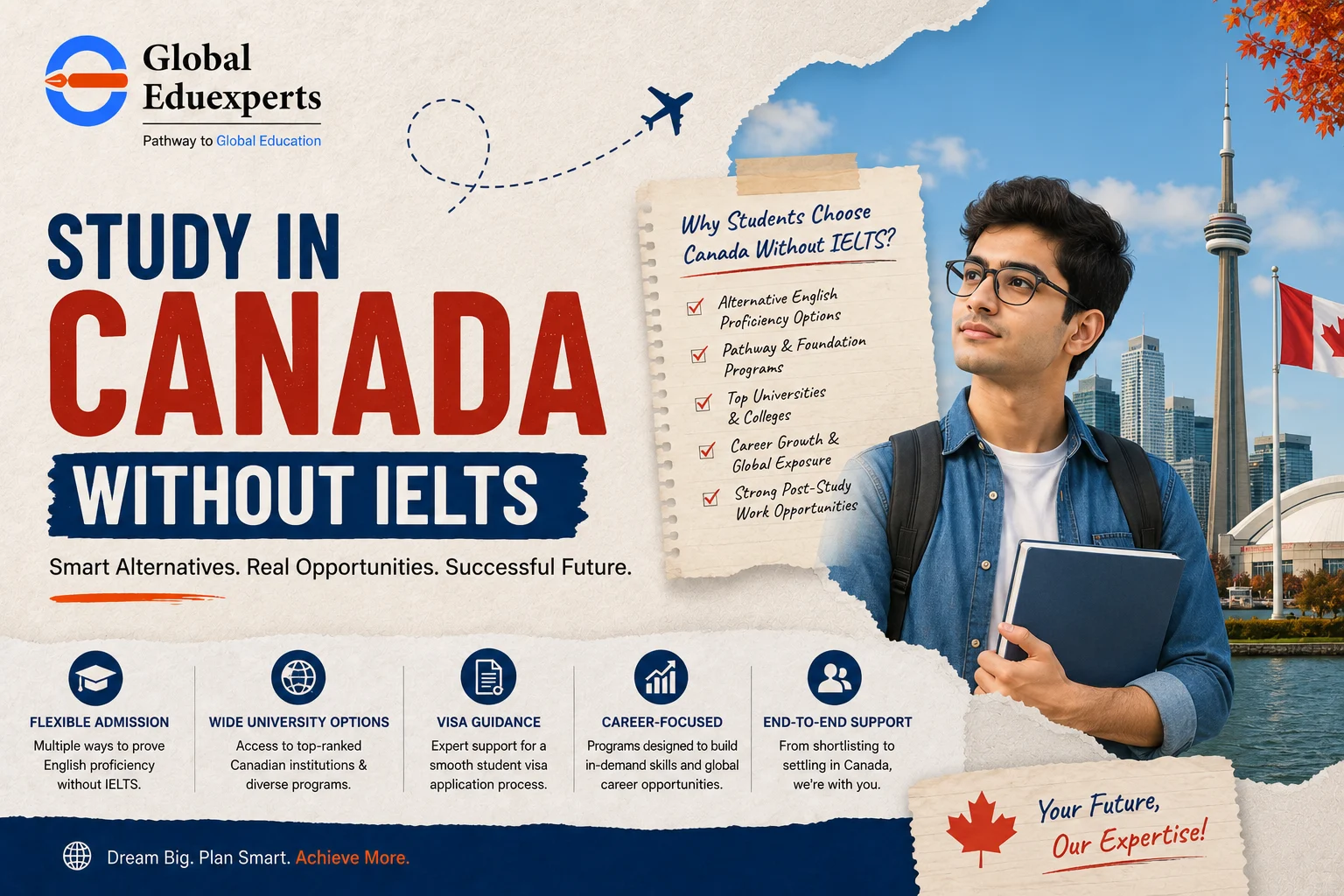
Guidance for study in Canada without IELTS helps Indian students explore alternative admission pathways through Duolingo, TOEFL, PTE, MOI letters, pathway programs, and conditional admissions offered by Canadian universities and colleges. It supports students who may struggle with traditional IELTS requirements by helping them understand realistic university options, visa considerations, English preparation routes, and long-term academic planning for studying and building a career in Canada.
For many Indian students, the idea of studying abroad often begins with one stressful word — IELTS. Some students delay their plans for months because of it. Others assume that low English-speaking confidence automatically means they cannot study in Canada. And honestly, the internet has made this confusion worse. One website says IELTS is mandatory. Another claims you can get a Canada student visa without IELTS in just a few steps. The reality sits somewhere in the middle.
Yes, study in Canada without IELTS is possible in certain situations. But it is not as simple as many social media videos make it sound.
Canadian universities and colleges still need proof that international students can understand academic English, communicate properly, and survive classroom environments. What changes is the method of proving English proficiency. In many cases, IELTS is only one option — not the only option.
That distinction matters more than students realize.
A student from India who completed education in English medium, scored well in English subjects, or studied under certain boards may sometimes qualify for alternative language assessment routes. Some institutions may accept Duolingo, TOEFL, PTE, MOI (Medium of Instruction Letter), or internal English assessments depending on the course and university policies. However, acceptance varies heavily by institution, province, intake, and even course type.
This is where many students misunderstand the process.
Some students hear that a friend got admission without IELTS and assume the same path will automatically work for them. But universities evaluate English proficiency differently. A diploma college in one province may accept Duolingo, while a postgraduate university program elsewhere may still strongly prefer IELTS Academic scores. Even when admission is possible without IELTS, visa officers may still examine whether the student can genuinely handle academic communication in Canada.
So if you are asking, “can I study in Canada without IELTS?” — the practical answer is:
Yes, in many cases you can. But you still need acceptable proof of English proficiency.
That proof may come through:
But there is another side students should understand carefully.
Choosing a university only because it avoids IELTS can become risky if the overall academic quality, PGWP eligibility, location opportunities, or visa strength are weak. Some students become so focused on bypassing IELTS that they ignore bigger career questions:
These questions often matter far more than the English test itself.
In recent years, many Canadian institutions have expanded their acceptance of English proficiency alternatives for Canada universities, especially after online testing systems became more common globally. Tests like Duolingo gained wider acceptance during and after pandemic disruptions. Still, acceptance policies continue to evolve, and what worked for one intake may change later.
This is why students should avoid relying on outdated YouTube advice or random social media claims.
The smarter approach is to evaluate:
For example, a student with strong English-medium schooling and good academic performance may have more flexibility with alternatives to IELTS for Canada study visa applications. Meanwhile, another student with weak communication skills may technically get admission but later struggle during visa interviews, SOP preparation, or classroom participation.
That practical difference is rarely discussed openly.
Another common misconception is that “no IELTS” means “easy admission.” In reality, Canadian institutions still maintain academic standards. Even colleges accepting study in Canada with Duolingo instead of IELTS usually expect minimum proficiency benchmarks. Some may additionally ask for interviews, writing samples, or bridge programs.
Students should also understand the separation between:
Sometimes a university may issue an offer letter without IELTS, but immigration authorities can still review whether the student appears academically prepared for English-language education. This does not mean visas are impossible without IELTS — many students successfully receive approvals using accepted alternatives — but documentation quality and profile consistency become extremely important.
For Indian students specifically, educational background plays a major role. CBSE, ICSE, and certain English-medium state board students may sometimes receive exemptions or alternative evaluation consideration depending on university policy. However, there is never a universal rule across all Canadian institutions.
That is why searching for “universities in Canada without IELTS for Indian students” should never stop at just a list of names. The real analysis should include:
These operational details affect outcomes more than students initially expect.
In practical terms, how to study in Canada without IELTS usually involves building a complete profile rather than finding shortcuts. Strong SOPs, clear financial documentation, genuine academic planning, and realistic course selection often influence the process more than students realize.
And honestly, this is where experienced guidance becomes valuable. Not because IELTS is impossible, but because every student profile behaves differently.
Some students benefit more from preparing for IELTS properly. Others genuinely qualify through alternative pathways. The right decision depends on academic history, communication ability, target universities, budget, and long-term career plans — not internet myths.
For Indian students exploring study abroad in Canada without IELTS requirement, the safest mindset is this:
Do not look for loopholes. Look for the most realistic and sustainable pathway.
Because in the end, studying in Canada is not only about getting admission. It is about succeeding after arrival — academically, professionally, and personally.
Students comparing study in Canada without IELTS often also explore countries with flexible admission pathways, scholarship opportunities, and different visa structures. Exploring options like STUDY IN UK, STUDY IN IRELAND, and STUDY IN DUBAI can help students compare English proficiency requirements, career opportunities, and long-term study abroad goals before making a final decision.
For years, IELTS has been treated almost like a compulsory checkpoint for Indian students planning to move abroad. Many students assume that without a strong IELTS score, their Canada dream automatically ends. But the reality today is more flexible than it used to be.
Canadian universities and colleges now recognize multiple ways to evaluate English proficiency. This shift happened gradually as institutions started receiving applications from students with different educational backgrounds, online learning exposure, and alternative testing formats. As a result, several English proficiency alternatives for Canada universities are now accepted depending on the institution, course level, and admission category.
Still, this is where confusion begins.
Students often search for “study in Canada without IELTS” and assume all universities accept every alternative equally. That is not how the process works. Some colleges may accept Duolingo for admission but not for certain competitive programs. Some universities may consider MOI letters only for specific countries or educational boards. Others may still prioritize IELTS even while listing alternatives officially.
So the smarter question is not simply:
“Can I avoid IELTS?”
It is:
“Which English proficiency option fits my academic profile and university goals realistically?”
That difference matters.
One of the biggest changes in recent years has been the rise of Duolingo acceptance. Many students now explore study in Canada with Duolingo instead of IELTS because the test feels faster, cheaper, and more convenient compared to traditional English exams.
The Duolingo English Test is:
For students living in smaller Indian cities, this accessibility became important. Not everyone has nearby IELTS test centers or coaching facilities.
Many Canadian colleges and universities started temporarily accepting Duolingo during pandemic-related disruptions, and several institutions continued accepting it afterward as part of their international admissions process.
However, students should understand an important operational reality:
Duolingo acceptance varies significantly.
Some universities:
In other words, Duolingo is widely accepted — but not universally interchangeable with IELTS.
Students also sometimes underestimate the test because it feels easier initially. But strong reading comprehension, vocabulary, and spontaneous speaking ability still matter. Low preparation often shows in scores quickly.
Before Duolingo became popular, TOEFL was already a well-established alternative. Even today, many Canadian institutions continue to trust TOEFL strongly for academic admissions.
For students comfortable with structured academic English and computer-based testing, TOEFL can actually feel more aligned with university-style communication.
TOEFL is commonly preferred by students who:
Unlike casual assumptions online, some universities may actually value TOEFL scores similarly to IELTS because both are long-established standardized tests.
The challenge is that TOEFL can feel academically demanding for students unfamiliar with fast listening sections or note-taking tasks. Some Indian students who struggle with accents or time management find it harder initially than expected.
Still, it remains one of the strongest alternatives to IELTS for Canada study visa and university admissions.
PTE Academic has also gained popularity among Indian students over the last few years. The test uses AI-based scoring systems and focuses heavily on integrated language skills.
Students often choose PTE because:
Several Canadian colleges and universities now accept PTE for admissions. However, acceptance levels can vary by course and institution.
One practical observation many students discover later:
PTE often rewards familiarity with test strategy as much as language ability. Students who practice the format consistently sometimes improve faster than expected.
But again, no single test guarantees admission or visa success automatically. The overall student profile still matters heavily.
The MOI route creates the most misunderstanding online.
A Medium of Instruction letter is usually issued by a school or college confirming that the student completed education in English medium. Some students use this instead of standardized English test scores when applying to certain institutions.
Yes, some universities in Canada without IELTS for Indian students may consider MOI letters under specific conditions.
But there are important limitations:
Students should avoid assuming that an English-medium school certificate automatically removes all language requirements. Institutional policies differ widely.
In practical admissions counseling, MOI acceptance often depends on:
This is why blindly relying on YouTube shortcuts can create problems later during application reviews.
Apart from the commonly known options, certain Canadian institutions may also consider:
Some colleges offer conditional admission where students complete an English pathway program before entering the main academic course. This route is particularly relevant for students whose profiles are academically strong but need language improvement support.
For some students, this becomes a more realistic option than repeatedly retaking language exams.
This distinction is extremely important and often ignored online.
A university may accept an alternative English test for admission. But visa documentation still needs to present a credible academic profile overall. Immigration authorities assess whether the student appears capable of studying successfully in an English-speaking environment.
That does not mean a Canada student visa without IELTS is impossible. Many students successfully receive visas using accepted alternatives like Duolingo, TOEFL, or PTE. But documentation quality, financial clarity, SOP strength, and academic consistency become even more important.
Sometimes students focus entirely on avoiding IELTS while ignoring communication skills completely. That approach can become risky later during:
The long-term goal should never be “avoid English testing somehow.”
It should be “prepare for real academic life in Canada.”
There is no single best option for everyone.
A student from a strong English-medium academic background may comfortably qualify through Duolingo or MOI-based flexibility. Another student targeting research universities may benefit more from TOEFL. Someone uncomfortable with face-to-face speaking may prefer PTE.
The right pathway depends on:
This is why serious planning matters more than shortcuts.
For Indian students exploring study abroad in Canada without IELTS requirement, the smartest strategy is usually to build the strongest overall profile possible rather than only searching for the easiest English test exemption.
Because once students arrive in Canada, communication stops being an exam requirement — it becomes part of everyday survival, academics, networking, and career growth.
Students researching alternative English proficiency tests for Canada often compare admission requirements across other major destinations as well. Exploring USA Eligibility, UK Eligibility, Australia Eligibility, and Ireland Eligibility can help students understand how universities evaluate English proficiency, academic backgrounds, and alternative admission pathways internationally.
One of the most common questions Indian students ask while planning overseas education is:
“Which Canadian universities accept students without IELTS?”
The question sounds simple, but the actual answer is more layered than most students expect.
Yes, there are many universities in Canada without IELTS for Indian students, but “without IELTS” does not usually mean “without English proficiency proof.” Most institutions still require evidence that students can understand lectures, complete assignments, communicate academically, and adapt to English-speaking environments.
What changes is the type of proof accepted.
Some universities accept Duolingo. Others may allow TOEFL, PTE, or MOI letters. Some institutions offer pathway or ESL programs where students improve language skills before entering the main course. And in certain cases, English-medium education backgrounds may help students qualify for exemptions.
The important thing is understanding which institutions offer flexibility — and under what conditions.
Because honestly, many students focus only on finding colleges that skip IELTS and forget to evaluate whether the institution actually supports their long-term career plans.
That mistake can become expensive later.
Canadian universities and colleges receive applications from students across different educational systems worldwide. Over time, institutions realized that language ability cannot always be measured through a single exam format.
A student may struggle with IELTS test patterns but still communicate effectively in academic English. Another may come from 12 years of English-medium education but face difficulty in standardized testing environments.
This is one reason many institutions started expanding their English proficiency alternatives for Canada universities.
Another major reason was accessibility. During pandemic disruptions, online testing options like Duolingo became more widely accepted. Since then, many colleges have continued offering alternative pathways to international students.
But flexibility does not mean reduced academic expectations.
Canadian institutions still expect students to:
So even when institutions offer study in Canada without IELTS pathways, they still assess whether the student appears academically prepared overall.
Not every institution follows the same approach. In practical admissions trends, flexibility is often seen more commonly in:
Meanwhile, highly competitive universities or research-intensive programs may still prefer stronger traditional English testing benchmarks.
This distinction matters because students sometimes see “IELTS waived” headlines online and assume every program inside that institution follows the same policy. In reality, acceptance conditions may vary between:
That operational detail is often overlooked.
Many Canadian colleges accepting students without IELTS now consider:
These colleges often focus on practical, career-oriented education and may provide more flexible entry pathways for international students.
For Indian students especially, this can become helpful when:
However, students should not choose colleges only because language requirements seem easier.
A better evaluation includes:
| Important Factor | Why It Matters |
|---|---|
| PGWP eligibility | Impacts post-study work opportunities |
| Internship/co-op access | Helps with Canadian work experience |
| Location | Affects part-time jobs and career networking |
| Industry reputation | Influences employability |
| Tuition costs | Impacts long-term financial planning |
| Student support services | Important for international student adjustment |
In many cases, students later realize that the “easiest admission option” was not necessarily the strongest long-term choice.
One of the most practical routes for students who do not meet direct English language requirements is pathway education.
Several Canadian universities work with pathway providers or internal language departments that allow students to:
This pathway model is especially useful for students who are academically capable but need additional language preparation before entering full university coursework.
These programs are commonly called:
For some students, this becomes a smarter long-term option than rushing through repeated IELTS attempts under pressure.
A student who genuinely improves communication skills during a pathway program may later adapt much more comfortably to:
That practical adjustment phase matters more than many students initially realize.
Many Indian students search for colleges that accept MOI (Medium of Instruction) letters instead of IELTS.
Yes, some institutions do consider MOI letters. But acceptance depends heavily on:
Some colleges may accept MOI for admission but still encourage standardized test scores for stronger application evaluation.
And importantly, not all institutions accept MOI equally.
Students sometimes assume that because their schooling was in English medium, every university will automatically waive language testing. Unfortunately, admissions do not work that uniformly.
This is why proper profile evaluation matters before applying.
This is where realistic counseling becomes important.
Technically, many students can receive admission offers through alternative pathways. But practical success depends on whether the student can actually manage academic life after arrival.
Students who avoid language preparation entirely sometimes struggle later with:
So while how to study in Canada without IELTS is a valid question, students should also ask:
“Am I genuinely prepared for studying in English full-time?”
That honest self-assessment matters more than shortcuts.
A strong Canadian study profile usually includes:
Students often become too focused on finding the fastest “no IELTS” route and ignore profile balance completely.
But Canadian institutions — and visa evaluations — look at the bigger picture.
For Indian students exploring study abroad in Canada without IELTS requirement, the best strategy is usually to combine:
Because ultimately, universities are not just evaluating whether students can enter Canada.
They are evaluating whether students can succeed there academically and professionally over time.
Choosing the right university matters far beyond flexible language requirements alone. Students can also explore USA Courses, UK Courses, and STUDY IN EUROPE opportunities to compare career-focused programs, university reputation, internship exposure, and long-term global education pathways across different countries.
A few years ago, most Indian students preparing for Canada had only one clear English testing path — IELTS. Today, things look different. One of the biggest changes in international admissions has been the growing acceptance of the Duolingo English Test by Canadian universities and colleges.
Because of this shift, many students now actively search for ways to study in Canada with Duolingo instead of IELTS.
And yes, in many cases, it is genuinely possible.
But there is also a lot of confusion around how Duolingo acceptance actually works. Some students assume every Canadian university now accepts it equally. Others believe Duolingo automatically makes admissions easier. Neither assumption is completely accurate.
The reality is more practical — and more institution-specific.
The Duolingo English Test gained attention mainly because it solved problems that many students faced with traditional exams.
For a large number of Indian applicants, IELTS preparation can become stressful due to:
Duolingo changed this experience by offering:
Naturally, students looking for alternatives to IELTS for Canada study visa applications started exploring it seriously.
But accessibility alone is not the reason institutions began accepting Duolingo.
Canadian universities also recognized that many capable students communicate effectively in English even if they struggle with traditional exam formats. This led several institutions to expand their English testing options over time.
Yes, many Canadian institutions do accept Duolingo scores today.
This includes:
However, acceptance policies vary significantly.
Some universities may:
This is why students searching for universities in Canada without IELTS for Indian students should never rely only on social media lists or outdated blogs.
Policies change regularly.
Even within the same institution:
So while study in Canada without IELTS is possible through Duolingo in many situations, the strategy needs careful planning.
Most Canadian institutions accepting Duolingo usually expect scores within a certain range depending on the program level.
In practical admissions trends:
Highly competitive universities may set stricter expectations because academic writing, research participation, and classroom discussions become more demanding at advanced levels.
Students sometimes make the mistake of aiming only for the minimum required score. But admissions do not always work on minimum eligibility alone.
A stronger score can help improve:
Especially for Indian students, where visa documentation and academic consistency matter heavily, stronger English proficiency can support the overall profile positively.
This is something many students realize only after taking the exam.
Because Duolingo feels modern and shorter, students often assume preparation is unnecessary. But the test still evaluates:
And unlike some traditional tests, the adaptive nature of Duolingo changes question difficulty based on performance. This can surprise students who underestimate preparation.
Another challenge is spontaneous communication.
Some Indian students perform well in memorized formats but struggle when the test demands quick natural responses. Duolingo often reveals this difference faster than expected.
So while it is a strong option among English proficiency alternatives for Canada universities, it still requires serious preparation.
There are definitely situations where Duolingo becomes a practical choice.
For students from smaller cities or remote areas, accessibility itself becomes valuable. Not everyone has easy access to IELTS coaching or nearby test centers.
Other practical advantages include:
| Advantage | Why Students Prefer It |
|---|---|
| Online format | No travel required |
| Faster results | Helpful for urgent application timelines |
| Lower cost | Easier for budget-conscious students |
| Flexible scheduling | Less waiting pressure |
| Shorter exam duration | Reduces fatigue for some students |
For students balancing college, work, or multiple applications, this flexibility can reduce unnecessary stress during the admissions process.
This is the part many internet videos skip.
Even though many institutions accept Duolingo, there are still practical limitations:
Students should also understand that language testing is only one part of the process.
A weak SOP, poor academic alignment, unrealistic course selection, or unclear financial documentation cannot be fixed simply through Duolingo acceptance.
Sometimes students become so focused on bypassing IELTS that they stop evaluating whether their overall Canada study plan makes sense.
That usually creates bigger problems later.
Students considering Canada student visa without IELTS pathways through Duolingo should approach applications strategically.
A stronger practical approach usually includes:
This matters because immigration evaluation looks at the student profile holistically.
A student with:
may appear far more credible than someone trying to use “no IELTS” as a shortcut without preparation.
This is probably the most important reality students should understand.
The goal should never be simply “avoid IELTS somehow.”
Because after arriving in Canada, students still need English daily for:
Students who genuinely build communication confidence early usually adjust faster academically and socially.
So if you are planning to study abroad in Canada without IELTS requirement using Duolingo, think beyond admission alone.
The real goal is not just getting into Canada.
It is being able to grow there confidently once classes, work, and real-life communication actually begin.
Many students considering Duolingo-based admissions also compare testing flexibility and admission processes in other countries. Exploring Australia Visa, UK Visa, and USA Visa pathways can help students better understand how English proficiency, documentation quality, and visa preparation vary across major study abroad destinations.
This is probably one of the most searched questions among Indian students planning to study abroad:
“Can I get a Canada student visa without IELTS?”
The short answer is yes — in certain situations, it is possible.
But the longer answer is where things become important.
Many students assume that if a college offers admission without IELTS, the visa process automatically becomes simple too. That is not always true. Canadian visa evaluation is broader than just admission eligibility. Immigration officers assess whether a student appears genuinely prepared for studying in an English-speaking academic environment.
So while study in Canada without IELTS is possible, students need to understand how visa pathways actually work before making decisions based only on social media claims or “no IELTS guaranteed” advertisements.
Because honestly, some of the information circulating online oversimplifies the process heavily.
This distinction is extremely important.
A Canadian university or college may accept:
instead of IELTS for admission purposes.
But visa officers evaluate the entire student profile separately.
They usually look at:
This means getting an offer letter alone does not guarantee visa approval.
Students sometimes misunderstand this and focus only on finding Canadian colleges accepting students without IELTS, without evaluating whether the full profile looks academically and financially genuine.
That gap can create problems later.
For Indian students, the conversation around Canada student visa without IELTS often connects to SDS and non-SDS application routes.
Earlier, SDS (Student Direct Stream) became popular because it offered a more streamlined processing route for eligible students meeting specific requirements. IELTS scores were commonly associated with SDS eligibility standards.
Because of this, many students started believing:
“No IELTS means no Canada visa.”
That is not completely accurate.
Students may still apply through alternative pathways depending on:
However, visa processing expectations can differ between pathways, and requirements may evolve over time based on immigration updates.
This is why students should always check current official guidelines instead of relying on outdated advice from older YouTube videos or random forums.
Today, several institutions support English proficiency alternatives for Canada universities, including:
Many students successfully pursue study in Canada with Duolingo instead of IELTS and receive visas through properly prepared applications.
But one important practical reality often gets ignored:
Alternative language proof works best when the rest of the student profile is also strong.
For example, a student with:
may still present a credible application without IELTS.
Meanwhile, a weak academic profile combined with unclear study goals and poor documentation can create visa concerns regardless of the English test used.
This is why experienced counselors usually evaluate the full profile instead of focusing only on the language exam.
Even if IELTS is not mandatory in every situation, communication ability still matters.
Canadian immigration authorities understand that international students must function in:
So visa evaluations often indirectly examine whether the student appears capable of adapting academically.
This does not mean students need perfect English fluency. But applications should reflect realistic academic readiness.
For example:
Sometimes students become so focused on avoiding IELTS that they neglect communication preparation entirely. That can weaken the overall profile more than the absence of IELTS itself.
Students exploring alternatives to IELTS for Canada study visa often enter non-SDS or institution-specific application routes depending on current immigration policies.
In practical terms, this usually means:
Students should also understand that choosing low-quality colleges only because they offer “no IELTS admission” can negatively affect the overall strength of the application.
Sometimes the issue is not IELTS at all.
It is whether the entire study plan appears genuine and academically meaningful.
That difference matters a lot.
Many Indian students ask whether MOI letters or pathway programs automatically improve visa chances.
The reality is more nuanced.
Some institutions may accept MOI-based admissions, especially if students completed previous education in English medium. Others may offer ESL or pathway programs before full academic entry.
These routes can work well for students who:
But again, there is no universal formula.
Acceptance depends on:
This is why profile-specific guidance matters much more than generic “without IELTS” marketing.
One common mistake Indian students make is treating IELTS avoidance as the primary goal.
That mindset often leads students toward:
Instead, students should focus on:
| Smarter Focus Areas | Why They Matter |
|---|---|
| Strong academic planning | Improves application credibility |
| Genuine SOP | Reflects realistic intentions |
| Good financial documentation | Supports visa confidence |
| Logical course progression | Reduces profile inconsistencies |
| Real communication preparation | Helps academically after arrival |
| Institution reputation | Impacts long-term opportunities |
In many cases, students who prepare holistically perform much better during both admissions and visa processing.
The truth is, getting a visa is only the beginning.
Students planning to study abroad in Canada without IELTS requirement should think beyond just entering the country. Once classes begin, communication becomes part of everyday academic survival.
Students will still need English for:
So the smartest approach is not simply finding loopholes to bypass IELTS.
It is building a realistic pathway that supports:
Because ultimately, Canadian education systems are evaluating more than a test score.
They are evaluating whether the student appears genuinely prepared for the journey ahead.
Students planning visa applications without IELTS should also understand how financial preparation, documentation, and eligibility differ globally. Exploring USA Visa, UK Visa, Ireland Visa, and Dubai Visa guidance can help students compare international student visa expectations and make more informed long-term education decisions.
Not every student planning to study in Canada feels fully confident about English proficiency at the beginning. And honestly, that is more common than people think.
Some students perform well academically but struggle with standardized language tests like IELTS. Others come from English-medium schools yet still feel nervous about speaking fluently in international classroom environments. There are also students who understand English comfortably but repeatedly miss required scores in one specific exam section.
This is exactly why pathway programs and English preparation courses exist.
For many Indian students exploring study in Canada without IELTS, pathway education becomes a practical middle ground — not a shortcut, but a structured transition into Canadian academics.
And in many cases, it can actually help students adjust more realistically than rushing directly into full academic coursework unprepared.
Pathway programs are structured academic transition programs designed for international students who may not yet meet direct university or college English language requirements.
These programs usually focus on:
After successfully completing the pathway or English preparation stage, students can move into their main diploma or degree program without needing to retake IELTS in some cases.
This is why many students searching for how to study in Canada without IELTS eventually explore pathway-based admissions.
The idea is simple:
Instead of rejecting students immediately for language score gaps, institutions provide an academic preparation route before full entry into the primary course.
Canadian colleges and universities understand something important:
Language confidence develops differently for every student.
A student may have strong academic intelligence but still struggle with:
This becomes even more common among students from smaller cities or non-international academic backgrounds in India.
Rather than treating English scores as the only measure of student potential, many institutions created:
These programs help students gradually adapt before entering full academic pressure environments.
And honestly, for some students, this transition period becomes extremely valuable later.
Conditional admission is one of the most common pathways connected to study abroad in Canada without IELTS requirement options.
In simple terms, the institution offers admission on the condition that the student first completes:
Once the student successfully completes the required language pathway, they transition into the main academic course.
This system helps students who:
For example, a student may qualify academically for a business diploma program but fall slightly short on English test requirements. Instead of rejecting the application entirely, the college may offer:
“Complete our language pathway first, then begin your academic program.”
This approach is more common than many students realize.
One misconception students often have is that English preparation programs are basic spoken English classes.
In reality, Canadian ESL and EAP courses are usually designed around academic survival skills.
Students often learn:
This matters because studying abroad is not only about understanding English words. It is about functioning comfortably inside academic systems where communication affects almost everything.
Many Indian students discover this after arrival.
Even students with decent IELTS scores sometimes struggle initially with:
This is why pathway education can genuinely help certain students build long-term confidence instead of simply chasing minimum test scores.
Many Canadian colleges accepting students without IELTS work with:
These partnerships allow students to improve English proficiency before entering their main academic programs.
Pathway routes are commonly seen in:
Some institutions may accept:
combined with pathway-based admissions.
However, the exact structure varies significantly between institutions.
Some programs may last:
depending on the student’s starting language level.
Yes — and this is one of the most practical realities students should understand.
Many international students continue improving English significantly after arriving in Canada through:
In fact, some students who struggled with confidence in India become much more comfortable within a few months of immersion.
But there is an important balance here.
Students should not assume:
“I’ll learn everything after reaching Canada.”
Basic academic readiness still matters before arrival.
Students need enough communication ability to:
So while English proficiency alternatives for Canada universities create flexibility, students still need genuine willingness to improve communication actively.
One thing students sometimes overlook is that pathway education affects:
For example:
| Consideration | Why It Matters |
|---|---|
| Extra tuition fees | Pathway courses add educational costs |
| Additional study time | Graduation timelines may extend |
| Visa documentation | Must clearly explain pathway purpose |
| Academic commitment | Students must complete pathway requirements successfully |
| Institution quality | Not all pathway providers offer equal support |
This is why pathway programs should be chosen strategically — not simply because they avoid IELTS.
Sometimes students rush toward “easy admission” options without checking:
Those details matter much more after arrival.
The students who benefit most from pathway education are usually those who treat it as preparation — not avoidance.
A well-designed English preparation program can help students:
And honestly, this adjustment phase often affects long-term success more than students initially expect.
Because once students enter regular classes, communication becomes part of daily academic survival.
For Indian students exploring alternatives to IELTS for Canada study visa and admissions, pathway programs can become a realistic and supportive option when chosen carefully.
Not because they remove challenges completely.
But because they help students prepare for those challenges more gradually and confidently.
Students exploring pathway and foundation programs in Canada may also benefit from comparing preparatory education routes offered internationally. Reviewing STUDY IN AUSTRALIA, STUDY IN UK, and STUDY IN IRELAND options can help students understand how different countries support international students with academic transition and English preparation programs.
The idea of study in Canada without IELTS sounds exciting to many Indian students. For some, it feels like a faster and less stressful way to begin their study abroad journey. And honestly, alternative pathways do exist today. Many universities and colleges now accept Duolingo, PTE, MOI letters, pathway programs, and other forms of English proficiency evaluation.
But this is also where many students make costly mistakes.
Because once students hear “Canada without IELTS,” they sometimes stop evaluating the process realistically. The focus shifts from building a strong study profile to simply finding the easiest possible admission route.
That mindset creates problems later — during admissions, visa processing, academics, and sometimes even after reaching Canada.
One of the biggest mistakes students make is assuming that avoiding IELTS automatically makes the overall process easier.
In reality, Canada student visa without IELTS pathways still require:
Students sometimes spend weeks searching for colleges with flexible English requirements but ignore bigger questions like:
This happens more often than people think.
Some students become so focused on bypassing IELTS that they accidentally choose weak institutions or random courses that do not support long-term goals at all.
This is probably the most misunderstood part of the entire process.
Students often assume:
“If the college accepted me without IELTS, the visa will also be easy.”
But university admission and visa approval are two separate evaluations.
A college may accept:
However, immigration authorities still assess whether the student appears genuinely prepared for studying in an English-speaking country.
Visa officers may review:
This is why students exploring alternatives to IELTS for Canada study visa applications must understand that documentation quality becomes extremely important.
A weak overall profile cannot be hidden simply because a college accepted alternative language proof.
Another common mistake is applying emotionally instead of strategically.
Students sometimes apply to universities based only on:
without checking whether the course actually makes sense academically.
For example:
These mismatches can weaken both admissions and visa outcomes.
A realistic application usually considers:
| Important Factor | Why It Matters |
|---|---|
| Academic background | Supports profile consistency |
| Course relevance | Helps justify study intentions |
| Career alignment | Improves SOP credibility |
| Institution reputation | Impacts long-term opportunities |
| Province/job market | Affects future employability |
| Financial readiness | Important for visa evaluation |
Students who ignore these basics often face avoidable complications later.
Many students believe that having English-medium schooling automatically removes all English language requirements.
This is one of the most common misconceptions around English proficiency alternatives for Canada universities.
Yes, some institutions may accept MOI (Medium of Instruction) letters. But acceptance depends on:
Not every institution treats MOI the same way.
Some colleges may:
Students often rely on outdated online advice without checking official institution requirements carefully. Policies change frequently, especially for international admissions.
That is why profile-specific planning matters much more than generic “IELTS waiver” assumptions.
This issue becomes even more important for students applying through non-traditional language routes.
When students pursue study abroad in Canada without IELTS requirement, the SOP (Statement of Purpose) often becomes one of the strongest credibility documents in the application.
But many students:
Visa officers and admissions teams review thousands of applications. Generic or poorly structured documentation becomes noticeable very quickly.
Similarly, financial documents also need clarity.
Students sometimes:
These issues create more problems than the absence of IELTS itself.
This has become increasingly common.
Students often build entire application strategies from:
The problem is that many of these sources discuss:
What worked for one student in one intake may not work the same way for another profile.
For example:
This is why students searching for how to study in Canada without IELTS should always verify current institutional requirements carefully instead of depending entirely on internet trends.
Sometimes students focus so heavily on “avoiding IELTS” that they stop improving communication skills completely.
That creates serious adjustment problems later.
Even if admission is secured through:
students still need English daily for:
Many students discover after arrival that real-life communication feels very different from application paperwork.
The students who adapt best are usually not the ones who found the easiest loophole.
They are the ones who prepared themselves gradually and realistically.
This is probably the biggest mistake overall.
Some students choose institutions only because:
without asking:
“Will this decision actually support my future?”
Canada study planning should ideally focus on:
Because in the end, studying abroad is not just about receiving an offer letter.
It is about building a profile strong enough to survive and grow after reaching Canada — academically, professionally, and personally.
Many application mistakes happen because students focus only on admission speed instead of long-term planning. Exploring USA Cost, UK Cost, Australia Cost, and Dubai Cost can help students compare tuition fees, living expenses, visa preparation costs, and realistic financial planning before choosing the right study destination.
One of the biggest reasons Indian students search for study in Canada without IELTS options is financial pressure.
For many families, studying abroad already feels like a major investment. Add repeated IELTS attempts, coaching fees, travel expenses, and delayed intakes — and the process can quickly become stressful. Because of this, students often assume that avoiding IELTS will automatically reduce the total cost of studying in Canada.
But the reality is slightly more complicated.
Yes, alternative pathways like Duolingo, MOI-based admissions, pathway programs, and English preparation courses can sometimes reduce certain expenses. At the same time, some “without IELTS” routes may actually increase costs through additional semesters, language preparation programs, or extended study timelines.
So the smarter question is not:
“How can I avoid IELTS costs?”
It is:
“What will the full Canada study budget realistically look like with alternative admission pathways?”
That practical mindset helps students plan much more effectively.
Whether students apply with IELTS or through English proficiency alternatives for Canada universities, tuition remains the biggest financial component.
For Indian students, tuition usually depends on:
In practical terms:
Students searching for Canadian colleges accepting students without IELTS sometimes choose institutions only because admission appears easier, without checking long-term financial sustainability.
That becomes risky later.
A lower tuition fee may initially seem attractive, but students should also evaluate:
A cheaper course that limits future opportunities may not actually save money in the long run.
One common misconception is that “without IELTS” means “without English testing costs.”
In reality, most students still use some form of English proficiency proof.
Popular alternatives to IELTS for Canada study visa and admissions include:
Among these, Duolingo is often considered the most budget-friendly option because:
This is one reason many students prefer study in Canada with Duolingo instead of IELTS.
However, students should still budget for:
Some students underestimate preparation completely and later spend money on multiple retakes anyway.
For students who do not meet direct English requirements, pathway or ESL programs can become part of the study plan.
These programs help students improve:
But pathway education also affects the financial structure.
Students should understand that:
For example, a student entering through a conditional admission route may complete:
This pathway can work extremely well for academic adjustment. But financially, students need realistic planning from the beginning.
Many students researching how to study in Canada without IELTS focus only on admission flexibility and forget to calculate the complete educational timeline.
This is probably the area where Indian students underestimate costs the most.
Tuition is easy to calculate. Daily life is harder.
Living expenses vary significantly depending on:
For example:
| Expense Category | Common Financial Impact |
|---|---|
| Accommodation | Usually the highest monthly expense |
| Food & groceries | Depends heavily on lifestyle |
| Public transport | Higher in metro cities |
| Health insurance | Mandatory in many cases |
| Internet & phone | Ongoing monthly costs |
| Winter clothing | Often overlooked initially |
Students moving to major cities sometimes experience financial shock during the first few months, especially when rent prices are higher than expected.
This is why realistic budgeting matters more than promotional “affordable Canada study” claims online.
Another practical issue many students discover later is the number of smaller costs involved throughout the process.
These may include:
Individually, these may seem manageable. Combined, they can become significant.
Students pursuing study abroad in Canada without IELTS requirement pathways sometimes spend extra money because of:
This is why careful planning saves more money than simply searching for the cheapest route.
Many students assume part-time jobs will fully manage their living expenses in Canada.
Realistically, part-time work can help support daily expenses. But depending entirely on it for tuition or major financial obligations can become stressful.
Job availability depends on:
Students with stronger English communication skills usually adapt faster to customer-facing or professional part-time roles. This is another reason communication preparation still matters even when applying without IELTS.
Students often focus only on first-year expenses while ignoring:
A more sustainable financial plan usually includes:
Families should also avoid comparing their journey directly with another student’s experience online. Costs vary heavily depending on institution, city, course type, and personal lifestyle choices.
This is probably the most important financial reality students should understand.
Some institutions market aggressively around:
But students should still evaluate:
Sometimes a slightly higher educational investment at a stronger institution creates better long-term career opportunities and financial stability later.
For Indian students exploring Canada student visa without IELTS pathways, financial planning should focus on balance — not shortcuts.
Because studying in Canada is not just an admission expense.
It is a multi-year life decision involving education, career growth, adaptability, and long-term financial responsibility.
Financial planning is one of the most important parts of any study abroad journey. Students comparing Canada with other destinations can also explore USA scholarships, UK Scholarships, and Australia Scholarships opportunities to better understand tuition support options, living expenses, and long-term affordability across different countries.
The idea of study in Canada without IELTS has become increasingly popular among Indian students over the last few years. For some students, it feels like an opportunity that removes one major barrier from the study abroad process. For others, it creates confusion because the internet often presents it either as an easy shortcut or as something impossible.
The truth sits somewhere in between.
Yes, there are genuine advantages to alternative English proficiency pathways. Canadian universities and colleges today offer more flexibility than before through Duolingo, PTE, MOI letters, pathway programs, and conditional admissions.
But there are also practical limitations students need to understand honestly.
Because studying abroad is not just about securing admission. It is about surviving academically, adapting personally, and building a stable long-term future in a completely different educational environment.
Greater Accessibility for Students From Different Backgrounds
One of the biggest advantages of study abroad in Canada without IELTS requirement pathways is accessibility.
Not every student performs well in standardized testing environments.
Some students:
Come from smaller towns with limited coaching access
Face anxiety during speaking tests
Struggle with one specific IELTS module repeatedly
Have strong academic records but weak exam confidence
Cannot afford multiple expensive test attempts
For these students, alternatives like:
Duolingo
TOEFL
PTE
MOI-based evaluation
ESL pathways
create opportunities that may otherwise feel unreachable.
This flexibility has made international education more accessible to students who genuinely have academic potential but struggle with traditional testing structures.
And honestly, that change has helped many deserving students continue their education plans instead of abandoning them entirely.
Faster and More Flexible Admission Pathways
Another major advantage is convenience.
Students exploring study in Canada with Duolingo instead of IELTS often appreciate:
Online testing
Faster results
Lower costs
Flexible scheduling
Reduced travel pressure
For students facing tight admission deadlines, these options can help speed up the application process significantly.
Similarly, pathway programs and conditional admissions provide alternatives for students who need additional language preparation instead of outright rejection.
In practical terms, this flexibility allows students to:
Save time
Avoid repeated IELTS delays
Maintain intake timelines
Continue academic planning without interruption
This becomes especially important for students who already have academic gaps or delayed study histories and cannot afford losing another admission cycle.
More Admission Opportunities for Students With Strong Academics
Many Indian students misunderstand language testing completely.
A student may:
Score well academically for years
Study entirely in English medium
Understand academic English comfortably
Still perform poorly in one standardized exam
This is one reason several English proficiency alternatives for Canada universities now exist.
Alternative pathways allow universities to evaluate students more holistically rather than depending entirely on one test score.
For academically capable students, this can open admission opportunities that would otherwise remain inaccessible despite strong educational potential.
Communication Skills Still Matter — Even Without IELTS
This is where the conversation becomes more balanced.
One limitation students should understand clearly is that avoiding IELTS does not remove the need for English communication ability.
Once students arrive in Canada, English becomes part of:
Classroom learning
Assignment writing
Group projects
Presentations
Internship interviews
Workplace communication
Everyday life
Students who focus only on bypassing the test without improving actual communication skills often struggle later.
This happens more frequently than many students admit openly.
Some students receive admission successfully through:
Duolingo
Pathway programs
MOI exemptions
but later face difficulty adjusting academically because classroom communication feels overwhelming.
So while how to study in Canada without IELTS is a valid question, students should also ask:
“Am I genuinely preparing myself for studying in English every day?”
That question matters more long term.
Visa Challenges Can Sometimes Become More Sensitive
Another practical limitation is visa evaluation complexity.
Students often assume:
“No IELTS means easier visa approval.”
But immigration assessments usually evaluate the full student profile.
When students apply through alternatives to IELTS for Canada study visa routes, visa officers may pay closer attention to:
SOP quality
Academic consistency
Course relevance
Financial documentation
Communication preparedness
Overall profile credibility
This does not mean visas are impossible without IELTS. Many students receive approvals successfully through alternative pathways.
But weaker documentation combined with weak language preparation can increase profile concerns.
This is why students should avoid choosing “no IELTS” routes only because they seem easier on social media.
Not Every University Offers the Same Flexibility
Students also need to understand that not all institutions treat English alternatives equally.
Some universities:
Fully accept Duolingo
Offer pathway programs
Consider MOI letters
Provide conditional admissions
Others may:
Prefer IELTS strongly
Restrict alternative tests for certain programs
Require additional interviews
Maintain higher academic language expectations
Competitive postgraduate or research-oriented programs may still expect stronger traditional English testing benchmarks.
This is why students searching for universities in Canada without IELTS for Indian students should evaluate institution quality carefully instead of relying only on viral internet lists.
Pathway Programs Help Some Students — But Add Time and Cost
Pathway education can genuinely support students who need gradual language adjustment. But it also comes with additional considerations.
Students entering through:
ESL programs
Foundation courses
English preparation pathways
may experience:
Additional tuition expenses
Longer study duration
Delayed graduation timelines
Extra living costs
For some students, this investment is worthwhile because it improves academic confidence significantly.
For others, poor planning creates unnecessary financial pressure later.
This is why pathway programs should be chosen strategically — not emotionally.
Long-Term Academic Success Depends on More Than Admission
One of the most overlooked realities is that admission is only the beginning.
Students who succeed long term in Canada usually develop:
Communication confidence
Academic discipline
Independent learning ability
Networking skills
Cultural adaptability
And these qualities cannot be replaced entirely by flexible admission policies.
Sometimes students become so focused on entering Canada that they forget to prepare for life after arrival.
But once classes begin, real challenges start:
Fast-paced lectures
Research assignments
Presentation expectations
Group collaboration
Internship communication
Professional networking
Students who gradually build English confidence alongside their application process often adapt much more smoothly.
The Best Approach Is Balance, Not Shortcuts
For Indian students exploring Canada student visa without IELTS pathways, the smartest approach is usually balanced planning.
Alternative pathways can absolutely help deserving students access international education opportunities. They create flexibility for students who may struggle with traditional exams but still have genuine academic potential.
At the same time, students should avoid treating “without IELTS” as a shortcut to bypass preparation completely.
A stronger long-term strategy usually includes:
Smart Preparation AreasWhy They Matter
Real communication improvementHelps after arrival
Strong SOP and documentationSupports profile credibility
Realistic university selectionImproves long-term outcomes
Financial planningReduces stress later
Academic readinessHelps classroom adjustment
Career-focused course choiceSupports future employability
Because in the end, the real goal is not simply getting admission without IELTS.
It is building a study abroad journey that remains sustainable academically, financially, and professionally after reaching Canada.
Every study destination offers different advantages in terms of education quality, work opportunities, immigration pathways, and university flexibility. Exploring STUDY IN USA, STUDY IN UK, STUDY IN EUROPE, and STUDY IN ASIA can help students compare academic systems and choose a destination aligned with their long-term career plans.
Planning to study abroad already feels overwhelming for many Indian students. Add language testing confusion into the mix, and the process can quickly become emotionally exhausting. This is especially true for students exploring study in Canada without IELTS options because the internet is filled with mixed advice, shortcuts, myths, and incomplete information.
Some students are told IELTS is absolutely mandatory. Others are promised “guaranteed admission without IELTS” within days. Neither extreme explains the real situation properly.
The truth is, studying in Canada without IELTS is possible for many students today. But successful planning requires much more than simply finding colleges with flexible English requirements.
It requires realistic decision-making.
Because the students who succeed long term are usually not the ones who searched for the fastest shortcut. They are the ones who built balanced, practical study plans from the beginning.
Before searching for universities, pathways, or visa options, students should first evaluate their actual situation honestly.
This includes:
Many students skip this stage completely.
Instead, they begin searching directly for:
without understanding whether the overall plan fits their profile realistically.
For example:
The right route depends on the student — not internet trends.
One of the biggest mistakes students make while exploring universities in Canada without IELTS for Indian students is selecting institutions only because admission requirements appear easier.
But university selection should involve much deeper thinking.
Students should evaluate:
| Important Area | Why It Matters |
|---|---|
| Course relevance | Supports future career goals |
| Institution reputation | Impacts employability |
| PGWP eligibility | Affects post-study work opportunities |
| Internship/co-op options | Helps with Canadian experience |
| Province and location | Influences job opportunities |
| Tuition and living costs | Affects financial sustainability |
| Student support services | Important for adjustment |
Sometimes students choose weaker institutions simply because they avoid IELTS requirements. Later, they realize the course offers limited career value or poor employment support.
That is why realistic university shortlisting matters more than chasing easy admissions.
There is no single “best” alternative for everyone.
Students exploring alternatives to IELTS for Canada study visa and admissions usually encounter options like:
But choosing the right option depends on personal circumstances.
For example:
The important thing is understanding that these are not loopholes. They are different evaluation pathways with different expectations.
This is one of the smartest things students can do early.
Even if students pursue study in Canada with Duolingo instead of IELTS, real communication ability still matters after arrival.
Once classes begin, students need English for:
Students who focus only on test exemptions often struggle later because academic communication feels overwhelming.
Improving English does not always require expensive coaching.
Many students gradually improve through:
The goal is not perfect grammar.
The goal is practical communication confidence.
Many Indian students underestimate Canada study costs badly.
While exploring study abroad in Canada without IELTS requirement, students often focus only on tuition and forget:
Students should also avoid assuming part-time jobs will solve every financial challenge after arrival.
A healthier financial plan usually includes:
Financial stress affects academic performance more than students initially expect.
For students applying through Canada student visa without IELTS pathways, visa documentation becomes especially important.
Immigration evaluations often focus on:
Students should avoid:
A visa application should feel believable, academically meaningful, and professionally aligned.
In many cases, realistic documentation matters more than the language test format itself.
This has become one of the biggest problems in recent years.
Students often plan their entire journey using:
But policies change frequently.
What worked for one student in one intake may not work the same way later. Institutions regularly update:
That is why students should always verify official institutional information carefully before making final decisions.
This is probably the most important mindset shift students need.
The real goal is not simply:
“How to study in Canada without IELTS.”
The real goal is:
“How to build a stable future through international education.”
That includes:
Students who think beyond admission usually make stronger decisions overall.
Sometimes that may even mean preparing properly for IELTS instead of avoiding it completely. In other cases, alternative pathways genuinely make more sense.
There is no universal answer.
Students who usually adjust best in Canada are not necessarily the students with the highest scores.
They are often the students who:
For Indian students exploring Canadian colleges accepting students without IELTS, flexibility today definitely exists. The opportunities are real.
But the smartest approach is to treat those opportunities responsibly — not emotionally.
Because in the end, studying in Canada is not just about finding a way to enter the country.
It is about building a life and career that remains sustainable long after the admission letter arrives.
Successful international education planning usually involves comparing multiple countries before making a final decision. Students can explore STUDY IN USA, STUDY IN AUSTRALIA, STUDY IN IRELAND, and STUDY IN DUBAI to evaluate visa pathways, education costs, scholarships, career opportunities, and post-study growth potential according to their academic and financial goals.
Yes, in many cases, Indian students can pursue study in Canada without IELTS through alternatives like Duolingo, TOEFL, PTE, MOI letters, pathway programs, or conditional admissions. However, requirements vary by university and course. Students still need to demonstrate English proficiency through accepted alternatives and maintain a strong overall academic and financial profile during admissions and visa processing.
Many Canadian universities and colleges now accept alternatives such as Duolingo English Test, TOEFL, PTE Academic, and sometimes CAEL. Some institutions may also consider MOI (Medium of Instruction) letters or pathway programs. Acceptance policies differ between institutions, so students should always verify the latest requirements directly with their chosen university before applying.
Yes, a Canada student visa without IELTS is possible in certain situations if students apply through accepted alternative English proficiency routes. However, visa officers still evaluate the overall student profile, including academics, financial documents, SOP quality, communication readiness, and study intentions. Admission without IELTS does not automatically guarantee visa approval.
Pathway and ESL programs can be a practical option for students who need additional English preparation before entering full academic courses. These programs help improve communication, academic writing, and classroom confidence. However, students should also consider extra tuition costs, study duration, and long-term academic goals before choosing a pathway-based admission route.
Students should avoid choosing universities only because they offer “no IELTS” admissions. Common mistakes include weak SOPs, unrealistic course selection, poor financial documentation, misunderstanding MOI rules, and ignoring communication preparation. A successful Canada study application usually depends on realistic planning, strong profile consistency, and careful university selection rather than shortcuts alone.


