
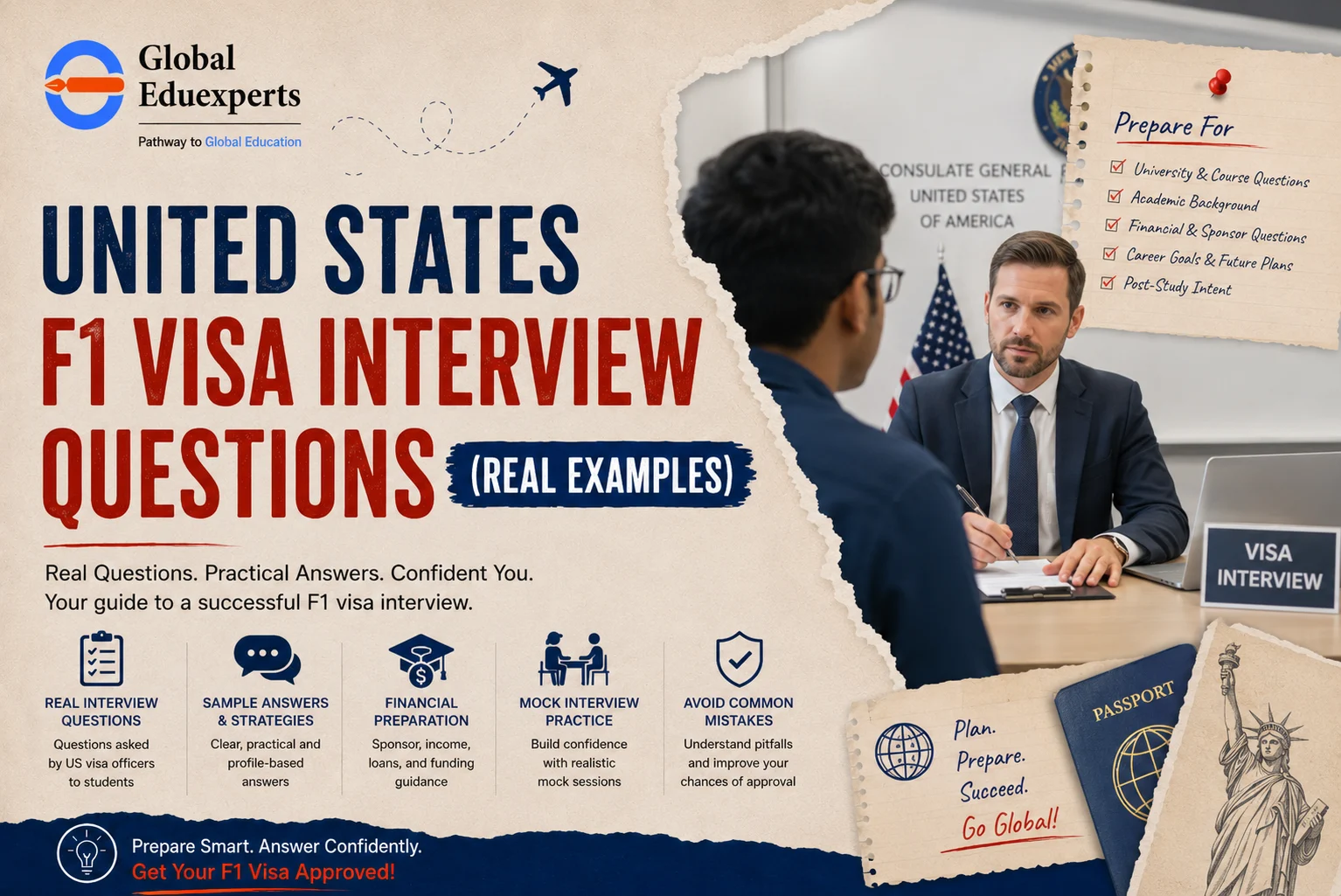
Guidance for United States F1 visa interview questions helps students understand how to prepare for USA embassy interviews through realistic answer strategies, financial preparation, mock interview practice, and profile-based communication improvement. It supports Indian students applying for F1 student visas by helping them handle university-related questions, sponsor discussions, career plans, visa documentation, and common interview challenges with greater clarity, confidence, and practical preparation.
For many students planning to study in the United States, the F1 visa interview feels more stressful than:
And honestly, that reaction is understandable.
The interview usually lasts only a few minutes, yet students feel like their:
What creates more pressure is uncertainty.
Students constantly wonder:
These questions have become even more common recently because students see:
Unfortunately, much of that advice creates more confusion than clarity.
Many students think the visa interview exists mainly to test English fluency.
Not exactly.
The real purpose is usually much broader.
Visa officers mainly try to understand:
That is why officers often ask simple-looking questions like:
The questions may sound basic. The answers reveal a lot.
Especially when responses feel:
This surprises students often.
Many students preparing for:
In reality, officers usually prefer:
A student speaking naturally with:
Especially now.
Visa officers conduct hundreds of interviews regularly. Repetitive scripted responses become easy to recognize quickly.
One thing that shocks many students:
the interview often lasts only:
Sometimes even less.
That creates panic because students assume:
“the officer barely asked anything.”
But officers already review major profile details before the conversation begins:
The interview mainly helps them confirm:
whether the student’s explanation aligns naturally with the documents and overall profile.
This is why clarity matters so much.
This question appears extremely frequently during:
And students often answer it poorly.
Some give generic statements like:
These answers sound weak because they could apply to almost any student globally.
Stronger answers usually explain:
Not emotionally dramatic. Just logically clear.
Students underestimate this part constantly.
Visa officers often evaluate:
Especially recently.
Questions around:
One important reality:
students do not need to appear extremely wealthy.
But finances should appear:
Large unexplained deposits or financial confusion create unnecessary risk.
Students often assume rejection happens mainly because:
Sometimes maybe. Usually not the main reason.
Common rejection triggers often include:
For example:
a student with:
Especially if answers sound memorized instead of genuine.
This is probably one of the biggest mistakes students make while preparing for:
Students memorize:
Then panic when officers ask:
The interview becomes uncomfortable quickly.
Good preparation usually focuses on:
Not acting like a rehearsed presentation.
Students from India often become extremely self-conscious about:
Honestly, most officers are not expecting perfect American English.
They mainly evaluate whether:
Some students with very simple English still receive approvals smoothly because:
Meanwhile, overly polished but confusing answers sometimes create doubt.
Not aggressively. Quietly.
Students sometimes forget that officers also notice:
This does not mean students must act extremely confident or overly formal.
Actually, exaggerated confidence sometimes feels unnatural.
The strongest interviews often feel:
This sounds obvious. Yet many students cannot clearly explain:
Some even forget:
That creates avoidable pressure instantly.
Students preparing for:
This has become a serious issue recently.
Students constantly watch:
Most of these oversimplify the actual process heavily.
There is no universal perfect answer.
Different officers ask:
Students who focus too heavily on:
Students preparing for:
Not when they try sounding “perfect.”
Because eventually, visa officers are not searching for:
Usually they are trying to determine one thing:
Does this student genuinely appear prepared for international education in the United States?
Before preparing for embassy interviews, many students first review broader admission and planning guidance to understand how their overall profile will be evaluated. Reading pages like
STUDY IN USA,USA Eligibility, andUSA Visahelps students connect university admissions, visa expectations, and financial preparedness more realistically before attending an F1 visa interview.
Students preparing for:
usually spend hours searching online trying to find:
“the perfect answers.”
Honestly, that approach creates more anxiety than confidence sometimes.
Because the F1 visa interview is not an exam with:
Visa officers mainly want to understand whether:
That is why students who sound:
Especially now.
This is probably one of the most common:
Students often answer badly by saying:
These responses sound weak because they lack academic reasoning.
A stronger answer usually explains:
A realistic example:
“My university offers strong project-based learning in business analytics, and the curriculum includes internship opportunities connected with industry partners. I also compared course structure and faculty specialization with other universities before making the decision.”
Notice something important:
the answer sounds specific. Not dramatic.
Students preparing for:
And still many give extremely generic answers like:
Visa officers hear these lines repeatedly.
A stronger response usually connects:
Example:
“I want to study in the USA because the program structure focuses heavily on practical learning, internships, and industry exposure. My chosen course aligns closely with my long-term goal of working in data-driven financial consulting, which currently has stronger specialization opportunities in the US education system.”
The difference feels subtle. But important.
This question quietly tests whether:
the student actually understands their academic direction.
Weak answers usually sound:
Especially recently, officers have become more cautious around students blindly following:
A better answer explains:
Example:
“My undergraduate studies introduced me to software systems, but during internships I became more interested in data analysis and business decision-making. This course allows me to combine technical knowledge with analytical applications relevant to my long-term career goals.”
Financial questions appear very frequently during:
Students sometimes panic unnecessarily here.
The officer mainly wants clarity.
A simple, direct answer usually works best.
Example:
“My father is sponsoring my education. He owns a manufacturing business, and we have also arranged partial financial support through an approved education loan.”
Short. Clear. Financially believable.
Students often make mistakes by:
This question checks:
Weak answers usually sound:
Example of a practical response:
“My mother works as a senior manager in a private company, and my father manages our family business. Their combined annual income and savings support my tuition and living expenses.”
Students should know:
Without memorizing exact scripts.
Students often assume:
showing a bank statement is enough.
Not always.
Visa officers usually evaluate whether:
the financial plan feels sustainable across multiple years abroad.
Example:
“We have planned funding through family savings and an education loan. We have already arranged funds for the initial tuition and living expenses, and the remaining financial support is structured through approved loan disbursement.”
Notice:
the answer sounds financially organized.
That matters more than sounding wealthy.
This question creates nervousness because students fear:
talking about long-term plans incorrectly may affect approval.
The safest approach is usually:
Not immigration-focused.
Example:
“After completing my master’s program, I plan to gain practical industry exposure related to my field and eventually return to India to work in technology consulting, where international project experience is increasingly valued.”
Students do not need exaggerated promises like:
“I will definitely return immediately.”
Officers usually look for:
logical professional direction.
Students become extremely nervous around this question unnecessarily.
The key issue is honesty.
Trying to hide family connections creates much larger problems than simply answering clearly.
Example:
“Yes, my cousin lives in Texas. However, my primary purpose for traveling is education, and my university is located separately from my relative’s residence.”
Direct answers usually work best.
This question appears frequently during:
Weak answers often insult Indian education systems unnecessarily.
Not a good idea.
A better response explains:
specific academic or industry-related advantages.
Example:
“The USA program offers stronger specialization and practical industry integration in my chosen field, especially through project-based learning and internship exposure that aligns with my long-term career goals.”
Balanced. Professional. Not exaggerated.
Students sometimes think:
one university sounds weak.
Others think:
too many universities sounds careless.
Neither is automatically true.
The officer usually wants to understand whether:
the student researched options realistically.
Example:
“I applied to four universities after comparing curriculum structure, internship opportunities, tuition costs, and long-term career relevance. I selected this university because it matched my academic and financial priorities best.”
Again:
logical thinking matters more than “perfect answers.”
Students fear this question heavily.
Especially students with:
The strongest approach:
honest explanation without over-defensiveness.
Example:
“After graduation, I spent time preparing for language exams and also worked on improving my technical skills through internships and certification programs before applying for higher education.”
Simple. Professional. Realistic.
This is one of the biggest patterns during:
Students memorize:
Then panic when officers ask:
unexpected follow-up questions.
The interview quickly becomes uncomfortable.
Strong interviews usually feel:
Not rehearsed.
Some students speak so cautiously they appear uncertain.
Others sound overly aggressive trying to appear confident.
Both extremes create problems sometimes.
Visa officers generally respond better to students who appear:
Not overly dramatic.
Students preparing for:
Less time understanding:
That imbalance becomes visible quickly during interviews.
Because eventually, officers are not searching for:
Usually they are trying to determine something much simpler:
Does this student genuinely understand why they are going to the United States to study?
Students often struggle to answer university and course-related questions confidently when they are unclear about program structure or long-term academic direction. Exploring pages such as
USA Courses,USA Eligibility, andSTUDY IN USAcan help students better understand course selection, admission expectations, and how to explain their academic goals naturally during visa interviews.
Among all:
one question appears almost everywhere:
“Why do you want to study in the USA?”
Simple question. Yet this is where many students struggle unexpectedly.
Not because they lack goals.
Usually because they prepare answers that sound:
Visa officers hear thousands of interviews every year. Generic responses become easy to recognize very quickly.
Especially now.
Students often believe they need:
Actually, officers usually respond better to:
That difference matters a lot.
This part gets misunderstood constantly.
When visa officers ask:
“Why study in USA?”
they are not expecting:
Usually they are evaluating:
That is why weak answers often sound like:
These responses feel generic because they could apply to almost any student globally.
Students preparing for:
The strongest responses are usually very straightforward.
A natural answer generally includes:
Not long speeches.
Just logical connection.
For example:
“I chose to study in the USA because my program focuses heavily on practical learning and industry exposure. The curriculum aligns closely with my background in computer science and supports my long-term goal of working in data-driven technology consulting.”
Notice something important:
the answer sounds calm. Not rehearsed.
This is one of the biggest problems students face during:
Students memorize:
Then panic when officers ask:
unexpected follow-up questions.
The conversation becomes uncomfortable quickly.
Especially when students try remembering exact wording instead of understanding their own academic story naturally.
Visa officers usually notice:
The strongest interviews often sound conversational rather than “perfect.”
Another major mistake:
students talk only about:
Career growth matters obviously. But the F1 visa is still an education visa.
Students should explain:
Then connect those goals with:
For example:
“My undergraduate studies introduced me to financial systems, but I want deeper specialization in business analytics and practical exposure to global financial technologies. The US program structure supports that through applied learning and internship integration.”
That feels much stronger than:
“I want a high salary job in America.”
Visa officers often evaluate:
whether the course logically fits the student’s:
This becomes especially important for students changing fields.
For example:
Field changes are possible obviously.
But students must explain:
why the transition makes sense professionally.
Weak explanations create doubt quickly.
Strong explanations usually connect:
This sounds small. But it happens constantly.
Students repeatedly say:
Without actually explaining anything specific.
Visa officers hear these phrases repeatedly.
Instead, students should explain:
Specific answers feel much more believable than vague ambition.
This surprises students often.
Many prepare only the main answer:
“Why USA?”
Then officers ask:
Suddenly students lose confidence because:
the memorized script ends there.
Good preparation means understanding:
Not simply memorizing one answer.
Students preparing for:
Weak answers usually insult Indian education systems unnecessarily.
Bad idea.
A stronger response explains:
specific academic or practical differences.
For example:
“The program I selected in the USA offers stronger specialization and project-based learning connected with industry applications. I was specifically interested in the curriculum structure and internship opportunities available within this field.”
Balanced. Professional. Respectful.
Students from India often become extremely nervous about:
Honestly, most visa officers are not expecting perfect American English.
They mainly evaluate whether:
Some students with:
Meanwhile, students using overly complicated language sometimes create more confusion.
Nervous students often:
Usually risky.
F1 visa interviews are short.
Officers generally prefer:
Not long motivational speeches.
Students sometimes try sounding:
But unrealistic answers often create doubt instead.
Especially if:
Balanced honesty usually feels more credible.
For example:
saying,
“I want to build stronger practical skills and improve my professional opportunities in the technology sector”
often sounds stronger than:
“I want to become globally successful and earn millions.”
This became much more common recently.
Students constantly watch:
Then everyone starts sounding similar.
Visa officers notice that quickly.
Students who perform best during:
They:
Not mechanically.
Students preparing for:
Less time understanding:
That imbalance becomes visible immediately during interviews.
Because eventually, visa officers are not searching for:
Usually they are trying to determine something much simpler:
Does this student genuinely understand why studying in the USA makes sense for their future?
A strong “Why USA?” answer usually becomes easier when students understand how education systems, work opportunities, and career pathways differ across countries. Comparing destinations through
STUDY IN USA,STUDY IN UK, andSTUDY IN AUSTRALIAgives students clearer perspective while building more genuine and career-focused interview responses.
Among all:
financial questions create the most nervousness for students and families.
Honestly, that fear is understandable.
Students usually worry about:
Social media makes this worse sometimes.
Students constantly watch:
Much of it creates unnecessary panic.
The reality is more practical.
Visa officers mainly want to understand:
whether the student’s financial plan looks:
Not perfect. Not luxurious. Just believable.
The F1 visa is an education visa.
That means officers must evaluate whether:
the student can realistically manage:
Especially recently.
International education costs increased sharply over the last few years because of:
Officers know this.
That is why:
financial clarity matters more now than it did earlier.
Students preparing for:
The officer mainly wants:
clear, direct information.
A simple response usually works best.
For example:
“My father is sponsoring my education through family savings, and we have also arranged partial support through an approved education loan.”
Notice:
the answer sounds organized and financially structured.
Students often make mistakes by:
That creates confusion quickly.
This sounds obvious. Yet many students struggle here unexpectedly.
Visa officers may ask:
Students should answer naturally without hesitation.
Weak answers usually sound:
For example:
“My mother works as a senior manager in a private company, and my father manages our family business related to construction materials.”
Short. Clear. Professional.
Students do not need exact scripted wording. But they should understand:
This is one of the biggest misunderstandings during:
Students often assume:
higher bank balance automatically guarantees stronger approval chances.
Not necessarily.
Visa officers usually care more about:
Large sudden deposits before visa interviews sometimes create more doubt instead of confidence.
Especially if:
Stable finances usually appear more believable than dramatic last-minute arrangements.
Many students panic unnecessarily about education loans.
Especially Indian students.
The reality:
education loans are widely accepted for international education.
Visa officers generally do not reject students simply because:
part of the funding comes from loans.
But students should understand:
the financial structure must still feel manageable.
For example:
a student attending:
The issue is usually not the loan itself.
It is whether the overall financial plan feels sustainable.
This mistake happens constantly.
Students sometimes appear for interviews without clearly knowing:
That creates immediate confusion.
Students preparing for:
Not memorized perfectly. Just understood realistically.
Especially for students attending universities in:
Visa officers sometimes evaluate whether:
students understand real living costs abroad.
Weak answers usually sound:
For example:
saying,
“I will manage everything through part-time work”
can create problems.
Part-time jobs may support smaller expenses. They are not supposed to become the primary financial plan.
A stronger answer usually explains:
Students often overlook this completely.
If:
This does not mean only wealthy families receive approvals.
Not true.
But the financial story should make practical sense.
Especially now when:
international education costs have increased noticeably.
Certain mistakes repeat constantly during:
Students:
Another common issue:
students become extremely nervous around financial questions and start:
Usually risky.
Students receiving:
Visa officers may ask:
“How much scholarship have you received?”
or
“Who will cover the remaining amount?”
Students should answer calmly and clearly.
This part rarely gets discussed enough.
Families usually calculate budgets using:
Then currencies fluctuate unexpectedly.
Students depending heavily on:
Visa officers understand this reality too.
That is why:
financial stability matters more than temporary balances.
Students sometimes try too hard to:
But unrealistic documentation often creates more risk.
Especially if:
Balanced honesty usually feels more credible.
Students preparing for:
Less time understanding:
That gap becomes visible quickly during interviews.
Because eventually, visa officers are not searching for:
Usually they are trying to determine something much simpler:
Does this student genuinely appear financially prepared for studying in the United States?
Financial discussions during visa interviews often become easier when students already understand realistic tuition structures, scholarship options, and living expenses abroad. Reviewing pages like
USA Cost,USA scholarships, andUSA Visahelps students prepare practical funding explanations, education loan planning, and sponsor-related answers more confidently before their embassy appointment.
Students preparing for:
usually want one thing more than anything else:
“What are officers actually asking Indian students right now?”
That curiosity makes sense.
Because reading official visa guidelines feels very different from standing:
The atmosphere itself creates pressure.
Especially for first-time applicants.
And honestly, most students discover something surprising afterward:
the interview usually feels simpler than the fear they created before it.
But only when preparation feels genuine.
One thing Indian students notice quickly:
visa officers often ask very similar categories of questions.
Not because interviews are scripted.
Because officers mainly evaluate:
That is why questions around:
The conversation style may differ. The core purpose usually stays similar.
This is probably one of the most repeated:
Students often expect complicated technical questioning.
Instead, officers ask very direct questions like:
Weak answers usually sound:
Indian students who perform better usually explain:
Not because the answer sounds impressive.
Because it sounds believable.
Students preparing for:
Yet many still overprepare artificial responses.
Real interview experiences show something interesting:
officers usually prefer:
Not motivational speeches.
For example:
students who calmly explain:
This surprises students sometimes.
Many assume:
academic questions always come first.
Not necessarily.
Some Indian students report officers immediately asking:
Especially for:
The officer usually wants to understand whether:
the education plan feels financially realistic.
Not whether the family is extremely wealthy.
One of the biggest shocks for Indian students:
the interview often finishes within:
Sometimes faster.
Students panic afterward thinking:
“The officer barely asked anything.”
But officers already review:
The interview mainly confirms:
whether the student’s explanation aligns naturally with the profile.
This is why:
clarity matters much more than lengthy answers.
Students often believe:
Actually, real interview experiences suggest something different.
Officers usually respond better when students:
Even students with:
Meanwhile, memorized answers create visible discomfort quickly.
This became much more common recently because of:
Students memorize:
Then officers ask:
unexpected follow-up questions.
Suddenly:
Real embassy interviews rarely follow exact online scripts.
That is important to understand early.
Indian students hear this question regularly.
Especially students applying for:
Weak answers usually criticize Indian education systems aggressively.
Usually unnecessary.
Stronger responses explain:
Balanced answers usually feel more credible than dramatic comparisons.
This does not automatically mean rejection risk.
But officers usually want clarity around:
Real interview experiences show:
students who explain gaps honestly and professionally usually perform better than students trying to:
Especially now.
Profile consistency matters much more than “perfect academic history.”
Many students imagine visa officers behaving:
Most real interview experiences describe officers as:
Not overly conversational.
Some officers smile often. Others remain serious throughout.
Students should never assume:
Those assumptions create unnecessary panic.
Mock interviews help sometimes.
But students often overdo them.
They practice:
Real preparation usually works better when students:
That feels much closer to real embassy interactions.
This happens constantly during:
Students suddenly forget:
Not because they are unprepared.
Mostly because nervousness affects recall.
Students who:
Simple things matter more than students expect.
Indian students often compare:
Honestly, officer style varies more individually than by city.
Some counters ask:
Students should avoid obsessing over:
“which consulate gives easier approval.”
Profile credibility matters far more.
Students preparing for:
Real embassy experiences suggest something much simpler.
Students usually perform better when:
Because eventually, visa officers are not searching for:
Usually they are trying to determine one thing:
Does this student genuinely appear prepared for studying in the United States?
Many Indian students preparing for embassy interviews also look for region-specific guidance to understand how overseas education planning usually begins in their own city. Pages such as
STUDY ABROAD FROM DELHI,STUDY ABROAD FROM MUMBAI, andSTUDY ABROAD FROM BANGALOREprovide practical insights into counselling support, application planning, and student preparation journeys across India.
Students preparing for:
usually focus heavily on:
But many visa problems actually begin because of:
small, avoidable mistakes students do not notice themselves.
And honestly, most of these mistakes happen because students become:
Especially now.
Students constantly watch:
Then enter the real interview sounding:
That combination creates unnecessary risk quickly.
This is probably the most common mistake during:
Students memorize:
Then the officer asks:
one unexpected follow-up question.
Everything collapses immediately.
The student suddenly:
Visa officers conduct hundreds of interviews regularly. Memorized speaking patterns become very easy to identify.
Especially now when:
online visa coaching content has made students sound increasingly similar.
Natural communication almost always feels stronger than scripted perfection.
Students often misunderstand what “good communication” means during:
It does not mean:
Actually, overcomplicated answers sometimes create more confusion.
Weak communication usually appears when students:
Visa officers mainly want:
Not motivational speeches.
Even students with:
This issue creates major problems during:
Sometimes students:
These inconsistencies create doubt quickly.
Especially regarding:
One common example:
a student says:
“My father funds everything.”
Then documents show:
Small contradictions matter much more than students expect.
Students sometimes believe:
extremely ambitious answers create stronger impressions.
Not always.
For example:
students saying:
Especially if:
Stronger interviews usually present:
Visa officers generally respond better to:
clear direction rather than exaggerated ambition.
This happens constantly.
Students with:
Especially outside US embassies where:
Students begin:
One important reality:
being nervous is normal.
Visa officers know students feel stressed.
The issue begins when nervousness creates:
Financial questions remain one of the most sensitive parts of:
Students often prepare:
Then officers ask:
Suddenly the student:
That creates unnecessary concern immediately.
Students do not need:
perfect financial memory.
But they should understand:
This issue increased recently because:
many students focus mainly on:
Then during the interview, officers notice:
This does not mean lower-ranked universities automatically cause rejection.
Not true.
But students should still explain:
why the university makes sense academically and professionally.
Especially when:
Mock interviews help sometimes.
But students often practice:
Eventually:
the interview stops sounding human.
Real embassy conversations rarely follow fixed structures exactly.
Students preparing for:
Not mechanically.
This became much more serious recently.
Students constantly watch:
Then panic when:
their actual interview feels completely different.
Real visa interviews are usually:
Not dramatic.
Students chasing “perfect interview tricks” often ignore:
The fundamentals matter far more.
This sounds simple. Yet many answers accidentally become:
For example:
students constantly talking about:
Especially during:
Academic and professional growth should remain the primary focus.
Real interview experiences show:
many avoidable rejections happen because of:
Not because:
Students often misunderstand that part completely.
Interestingly, successful students are rarely:
Usually they:
That combination matters much more than “perfect answers.”
Students preparing for:
Less time:
understanding their own:
That imbalance becomes visible immediately during interviews.
Because eventually, visa officers are not searching for:
Usually they are trying to determine one thing:
A large number of F1 visa interview mistakes actually begin much earlier during university selection, profile planning, or incomplete eligibility understanding. Students often benefit from reviewing
USA Eligibility,USA Courses, andUSA Costto build stronger academic logic, financial clarity, and realistic career planning before attending their visa interview.
Students preparing for:
usually hear one recommendation repeatedly:
“Take mock interviews before your visa appointment.”
Honestly, mock interviews can help a lot.
But only when students use them correctly.
Because many students accidentally turn mock interview preparation into:
Then the real embassy interview feels completely different.
Especially now.
Visa officers increasingly notice when students sound:
That is why:
good mock interview preparation should improve:
Not create scripted answers.
Students often misunderstand this completely.
The goal of:
The real purpose is usually:
helping students:
That difference matters a lot.
Especially during short embassy interviews where:
officers ask unexpected follow-up questions constantly.
Some students practice interviews like:
stage performances.
They memorize:
Then during the real interview:
one unexpected question appears.
Suddenly:
Real embassy interviews usually feel:
Good preparation should match that reality.
Students preparing for:
Less time:
understanding:
That imbalance becomes visible quickly during interviews.
Strong mock interview preparation usually focuses on:
Not “perfect English.”
Indian students often become overly worried about:
Honestly, most US visa officers are not expecting:
perfect American accents.
They mainly evaluate whether:
Students with:
Meanwhile, students trying too hard to sound polished sometimes:
One major reason students struggle during:
For example:
students memorize:
Then panic when officers ask:
Good mock interview preparation should include:
unexpected follow-up questions too.
Because real interviews rarely follow fixed patterns exactly.
Students often focus only on:
spoken answers.
But nervous body language sometimes creates more pressure:
This does not mean students need:
overconfident behavior.
Actually, exaggerated confidence sometimes feels unnatural too.
The strongest interviews usually feel:
Simple posture and breathing control help more than students expect.
This feels uncomfortable initially.
Still very useful.
Students often do not realize:
Watching recorded mock interviews helps students notice:
Especially during:
Many students practice:
academic answers heavily.
Then become confused during:
Students preparing for:
Not memorized mechanically.
Just understood confidently.
This surprises students often.
Some practice:
Eventually:
the conversation stops sounding human.
Students begin:
Good preparation creates:
adaptability.
Not dependency on scripts.
This is one of the biggest mindset shifts.
Students preparing for:
Real interviews reward something different:
Visa officers usually notice:
whether students genuinely understand:
That understanding matters far more than dramatic delivery.
Students practicing casually at home sometimes perform very differently during:
real embassy environments.
Because actual interview settings include:
Good preparation occasionally includes:
Not to scare students.
To improve adaptability.
One interesting pattern:
students usually sound better after:
making answers shorter.
Nervous students tend to:
Real embassy interviews usually reward:
Not lengthy speeches.
This became much more common recently.
Students constantly watch:
Then everyone starts sounding similar.
Visa officers notice repetitive patterns quickly.
Students who perform best usually:
Not mechanically.
Students often ask:
“How can I look confident during the interview?”
Realistically, confidence usually improves naturally when students:
Artificial confidence rarely lasts during unexpected questioning.
Clarity does.
Students preparing for:
Not really.
The strongest preparation usually helps students:
Because eventually, visa officers are not searching for:
Usually they are trying to determine something much simpler
Mock interview preparation becomes far more effective when students already understand their academic profile, course goals, and visa process clearly. Exploring pages like
USA Visa,USA Courses, andSTUDY IN USAhelps students practice more natural interview responses instead of relying heavily on memorized answers or scripted embassy preparation.
For many students, the most stressful moment during the:
It is the few seconds immediately after the interview ends.
Students stand there trying to understand:
And honestly, confusion increases because:
students hear different stories online constantly.
Some students receive:
That unpredictability creates anxiety naturally.
Especially recently.
Most F1 visa interviews end very quickly.
Sometimes within:
After the conversation, officers usually communicate one of several outcomes immediately.
Typically:
Students often overanalyze:
Honestly, these things do not always predict the final result accurately.
Some serious-looking officers approve visas quickly.
Some friendly conversations still end in delays or refusals.
The final decision depends much more on:
This is obviously the outcome students hope for.
Usually, when officers approve the visa:
The actual passport with visa stamping is normally delivered later through:
Processing timelines vary.
Some students receive passports:
Students often expect:
instant passport return after approval.
That rarely happens.
This became more common over recent years.
Sometimes officers say:
“Your application requires additional administrative processing.”
Students panic immediately thinking:
rejection is guaranteed.
Not always.
Administrative processing can happen for multiple reasons:
Especially for:
Some cases clear relatively quickly.
Others take longer.
Unfortunately, timelines are difficult to predict accurately.
That uncertainty becomes emotionally exhausting for students waiting close to:
Students searching:
This creates huge fear online.
A 221(g) usually means:
the visa application needs:
It is not always a rejection.
But it also does not guarantee approval later automatically.
Students may receive requests for:
One important reality:
students should respond carefully and accurately rather than rushing incomplete submissions.
This is probably the most emotionally difficult outcome.
Especially because:
interviews are short,
and explanations often feel limited.
Common rejection triggers during:
Sometimes students with:
That surprises families often.
One major mistake:
students assume:
“the officer rejected me personally.”
Usually not true.
Visa officers evaluate:
Not whether the student is:
This distinction matters psychologically.
Especially after refusals.
Students frequently panic after rejection and ask:
“Can I apply again immediately?”
Technically yes.
Strategically?
Depends completely on:
If:
Students should first understand:
Not emotionally.
Students sometimes think:
one visa rejection permanently destroys future chances.
Not true.
Many students receive approvals later after:
What matters most:
understanding the actual weaknesses honestly.
Not blaming:
After approval, students constantly refresh:
Naturally.
But delays sometimes happen because of:
Students should avoid:
panic assumptions after short delays.
Especially during peak intake seasons when embassy volume increases heavily.
This period becomes mentally difficult for many students.
Especially because:
there is often:
Students sometimes make mistakes like:
Usually risky.
The stronger approach:
Students often leave interviews:
Especially outside US embassies where:
students watch:
The emotional atmosphere itself becomes intense.
That pressure is normal.
This became much more serious recently.
Students constantly watch:
Real outcomes are often much more uneven.
Some strong profiles face delays.
Some average profiles receive quick approvals.
Visa processing does not always follow:
simple online formulas.
One practical mistake:
students stop updating universities after:
Universities often provide:
Especially when students communicate early and professionally.
Silence creates more complications later.
Students preparing for:
But post-interview preparation matters too:
Because international education processes rarely move perfectly from beginning to end.
Unexpected delays happen more often now than students expect.
Students sometimes emotionally attach:
their entire future
to one embassy conversation.
Understandable. But dangerous mentally.
The F1 visa interview matters obviously.
Still, long-term success abroad eventually depends much more on:
Not only visa approval day.
Students preparing for:
Because eventually, embassy officers are not evaluating:
Usually they are trying to determine one thing:
Does this student genuinely appear eligible and prepared for studying in the United States?
Students handling visa approvals, delays, or reapplication planning often need broader guidance around admissions, financial preparation, and future study options. Reading
USA Visa,USA Cost, andUSA scholarshipscan help students understand practical next steps, budgeting expectations, and alternative preparation strategies after their embassy interview outcome.
Most United States F1 visa interview questions focus on university selection, course choice, career goals, sponsor details, education loans, family income, and future plans after graduation. Visa officers usually ask simple but practical questions to understand whether the student genuinely appears academically prepared and financially capable of studying in the USA. Communication clarity and profile consistency matter more than memorized answers.
Most USA student visa interviews are surprisingly short and usually last between 2 to 5 minutes. Some interviews finish even faster depending on the student’s profile and the officer’s evaluation process. Students should not panic if the interview feels short because visa officers already review major application details before the conversation begins and mainly use the interview to confirm profile credibility.
Feeling nervous during a United States F1 visa interview is completely normal, especially for first-time applicants. Visa officers understand students may feel stressed during embassy interviews. However, excessive nervousness can sometimes affect communication clarity, confidence, and answer consistency. Students usually perform better when they focus on understanding their own profile naturally instead of memorizing perfect interview scripts or complicated responses.
A 221(g) case usually means the visa application requires additional review, verification, or supporting documents before a final decision is made. It does not automatically mean rejection. Students may be asked for updated financial proof, academic documents, sponsor information, or technical details related to their course. Processing timelines vary significantly depending on the case and embassy review requirements.
Yes, students can reapply after an F1 visa rejection if they believe their profile, financial explanation, university selection, or interview preparation has improved meaningfully. Immediate reapplication without correcting the actual concerns often creates repeated refusals. Students should first understand possible rejection reasons carefully and improve academic clarity, financial planning, communication confidence, or documentation consistency before scheduling another interview.


