
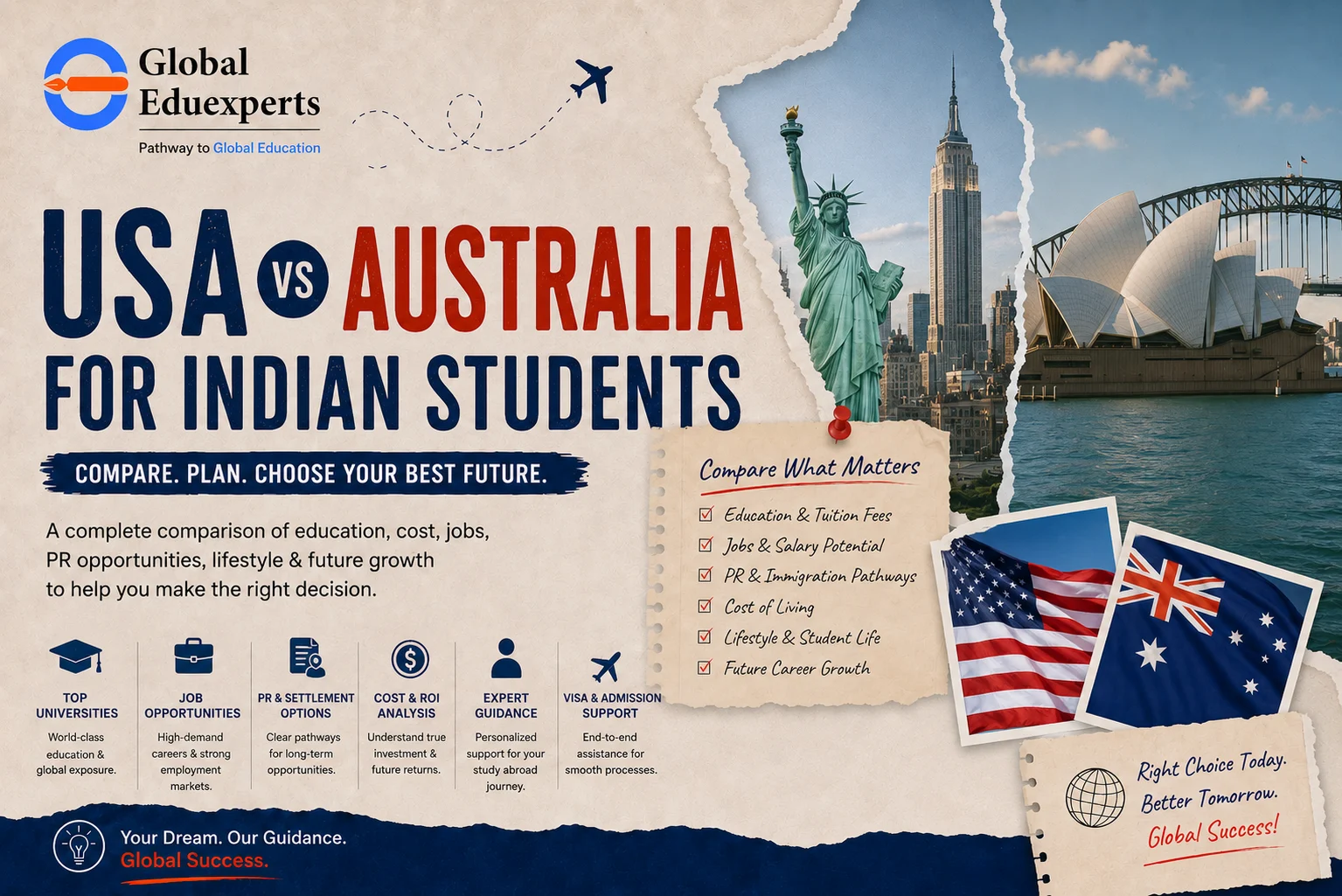
Students comparing USA vs Australia for Indian students receive practical guidance on education costs, PR opportunities, job markets, visa processes, future-demand courses, and long-term career outcomes in both countries. The comparison helps students and families make realistic decisions based on budget, career goals, immigration plans, earning potential, and lifestyle expectations instead of relying only on rankings or online trends.
Choosing between the USA and Australia has become harder for Indian students in recent years. Earlier, the decision was often simple. Students who wanted high-paying technology careers leaned toward America, while students looking for balanced immigration pathways preferred Australia.
Now the situation feels more layered.
Visa rules keep changing. Job markets shift quickly. Living costs are rising in both countries. And students are no longer thinking only about university rankings. They are thinking about stability, long-term growth, work opportunities, and whether the investment will actually feel worthwhile five years later.
That change in mindset matters.
Because the better country is not the same for every student.
The USA still dominates in terms of scale, innovation, and global corporate presence. Industries like artificial intelligence, software engineering, finance, biotechnology, and data science continue creating massive career opportunities.
For students focused on ambitious career acceleration, the USA often feels unmatched.
Companies like Google, Microsoft, Amazon, Tesla, and major financial institutions attract international graduates aggressively. Internship ecosystems are also stronger in many American universities.
But there is another side students should understand honestly.
Competition in the USA is intense. Very intense.
A strong degree alone is no longer enough. Students often need:
Australia operates differently.
The market is smaller, but career pathways can feel more structured and balanced for many international students. Healthcare, construction, cybersecurity, business analytics, nursing, accounting, and engineering continue seeing demand across several Australian states.
| Factor | USA | Australia |
|---|---|---|
| Job Market Size | Extremely large | Moderate but stable |
| Tech Opportunities | Excellent | Strong but smaller |
| Work-Life Balance | Competitive environment | More balanced lifestyle |
| Graduate Hiring Pressure | High | Moderate |
| Internship Ecosystem | Very strong | Growing steadily |
| PR Opportunities | Limited | More structured |
Students searching for USA or Australia which is better for Indian students usually discover that the answer depends heavily on personality, career ambition, and risk tolerance.
One reason many students prefer the USA is salary potential.
Technology and finance roles in America can offer significantly higher packages compared to Australia, especially after gaining experience. For ambitious professionals, the earning ceiling in the USA is generally higher.
Still, online salary comparisons often ignore something important.
Higher salaries also come with:
One Indian student working in California described the experience honestly. Financial growth was excellent, but the pressure to constantly perform never really disappeared.
Australia feels different.
Salaries may appear lower compared to top US packages, but work-life balance and long-term lifestyle stability often feel more manageable for many graduates.
| Industry | USA Average Potential | Australia Average Potential |
|---|---|---|
| Software & AI | Very High | High |
| Healthcare | High | High |
| Finance | Excellent | Strong |
| Engineering | Strong | Stable |
| Research Careers | Exceptional | Moderate |
This is why comparisons around USA vs Australia salary and career opportunities should never focus only on numbers.
Sustainability matters too.
The USA provides unmatched exposure to large-scale innovation, global startups, venture capital ecosystems, and research-driven industries.
Students aiming for:
often benefit strongly from the American ecosystem.
Australia, meanwhile, offers a more balanced international student experience. Many Indian students adjust faster socially and professionally because immigration systems, workplace culture, and student support structures can feel slightly less aggressive.
That does not make Australia “easier.”
It simply creates a different kind of professional environment.
Students comparing USA vs Australia for Indian students often make the mistake of searching for one universally “better” answer.
There is none.
The USA usually suits students who:
Australia often suits students who:
And honestly, over the years, many students have realized something important.
The right country is rarely the one with the loudest hype online.
It is the one that realistically matches your career goals, financial comfort, adaptability, and long-term vision.
Students comparing long-term career growth often explore country-specific guidance before making a final decision. Reading detailed pages like
STUDY IN USAandSTUDY IN AUSTRALIAhelps students understand industry demand, global exposure, and employment realities beyond rankings. Many students also reviewUSA Coursesto compare future-focused programs linked with strong international career opportunities.
For most Indian families, the biggest question is not whether studying abroad is valuable.
It is whether the cost feels manageable in real life.
Students comparing the USA vs Australia for Indian students conversation usually begin with university rankings or career opportunities. But somewhere during the admission process, the focus shifts toward finances very quickly.
Tuition fees. Rent. Visa costs. Health insurance. Currency fluctuations. Unexpected expenses.
And honestly, many students underestimate how emotionally stressful financial pressure abroad can become if planning is weak from the beginning.
The USA and Australia both offer strong education systems, but the overall cost structure feels very different once students start calculating the actual numbers.
The USA generally has higher tuition ranges, especially for private universities and STEM-focused programs.
Top-ranked American universities can become extremely expensive, particularly for master’s degrees in engineering, business analytics, computer science, or finance.
Australia, while still costly, often feels slightly more predictable financially for many Indian students.
| Study Destination | Average Annual Tuition |
|---|---|
| USA | ₹20 Lakhs – ₹45 Lakhs |
| Australia | ₹18 Lakhs – ₹35 Lakhs |
Public universities in the USA sometimes offer lower tuition than private institutions, but international students still face significant expenses overall.
Australia also has premium universities with higher fees, especially in cities like Sydney and Melbourne. Still, many students feel budgeting becomes slightly easier because course duration and living structures can feel more stable.
Students searching for Cost of studying in USA vs Australia for Indian students should also remember that shorter course duration can influence overall expenses significantly.
This is where the financial difference becomes more noticeable.
In the USA, living costs vary dramatically depending on the state and city. New York, San Francisco, Boston, and Los Angeles can become financially exhausting for international students.
Australia has expensive cities too. Sydney is not cheap. But overall living structures sometimes feel slightly less volatile compared to major American metro regions.
| Expense Category | USA | Australia |
|---|---|---|
| Accommodation | ₹70,000 – ₹1.8 Lakhs | ₹60,000 – ₹1.5 Lakhs |
| Food & Groceries | Moderate to High | Moderate |
| Transportation | Depends on city | Usually manageable |
| Utilities | Seasonal fluctuations | Relatively stable |
One Indian student studying in California recently admitted that rent alone consumed far more of the monthly budget than expected. Earlier, online cost calculators made the situation look manageable.
Reality felt different after arrival.
That gap between estimated and actual expenses is something students should prepare for carefully.
Visa expenses are another area students often overlook while comparing the Study in USA vs Australia cost comparison.
| Expense | USA | Australia |
|---|---|---|
| Student Visa Fee | Higher overall process cost | Slightly lower |
| Health Insurance | Often expensive | Mandatory OSHC system |
| Medical Expenses | Very costly without insurance | More regulated |
Healthcare costs in the USA can become financially dangerous without proper insurance coverage. Australia’s OSHC system provides a more structured approach for international students, although it still adds noticeable yearly expenses.
This is one reason some families feel Australia offers slightly better budgeting predictability.
Both countries allow part-time work opportunities, but students should avoid building unrealistic expectations around them.
Social media often creates the impression that part-time jobs comfortably manage tuition and living expenses.
That rarely happens.
Part-time income usually helps with:
But depending entirely on part-time work creates pressure quickly.
| Financial Factor | USA | Australia |
|---|---|---|
| Earning Potential | Higher ceiling | Stable income opportunities |
| Cost Pressure | High in major cities | Moderate to high |
| Currency Risk | Significant | Significant |
| Financial Predictability | Less stable | Slightly more manageable |
Students comparing USA or Australia which is better for Indian students financially often discover that the decision depends less on “cheap vs expensive” and more on lifestyle expectations, career goals, and long-term repayment comfort.
The USA may offer stronger long-term salary potential, especially in technology and innovation-driven industries.
Australia often feels more balanced for students prioritizing:
Neither option is automatically affordable.
And honestly, students who usually handle international education best are not always the wealthiest ones.
Often, they are the ones who planned realistically instead of emotionally.
Financial planning becomes much easier when students compare actual country-wise expenses instead of depending on rough online estimates. Exploring resources like
USA Cost,Australia Cost, andIreland Costhelps students understand tuition structures, accommodation pressure, healthcare costs, and realistic overseas budgeting before planning education loans or university applications.
For many Indian students, studying abroad is not only about earning an international degree.
It is also about long-term stability.
Some students want global work exposure for a few years and plan to return to India later. Others quietly hope their education becomes the first step toward permanent residency and eventually a more settled life abroad.
That is where the conversation around Australia vs USA PR for Indian students becomes important.
And honestly, this is one area where the USA and Australia feel completely different.
Australia has built a relatively transparent immigration system compared to many countries.
It is not easy. But it is more predictable.
Students studying in Australia often receive post-study work rights after graduation. These pathways allow graduates to gain local work experience, improve immigration points, and eventually apply for permanent residency through skilled migration programs.
| PR Consideration | Australia |
|---|---|
| Post-Study Work Visa | Available |
| Skilled Occupation Lists | Major role in PR |
| State Nomination Options | Available |
| Points-Based Immigration | Yes |
| Pathway Clarity | More structured |
This structure is one reason many Indian students choose Australia even when tuition costs are high.
Students in fields like:
often find stronger alignment with Australia’s long-term migration demand.
But there is something students should understand carefully.
Policies change regularly.
Earlier, some pathways felt easier and faster. Recently, immigration competition has increased, and point requirements have become more demanding in several categories.
That shift matters.
The USA operates very differently.
Students comparing Australia or USA for permanent residency often assume studying in America automatically creates a clear settlement pathway.
It usually does not.
The USA provides excellent career opportunities, especially in technology, finance, AI, and research-driven industries. But immigration systems are more employment-dependent and legally complex.
| Immigration Factor | USA |
|---|---|
| Post-Study Work | OPT / STEM OPT |
| Direct PR System | No student-based PR route |
| Employment Sponsorship | Critical |
| H-1B Dependency | High |
| PR Timeline | Often lengthy |
For Indian students, the path often looks like this:
That process can take years.
Sometimes much longer.
One Indian software professional working in the USA described the situation honestly. Career growth was excellent, but long-term immigration uncertainty remained emotionally exhausting despite professional success.
This is rarely discussed clearly on social media.
Students often focus heavily on university admissions while ignoring what happens after graduation.
That is risky.
Post-study work rights influence:
| Factor | USA | Australia |
|---|---|---|
| Graduate Work Rights | OPT-based | Structured graduate visas |
| Work Flexibility | Depends on sponsorship | Broader flexibility |
| PR Transition | Difficult | More accessible |
| Immigration Predictability | Lower | Moderate |
Students searching for Best country USA or Australia for Indian students often realize that the answer depends heavily on whether the goal is:
The priorities change the outcome completely.
This is important.
Some students now select countries almost entirely based on immigration trends. That creates problems later when:
One student recently shifted from a strong research-focused USA admit to a completely unrelated Australian course only because someone promised “easy PR.”
Two years later, career dissatisfaction became a bigger issue than immigration itself.
That happens more often than people admit.
For students prioritizing:
Australia often feels more practical.
For students prioritizing:
the USA still remains extremely attractive despite immigration uncertainty.
Students comparing USA vs Australia for Indian students should avoid looking for a universally perfect answer.
Because honestly, long-term success abroad depends less on the country itself and more on how realistically the student’s goals, profession, adaptability, and expectations align with that country’s system.
Students researching long-term settlement opportunities often move toward country-specific immigration and visa guidance for clearer understanding. Pages such as
USA Visa,Australia Visa, andDubai Visahelp students compare post-study work pathways, documentation expectations, and immigration realities before selecting a destination mainly based on PR trends or online opinions.
For many Indian students, the real question begins after graduation.
Getting admission abroad feels exciting. Finding stable employment afterward feels much more personal.
Students comparing USA vs Australia for Indian students often focus heavily on university rankings during the application stage. But over time, conversations shift toward:
And honestly, this is where the USA and Australia begin feeling very different from each other.
Neither country guarantees success.
But both offer strong opportunities when students understand how their employment systems actually work.
The USA has one of the strongest internship ecosystems globally.
Universities often maintain direct industry partnerships with:
Students pursuing STEM, business analytics, AI, finance, or engineering programs often gain access to large-scale internship networks during studies.
That exposure becomes extremely valuable later.
In many American industries, internships are not optional anymore. They act almost like unofficial job auditions.
| Factor | USA | Australia |
|---|---|---|
| Internship Availability | Very high | Growing steadily |
| Industry Partnerships | Extensive | Moderate to strong |
| Startup Exposure | Excellent | Developing |
| Research Opportunities | Strong | Moderate |
Australia offers internships too, especially in healthcare, construction, IT, hospitality, and business-related fields. But compared to the USA, the internship ecosystem feels smaller because the overall market size is smaller.
Still, some students prefer that environment because it feels less aggressively competitive.
Many students searching for USA vs Australia job opportunities for Indian students underestimate how important post-study work rights are.
A degree alone does not create career stability.
Students need time after graduation to:
Australia offers relatively structured graduate work opportunities through temporary graduate visas.
The USA uses the OPT system, with extended work rights available for STEM graduates.
| Factor | USA | Australia |
|---|---|---|
| Graduate Work Rights | OPT / STEM OPT | Temporary Graduate Visa |
| Work Duration | Limited but valuable | More structured |
| Employer Sponsorship Dependency | High | Lower initially |
| PR Alignment | Difficult | Better connected |
This difference changes how students experience pressure after graduation.
One Indian graduate in the USA described the early career phase as professionally rewarding but emotionally uncertain because work authorization depended heavily on employer sponsorship timelines.
Australian pathways often feel slightly more stable for students prioritizing long-term settlement flexibility.
Part-time work is another area where expectations sometimes become unrealistic.
Social media often portrays international students managing all expenses comfortably through part-time jobs alone.
That is rarely the full picture.
| USA | Australia |
|---|---|
| Campus Assistant Roles | Retail Jobs |
| Food Services | Hospitality Work |
| Library & Research Support | Warehouse & Delivery Jobs |
| Technical Support Roles | Customer Service Roles |
Australia is often considered slightly more accessible for part-time student employment because wage structures and labor systems feel more student-friendly in many regions.
The USA can provide higher earning potential in certain areas, but work competition and time management pressure can become intense depending on the university and location.
And honestly, balancing studies, internships, networking, and part-time work simultaneously is harder than many students expect before arriving abroad.
The USA remains dominant in:
For ambitious students aiming for high-growth global industries, America still offers enormous professional exposure.
Australia performs strongly in:
| Industry | USA | Australia |
|---|---|---|
| AI & Tech | Exceptional demand | Strong but smaller |
| Healthcare | Strong | Very strong |
| Construction | Moderate | High demand |
| Finance | Excellent | Stable |
| Skilled Occupations | Limited PR link | Better migration alignment |
Students exploring USA vs Australia salary and career opportunities should understand that industry alignment matters more than country hype.
A student entering an in-demand field in Australia may secure more stable long-term growth than someone struggling inside an oversaturated industry in the USA.
Students comparing Best country USA or Australia for Indian students often expect one universal answer.
There is none.
The USA usually suits students who:
Australia often suits students who:
And honestly, earlier many students chose countries emotionally based on trends.
Now, more students are starting to ask smarter questions:
“Can I realistically build a career there after graduation?”
That shift probably matters more than any ranking table.
Employment opportunities after graduation usually depend heavily on course selection and local industry demand. Students comparing job markets often continue toward
USA Courses,Uk Courses, andSTUDY IN EUROPEto explore industries linked with stronger hiring trends, internship opportunities, and practical long-term career growth in international markets.
When Indian students compare the USA and Australia, they usually begin with tuition fees, PR opportunities, or job prospects.
But after students actually move abroad, another reality becomes more important.
How does daily life feel there?
That question changes everything.
Because studying abroad is not only about classrooms and degrees. It is also about adapting to a completely different education culture, social environment, communication style, and lifestyle rhythm.
And honestly, students sometimes underestimate how emotionally demanding that adjustment can become during the first few months.
The USA education system is heavily focused on participation, innovation, and independent thinking.
Students are expected to:
For some Indian students, especially those coming from traditional academic systems, this shift feels uncomfortable initially.
One student pursuing computer science in Texas admitted that the hardest part was not academics. It was learning how to speak confidently inside classrooms where everyone seemed extremely expressive.
Australia also encourages independent learning, but the classroom environment often feels slightly less intense compared to many American universities.
| Factor | USA | Australia |
|---|---|---|
| Classroom Participation | Very high | Moderate to high |
| Research Focus | Extremely strong | Strong |
| Assignment Pressure | Continuous | Balanced |
| Practical Learning | Extensive | Industry-oriented |
| Academic Flexibility | Very flexible | Moderately flexible |
Students searching for USA or Australia which is better for Indian students often discover that comfort with communication style matters more than expected.
The USA can feel academically aggressive, especially in competitive universities and STEM-focused programs.
Students often juggle:
That environment creates strong professional growth. But it can also become mentally exhausting.
Australia usually offers a more balanced academic pace for many students. There is still pressure, especially during assessments and project deadlines, but work-life balance tends to feel more achievable.
That difference becomes visible over time.
| Academic Factor | USA | Australia |
|---|---|---|
| Competitive Environment | Very high | Moderate |
| Research Intensity | Exceptional | Strong |
| Work-Life Balance | Challenging | Better balanced |
| Networking Pressure | High | Moderate |
| Classroom Competition | Aggressive in some fields | Relatively stable |
This is one reason some students prefer Australia despite the USA offering stronger global corporate exposure.
Both countries attract international students from across the world, but campus culture feels different.
American universities often create very active campus ecosystems:
Students looking for energetic, fast-moving environments often enjoy this atmosphere.
Australia feels socially inclusive too, but slightly calmer overall.
Indian students usually adapt comfortably because of:
Still, adaptation challenges exist everywhere.
One student in Melbourne described the early months as emotionally confusing despite the friendly environment. Missing family, cultural adjustments, and financial stress became harder than expected.
That part of studying abroad rarely appears in promotional videos.
Lifestyle differences between the USA and Australia become more noticeable outside classrooms.
| Lifestyle Factor | USA | Australia |
|---|---|---|
| Pace of Life | Fast and competitive | More relaxed |
| Public Transport | City-dependent | Generally accessible |
| Outdoor Lifestyle | Moderate | Strong |
| Work Culture | Performance-focused | Balanced |
| Social Adaptability | Depends on region | Usually smoother |
The USA often rewards ambition aggressively. Students aiming for high-performance industries sometimes thrive in that environment.
Australia usually feels more lifestyle-oriented, especially for students prioritizing:
Neither experience is automatically better.
It depends on personality.
Students comparing USA vs Australia for Indian students often assume adaptation depends only on English fluency or academic ability.
Actually, emotional adaptability matters just as much.
The USA may suit students who:
Australia often suits students who:
And honestly, earlier many students selected countries mainly based on rankings or immigration trends.
Now, more students are realizing something important.
The country where you can adapt comfortably often matters more than the country that simply looks impressive on paper.
Students trying to understand daily academic life abroad often compare different international student environments before finalizing a destination. Exploring pages like
STUDY IN UK,STUDY IN ASIA, andSTUDY IN IRELANDgives broader insight into teaching styles, multicultural exposure, work-life balance, and student adaptability across different global education systems.
For many Indian families, studying abroad is no longer viewed only as an academic decision.
It is a financial investment.
And honestly, this is where the comparison between the USA and Australia becomes more emotional than students initially expect. Tuition fees can be calculated on paper. Loan pressure cannot.
Students comparing USA vs Australia for Indian students usually ask the same practical question sooner or later:
“Which country gives better return on investment?”
The answer depends less on rankings and more on long-term sustainability.
A lot of students make the mistake of calculating ROI only through salary conversion.
That approach feels incomplete.
A country offering higher salaries may also come with:
At the same time, a country with moderate salaries may provide:
This is why comparing USA or Australia which is better for Indian students requires looking beyond social media salary videos.
| ROI Factor | USA | Australia |
|---|---|---|
| Tuition Cost | Higher overall | Moderate to high |
| Salary Potential | Very high | Strong and stable |
| PR Pathway | Difficult | More accessible |
| Loan Repayment Pressure | Higher risk | More manageable |
| Work-Life Balance | Competitive | Better balance |
The “better” option changes depending on what students value most after graduation.
The USA often requires a larger upfront investment, especially for:
Many Indian students rely heavily on education loans while studying in America.
That creates pressure later.
One student pursuing data science in the USA admitted that despite securing a good job, the loan burden remained mentally exhausting during the first few working years because living costs and visa uncertainty continued simultaneously.
Australia also involves significant expenses, but total educational investment sometimes feels more controlled due to:
| Financial Factor | USA | Australia |
|---|---|---|
| Average Tuition | ₹20–45 Lakhs | ₹18–35 Lakhs |
| Living Cost Pressure | High | Moderate to high |
| Healthcare Expenses | Expensive | More regulated |
| Education Loan Dependency | Very common | Common |
Students searching for Study in USA vs Australia cost comparison often discover that affordability depends heavily on lifestyle choices, city selection, and course type.
The USA still dominates in terms of salary ceilings.
Industries like:
can offer exceptional financial growth over time.
Ambitious students aiming for aggressive career acceleration often prefer the American ecosystem for this reason.
Australia offers strong salaries too, particularly in:
But salary growth usually feels more stable than explosive.
| Career Area | USA | Australia |
|---|---|---|
| Tech Salaries | Extremely high | Strong |
| Healthcare Income | High | High |
| Graduate Starting Pay | Competitive | Stable |
| Long-Term Growth | Aggressive | Sustainable |
This is why conversations around USA vs Australia salary and career opportunities should never focus only on starting salaries.
Consistency matters too.
Currency conversion affects Indian students more than they realize initially.
A stronger foreign currency may create impressive salary conversions when viewed from India. But daily life expenses abroad consume a large portion of income too.
Recently, currency fluctuations have increased financial unpredictability for many international students.
That affects:
Australia often feels slightly more financially sustainable for students prioritizing:
The USA can offer exceptional financial rewards, but the path often carries greater uncertainty and competition.
Students comparing Best country USA or Australia for Indian students often hope for one universal answer.
There is none.
The USA usually offers better ROI for students who:
Australia often offers better ROI for students who:
And honestly, over the years, one pattern has become clear.
The students who feel most satisfied later are not always the ones earning the highest salaries.
Often, they are the ones whose financial decisions remained sustainable long after graduation.
Return on investment becomes clearer when students evaluate country-specific costs alongside career outcomes and immigration flexibility. Many readers naturally continue toward
USA scholarships,Australia Scholarships, andUK Scholarshipsto understand how funding opportunities, tuition reduction, and financial aid can influence long-term overseas education affordability.
For many Indian students, the admission process feels exciting at first.
University shortlists. IELTS preparation. SOP writing. Visa planning.
Then the paperwork starts.
And honestly, this is where stress usually begins.
Students comparing USA vs Australia for Indian students often assume both countries follow similar admission and visa systems. They do not. The overall process, documentation expectations, interview style, and approval patterns feel quite different once applications move forward.
Some students handle that transition smoothly.
Others get overwhelmed by small mistakes that could have been avoided earlier.
The USA admission system is usually more profile-driven.
Universities often evaluate:
For competitive American universities, students often need to present a complete personal and academic profile instead of just strong marks.
Australia focuses heavily on:
The process can feel slightly more structured and direct compared to the USA.
| Admission Factor | USA | Australia |
|---|---|---|
| Academic Profile Weight | Very high | High |
| SOP Importance | Extremely important | Important |
| Research Experience | Valuable | Helpful but not always critical |
| Internship Focus | Strong advantage | Moderate advantage |
| Application Complexity | Higher | Moderate |
Students searching for USA vs Australia for masters for Indian students often notice that American universities expect stronger personalization in applications.
Australia generally feels more process-oriented.
Both countries require English proficiency tests, but accepted exams and score expectations can vary depending on universities and programs.
| Exam | USA | Australia |
|---|---|---|
| IELTS | Widely accepted | Widely accepted |
| PTE | Accepted by many universities | Very commonly accepted |
| TOEFL | Strongly preferred in some universities | Accepted |
| Duolingo | Selective acceptance | Limited acceptance |
Recently, many students prefer PTE because of faster results and flexible exam patterns. But university acceptance still varies.
That detail matters more than students think.
One student prepared only for Duolingo because it felt easier and cheaper initially. Later, several preferred universities required IELTS or TOEFL scores, forcing additional preparation and delaying applications.
These small planning mistakes create bigger problems later.
The Statement of Purpose has become one of the most important parts of overseas applications.
Weak SOPs usually sound generic and emotionally empty.
Admissions teams read thousands of applications that say:
That language rarely creates impact anymore.
| SOP Expectation | Why It Matters |
|---|---|
| Clear course reasoning | Shows career direction |
| Academic alignment | Reduces credibility concerns |
| Realistic goals | Builds trust |
| Honest career transitions | Explains profile gaps |
| Long-term planning | Reflects seriousness |
The USA often expects more detailed personal storytelling and career positioning.
Australia focuses strongly on whether the student’s academic path and financial planning appear genuine and practical.
And honestly, copied SOP templates remain one of the biggest mistakes Indian students still make.
The visa process is where students usually feel the highest pressure.
The USA student visa system involves:
The interview stage becomes extremely important because officers often evaluate communication confidence, intent clarity, and financial preparedness quickly.
Australia’s visa process is more document-driven overall. Financial evidence, Genuine Temporary Entrant positioning, academic relevance, and documentation consistency matter heavily.
| Visa Factor | USA | Australia |
|---|---|---|
| Visa Interview | Mandatory | Usually document-focused |
| Financial Verification | Important | Very important |
| Processing Complexity | Moderate to high | Moderate |
| Documentation Sensitivity | High | High |
| Approval Evaluation | Interview + profile | Documentation + intent |
Students comparing Australia vs USA PR for Indian students sometimes focus only on long-term settlement opportunities while ignoring how critical the initial student visa stage actually is.
Recently, one pattern has become very common among Indian students.
Rushed applications.
Students delay:
Then everything becomes stressful near deadlines.
| Mistake | Possible Impact |
|---|---|
| Generic SOPs | Weak application quality |
| Inconsistent financial documents | Visa concerns |
| Unrealistic university selection | Rejections |
| Late applications | Limited options |
| Poor interview preparation | Lower confidence |
One Indian student applying to the USA had strong academics but struggled during the visa interview because career goals sounded unclear and inconsistent.
Another student applying to Australia faced delays because financial documentation lacked proper explanation despite sufficient funds.
These situations happen more often than students expect.
Students comparing Best country USA or Australia for Indian students often ask which country has the easier admission and visa process.
There is no universal answer.
The USA usually feels more competitive and personality-driven.
Australia often feels more documentation-focused and structured.
But honestly, students who prepare early, stay realistic, and understand the process carefully tend to perform well in both systems.
The problems usually begin when students rely on shortcuts instead of preparation.
Visa approval chances often improve when students understand eligibility requirements early instead of rushing applications later. Reviewing detailed resources like
USA Eligibility,Australia Eligibility, andUK Eligibilityhelps students prepare stronger academic profiles, language scores, SOPs, and financial documentation before beginning the admission process.
Choosing the right country matters.
Choosing the right course matters even more.
A lot of Indian students spend months comparing the USA vs Australia for Indian students debate without asking a more important question first:
“Which industry will still create opportunities five or ten years from now?”
That question changes everything.
Earlier, students often selected courses based on trends, family pressure, or whatever seemed popular among friends. Recently, that approach has started failing more often. Some industries are growing aggressively. Others are becoming overcrowded very quickly.
And honestly, a strong university cannot fully compensate for choosing a course with weak long-term demand.
Students exploring future-demand careers usually compare multiple study destinations before finalizing a course pathway. Pages like
STUDY IN EUROPE,STUDY IN DUBAI, andSTUDY IN ASIAhelp students understand emerging industries, technology-focused education systems, and global job trends connected with long-term career sustainability.
The USA still leads globally in advanced technology ecosystems.
Students pursuing:
often prefer American universities because of direct industry integration and research opportunities.
The connection between universities and global tech companies in the USA remains extremely strong.
| Technology Area | USA | Australia |
|---|---|---|
| AI & Machine Learning | Exceptional | Growing rapidly |
| Data Science | Very high demand | Strong demand |
| Cybersecurity | Excellent opportunities | Strong PR-linked demand |
| Software Engineering | Global leadership | Stable growth |
One Indian student pursuing AI in the USA recently mentioned that classroom projects often mirrored real startup and corporate problems instead of theoretical assignments.
That practical exposure matters later during hiring.
Australia also offers strong technology programs, especially in cybersecurity and software systems. But the ecosystem feels smaller compared to the USA’s scale and innovation intensity.
Healthcare has become one of the safest long-term career sectors globally.
And honestly, demand keeps increasing.
Australia currently shows strong demand for:
The USA also offers excellent healthcare opportunities, although licensing processes can become more complex depending on the profession.
| Healthcare Field | USA | Australia |
|---|---|---|
| Nursing Demand | High | Very high |
| Public Health | Strong | Strong |
| Medical Research | Exceptional | Moderate |
| Healthcare Administration | Growing | Stable |
Students comparing USA vs Australia job opportunities for Indian students often notice that healthcare fields align more naturally with long-term Australian immigration demand.
That creates additional stability for many graduates.
Engineering remains popular across both countries, especially in:
Australia often provides stronger alignment between engineering occupations and skilled migration pathways.
The USA offers larger-scale engineering industries, especially in advanced manufacturing, aerospace, automation, and infrastructure technology.
Business-related programs also remain attractive, but students should approach them carefully.
Earlier, generic MBA degrees alone carried strong international value. Recently, specialization matters much more.
| Course Area | USA | Australia |
|---|---|---|
| MBA Programs | Strong global reputation | Practical industry focus |
| Construction Management | Moderate demand | Very high demand |
| Civil Engineering | Strong | Strong PR relevance |
| Finance & Analytics | Excellent | Stable growth |
Students searching for USA vs Australia salary and career opportunities should understand that specialized business skills now perform far better than broad management degrees alone.
This is important.
Many students still choose courses based on what was successful five years ago.
That approach is becoming risky.
Global industries are shifting because of:
| Future-Oriented Field | USA Potential | Australia Potential |
|---|---|---|
| AI & Automation | Extremely strong | Growing |
| Renewable Energy | Strong | Strong |
| Cybersecurity | Excellent | Excellent |
| Healthcare Technology | High growth | Stable growth |
| Data Analytics | Exceptional | Strong |
One student recently rejected a highly saturated generic management program and instead moved toward healthcare analytics. The decision initially felt uncertain.
Two years later, employment outcomes looked significantly stronger than many peers in oversaturated fields.
Sometimes practical decisions outperform trendy ones.
Students comparing USA vs Australia for masters for Indian students often expect one country to dominate every field.
That rarely happens.
The USA usually suits students aiming for:
Australia often suits students looking for:
And honestly, the smartest students today are no longer asking:
“Which country is best?”
They are asking:
“Which course will still matter when I graduate?”
The better option depends on career goals, financial comfort, and long-term plans. The USA usually offers stronger opportunities in technology, AI, finance, and research-driven industries with higher salary potential. Australia is often preferred for balanced lifestyle, structured PR pathways, and long-term settlement possibilities. Students should compare career outcomes, visa systems, and financial sustainability instead of following trends alone.
In many cases, Australia can feel slightly more affordable overall, especially when comparing living costs and long-term financial pressure. The USA often has higher tuition fees and expensive healthcare systems, particularly in major cities. However, total expenses vary depending on university selection, course duration, accommodation choices, and personal lifestyle. Proper budgeting matters more than choosing the “cheaper” country blindly.
Australia generally provides clearer and more structured permanent residency pathways for international students through skilled migration systems and post-study work visas. The USA offers excellent career growth but has a more complex immigration process that often depends on employer sponsorship and visa lotteries. Students prioritizing long-term settlement usually find Australia more predictable compared to the American immigration system.
The USA has a larger and more competitive job market, especially in AI, software engineering, finance, and research-based industries. Australia offers stable opportunities in healthcare, cybersecurity, engineering, construction, and skilled occupations. The best destination depends on the student’s course, adaptability, communication skills, and long-term career plans rather than country popularity alone.
Courses related to artificial intelligence, data science, cybersecurity, healthcare, engineering, renewable energy, and business analytics continue showing strong global demand. The USA leads in advanced technology and innovation-focused careers, while Australia performs strongly in healthcare, infrastructure, skilled trades, and migration-linked occupations. Students should focus on future industry relevance instead of selecting courses only because they are currently trending online.


