
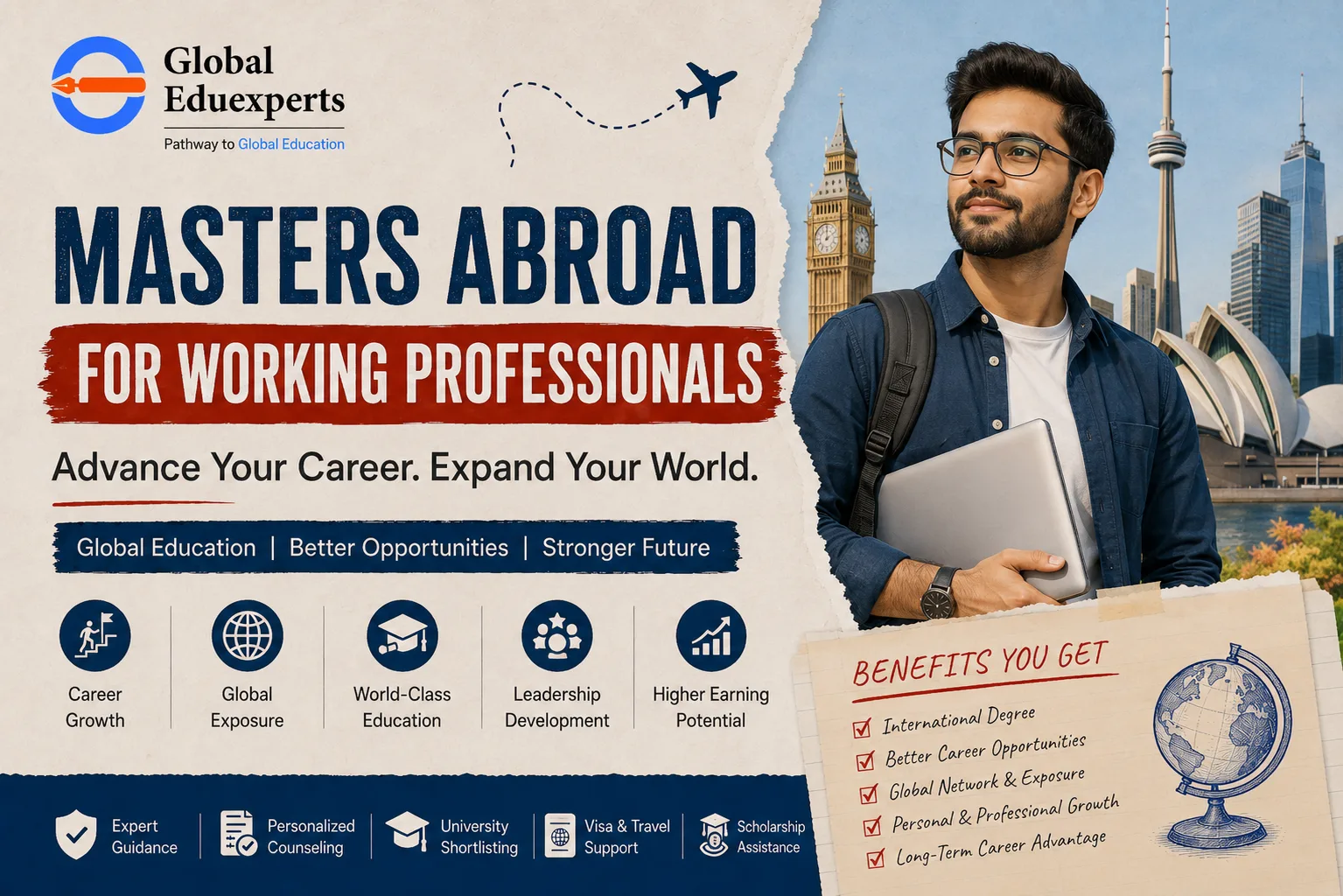
Working professionals in Sector 62 Noida are increasingly pursuing master's degrees abroad to gain advanced industry knowledge, strengthen leadership capabilities, and access global career opportunities. The process helps experienced professionals identify suitable programs, evaluate international study destinations, meet admission requirements, plan finances, and prepare for long-term career growth. The primary outcome is enhanced employability, broader professional networks, and improved opportunities for senior, specialized, or international roles across competitive global industries.
A few years ago, pursuing a master's degree abroad was often associated with fresh graduates.
Today, the trend looks very different.
An increasing number of professionals working in IT companies, consulting firms, fintech organizations, engineering companies, healthcare businesses, and multinational corporations around Sector 62 Noida are stepping away from full-time employment to pursue international higher education.
The reason is not simply obtaining another qualification.
Most professionals are looking for something much bigger.
They want:
This shift explains why demand for masters abroad for working professionals continues to grow among experienced Indian professionals.
The conversation is no longer about getting a degree.
It is about creating the next phase of a career.
Many professionals begin their careers with strong momentum.
Promotions happen.
Responsibilities increase.
New projects arrive.
Then, after four to eight years of experience, growth sometimes slows down.
Professionals often find themselves asking:
These questions are becoming increasingly common among professionals in Noida's growing corporate ecosystem.
| Challenge | Typical Impact |
|---|---|
| Limited leadership opportunities | Slower career progression |
| Specialized skill gaps | Reduced competitiveness |
| Salary growth stagnation | Long-term earning limitations |
| Global exposure limitations | Restricted career mobility |
A master's degree abroad is often viewed as a strategic solution to overcome these barriers.
The workplace itself has changed dramatically.
Companies now operate across:
As a result, employers increasingly value professionals who understand international business environments.
| Skill Area | Professional Benefit |
|---|---|
| Cross-cultural communication | Global collaboration |
| International business exposure | Broader market understanding |
| Strategic thinking | Leadership development |
| Industry specialization | Higher-value roles |
Many professionals pursue masters abroad from noida because they recognize that international education often provides exposure that is difficult to replicate through workplace experience alone.
While education should never be viewed only through a salary lens, compensation remains an important consideration.
Many professionals invest in higher education because they want access to:
| Factor | Career Impact |
|---|---|
| Advanced specialization | Premium roles |
| Global experience | International opportunities |
| Industry exposure | Higher-value positions |
| Stronger networks | Expanded career options |
Of course, salary outcomes vary by:
However, many professionals view a master's degree as an investment in long-term career growth rather than immediate financial returns.
One reason international education attracts working professionals is the practical learning environment.
Many master's programs abroad integrate:
| Experience Type | Value for Professionals |
|---|---|
| Live projects | Practical application |
| Industry mentoring | Professional guidance |
| Internship exposure | Workplace learning |
| Global case studies | Strategic perspective |
Professionals often find that these experiences complement their previous work experience and help them build broader business perspectives.
Not every professional wants to remain in purely technical roles.
Many aspire to become:
Leadership-focused master's programs often expose students to:
| Leadership Area | Professional Advantage |
|---|---|
| Strategic planning | Better decision-making |
| Team leadership | Management readiness |
| Business communication | Executive effectiveness |
| Problem-solving | Organizational impact |
For professionals aiming to move beyond execution roles, these skills can become highly valuable.
One benefit professionals frequently underestimate is networking.
A master's degree abroad often places students in classrooms with:
| Network Benefit | Career Value |
|---|---|
| Global contacts | International opportunities |
| Industry connections | Career mobility |
| Alumni networks | Professional support |
| Cross-border relationships | Business expansion |
Years after graduation, these connections often continue to influence career opportunities.
Sometimes a classroom discussion becomes a future business partnership.
Sometimes an academic project becomes an international job opportunity.
These outcomes are difficult to predict but can have significant long-term value.
The global economy is evolving rapidly.
Industries increasingly seek expertise in:
Many professionals realize that traditional work experience alone may not be enough to stay competitive in these evolving sectors.
| Specialization | Growing Demand |
|---|---|
| Business Analytics | High |
| Artificial Intelligence | High |
| Data Science | High |
| Project Management | Strong |
| Finance and FinTech | Strong |
| Healthcare Management | Growing |
This is one reason executive masters abroad for indian professionals and specialized master's programs continue attracting experienced applicants.
Career growth is no longer limited to one city or even one country.
Many professionals want flexibility to work across global markets.
International education can provide exposure to:
| Mobility Advantage | Potential Outcome |
|---|---|
| Wider job market | More opportunities |
| International exposure | Career flexibility |
| Global work experience | Professional differentiation |
For many professionals, this broader career access is just as valuable as the academic qualification itself.
Another reason demand continues to grow is the availability of flexible study formats.
Many universities now offer:
| Program Feature | Benefit |
|---|---|
| Shorter duration | Faster return to workforce |
| Practical curriculum | Immediate relevance |
| Industry focus | Better employability |
| Flexible structure | Career-friendly learning |
This flexibility makes higher education more realistic for professionals who already have significant work experience.
Ten years ago, many students pursued overseas education primarily for academic reasons.
Today, professionals are approaching the decision differently.
They evaluate:
The focus has shifted from earning a degree to building a stronger professional future.
For professionals in Sector 62 Noida, pursuing a master's degree abroad is often less about leaving a job and more about creating new opportunities.
The decision is typically driven by a combination of:
As industries become increasingly global and competitive, experienced professionals are recognizing that continuous learning remains one of the most powerful tools for long-term career growth.
That is why masters abroad for working professionals continues to attract ambitious individuals who are looking beyond their current role and planning for where they want their careers to be five or ten years from now.
Many professionals begin by exploring broader international education opportunities before narrowing down specific programs. Reviewing resources like
STUDY ABROAD FROM NOIDAcan help understand destination options, admission pathways, and planning strategies. Those evaluating global career markets often compare opportunities available throughSTUDY IN USA,STUDY IN UK, andSTUDY IN AUSTRALIAto align education decisions with long-term professional goals.
One of the biggest questions working professionals face is not whether they should pursue higher education abroad.
It is where they should go.
A few years ago, students often selected destinations based on rankings or popularity alone. Today, experienced professionals approach the decision differently.
They compare:
For professionals in Sector 62 Noida who already have several years of work experience, choosing the right country can significantly influence both short-term educational outcomes and long-term career growth.
And honestly, there is no single "best" destination.
The right country depends on:
However, some destinations consistently attract Indian professionals because of their strong combination of education quality and career opportunities.
Over the last decade, Canada has become a preferred destination for many Indian professionals.
One reason is its balance between education, employment opportunities, and immigration pathways.
Professionals pursuing masters in canada for working professionals often appreciate the country's practical learning environment and employer-focused education system.
| Advantage | Benefit |
|---|---|
| Strong job market | Career opportunities |
| Post-study work options | Employment flexibility |
| Diverse workforce | Global exposure |
| Immigration pathways | Long-term settlement options |
| Industry-focused education | Practical skills development |
Fields such as:
continue attracting professionals from India.
Many applicants also value Canada's reputation for welcoming international talent.
The UK remains a strong option for professionals who want shorter program durations.
Many master's programs can be completed in approximately one year.
For professionals stepping away from employment, this shorter duration can be a significant advantage.
| Advantage | Benefit |
|---|---|
| One-year master's programs | Faster workforce re-entry |
| Globally recognized universities | International credibility |
| Strong business ecosystem | Career exposure |
| Graduate work opportunities | Post-study flexibility |
Interest in masters in uk for indian professionals continues to grow because professionals can often return to the job market more quickly while still gaining international qualifications.
Industries such as:
remain particularly attractive.
The United States remains one of the world's most influential education destinations.
For professionals focused on innovation, research, and high-growth industries, the USA often remains a top consideration.
| Advantage | Benefit |
|---|---|
| Global technology ecosystem | Industry exposure |
| Research opportunities | Innovation-focused learning |
| High earning potential | Career growth |
| Large employer network | Recruitment opportunities |
Professionals working in:
often consider the USA because of its concentration of leading companies and advanced research environments.
However, applicants should carefully evaluate:
before making a final decision.
Australia has become increasingly attractive for professionals seeking globally recognized education combined with strong employment outcomes.
Many universities maintain close relationships with industry partners.
| Advantage | Benefit |
|---|---|
| Industry-linked programs | Practical experience |
| International workforce | Global networking |
| Strong quality of life | Student experience |
| Post-study opportunities | Career flexibility |
Professionals frequently choose Australia for programs related to:
The country's emphasis on practical learning is often appreciated by professionals who already possess workplace experience.
A destination that receives increasing attention from Indian professionals is Ireland.
Although smaller than some traditional destinations, Ireland has established itself as a significant hub for:
| Advantage | Benefit |
|---|---|
| Strong multinational presence | Career opportunities |
| Technology ecosystem | Industry exposure |
| English-speaking environment | Easier transition |
| Growing demand for skilled talent | Employability potential |
Professionals interested in technology and business fields often find Ireland particularly attractive because of its close relationship with many multinational employers.
Many professionals initially think of Europe as a single destination.
In reality, Europe offers a wide range of educational systems and career environments.
Countries such as:
have become increasingly popular among experienced applicants.
| Advantage | Benefit |
|---|---|
| Diverse education systems | More options |
| International workforce | Global exposure |
| Specialized programs | Industry alignment |
| Research opportunities | Innovation-focused learning |
Some countries are particularly attractive for:
Professionals often appreciate the variety of academic and career pathways available across Europe.
A common mistake professionals make is focusing entirely on university rankings.
In reality, post-study employment opportunities often influence overall return on investment far more than rankings alone.
| Factor | Importance |
|---|---|
| Practical work experience | Career development |
| Industry exposure | Employability |
| Salary potential | Financial return |
| Professional networking | Future opportunities |
Professionals should evaluate:
before selecting a destination.
Unlike fresh graduates, working professionals often approach education as a strategic investment.
Many are leaving stable jobs, pausing career progression, or making significant financial commitments.
Because of this, ROI becomes a major consideration.
| Consideration | Why It Matters |
|---|---|
| Tuition fees | Upfront investment |
| Living expenses | Total education cost |
| Salary outcomes | Career return |
| Employment opportunities | Long-term value |
| Program duration | Opportunity cost |
A more expensive destination is not always a better investment.
Likewise, a lower-cost program may not always generate stronger career outcomes.
The goal is balancing cost with future opportunities.
There is no universal answer for every professional.
The ideal country often depends on career specialization.
| Industry | Common Destination Choices |
|---|---|
| Technology | USA, Canada, Ireland |
| Finance | UK, USA |
| Business Analytics | Canada, UK, Australia |
| Engineering | Germany, Canada |
| Healthcare Management | UK, Australia, Canada |
| Data Science | USA, Canada, Ireland |
This is one reason experienced education consultants in noida often focus heavily on career alignment rather than simply recommending popular destinations.
Not every professional plans to settle abroad permanently.
However, many want flexibility.
Countries with clearer post-study employment and immigration frameworks often attract greater interest.
| Benefit | Impact |
|---|---|
| Career continuity | Professional growth |
| Global mobility | Expanded opportunities |
| Long-term planning | Greater flexibility |
Students should always review current immigration regulations because policies can change over time.
One of the most important realities working professionals discover is that there is no perfect destination.
A country that works well for a software engineer may not be ideal for a finance professional.
A destination with strong immigration pathways may not offer the strongest opportunities in a particular industry.
For professionals evaluating the best countries for masters abroad after work experience, the smartest approach is to focus on:
rather than following trends alone.
For ambitious professionals in Sector 62 Noida, international education is increasingly becoming a career strategy rather than an academic decision.
And choosing the right destination is often the first major step in that strategy.
Destination comparison becomes much easier when professionals look beyond rankings and evaluate practical outcomes. Exploring detailed guides such as
STUDY IN USA,STUDY IN UK,STUDY IN IRELAND, andSTUDY IN EUROPEhelps applicants compare post-study work opportunities, immigration pathways, industry demand, and return-on-investment factors that matter when pursuing a master's degree after gaining work experience.
For working professionals, selecting a master's program abroad is often more complicated than choosing a university.
In fact, many admission experts would argue that choosing the right program is far more important than choosing the most famous institution.
A common mistake professionals make is selecting courses based on:
Instead of asking, "Which course is popular?", experienced professionals should ask a different question:
"Which program will help me reach my next career goal?"
That shift in thinking can completely change the decision-making process.
Professionals pursuing masters abroad for working professionals are usually making a significant investment of time, money, and career momentum. Choosing the wrong program can delay professional growth, while choosing the right one can open opportunities that might otherwise take years to achieve.
Many professionals begin their search by looking at course catalogs.
The smarter approach is to start with career objectives.
Before researching universities, it helps to answer a few important questions.
These answers often provide more direction than any university ranking.
| Career Goal | Potential Program Direction |
|---|---|
| Leadership roles | MBA, Management Programs |
| Data-driven careers | Business Analytics, Data Science |
| Technology advancement | AI, Cybersecurity, Computer Science |
| Product leadership | Product Management Programs |
| Healthcare leadership | Healthcare Management |
When professionals understand the destination, choosing the route becomes much easier.
Universities often value applicants who demonstrate a logical connection between their past experience and future studies.
This does not mean professionals can never switch careers.
Career transitions are possible.
However, admissions committees typically prefer applicants who can clearly explain their academic decisions.
| Current Experience | Related Master's Program |
|---|---|
| Software Development | Computer Science, AI |
| Financial Services | Finance, FinTech |
| Marketing | Digital Marketing, Business Analytics |
| Operations | Supply Chain Management |
| Healthcare | Healthcare Administration |
A logical progression often strengthens both admissions applications and future employability.
One reason some professionals struggle after graduation is that they choose programs without evaluating market demand.
A course may sound impressive but offer limited career opportunities in target markets.
| Evaluation Area | Why It Matters |
|---|---|
| Job market demand | Career opportunities |
| Industry growth | Long-term relevance |
| Skill shortages | Employer demand |
| Salary potential | Financial return |
Industries evolve quickly.
Fields that were in high demand five years ago may not be expanding at the same pace today.
This is why professionals should evaluate future industry trends rather than relying entirely on current popularity.
Although demand changes over time, certain sectors continue to create opportunities across multiple countries.
| Specialization | Common Career Pathways |
|---|---|
| Business Analytics | Data-driven decision making |
| Artificial Intelligence | Machine learning and automation |
| Data Science | Analytics and predictive modeling |
| Cybersecurity | Information security leadership |
| Finance and FinTech | Banking and financial innovation |
| Healthcare Management | Healthcare operations |
| Project Management | Business transformation |
Professionals should still evaluate whether a specialization aligns with their interests and long-term goals rather than choosing it simply because it is popular.
Not every professional pursues higher education for the same reason.
Some want advancement within their current industry.
Others want an entirely new direction.
The program selection process changes significantly depending on the objective.
| Objective | Program Selection Focus |
|---|---|
| Career Growth | Build on existing expertise |
| Career Transition | Develop new skills and knowledge |
For example:
A software engineer pursuing AI is often seeking advancement.
A software engineer pursuing management consulting may be pursuing a transition.
Both paths can be successful, but they require different planning strategies.
Professionals sometimes focus heavily on course content while overlooking employability outcomes.
A master's degree should ideally strengthen career opportunities after graduation.
| Factor | Career Benefit |
|---|---|
| Industry projects | Practical experience |
| Internships | Workplace exposure |
| Alumni network | Professional connections |
| Employer partnerships | Recruitment access |
The strongest programs often combine academic quality with practical career preparation.
This is one of the most common areas of confusion among working professionals.
Many assume an MBA is automatically the best option after gaining experience.
That is not always true.
| MBA | Specialized Master's |
|---|---|
| Broad business focus | Deep technical expertise |
| Leadership development | Subject specialization |
| Management pathways | Technical career growth |
| Cross-functional learning | Industry-specific skills |
Professionals seeking executive leadership roles often consider MBAs.
Professionals aiming for technical specialization may benefit more from focused master's programs.
The right choice depends on career direction rather than prestige alone.
Working professionals often evaluate education differently than fresh graduates.
Time away from employment matters.
| Program Type | Typical Duration |
|---|---|
| UK Master's | Around 1 year |
| Canada Master's | 1–2 years |
| USA Master's | 1.5–2 years |
| Australia Master's | 1.5–2 years |
Shorter programs may reduce overall education costs and allow faster re-entry into the workforce.
Longer programs may offer additional internship or research opportunities.
Both approaches have advantages depending on individual goals.
Every year, certain programs become extremely popular.
Recently, areas such as:
have attracted significant attention.
But popularity alone should never determine a career decision.
| Mistake | Potential Consequence |
|---|---|
| Choosing trends over interests | Low motivation |
| Ignoring career background | Weak profile alignment |
| Following friends' choices | Poor fit |
| Focusing only on salary | Long-term dissatisfaction |
A highly ranked program may not be the right program.
A trending specialization may not match your strengths.
Personal fit matters.
The best master's programs help professionals achieve goals that extend beyond immediate employment.
Evaluating programs through this broader lens often leads to better decisions.
Many working professionals already have demanding careers.
Researching hundreds of programs, universities, and destinations can quickly become overwhelming.
This is one reason many individuals work with study abroad consultants in noida, education consultants noida, and overseas education consultants in noida.
Experienced advisors often help professionals:
The objective is not simply securing admission.
It is finding the program that supports long-term professional success.
Choosing a master's program abroad should never be treated as a ranking competition.
For working professionals, it is a strategic career decision.
The strongest choices usually happen when professionals align:
rather than following market trends or popular opinions.
For professionals in Sector 62 Noida considering international education, the most successful outcomes often come from selecting a program that solves a specific career challenge and creates a clear pathway toward future growth.
Because ultimately, a master's degree is not just about what you study.
It is about where that education can take your career next.
Course selection is often easier when professionals understand how specific programs align with future roles. Reviewing country-focused academic options through
USA CoursesandUk Coursescan provide insights into specialization choices, industry-focused curricula, and emerging career pathways. This helps applicants move beyond trends and focus on programs that support long-term professional growth and employability.
For many working professionals, the decision to pursue a master's degree abroad is exciting.
Choosing the destination is often much harder.
At first glance, Canada, the UK, the USA, and Australia all appear attractive. They offer globally recognized universities, international career opportunities, and strong academic environments.
But once professionals begin researching seriously, they quickly realize that each destination offers a very different experience.
The reality is that there is no universally "best" country.
The better question is:
Which destination aligns best with your career goals, budget, industry, and long-term plans?
Professionals considering masters abroad for working professionals should evaluate destinations beyond rankings and social media trends. Factors such as work opportunities, return on investment, program duration, and career outcomes often matter far more in the long run.
One of the first differences professionals notice is program length.
Unlike fresh graduates, working professionals often think carefully about the time spent away from employment.
| Destination | Common Duration |
|---|---|
| UK | Around 1 year |
| Canada | 1–2 years |
| USA | 1.5–2 years |
| Australia | 1.5–2 years |
The UK's one-year master's programs are particularly attractive for professionals seeking a faster return to the workforce.
Canada, Australia, and the USA generally offer longer programs, which may provide more opportunities for internships, research projects, and industry engagement.
Neither option is automatically better.
It depends on individual priorities.
Cost remains one of the biggest considerations for experienced professionals.
Many applicants are financing education through:
As a result, understanding the financial commitment is essential.
| Destination | Relative Tuition Range |
|---|---|
| Canada | Moderate |
| UK | Moderate to High |
| Australia | Moderate to High |
| USA | Often Higher |
Actual costs vary significantly depending on:
A business analytics degree at one university may cost substantially more than a similar program elsewhere.
Professionals should evaluate total investment rather than focusing only on tuition.
Tuition fees represent only part of the financial picture.
Accommodation, transportation, healthcare, food, and personal expenses can add substantially to overall education costs.
| Factor | Impact on Budget |
|---|---|
| Accommodation | Often largest expense |
| Transportation | City dependent |
| Healthcare | Country specific |
| Daily expenses | Ongoing costs |
For example, living in a major metropolitan area typically costs more than studying in smaller cities.
Professionals evaluating ROI should calculate total educational expenses rather than tuition alone.
A growing number of professionals seek opportunities to gain practical experience while studying.
Work-study options vary between countries and institutions.
| Benefit | Value |
|---|---|
| Industry exposure | Practical learning |
| Professional networking | Career development |
| Additional income | Financial support |
| Resume enhancement | Employability growth |
Many working professionals view practical experience as equally important as classroom education.
Programs with strong industry integration often attract greater interest from experienced applicants.
Interest in masters in canada for working professionals remains strong because of Canada's combination of education quality and employment opportunities.
| Advantage | Professional Benefit |
|---|---|
| Industry-oriented programs | Career relevance |
| Diverse workforce | International exposure |
| Post-study work pathways | Career continuity |
| Growing technology sector | Job opportunities |
Canada is particularly attractive for professionals in:
The country's reputation for welcoming international talent also contributes to its popularity.
The UK has become a preferred destination for many professionals because of its shorter academic timelines.
| Advantage | Benefit |
|---|---|
| One-year master's programs | Faster completion |
| Strong academic reputation | Global recognition |
| International business environment | Career exposure |
| Wide program variety | Greater flexibility |
Professionals considering masters in uk for indian professionals often appreciate the ability to earn a globally respected qualification without spending multiple years away from the workforce.
This can be especially attractive for mid-career professionals.
For professionals seeking access to some of the world's largest industries and innovation ecosystems, the USA remains highly attractive.
| Advantage | Professional Value |
|---|---|
| Technology leadership | Innovation exposure |
| Research opportunities | Advanced learning |
| Large employer network | Recruitment potential |
| Diverse academic options | Program flexibility |
Professionals working in:
often consider the USA because of its deep integration with global innovation sectors.
However, higher costs and longer program durations should be evaluated carefully.
Australia has built a strong reputation among international students seeking practical and career-oriented education.
| Advantage | Benefit |
|---|---|
| Industry-focused curriculum | Practical skills |
| Global workforce exposure | International networking |
| Quality of life | Student experience |
| Employment opportunities | Career development |
Many professionals find Australia's emphasis on applied learning particularly valuable because it complements existing workplace experience.
One mistake professionals sometimes make is assuming admission standards are the same everywhere.
In reality, requirements vary considerably.
| Requirement | Commonly Requested |
|---|---|
| Academic records | Yes |
| Work experience | Often valuable |
| SOP | Frequently required |
| LORs | Common |
| English proficiency | Usually required |
Some universities place significant emphasis on work experience, while others focus more heavily on academic credentials.
Understanding destination-specific expectations is important during application planning.
Visa regulations are another factor many professionals consider.
Although academic quality remains important, long-term opportunities often influence destination selection.
| Consideration | Impact |
|---|---|
| Work permissions | Career opportunities |
| Graduate pathways | Employment flexibility |
| Immigration options | Long-term planning |
Policies can change periodically, so applicants should always verify the latest requirements before making decisions.
Many professionals initially focus heavily on university rankings.
Experienced applicants often shift their focus toward employability outcomes.
| Factor | Importance |
|---|---|
| Graduate employability | High |
| Industry partnerships | High |
| Internship access | High |
| Alumni network | Significant |
A university with strong employer relationships may create better career outcomes than a higher-ranked institution with weaker industry connections.
Working professionals often view education differently from fresh graduates.
They are usually investing:
This makes ROI one of the most important decision factors.
| Element | Evaluation Area |
|---|---|
| Education cost | Financial investment |
| Salary growth | Career return |
| Industry access | Professional opportunities |
| Global mobility | Long-term value |
The most expensive destination is not always the best investment.
Likewise, the cheapest option may not generate the strongest outcomes.
Balance matters.
A software engineer, marketing manager, healthcare professional, and finance specialist may all arrive at different destination choices.
That is completely normal.
Successful professionals typically evaluate:
rather than selecting a destination solely because it is currently popular.
For professionals in Sector 62 Noida considering masters abroad for working professionals, the strongest decision is usually the one that aligns education with future career ambitions.
Because ultimately, the goal is not simply studying abroad.
The goal is creating better opportunities after graduation than were available before the journey began.
Before making a destination decision, it helps to compare more than university rankings. Resources like
USA Eligibility,UK Eligibility, andAustralia Eligibilityprovide a clearer picture of admission requirements, work experience expectations, language score criteria, and profile suitability. Professionals can then evaluate which country aligns best with their qualifications and career objectives.
One of the biggest misconceptions among working professionals is that years of industry experience automatically guarantee admission to international universities.
Work experience certainly helps.
But universities evaluate applicants through a much broader lens.
Admissions committees want to understand not only what you have achieved professionally but also whether you are academically prepared, capable of succeeding in a rigorous learning environment, and clear about how the program fits into your future goals.
This is why professionals applying for masters abroad for working professionals often discover that admission decisions are based on a combination of academic credentials, career progression, application quality, and future potential.
The strongest applications usually tell a clear story about where a candidate has been and where they want to go next.
Regardless of professional experience, universities typically begin their evaluation with academic qualifications.
Most master's programs require applicants to hold a recognized bachelor's degree.
| Requirement | Purpose |
|---|---|
| Bachelor's degree | Basic eligibility |
| Academic transcripts | Performance evaluation |
| Degree certificates | Qualification verification |
| Relevant educational background | Program suitability |
Some universities may place greater emphasis on academics, while others adopt a more holistic review process that balances academic performance with professional experience.
A lower academic score does not always eliminate opportunities, especially when supported by strong work achievements.
However, academic records remain an important part of the application.
One major advantage working professionals have over fresh graduates is professional exposure.
Universities often value applicants who bring real-world industry experience into the classroom.
| Experience Area | Value to Universities |
|---|---|
| Industry knowledge | Practical perspective |
| Leadership exposure | Classroom contribution |
| Problem-solving experience | Professional maturity |
| Project management | Applied learning |
Programs such as:
frequently attract candidates with several years of professional experience.
In many cases, work experience becomes a key differentiator during admissions evaluation.
A common assumption is that all master's programs expect multiple years of professional experience.
That is not necessarily true.
| Program Type | Typical Experience Requirement |
|---|---|
| MBA | Often preferred or required |
| Executive Master's Programs | Usually significant experience |
| Technical Master's Degrees | Sometimes optional |
| Research-Based Programs | Academic focus may dominate |
Professionals should review specific university requirements rather than relying on general assumptions.
Every institution follows its own admission framework.
Among all application documents, the Statement of Purpose is frequently one of the most important.
Many professionals underestimate its impact.
Admissions officers use the SOP to understand:
| Question | Purpose |
|---|---|
| Why this program? | Academic alignment |
| Why now? | Timing justification |
| Why this university? | Research evidence |
| What are your goals? | Career clarity |
A strong SOP does not simply repeat a resume.
Instead, it explains how past experiences connect to future ambitions.
For experienced applicants, this narrative becomes especially important.
One advantage working professionals have is that they often possess greater career clarity than recent graduates.
Universities frequently look for evidence that applicants understand:
| Evaluation Area | Importance |
|---|---|
| Career progression | Professional maturity |
| Goal clarity | Program fit |
| Industry understanding | Practical perspective |
| Educational motivation | Genuine intent |
Applications with a clear sense of direction often stand out.
Admissions committees generally prefer candidates who can explain exactly how the program supports their future plans.
Recommendations provide an external perspective on an applicant's abilities.
For working professionals, professional references often carry significant weight.
| Area | Value |
|---|---|
| Leadership ability | Management potential |
| Technical expertise | Subject competence |
| Professional growth | Career progression |
| Communication skills | Workplace effectiveness |
A detailed recommendation from someone who genuinely understands the applicant's work often has greater impact than a generic endorsement.
Since most international programs are delivered in English, universities typically require evidence of language proficiency.
Commonly accepted exams include:
| Purpose | Importance |
|---|---|
| Academic readiness | Classroom success |
| Communication ability | Student engagement |
| University compliance | Admission eligibility |
Professionals sometimes assume workplace English is sufficient.
However, universities usually require standardized proof of language proficiency unless specific exemptions apply.
Many applicants focus on improving one element of their application.
Admissions teams usually evaluate the entire profile.
| Component | Assessment Focus |
|---|---|
| Academics | Educational readiness |
| Work experience | Professional value |
| SOP | Career vision |
| LORs | External validation |
| Language scores | Communication skills |
A strong profile is often balanced rather than exceptional in only one area.
For example, moderate academic performance may be offset by outstanding professional achievements and a compelling application narrative.
Many professionals pursue master's programs because they want to move into a new field.
This is increasingly common.
A software engineer may transition into product management.
A finance professional may pursue business analytics.
An operations manager may move toward consulting.
| Question | Why It Matters |
|---|---|
| Why the transition? | Motivation clarity |
| What skills transfer? | Existing strengths |
| How does the program help? | Educational relevance |
Career transitions are generally accepted when applicants present a logical and realistic explanation.
The key is demonstrating purpose rather than simply following industry trends.
For mid-career professionals, admissions committees frequently evaluate more than technical skills.
Leadership potential can become a significant consideration.
| Indicator | Example |
|---|---|
| Team management | Supervisory responsibilities |
| Project ownership | Leading initiatives |
| Decision-making | Strategic contributions |
| Mentorship | Supporting colleagues |
Applicants who can demonstrate leadership growth often strengthen their overall profile.
Some applicants worry because they have fewer years of experience than other candidates.
What often matters more is the quality of that experience.
Admissions teams generally evaluate how applicants have used their experience rather than simply counting years.
The admission process can become complex, especially for professionals balancing work responsibilities alongside application preparation.
This is one reason many candidates consult study abroad consultants in noida, education consultants noida, and best overseas education consultants in noida.
Professional guidance often helps with:
The objective is not merely obtaining admission but identifying universities where the applicant's profile is genuinely competitive.
Ultimately, universities are not simply evaluating documents.
They are evaluating people.
The most successful applications often present a consistent narrative connecting:
For professionals in Sector 62 Noida planning international education, admission success usually comes from demonstrating not only what they have accomplished so far but also how a master's degree fits into the next stage of their professional journey.
Because in many cases, universities are investing in future potential just as much as past achievement.
Admission preparation often becomes smoother when applicants understand country-specific expectations in advance. Exploring guides such as
USA Eligibility,UK Eligibility, andIreland Eligibilitycan help professionals assess academic qualifications, work experience relevance, English language requirements, and application readiness before investing time and effort into university applications.
For most working professionals, the decision to pursue a master's degree abroad is not only an academic or career decision.
It is also a financial one.
Unlike fresh graduates who may depend entirely on family support, many professionals have additional responsibilities. Some are supporting parents. Others are managing home loans, personal commitments, or family expenses.
As a result, the question is rarely:
"Can I get admission?"
The question is often:
"Can I justify the investment?"
This is why financial planning plays a central role in the journey of masters abroad for working professionals. The most successful applicants are usually not the ones with the biggest budgets. They are the ones who understand costs clearly, plan realistically, and evaluate long-term value before making decisions.
Many professionals initially focus only on tuition fees.
That is understandable.
Tuition is often the largest visible expense.
However, the total cost of international education includes several additional components.
| Expense Category | Typical Purpose |
|---|---|
| Tuition fees | Academic expenses |
| Accommodation | Housing costs |
| Food and daily living | Personal expenses |
| Health insurance | Medical coverage |
| Visa and application fees | Immigration requirements |
| Travel expenses | International relocation |
| Study materials | Academic resources |
Looking only at tuition can lead to unrealistic budgeting.
A comprehensive financial plan considers the entire study period.
One reason professionals spend considerable time comparing countries is the difference in tuition costs.
The same specialization may have very different fee structures depending on the destination and institution.
| Destination | Relative Cost Level |
|---|---|
| Canada | Moderate |
| UK | Moderate to High |
| Australia | Moderate to High |
| USA | Often Higher |
| Ireland | Moderate |
Actual fees depend on:
A one-year program may have a higher annual fee but lower overall living costs compared to a two-year degree.
This is why professionals should evaluate total investment rather than comparing tuition alone.
One of the most common budgeting mistakes is underestimating living expenses.
Accommodation alone can represent a significant portion of monthly spending.
| Expense | Typical Requirement |
|---|---|
| Rent | Monthly housing |
| Utilities | Electricity, internet, heating |
| Transportation | Daily commuting |
| Food | Grocery and dining costs |
| Communication | Mobile and internet services |
Living costs also vary depending on location.
A student living in a major city may face significantly different expenses than someone studying in a smaller town.
Professionals should research location-specific costs before making decisions.
Education loans remain one of the most common funding solutions for international students.
Many professionals use loans strategically rather than because they lack savings.
| Benefit | Why It Matters |
|---|---|
| Immediate funding access | Supports admission timelines |
| Structured repayment | Financial flexibility |
| Reduced upfront burden | Better cash flow management |
| Broader university options | Increased flexibility |
However, loan decisions should always be evaluated carefully.
Professionals should understand:
A loan should support career growth, not create unnecessary financial pressure.
Many working professionals mistakenly assume scholarships are available only to fresh graduates.
That is not always true.
Universities increasingly offer funding opportunities to experienced applicants.
| Scholarship Type | Selection Basis |
|---|---|
| Merit scholarships | Academic performance |
| Leadership scholarships | Professional achievements |
| Industry-focused scholarships | Specialized expertise |
| University grants | Institutional criteria |
While scholarships may not always cover full costs, even partial funding can significantly improve affordability.
Professionals should begin scholarship research early because deadlines often arrive before admission deadlines.
Some professionals work for organizations that support higher education and skill development.
Unfortunately, many never explore this option.
| Sponsorship Type | Example |
|---|---|
| Partial tuition support | Shared education funding |
| Full sponsorship | Employer-funded education |
| Study leave programs | Career development support |
| Professional development grants | Industry-focused learning |
Employer sponsorship is more common in certain industries such as:
Even partial employer support can reduce personal financial obligations significantly.
Unlike recent graduates, working professionals often evaluate education through a business lens.
They want to understand whether the investment is likely to create meaningful career growth.
| Factor | Why It Matters |
|---|---|
| Tuition investment | Upfront cost |
| Salary growth potential | Financial return |
| Career advancement | Professional value |
| International exposure | Long-term opportunity |
| Industry access | Future employability |
An expensive degree is not automatically a good investment.
Likewise, a lower-cost program is not automatically a better one.
The focus should remain on overall value.
One financial factor professionals often overlook is opportunity cost.
When someone leaves a job to study full-time, they are not only paying tuition.
They may also be pausing income.
| Consideration | Financial Impact |
|---|---|
| Lost salary | Temporary income gap |
| Career interruption | Short-term pause |
| Relocation expenses | Additional costs |
This does not mean studying abroad is financially risky.
It simply means professionals should include these factors in their planning.
A realistic assessment creates better decision-making.
Financial planning becomes much easier when professionals break costs into manageable categories.
| Category | Planning Focus |
|---|---|
| Tuition | Academic costs |
| Housing | Monthly rent |
| Living expenses | Daily spending |
| Insurance | Health coverage |
| Emergency fund | Unexpected expenses |
One useful approach is to create both:
Unexpected expenses can occur during any international education journey.
Planning for them reduces stress later.
Many countries allow international students to work within defined regulations while studying.
For working professionals, this can provide:
| Benefit | Value |
|---|---|
| Income support | Reduced financial pressure |
| Workplace exposure | Local experience |
| Professional networking | Career opportunities |
However, students should never rely entirely on part-time work to fund their education.
Primary financial planning should remain based on confirmed resources.
An area many applicants overlook is exchange rate movement.
International education costs are often paid in foreign currencies.
Even small currency fluctuations can influence overall expenses.
| Factor | Impact |
|---|---|
| Tuition payments | Total cost variation |
| Living expenses | Monthly budgeting |
| Loan repayment | Long-term planning |
Professionals planning years in advance should account for possible currency changes when building budgets.
Many professionals begin thinking about finances only after receiving university offers.
In reality, financial planning should begin much earlier.
Early preparation provides time to:
The earlier financial planning begins, the more options usually become available.
The cost of studying abroad can seem significant at first.
And in many cases, it is.
However, the most successful professionals rarely focus only on expenses.
They evaluate the complete picture:
For professionals in Sector 62 Noida considering international education, the strongest financial strategy is not simply finding the cheapest option.
It is finding the option that offers the best balance between investment, career growth, and long-term professional value.
Because ultimately, a master's degree abroad is not just an educational expense.
For many professionals, it is an investment in the next stage of their career.
Financial planning usually requires a realistic understanding of tuition fees and living expenses across destinations. Comparing resources like
USA Cost,UK Cost,Australia Cost, andIreland Costhelps professionals estimate overall investment requirements, evaluate return on investment, and build a more practical budget for international education without relying on assumptions.
For working professionals, applying for a master's degree abroad is very different from applying as a fresh graduate.
There are additional factors to consider.
Professionals often have:
As a result, the process involves much more than simply choosing a university and submitting documents.
Many professionals find themselves balancing full-time jobs while researching hundreds of programs, comparing countries, preparing applications, and planning finances simultaneously.
This is one reason the demand for study abroad consultants in noida, education consultants noida, and best overseas education consultants in noida continues to grow among experienced professionals planning international education.
The right guidance can help simplify a process that often feels overwhelming.
One interesting reality is that most professionals already have access to information.
Universities publish admission requirements online.
Visa requirements are available publicly.
Scholarship information can often be found through official sources.
The challenge is usually not finding information.
The challenge is organizing it.
| Challenge | Impact |
|---|---|
| Too many university options | Decision fatigue |
| Limited research time | Delayed planning |
| Complex admission requirements | Confusion |
| Country comparisons | Unclear priorities |
| Scholarship searches | Missed opportunities |
Consultants often help by bringing structure to the decision-making process.
Many professionals begin by creating a list of universities.
A few days later, the list becomes overwhelming.
There may be:
This is where structured shortlisting becomes valuable.
| Factor | Why It Matters |
|---|---|
| Career goals | Long-term relevance |
| Work experience | Profile fit |
| Budget | Financial feasibility |
| Industry demand | Employment outcomes |
| Location | Career opportunities |
The objective is not simply identifying universities that will offer admission.
It is identifying institutions that support future career ambitions.
Many applicants ask a common question:
"Which universities can I get into?"
The answer depends on far more than academic marks.
Universities typically evaluate a combination of:
| Component | Assessment Focus |
|---|---|
| Academics | Educational readiness |
| Experience | Professional value |
| Career growth | Leadership potential |
| SOP | Goal clarity |
| Language proficiency | Communication readiness |
A realistic profile assessment often helps professionals target universities more effectively.
Fresh graduates often choose programs based on academic interests.
Professionals usually make decisions based on career outcomes.
The conversation becomes different.
Instead of asking:
"What should I study?"
Professionals often ask:
"What will help me advance my career?"
These questions require career-focused evaluation rather than purely academic advice.
One common mistake professionals make is applying randomly to a large number of universities.
More applications do not automatically improve outcomes.
A focused application strategy often works better.
| Area | Purpose |
|---|---|
| University mix | Balanced opportunities |
| Admission timelines | Better planning |
| Profile positioning | Stronger applications |
| Program selection | Career alignment |
The goal is building a practical and realistic admission roadmap rather than chasing only highly competitive institutions.
For experienced professionals, the Statement of Purpose is often one of the most important parts of the application.
Universities want to understand:
| Focus Area | Purpose |
|---|---|
| Career progression | Professional maturity |
| Program fit | Academic alignment |
| Future goals | Long-term vision |
| Industry understanding | Professional awareness |
Unlike fresh graduates, working professionals usually have richer experiences to discuss.
The challenge is presenting those experiences clearly and strategically.
Many professionals assume scholarships are primarily designed for recent graduates.
In reality, universities frequently offer funding opportunities to experienced candidates as well.
| Scholarship Type | Basis |
|---|---|
| Merit scholarships | Academic achievement |
| Leadership awards | Professional accomplishments |
| Diversity scholarships | Candidate background |
| University grants | Institutional criteria |
Because scholarship deadlines often arrive early, planning ahead becomes important.
Professionals who begin researching funding opportunities late may miss valuable options.
After securing admission, the next major stage is visa preparation.
For working professionals already managing demanding careers, visa requirements can feel time-consuming.
| Requirement | Purpose |
|---|---|
| Financial documentation | Funding proof |
| Application forms | Immigration compliance |
| Supporting documents | Verification |
| Interview preparation | Confidence building |
While visa decisions remain with immigration authorities, proper preparation often helps applicants avoid common mistakes and delays.
One challenge unique to working professionals is time.
Many applicants are balancing:
| Activity | Importance |
|---|---|
| University applications | Admission success |
| Scholarship deadlines | Funding opportunities |
| Language tests | Eligibility |
| Visa preparation | Travel readiness |
Missing a deadline can sometimes mean waiting for an entirely new intake cycle.
Structured planning helps reduce these risks.
A candidate with seven years of work experience requires a different strategy than someone applying immediately after university.
| Topic | Why It Differs |
|---|---|
| Career transitions | More complex decisions |
| Executive programs | Experience-based eligibility |
| ROI evaluation | Financial considerations |
| Leadership positioning | Professional branding |
This is why many abroad education consultants in noida increasingly offer specialized guidance for experienced applicants rather than treating all students the same way.
One misconception is that consultants only assist with paperwork.
In reality, their greatest value often lies elsewhere.
Professionals typically use guidance to:
The administrative support is useful.
The strategic support is often even more valuable.
Professionals should be cautious of anyone promising guaranteed admissions or unrealistic outcomes.
International education decisions involve multiple variables.
The most effective consultants generally focus on:
rather than simply maximizing the number of applications submitted.
For working professionals in Sector 62 Noida, pursuing a master's degree abroad is often one of the most important career decisions they will make.
It involves:
Having structured guidance throughout the process can help simplify decisions, reduce avoidable mistakes, and create a clearer path toward admission.
Because ultimately, successful international education journeys are rarely built on luck.
They are built on informed decisions, careful planning, and a strategy that aligns education with future career ambitions.
Many professionals seek guidance not only for admissions but also for destination planning and application strategy. Exploring
STUDY ABROAD FROM NOIDAoffers a broader understanding of overseas education pathways, while destination-specific resources such asSTUDY IN UKandSTUDY IN USAcan help applicants connect career goals with suitable countries, universities, and long-term opportunities.
Most working professionals spend months researching universities, comparing countries, and evaluating career opportunities before applying abroad.
Yet many strong candidates still make avoidable mistakes that weaken their applications or delay their plans.
Interestingly, these mistakes are rarely related to intelligence or capability.
In most cases, they happen because professionals are balancing demanding jobs, limited time, family responsibilities, and a complex admission process all at once.
The good news is that most of these issues can be avoided with proper planning.
Understanding where applicants commonly go wrong can significantly improve the chances of building a stronger admission strategy.
One of the most common mistakes professionals make is waiting until they feel completely ready.
They postpone applications because they want:
While preparation is important, excessive delays can create new challenges.
| Issue | Potential Impact |
|---|---|
| Missed deadlines | Lost admission opportunities |
| Reduced scholarship access | Higher education costs |
| Limited university choices | Fewer options |
| Visa timeline pressure | Increased stress |
Many professionals spend so much time planning that they delay taking action.
At some point, research must turn into execution.
Every year, certain programs become extremely popular.
Recently, fields such as:
have attracted enormous attention.
While these fields offer exciting opportunities, popularity alone should never determine academic choices.
| Mistake | Consequence |
|---|---|
| Ignoring personal interests | Reduced motivation |
| Choosing unfamiliar fields | Academic challenges |
| Following market hype | Poor long-term fit |
The right course is not necessarily the most popular one.
It is the one that aligns with your skills, interests, and career objectives.
Universities increasingly want to understand why experienced professionals are returning to education.
Many applications become weak because candidates focus entirely on the degree itself.
Admissions officers often look for clarity regarding:
| Question | Importance |
|---|---|
| Why this program? | Academic fit |
| Why now? | Career timing |
| What comes next? | Future planning |
| How does the degree help? | Goal alignment |
Applicants who cannot clearly explain their motivation often struggle to create compelling applications.
Among all application documents, the SOP is frequently underestimated.
Many professionals treat it like a formal document rather than a personal narrative.
As a result, universities receive applications filled with generic statements such as:
These phrases appear in thousands of applications every year.
| Mistake | Impact |
|---|---|
| Generic writing | Reduced differentiation |
| Lack of career clarity | Weak positioning |
| Copying templates | Loss of authenticity |
| No personal story | Lower engagement |
A strong SOP explains why a specific program fits a specific professional journey.
Authenticity often matters more than complexity.
Many professionals assume that having experience is enough.
Universities often evaluate how that experience is presented.
Admissions committees want evidence of growth, not merely employment history.
Some applicants believe they can secure admission to any university if they have enough work experience.
Others assume one prestigious university is their only acceptable option.
Both approaches create problems.
| Mistake | Potential Result |
|---|---|
| Applying only to highly competitive universities | Increased rejection risk |
| Ignoring realistic options | Limited opportunities |
| Overestimating profile strength | Poor application strategy |
Successful applicants usually build balanced university lists that include:
This creates a stronger overall admission strategy.
Many working professionals spend months researching universities but only a few days researching costs.
Financial preparation deserves equal attention.
| Financial Area | Importance |
|---|---|
| Living expenses | Essential budgeting |
| Visa costs | Application planning |
| Health insurance | Required expense |
| Emergency funds | Financial security |
| Currency fluctuations | Budget accuracy |
Unexpected financial stress can affect both admissions planning and the overall study experience.
Early financial preparation provides greater flexibility and confidence.
Scholarships are valuable.
However, relying entirely on scholarship funding can be risky.
Many scholarships are highly competitive.
Some offer partial funding rather than full coverage.
| Mistake | Risk |
|---|---|
| Applying too late | Missed opportunities |
| Relying on one scholarship | Funding uncertainty |
| Ignoring eligibility criteria | Rejection risk |
Professionals should view scholarships as one component of a broader financial strategy rather than the entire plan.
Some experienced professionals use English daily at work and assume language tests will be easy.
This assumption often leads to disappointing results.
Exams such as:
measure specific skills and formats.
| Mistake | Outcome |
|---|---|
| Late preparation | Lower scores |
| No mock testing | Weak performance |
| Ignoring speaking practice | Lost marks |
| Underestimating exam format | Reduced confidence |
Language preparation should begin well before application deadlines.
Many applicants focus heavily on admissions and think about visas later.
Unfortunately, visa preparation often requires substantial planning.
| Mistake | Possible Consequence |
|---|---|
| Incomplete documents | Delays |
| Financial inconsistencies | Additional scrutiny |
| Late preparation | Missed timelines |
Visa success often begins months before the actual application is submitted.
University rankings are useful.
Career outcomes are often more important.
Professionals should research:
| Question | Why It Matters |
|---|---|
| Where do graduates work? | Employability |
| Which industries recruit? | Career alignment |
| Are internships available? | Practical exposure |
The goal is not simply earning a degree.
The goal is improving future career opportunities.
Many professionals attempt to manage the entire process independently.
While this can work, it sometimes results in avoidable mistakes.
Experienced study abroad consultants in noida, education consultants noida, and abroad education consultants noida often help applicants:
The purpose is not replacing independent research.
It is helping applicants make more informed decisions.
Perhaps the most overlooked mistake is comparison.
A colleague's successful admission does not automatically mean the same strategy will work for another applicant.
Every profile is different.
Factors such as:
all influence outcomes.
The strongest applications are usually built around individual circumstances rather than copied from someone else's path.
Many professionals worry about creating a perfect application.
In reality, successful admissions are rarely perfect.
They are simply well-prepared.
Applicants who:
often place themselves in a much stronger position than those who rush the process.
For professionals in Sector 62 Noida pursuing masters abroad for working professionals, avoiding these common mistakes can significantly improve both admission outcomes and the overall study-abroad experience.
Because in most cases, success does not depend on having the strongest profile.
It depends on presenting the strongest version of the profile you already have.
Several application mistakes can be avoided by understanding admission, financial, and visa requirements early. Professionals who review resources such as
USA Visa,UK Visa, andAustralia Visaoften gain better clarity on documentation expectations and application timelines. Likewise, exploringUSA scholarships,UK Scholarships, andAustralia Scholarshipscan help applicants avoid overlooking valuable funding opportunities during planning.
A master's degree abroad can be valuable for working professionals seeking career advancement, leadership opportunities, industry specialization, or international exposure. The overall value depends on factors such as career goals, program quality, destination, total investment, and future employability. Professionals should evaluate long-term career outcomes and return on investment rather than focusing only on obtaining an international qualification.
Popular destinations include Canada, the UK, the USA, Australia, Ireland, and several European countries. Each offers different advantages related to program duration, career opportunities, post-study work options, industry demand, and immigration pathways. The best destination depends on the applicant's professional background, career objectives, financial considerations, and preferred industry sector rather than overall popularity.
Work experience requirements vary by university and program. MBA and executive master's programs often prefer applicants with several years of professional experience, while many technical and specialized master's degrees may accept candidates with limited or no work experience. Universities typically evaluate the quality of experience, career progression, leadership exposure, and relevance to the chosen program.
Yes, many universities offer scholarships specifically for international students, including experienced professionals. Scholarship opportunities may be based on academic performance, professional achievements, leadership potential, industry experience, or overall profile strength. While full funding is competitive, partial scholarships can significantly reduce tuition costs and improve the affordability of overseas education.
Ideally, professionals should begin planning 12 to 18 months before their intended intake. This allows sufficient time for university research, profile evaluation, English language test preparation, SOP development, scholarship applications, financial planning, and visa preparation. Early planning often leads to stronger applications, better university choices, and access to more scholarship and funding opportunities.


